
工业

Search documents
拉萨市前三季度经济运行总体平稳
Sou Hu Cai Jing· 2025-11-05 07:20
Core Insights - Lhasa's GDP for the first three quarters reached 75.391 billion yuan, with a year-on-year growth of 7.1%, maintaining the same growth rate as the overall region [1] Economic Performance - The primary industry added value was 1.482 billion yuan, growing by 9.0% year-on-year [1] - The secondary industry added value was 34.097 billion yuan, with a year-on-year increase of 8.8% [1] - The tertiary industry added value was 39.812 billion yuan, showing a year-on-year growth of 6.0% [1] Sector Contributions - Agricultural production showed stable growth, with total output value in agriculture, forestry, animal husbandry, and fishery reaching 2.721 billion yuan, up by 8.0% year-on-year [1] - The industrial sector maintained rapid growth, with the added value of above-scale industries increasing by 16.7%, accelerating by 4.2 percentage points compared to the same period last year, ranking third among all cities in the region [1] - The consumer market developed steadily, with total retail sales of consumer goods reaching 39.069 billion yuan, reflecting a year-on-year growth of 4.0% [1]
美股2026年度策略 | 高处如何布局?
Sou Hu Cai Jing· 2025-11-04 05:27
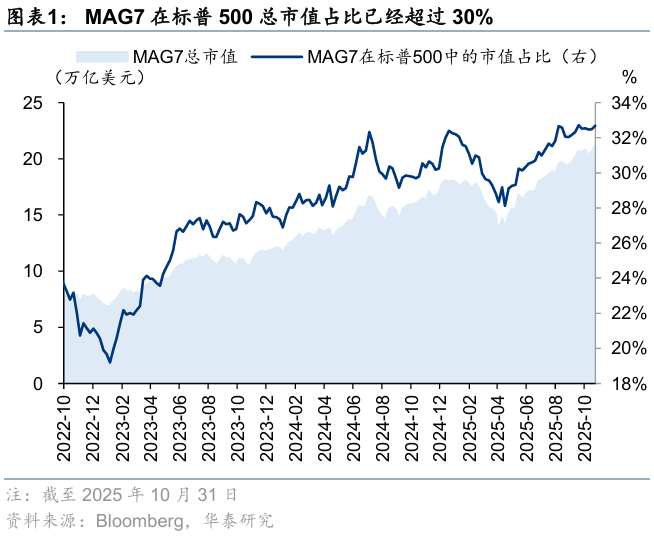
Group 1: Market Overview - The liquidity easing trend is expected to continue until the first half of 2026, with a focus on cyclical economic recovery in the second half of the year [1][5] - The U.S. stock market has experienced a K-shaped divergence, with the MAG7 companies contributing significantly to market capitalization growth [2][6] - As of October 31, 2025, the MAG7 companies accounted for over 30% of the S&P 500's total market capitalization, contributing nearly 50% of the market's expansion since 2023 [6][10] Group 2: Technology Sector Analysis - The current technology market is reminiscent of the late 1990s, with a concentration on high-quality large-cap stocks, raising concerns about potential market bubbles [3][22] - The EPS growth contribution from top tech stocks has been substantial, with MAG7's EPS growth reaching 24.7% [23][34] - Speculative trading has increased, with leverage in the stock market nearing levels seen during the 2020 QE period [34][35] Group 3: Economic Projections - The U.S. economy is expected to maintain a K-shaped divergence, but the driving factors may become more balanced compared to the past [4][57] - Bloomberg forecasts a 13.7% EPS growth for the S&P 500 in 2026, with a slowdown in capital expenditure growth for MAG7 [57][59] - Traditional economic recovery is anticipated to accelerate, supported by reduced trade policy uncertainty and monetary easing [57][63] Group 4: Investment Strategy Recommendations - Investors are advised to focus on profitable leading companies in the tech sector while gradually increasing exposure to cyclical sectors as the year progresses [5][64] - Historical data suggests that cyclical sectors tend to perform well after the end of a rate-cutting cycle, with significant positive returns expected [64][66] - Global diversification is recommended, with particular attention to developed markets like Germany and Switzerland, and emerging markets such as Saudi Arabia, South Korea, and India [65][67]

中国股票-MSASI 2.0:A股市场情绪与技术信号的全新解读
2025-11-04 01:56
Summary of Morgan Stanley A-Share Market Sentiment Indicator (MSASI) 2.0 Company/Industry - **Company**: Morgan Stanley - **Industry**: A-share Market in China Core Points and Arguments 1. **Introduction of MSASI 2.0**: Morgan Stanley has relaunched the A-share market sentiment indicator (MSASI 2.0) to better reflect investor behavior and sentiment trends, now based on 12 updated metrics [2][17][23] 2. **Historical Context**: The original MSASI was launched in March 2019 to track weekly sentiment changes in the A-share market. The need for an update arose due to changes in data availability and market structure [2][14] 3. **Expanded Metrics**: The new MSASI includes 12 indicators covering trading volume, market sentiment, short-selling sentiment, capital flows, and fundamental performance. Four new metrics have been added, including new account registrations on the Shanghai Stock Exchange and foreign capital inflows into the CSI 300 [2][17][23] 4. **Noise Reduction and Insight Enhancement**: Each indicator is processed using a 100-day rolling min-max normalization to reduce noise and highlight mid-term sentiment changes [2][27] 5. **Two Versions of MSASI**: The index has two versions: - **MSASI (Weighted)**: A real-time composite index ranging from 0 to 100 - **MSASI (Weighted 1-Month Moving Average)**: A one-month moving average that emphasizes broader trends [2][35] 6. **Strategy Framework**: The MSASI can identify sentiment extremes, with strategies based on the 1-month moving average: - Short the CSI 300 when the index reaches ≥78% for 70 trading days - Long the CSI 300 when the index drops to ≤22% for the same duration - Historical backtesting shows cumulative returns of 31% for shorting and 91% for going long, with hit rates of 60% and 67% respectively [3][44] 7. **Recent Performance**: As of late October 2025, the MSASI had reached a high but subsequently retreated, indicating a return to normal levels from an overheated state. A balanced strategy focusing on earnings quality and fundamental resilience is recommended [13][39] Other Important but Possibly Overlooked Content 1. **Data Correlation**: Historical data shows a high correlation (98%) between the new account registrations and the previously used "new investor registrations" metric, justifying the replacement [23] 2. **Market Sentiment Indicators**: The MSASI includes various indicators such as: - A-share turnover - Margin transaction balances - Relative Strength Index (RSI) for the CSI 300 - Number of limit-up A-shares - Backwardation in CSI 300 futures [20][52] 3. **Methodological Enhancements**: The methodology has been refined to ensure that all indicators are comparable and reflect mid-term sentiment changes rather than daily fluctuations [50][56] 4. **Future Implications**: The MSASI serves as a tool for investors to identify early turning points in market sentiment, which can lead to investment opportunities [14][40] This comprehensive summary captures the key aspects of the MSASI 2.0 report, highlighting its significance in understanding the A-share market sentiment and potential investment strategies.
红利板块逆势走强,红利ETF易方达(515180)、恒生红利低波ETF(159545)等助力布局高股息资产
Sou Hu Cai Jing· 2025-11-03 05:07
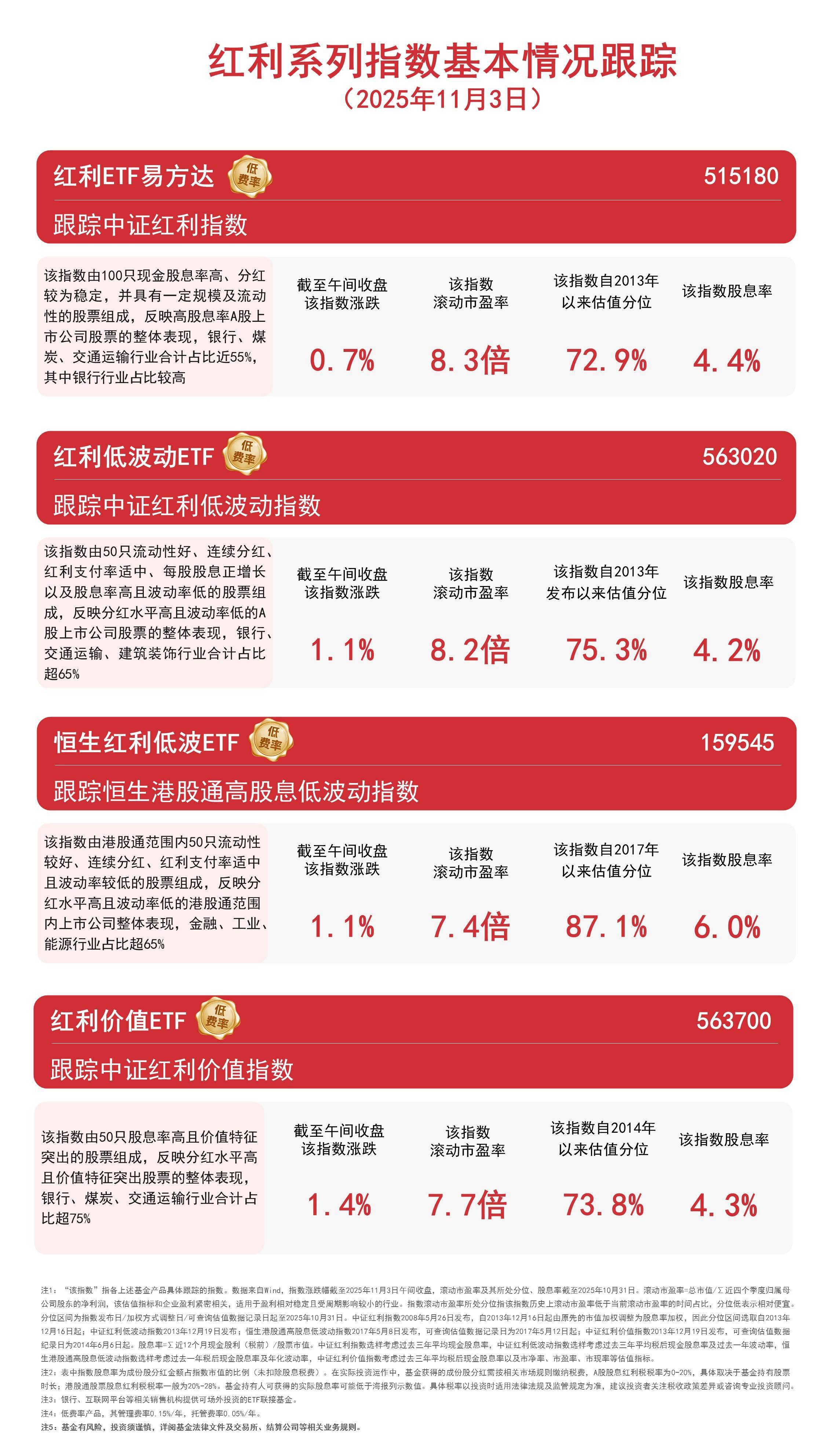
Group 1 - The dividend sector showed resilience, with the CSI Dividend Value Index rising by 1.4% and other related indices also experiencing gains of 1.1% and 0.7% respectively [1][5][7] - The E Fund Dividend ETF (515180) has seen a net inflow of over 1 billion yuan over the past 10 trading days, indicating strong investor interest [1] - The composition of the dividend-paying stocks includes those with moderate payout ratios, positive growth in dividends per share, and high dividend yields with low volatility, particularly in the banking, transportation, and construction sectors, which together account for over 65% [5][7] Group 2 - The Hang Seng Low Volatility Dividend ETF tracks a selection of 50 liquid stocks within the Hong Kong Stock Connect that have a history of continuous dividends and moderate payout ratios, with over 65% representation from the financial, industrial, and energy sectors [6][7] - The CSI Dividend Value ETF is designed to follow the CSI Dividend Value Index, which consists of 50 stocks characterized by high dividend yields and value traits [9]
巴西衬衫税导致小额包裹月度进口额下降43%
Shang Wu Bu Wang Zhan· 2025-10-31 16:40
Core Insights - The Brazilian government will impose a 20% tax on imported small packages valued under $50 starting August 2024, leading to a significant decrease in import volumes for major e-commerce platforms [1] Tax Revenue Impact - Monthly import value for e-commerce platforms dropped by $122 million, a 43% decline, with current import levels at only 50% of the previously predicted growth trajectory [1] - Federal tax revenue from import duties increased by 265 million Brazilian Reais per month, accounting for 0.08% of total tax revenue [1] - However, the reduction in import package volumes resulted in a monthly loss of 258 million Brazilian Reais in state tax revenue (17%-20% of goods circulation tax), leading to a net increase in national tax revenue of only 7 million Brazilian Reais [1] Employment Effects - The implementation of the "shirt tax" resulted in a mere 0.97% increase in retail and industrial employment over 12 months, which is below the national average increase of 3.04% [1] - The proportion of consumers abandoning cross-border e-commerce shopping due to the import tax rose from 13% in May 2024 to 38% currently, indicating a significant shift in consumer behavior [1]
北交所股票成交概况:219股上涨 55股下跌
Zheng Quan Shi Bao Wang· 2025-10-31 15:11
Market Overview - On October 31, the total trading volume of individual stocks on the Beijing Stock Exchange reached 1.299 billion shares, with a total trading value of 32.323 billion yuan, a decrease of 10.622 billion yuan compared to the previous trading day [1] - Among the tradable stocks, 219 stocks closed higher, accounting for 78.49% of the total, with notable gainers including Lijia Technology, Deyuan Pharmaceutical, and Sanyuan Gene, which rose by 13.91%, 13.09%, and 13.07% respectively [1] - Conversely, 55 stocks closed lower, with Huifeng Diamond, Jiuling Technology, and Meizhigao experiencing declines of 6.34%, 4.96%, and 4.57% respectively [1] Trading Activity - A total of 93 stocks had trading volumes exceeding 100 million yuan, with the highest trading values recorded for Beiterui, Fujida, and Guozi Software at 1.359 billion yuan, 999.5 million yuan, and 710 million yuan respectively [1] - The trading activity showed that 46 stocks had a turnover rate exceeding 10%, with 8 stocks exceeding 20%. Additionally, 73 stocks had turnover rates between 5% and 10%, while 159 stocks had turnover rates between 1% and 5% [1] Notable Stocks - Beiterui closed at 36.45 yuan with a rise of 4.71% and a turnover rate of 3.29%, with a trading value of approximately 1.359 billion yuan [1] - Guozi Software saw a significant increase of 11.75% to close at 44.70 yuan, with a turnover rate of 26.35% and a trading value of around 710 million yuan [1] - Deyuan Pharmaceutical closed at 41.30 yuan, up 13.09%, with a turnover rate of 12.64% and a trading value of approximately 523 million yuan [1] Summary of Trading Data - The trading data indicates a robust market activity with a significant number of stocks experiencing notable price movements and trading volumes, reflecting investor sentiment and market dynamics [1][2][3]
西藏前三季度GDP增长7.1% 多项经济指标增速位居全国前列
Zhong Guo Xin Wen Wang· 2025-10-31 13:33
Core Points - Tibet's GDP for the first three quarters reached 207.006 billion yuan, with a year-on-year growth of 7.1%, surpassing the national average by 1.9 percentage points, indicating a stable and progressive economic performance [1][3]. Economic Indicators - Industrial value added for large-scale enterprises grew by 12.5%, maintaining the highest growth rate in the country for eight consecutive months [3]. - Fixed asset investment increased by 18.6%, leading the nation for four months, significantly supporting economic stability [3]. - General public budget revenue was 23.275 billion yuan, up 14.2%, while expenditures reached 225.797 billion yuan, growing by 13.0%, both ranking first nationally [3]. - Total electricity consumption was 12.45 billion kWh, reflecting a 13.4% increase, indicating rising economic activity [3]. Social and Consumer Trends - Per capita disposable income for residents was 23,357 yuan, with a growth rate of 7.3%, exceeding the national average by 2.2 percentage points [3]. - The retail sales of consumer goods totaled 76.846 billion yuan, showing a year-on-year increase of 4.5%, indicating a steady recovery in the consumer market [3]. - The tourism sector thrived, with 63.7073 million domestic and international visitors, a growth of 11.2%, and total tourism expenditure reaching 73.673 billion yuan, up 9.9% [3]. Future Outlook - Tibet plans to continue implementing the decisions of the central government, focusing on stabilizing employment, businesses, markets, and expectations to promote high-quality economic development [4].

拓斯达:董事兼高级管理人员黄代波计划减持公司股份不超过450万股
Mei Ri Jing Ji Xin Wen· 2025-10-31 12:25
Group 1 - The company TuoSiDa (SZ 300607) announced that its director and senior management personnel, Mr. Huang Daibo, plans to reduce his shareholding by up to 4.5 million shares within three months after 15 trading days from the announcement date, which represents 0.9524% of the total share capital excluding shares in the repurchase special account [1] - For the year 2024, TuoSiDa's revenue composition is expected to be 100.0% from the industrial sector [1] - As of the report date, TuoSiDa's market capitalization stands at 15.8 billion yuan [1]

万盛股份:累计回购约10万股
Mei Ri Jing Ji Xin Wen· 2025-10-31 09:02
Group 1 - The company Wansheng Co., Ltd. has repurchased approximately 100,000 shares, accounting for 0.0175% of its total share capital, with a total expenditure of about 1.0627 million RMB as of October 31, 2025 [1] - The highest transaction price for the repurchased shares was 10.97 RMB per share, while the lowest was 9.71 RMB per share [1] - As of the report date, Wansheng Co., Ltd. has a market capitalization of 6.7 billion RMB [1] Group 2 - For the fiscal year 2024, the revenue composition of Wansheng Co., Ltd. is as follows: industrial sector accounts for 98.73%, trade sector for 1.08%, and other businesses for 0.19% [1]

前三季度全市经济运行稳中有进
Zheng Zhou Ri Bao· 2025-10-31 00:45
Economic Overview - The city's GDP for the first three quarters reached 11,189.8 billion yuan, with a year-on-year growth of 5.4% [1] - The primary industry added value was 153.1 billion yuan, growing by 2.9%; the secondary industry added value was 4,173.7 billion yuan, growing by 5.6%; and the tertiary industry added value was 6,863.0 billion yuan, growing by 5.3% [1] Industrial Performance - The agricultural sector showed stable growth, with total output value in agriculture, forestry, animal husbandry, and fishery increasing by 3.2% year-on-year [2] - The industrial economy saw an increase of 8.8% in the added value of above-scale industries, surpassing the provincial average by 0.4 percentage points [2] - Key industries such as automotive and electronics experienced significant growth, with respective increases of 19.2% and 11.8%, contributing 5.7 percentage points to the overall industrial growth [2] Service Sector Development - The service sector is developing well, with above-scale service industry revenue increasing by 10.4% year-on-year, exceeding the provincial average by 2.4 percentage points [2] - Nine out of ten major service industry categories reported year-on-year growth, with cultural, sports, and entertainment sectors growing by 12.1% and transportation and logistics by 9.4% [2] Investment and Consumption - Fixed asset investment grew by 4.5% year-on-year, with significant contributions from projects over 100 million yuan, which saw a 12.8% increase [3] - Private investment rose by 9.5%, higher than the provincial average, contributing 5.4 percentage points to overall investment growth [3] - Retail sales of consumer goods reached 4,903.9 billion yuan, with a year-on-year growth of 5.6%, driven by strong demand in sports and cultural products [3] Foreign Trade and Public Spending - The city's import and export volume reached 4,332.5 billion yuan, growing by 25.3% year-on-year, outpacing the provincial growth rate [4] - Public budget expenditures in key areas such as energy conservation and transportation saw significant increases, with growth rates of 71.4% and 49.2% respectively [4] Innovation and New Industries - The city is focusing on integrating technological and industrial innovation, with high-tech industries seeing added value growth of 10.2% [5] - New products such as lithium-ion batteries and electric vehicles have shown substantial production increases, with growth rates of 49.5% and 15.0% respectively [5][6] - E-commerce and new consumption models are rapidly emerging, with online retail sales increasing by 19.8% year-on-year [6]