
顺周期修复

Search documents
首席展望|嘉实基金方晗:马年看好AI扩散、供需改善及顺周期修复主线
Sou Hu Cai Jing· 2026-02-20 01:15
Core Viewpoint - The article emphasizes a positive outlook for China's economy in 2026, with foreign investment banks recommending increased allocations to A-shares and Hong Kong stocks, reflecting confidence in China's economic transformation and growth prospects [1]. Market Consensus - Two major consensus points for 2026 are identified: the continuation of a structural market trend and a focus on the AI technology revolution as the primary investment theme [5][6]. - The structural market trend is supported by favorable policy environments, potential for increased retail investment, and a recovery in corporate earnings [5]. - The AI technology revolution is expected to drive significant investment opportunities across various sectors, particularly in infrastructure and application breakthroughs [5][6]. Core Divergences - Three key divergences in the market are highlighted: 1. Whether valuation expansion will be limited or broken by the historical AI technology revolution [6]. 2. The impact of rising commodity prices on the Federal Reserve's interest rate path [7]. 3. The potential reallocation of household savings into stock assets due to the repricing of bank deposits [8]. Investment Themes - Three main investment themes for 2026 are proposed: 1. The diffusion of new technology, particularly AI, which is expected to create opportunities in sectors like storage, semiconductors, and energy [9]. 2. Industries experiencing stable demand and reduced supply pressures, such as lithium batteries, military, offshore wind, and dairy products [10]. 3. High-risk, cyclical assets that are likely to recover as the economy improves, including real estate, food and beverage, and discretionary consumption [10].


田轩解读2026资本市场攻略:从听故事到看报表,聚焦三大主线
2 1 Shi Ji Jing Ji Bao Dao· 2026-02-09 11:33
Core Viewpoint - The A-share market is at a critical juncture, transitioning its operational logic with a focus on profit verification and systemic optimization by 2026, while investors should be cautious of "consensus traps" and prioritize long-term value over short-term trends [2][4][9]. Group 1: Market Consensus and Trends - Three core consensus in the current A-share market include the recovery of cyclical sectors, rapid development of new productive forces, and the increasing value of low-valuation high-dividend assets [4]. - Compared to mid-2025, the market's driving logic has shifted from policy expectations to performance verification, with a stronger emphasis on profitability and a more balanced approach to growth and valuation [4][5]. - The low-valuation high-dividend assets are gaining traction due to dual confirmations from policy and valuation support, leading to a noticeable acceleration in recovery [4][5]. Group 2: Investment Opportunities and Risks - The consensus around cyclical and new productive forces is supported by fundamentals, with sectors like non-ferrous metals and chemicals benefiting from supply-demand restructuring and policy support [5]. - Investors should approach these consensus with caution, focusing on the sustainability of profits and the timing of policy implementation, while being wary of short-term data improvements being misinterpreted as long-term trends [5][6]. - Identifying quality opportunities in low-valuation high-dividend assets and technology breakthroughs in new productive forces can help mitigate the risks associated with consensus traps [8]. Group 3: Structural Changes and Future Outlook - By 2026, the A-share market is expected to exhibit a more sustainable and systematic growth pattern, supported by proactive fiscal and monetary policies, as well as structural changes in the market [9][10]. - The market is transitioning from a liquidity-driven environment to one driven by profit improvement and valuation recovery, with a dual focus on high dividends and technology growth [10][11]. - The core drivers of stable development in 2026 will include technological self-reliance, industrial upgrades, and consumption expansion, supported by effective policy implementation [11][12]. Group 4: Technology Investment Logic - The investment logic in the technology sector has shifted from focusing on technical feasibility to validating commercial viability and profitability [14]. - Key areas such as AI, semiconductors, and high-end manufacturing are expected to gain market attention as they demonstrate real commercial applications and revenue generation [14][15]. - Investors should assess companies based on their technological barriers, commercialization capabilities, and financial health to identify those with genuine competitive advantages [15][16].

首席展望|招商基金李湛:中国市场将迈入“盈利改善+估值抬升”的双重驱动阶段
Xin Lang Cai Jing· 2026-02-05 00:42
Core Viewpoint - The international capital market is optimistic about China's economic transformation and development prospects in 2026, with major foreign investment banks recommending increased allocations to A-shares and Hong Kong stocks, indicating a shift towards a dual-driven phase of profit improvement and valuation uplift [1][3]. Group 1: Investment Environment and Trends - In 2026, the investment focus is expected to be on "industrial innovation-driven + profit realization + resource supply-demand optimization," with emphasis on technology innovation, high-end manufacturing, and cyclical recovery [2][16]. - The global economic landscape in 2025 showed resilient growth amid uncertainties, with emerging markets becoming the main growth engines, which, combined with China's policy support and industrial upgrades, creates structural opportunities in the capital market [3][4]. - The investment environment is anticipated to shift from single valuation recovery to a dual-driven phase of profit improvement and valuation uplift [3][4]. Group 2: Capital Inflows and Funding Sources - The most certain source of incremental capital in 2026 is expected to be insurance funds, with foreign capital gradually shifting from trading to allocation, particularly in high-end manufacturing and technology sectors [2][7]. - Resident savings represent a significant potential slow variable, with some funds expected to migrate to equity markets through wealth management and public funds [2][7]. - The structure of incremental capital in 2026 is likely to be characterized by "multiple channels, low volatility, and long cycles," with insurance funds, foreign capital, and resident savings being the main contributors [7]. Group 3: Sector Opportunities and Focus Areas - The technology sector remains the main line of industry allocation, with a focus on the performance visibility and elasticity of computing infrastructure and key hardware being higher than that of application layers [8][10]. - High-end manufacturing and advanced industrial systems are expected to continue benefiting from manufacturing upgrades, while energy transition and new power systems are also important directions for investment [10]. - Industries related to resource security and supply chain safety, such as non-ferrous metals and key materials, are anticipated to have stable medium- to long-term demand support [10]. Group 4: Risk Assessment and Market Dynamics - The evolution of risks related to real estate and local government debt is transitioning from "emergency response" to "long-term management," while external demand uncertainty is identified as the most significant variable affecting the market in 2026 [5][6]. - The core of external demand uncertainty lies in the unpredictable external environment, which can directly disrupt domestic economic recovery and influence macro policy adjustments [6]. Group 5: Asset Allocation Recommendations - For balanced investors in 2026, an initial asset allocation recommendation is 55%-60% in stocks, 30%-35% in bonds, and 5%-10% in gold, focusing on capturing structural opportunities in hard technology, high-end manufacturing, and cyclical upgrades [12][13]. - Stocks should be the core allocation, while bonds can provide stability against market volatility, and gold should serve as a long-term strategic asset to hedge against geopolitical risks and external demand fluctuations [14][15].
2政策+资金双重暴击!建材行业震荡走高掀全民狂欢,龙头股集体暴走引领顺周期反攻新浪潮!
Sou Hu Cai Jing· 2026-01-22 11:25
Core Viewpoint - The A-share building materials sector is experiencing a strong upward trend, with multiple stocks showing active performance, driven by market expectations for a cyclical recovery in the sector [1] Group 1: Policy and Economic Support - The Ministry of Housing and Urban-Rural Development has released an opinion on improving housing quality, aiming for significant enhancements in housing standards, design, materials, construction, and operation by 2030, which directly benefits the consumption of building materials, waterproofing, and glass sectors [1] - The central bank has lowered various structural monetary policy tool rates by 0.25 percentage points, with the one-year re-lending rate reduced from 1.5% to 1.25%, aimed at promoting stable economic growth and providing liquidity support for the recovery of real estate and infrastructure sectors, indirectly boosting demand in the building materials industry [1] Group 2: Infrastructure and Supply Chain Developments - The issuance of special bonds by local governments has accelerated, with a total issuance scale of 0.18 trillion yuan, an increase of 0.10 trillion yuan year-on-year, easing government fiscal pressure and supporting demand for cement and pipe materials through accelerated municipal engineering and pipeline construction projects [2] - The building materials industry has seen improvements in supply-demand dynamics after five years of capacity clearance, with the waterproofing sector's concentration rapidly increasing, and a significant reduction in floating glass daily melting capacity by 27,200 tons compared to the 2021 peak, alongside a 160 million ton capacity exit in the cement industry, alleviating supply pressures and laying the foundation for profit recovery [2] Group 3: Sector-Specific Benefits - The waterproofing industry is expected to benefit from housing quality improvement policies, the release of renovation demand, and supply-side clearance, with leading companies projected to experience revenue declines significantly lower than the industry average from 2021 to 2024, and further price increases anticipated in 2025 [3] - The glass processing industry is poised to gain from accelerated cold repairs in floating glass production capacity and a balanced supply-demand structure, alongside increased demand for high-end glass driven by housing quality improvements [3] - The pipe and pipeline industry is supported by the rapid implementation of infrastructure projects and municipal pipeline renovation policies, with municipal engineering projects accelerating, directly benefiting related pipe material companies from the recovery in infrastructure demand [3]


美股2026年度策略 | 高处如何布局?
Sou Hu Cai Jing· 2025-11-04 05:27
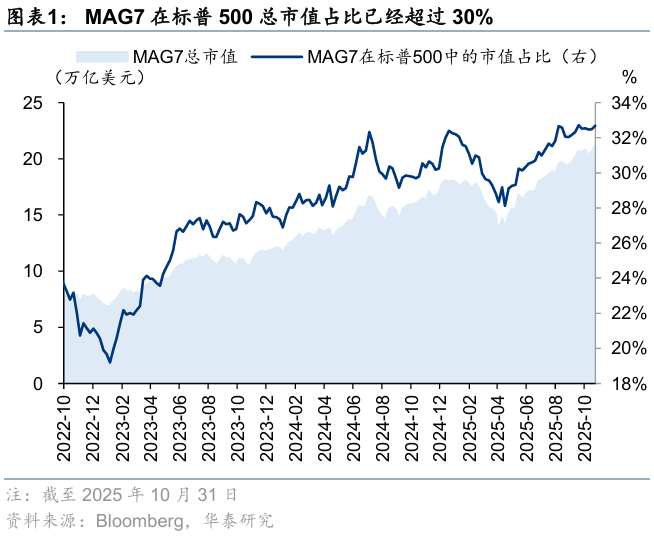
Group 1: Market Overview - The liquidity easing trend is expected to continue until the first half of 2026, with a focus on cyclical economic recovery in the second half of the year [1][5] - The U.S. stock market has experienced a K-shaped divergence, with the MAG7 companies contributing significantly to market capitalization growth [2][6] - As of October 31, 2025, the MAG7 companies accounted for over 30% of the S&P 500's total market capitalization, contributing nearly 50% of the market's expansion since 2023 [6][10] Group 2: Technology Sector Analysis - The current technology market is reminiscent of the late 1990s, with a concentration on high-quality large-cap stocks, raising concerns about potential market bubbles [3][22] - The EPS growth contribution from top tech stocks has been substantial, with MAG7's EPS growth reaching 24.7% [23][34] - Speculative trading has increased, with leverage in the stock market nearing levels seen during the 2020 QE period [34][35] Group 3: Economic Projections - The U.S. economy is expected to maintain a K-shaped divergence, but the driving factors may become more balanced compared to the past [4][57] - Bloomberg forecasts a 13.7% EPS growth for the S&P 500 in 2026, with a slowdown in capital expenditure growth for MAG7 [57][59] - Traditional economic recovery is anticipated to accelerate, supported by reduced trade policy uncertainty and monetary easing [57][63] Group 4: Investment Strategy Recommendations - Investors are advised to focus on profitable leading companies in the tech sector while gradually increasing exposure to cyclical sectors as the year progresses [5][64] - Historical data suggests that cyclical sectors tend to perform well after the end of a rate-cutting cycle, with significant positive returns expected [64][66] - Global diversification is recommended, with particular attention to developed markets like Germany and Switzerland, and emerging markets such as Saudi Arabia, South Korea, and India [65][67]
社服行业24年年度、25Q1业绩综述:子行业表现分化,关注韧性较强及顺周期修复板块
Bank of China Securities· 2025-05-23 11:17
Investment Rating - The report maintains an "Outperform" rating for the social services industry [1] Core Insights - The overall revenue of the sector is steadily increasing, but the recovery in performance is slower, with significant differentiation among sub-sectors. Attention is recommended for cyclical recovery sectors such as human resources and exhibitions, as well as resilient sectors like tourism and scenic spots [1][2] - In 2024, the social services sector achieved a total revenue of 191.54 billion, a year-on-year increase of 36.57%, while the net profit attributable to shareholders was 7.48 billion, a year-on-year decrease of 18.21%. The overall profitability has declined [10][14] - In Q1 2025, the sector generated a revenue of 44.84 billion, a year-on-year increase of 38.75%, with a net profit of 1.81 billion, a year-on-year increase of 33.06% [20][22] Summary by Sections Sector Summary - The revenue growth rate outperformed the profit growth rate, with the professional services and education sectors performing better. In 2024, the professional services sector saw a year-on-year increase of 79.57%, while the education sector's profit level improved significantly [10][14] - In Q1 2025, the professional services sector led with a revenue growth of 89.62%, followed by tourism and scenic spots at 7.39% [22] Tourism - The domestic travel market shows strong resilience, with a total of 5.615 billion domestic tourists in 2024, a year-on-year increase of 14.80% [34] - The cross-border travel market is experiencing high demand, with inbound tourists reaching 132 million in 2024, a year-on-year increase of 60.8% [40] Hotels - Business travel demand is still recovering, with the RevPAR expected to be under pressure throughout 2024 [13] Catering - The catering market is expected to see slower revenue growth in 2024, with Q1 2025 showing some improvement [16] Duty-Free - Duty-free sales in offshore areas are showing marginal improvement, with city channels expected to contribute to growth [18] Human Resources - The human resources sector is experiencing stable data operations, but employment market pressures remain [22] Exhibitions - The domestic exhibition market is steadily growing, with the number of exhibitions remaining stable in 2024 [24]






社服&零售行业年报及一季报总结:子行业表现分化,关注新消费+出海服务+顺周期修复
HUAXI Securities· 2025-05-12 04:35
Investment Rating - The industry rating is "Recommended" [4] Core Insights - The consumer services and retail sectors are under pressure, with notable performance in emotional consumption and tourism consumption [1][2] - In 2024, CITIC consumer services revenue and net profit attributable to shareholders are expected to grow by 2% and decline by 24% respectively, while the retail sector is projected to see an 8% drop in revenue but a 6% increase in net profit [1][2] - The report highlights the divergence in performance among sub-sectors, with tourism services (+56%), human resources (+15%), and scenic areas (+3%) showing relative strength [1][2] Summary by Relevant Sections Consumer Services - In 2024, revenue for CITIC consumer services is projected to grow by 2%, while net profit is expected to decline by 24%. The tourism services sector shows a significant revenue increase of 56% [1] - For Q1 2025, the consumer services sector continues to face pressure, with revenues down by 0.1% and net profits down by 8% [2] Retail Sector - The retail sector is expected to see an 8% decline in revenue for 2024, but net profit is projected to increase by 6% [1] - Notable performances include supermarkets and convenience stores, which saw a 156% increase in net profit due to non-operating factors [1] OTA (Online Travel Agency) - The online booking rate for travel continues to rise, with OTA transaction volume expected to grow by 17.8% in 2024 [3] - Major players like Ctrip and Tongcheng are experiencing significant revenue growth, with Ctrip's international business revenue reaching 10% of total revenue [3][6] Scenic Areas - The scenic area sector is expected to see a 3% increase in revenue and a 30% increase in net profit for 2024, driven by strong performances from key players [7] - In Q1 2025, revenue is projected to grow by 2%, but net profit is expected to decline by 18% [7] Hotel Sector - The hotel sector is facing pressure with a decline in RevPAR (Revenue per Available Room), but major hotel groups are maintaining aggressive expansion plans [8][9] - For Q1 2025, major hotel groups are experiencing varying impacts on net profit, with some showing significant declines [9] Human Resources - The outsourcing business remains strong, with companies like Core International and Beijing Human Resources seeing revenue growth of 22% and 14% respectively [10] - Government subsidies are contributing to significant net profit increases for these companies [12] E-commerce and Services - The report highlights the growth of self-owned brands, with companies like Ruoyu Chen achieving a 29.26% increase in total revenue for 2024 [13] - The demand for agency operations is declining, but self-owned brands are driving high growth [13] Dining Sector - The dining sector is under pressure due to intense price competition, but some brands are showing resilience [14] - In Q1 2025, the dining sector shows signs of marginal improvement as price competition eases [14] Jewelry Sector - The jewelry sector is experiencing performance divergence, with strong brands outperforming the market amid rising gold prices [15] - In Q1 2025, brands like Chaohongji and Mankalon are showing significant revenue and profit growth [15] Investment Recommendations - The report suggests focusing on high-demand consumer products and travel services, as well as companies benefiting from overseas expansion [17]






申万宏源交运一周天地汇:美国对等关税对航运三阶段影响,OPEC+5月计划日均增产41万桶
Shenwan Hongyuan Securities· 2025-04-06 06:46
Investment Rating - The report maintains a positive outlook on the transportation industry, particularly focusing on the shipping sector and logistics recovery [2][3]. Core Insights - The report outlines a three-phase impact of the U.S. tariff policy on shipping, emphasizing initial pessimism followed by gradual recovery as trade negotiations progress [3][22]. - It highlights the importance of shipping asset pricing, which is determined by capacity utilization and upstream-downstream price differentials [3][22]. - The report suggests that the logistics sector, especially express delivery, is expected to see significant growth due to rising e-commerce demand and favorable policies [3][22]. Summary by Sections 1. Industry Performance - The transportation index increased by 0.76%, outperforming the Shanghai Composite Index by 2.13 percentage points [4]. - The shipping sector showed mixed performance, with the coastal dry bulk freight index rising by 0.20% and the Shanghai export container freight index increasing by 4.96% [4]. 2. Shipping Sector Analysis - The report identifies three phases of tariff impact: initial negative pricing, followed by recovery as negotiations progress, and potential price increases due to supply chain disruptions [3][22]. - It emphasizes that the tariff impacts will compress profit margins and affect shipping valuations, particularly before the tariffs take effect [3][22]. 3. Oil and Freight Rates - OPEC+ plans to increase production by 410,000 barrels per day starting in May, which is higher than market expectations [3][25]. - VLCC rates decreased by 3% to $37,276 per day, while Suezmax rates fell by 6% to $49,895 per day [3][25]. - The report notes a significant drop in MR average rates by 14% to $20,442 per day due to demand slowdown [3][26]. 4. Express Delivery and Logistics - The report expresses optimism for direct logistics recovery, particularly for leading companies like JD Logistics and SF Express, as demand rebounds [3][22]. - It highlights the expected rapid growth in e-commerce express delivery demand in 2025, driven by clear policy support for optimizing logistics costs [3][22]. 5. Railway and Highway Transport - Railway freight volume and highway truck traffic continue to rise, indicating a sustained spring peak in logistics activity [3][22]. - The report mentions a government directive aimed at optimizing railway pricing policies, which could enhance the efficiency of freight transport [3][22]. 6. High Dividend Stocks - The report lists high dividend yield stocks in the transportation sector, including Bohai Ferry with a TTM yield of 10.19% and Daqin Railway with a yield of 6.95% [3][18]. - It suggests that these stocks may provide stable returns amid market fluctuations [3][18].