
石化

Search documents
长城基金汪立:前瞻布局春季行情
Xin Lang Cai Jing· 2025-12-02 06:09
Group 1: Market Overview - In November, the A-share market exhibited a volatile pattern, with the Shanghai Composite Index declining by 1.67%, while the ChiNext Index and the STAR Market Index fell by 4.23% and 6.24% respectively [1][7] - There was a significant shift in market structure as funds sought to rebalance their portfolios, with banking, petrochemical, textile, and light industry sectors showing the highest gains, while electronics, computers, and automotive sectors experienced notable pullbacks [1][7] Group 2: Macro Analysis - In October, the profits of industrial enterprises above designated size weakened, with a cumulative year-on-year growth rate of 1.9% from January to October, down from 2.4% in the previous period, and a significant drop to -5.5% in October compared to 21.6% in September [2][8] - The increase in raw material prices under the "anti-involution" policy, combined with weak demand, has narrowed corporate profit margins, although sectors like non-ferrous metals, electronic equipment, food, beverages, and automotive still maintained positive year-on-year growth [2][8] - The expectation of a Federal Reserve interest rate cut has risen, with indications from Fed officials suggesting a need for significant rate reductions to support economic growth, despite a recent increase in the unemployment rate to 4.4% [2][8] Group 3: Investment Strategy - Following the market correction since October, there has been a notable decline in margin trading activity, but recent stabilization in market risk appetite has led to a rebound in margin trading volumes [4][10] - The anticipated recovery in global liquidity due to the Fed's rate cut expectations, alongside the need for further policy measures to stimulate domestic growth, suggests a potential rebalancing of industry allocations [4][10] - Current market conditions may present an opportune moment to position for a spring rally, with a focus on emerging technologies, undervalued consumer stocks, and brokerage firms [5][11] - Specific sectors to watch include technology growth (internet, semiconductors, media, power equipment, innovative pharmaceuticals), consumer goods (mass products, hotels, airlines, retail), and non-ferrous metals, which are expected to benefit from easing monetary policies [5][11]
广东石化聚丙烯装置试用国产催化剂
Zhong Guo Hua Gong Bao· 2025-12-02 04:26
Core Insights - Guangdong Petrochemical has successfully completed the trial of domestically produced catalysts in its 200,000 tons/year polypropylene unit, producing the medium melt impact polypropylene product K8009, meeting all quality standards [1] - The company aims to reduce production costs and enhance supply chain security by promoting the localization of catalysts, which have previously relied on expensive imports [1][2] Group 1: Production and Technology - The 200,000 tons/year polypropylene unit utilizes the Japanese JPP company's Horizone process technology, capable of producing 55 grades of products including homopolymers and various copolymers [1] - The unit has previously used imported catalysts, which, while stable in performance, posed high costs and procurement risks due to reliance on a single supplier [1] Group 2: Catalyst Localization Efforts - The company has made significant progress in the localization of catalysts, with successful trials of domestically produced catalysts for low melt copolymer K8003 in late July, receiving positive market feedback [1] - The next steps involve closely monitoring downstream customer usage of the domestically produced catalysts to gather data and experience for a full replacement of imported catalysts [2]
韩央行:产业重组为石化业长期发展奠定基础
Zhong Guo Hua Gong Bao· 2025-12-02 03:02
Core Viewpoint - The restructuring of South Korea's petrochemical industry will exert downward pressure on economic growth in the short term, but long-term recovery in global demand and increased R&D investment can enhance competitiveness and lay the foundation for sustainable development [1][2] Industry Impact - The Bank of Korea projects that the restructuring will lead to a reduction in industrial output by up to 6.7 trillion KRW by 2026, affecting downstream industries [1] - As of 2023, the petrochemical industry accounts for 5.6% of South Korea's manufacturing output and 7.2% of its exports, contributing 2.2% of employment [1] - The industry has been facing continuous losses since 2022 due to global oversupply and weak demand, with operating profit margins plummeting from approximately 12% in 2021 to 2.9% in 2022, and further declining to -0.1% in 2024 [1] Structural Challenges - The industry faces multiple structural challenges, including a high concentration of exports to the Chinese market and reliance on oil-based production routes, which limits its resilience [2] - Korean petrochemical companies are at a disadvantage in raw material costs compared to U.S. and Chinese competitors, who utilize ethane and coal-based facilities, respectively [2] - The shift towards green transformation and digitalization is increasing cost pressures on the industry [2] Government Initiatives - The South Korean government will promote voluntary restructuring of companies starting from August 2025, focusing on reducing petrochemical production capacity, particularly for cracking facilities [2] - The Bank of Korea emphasizes the importance of seizing the restructuring opportunity to enhance industry competitiveness despite the short-term growth losses [2] Future Outlook - The report predicts that if companies increase R&D investment by approximately 3.5% annually over the next three years, the short-term growth losses from restructuring could be fully compensated by 2029, potentially leading to excess returns [2] - Currently, companies like Lotte Chemical and Hyundai HD Chemical have submitted restructuring plans to integrate naphtha cracking facilities in the Daesan Industrial Complex, with other companies required to submit their plans by the end of 2025 [2]
榆林石化聚乙烯首单厂库协议交割
Zhong Guo Hua Gong Bao· 2025-12-02 03:00
Core Viewpoint - The collaboration between China National Petroleum Corporation (CNPC) Northwest Chemical Sales Company, Lanzhou Petrochemical, and Northeast CNPC International Business Co., Ltd. has successfully delivered 330 tons of "Kunlun" brand 7042 low-density polyethylene to customers through a warehouse agreement in Yulin [1] Group 1: Industry Developments - The Northwest region is a key area for polyethylene production, hosting numerous agricultural film and plastic product processing enterprises [1] - The three companies have worked together to include Shaanxi in the polyethylene futures delivery area, registering the Yulin Petrochemical Polyolefin Plant as a futures delivery warehouse [1] - The first warehouse agreement delivery significantly reduces logistics and storage costs, helping companies enhance their benefits through hedging [1] Group 2: Future Outlook - With the continuous improvement of the delivery mechanism, Shaanxi is expected to become a core hub for polyethylene spot and futures trading in the Northwest [1] - The company aims to continuously upgrade and optimize its marketing model to enhance the quality and efficiency of Yulin Petrochemical products, injecting new momentum into the regional bulk commodity market [1]
烟台清洁能源发展创出八个第一,近三年能耗强度累计下降20.9%
Da Zhong Ri Bao· 2025-12-02 02:57
Core Viewpoint - Yantai is making significant strides in clean energy development, achieving a 20.9% reduction in energy intensity over the past three years while positioning itself as a model for green, low-carbon, and high-quality development in line with national carbon reduction strategies [1][3]. Group 1: Clean Energy Development - Yantai has established itself as a leader in clean energy, achieving "eight firsts" in the sector, including the first nuclear power and offshore wind power in Shandong Province, and the first commercial nuclear heating demonstration project in the country [2][3]. - The total installed capacity of clean energy in Yantai has surpassed 18 million kilowatts, with ongoing investments of 700 billion yuan in nuclear, wind, solar, and LNG projects, aiming to reach 60 million kilowatts by 2035 [3]. Group 2: Industrial Transformation - Many companies in Yantai are adopting green and low-carbon strategies as part of their transformation, with significant improvements in energy efficiency and production capacity [4][5]. - For instance, Mingdeheng Electronics has increased its monthly production capacity from 5 million to 60 million units while reducing energy consumption by 40% [4]. Group 3: Technological Innovation - Technological innovation is driving industrial decarbonization in Yantai, with companies like Nanshan Aluminum achieving significant reductions in carbon emissions through recycling and clean production methods [5]. - Yantai's chemical industry is also evolving into a high-end low-carbon base, with a focus on sustainable practices and innovation [5]. Group 4: Community and Lifestyle Changes - The transition to a low-carbon lifestyle is evident in Yantai, with initiatives such as nuclear heating providing consistent warmth and reducing coal consumption significantly [7]. - Community projects are promoting zero-carbon living, including solar-powered streetlights and electric vehicle charging stations, enhancing the quality of life for residents [7][8]. Group 5: Waste Management and Green Building - Yantai is implementing advanced waste management systems, including automated recycling that incentivizes residents to participate [8]. - The city is also leading in green building initiatives, with the largest near-zero energy building complex in Shandong Province and a high percentage of public transport being electric [8].
日本乙烯设备利用率持续走低
Zhong Guo Hua Gong Bao· 2025-12-02 02:55
Core Insights - Japan's ethylene production facility utilization rate was reported at 76.2% in October, remaining below 70% for two consecutive months and below 90% for 39 months, indicating ongoing economic challenges in the sector [1] - Ethylene production in October reached 452,300 tons, a 9% year-on-year increase, attributed to the resumption of all plants after last year's maintenance [1] - The Japanese government plans to reduce the number of ethylene production facilities from 12 to 8 by around 2030 to address the low utilization rates [1] Industry Trends - The Japan Petrochemical Industry Association noted that despite structural reforms in production facilities, results have been minimal [1] - Major companies like Mitsui Chemicals, Idemitsu Kosan, and Sumitomo Chemical have announced plans to consolidate their domestic general resin businesses [1] - The association's president predicts that while a V-shaped economic recovery is unlikely in 2026, the ethylene utilization rate could reach around 80% [1] Operational Challenges - The need for stable supply in key industries like automotive is emphasized, as aging production facilities require investment to ensure reliability [1] - The president of Innospec highlighted that improving utilization rates through facility integration could enhance profitability, but stable operation of the adjusted facilities is becoming increasingly important [1] - The Japanese government has expressed its commitment to support corporate R&D and domestic investment policies to address these challenges [1]
12月1日晚间公告 | 恒逸石化控股股东拟增持15-25亿元股份;卧龙新能投资8亿元储能项目
Xuan Gu Bao· 2025-12-01 12:13
Suspension and Resumption - Tailong Pharmaceutical's controlling shareholder is planning to transfer company shares, resulting in a stock suspension [1] Mergers and Acquisitions - Tanshan intends to acquire 51% equity of Shanghai Tongtu Semiconductor for 357 million yuan, with the target company engaged in IP technology licensing and chip design [2] Share Buybacks - Hengyi Petrochemical's controlling shareholder and its concerted parties plan to increase their holdings in the company by 1.5 billion to 2.5 billion yuan, with loans not exceeding 2 billion yuan [3] - Yongtai Energy plans to use 300 million to 500 million yuan for share buybacks aimed at cancellation [3] Investment Cooperation and Operational Status - Wolong New Energy is investing 804 million yuan to construct a 200,000 kW/1.2 million kWh independent energy storage demonstration project in Baotou [4] - Zhongchao Holdings' subsidiary won projects totaling 1.318 billion yuan, accounting for 23.97% of the company's audited revenue for 2024 [4] - Lizhong Group signed a technical agreement for commissioned processing of humanoid robot components with Weijing Intelligent [4] - Kaiwang Technology plans to establish a liquid cooling subsidiary with Wenjian Technology [4] - Ruishun Technology received a notice for a 331 million yuan cotton picker spindle production equipment construction project [4] - Tongyu Communication is accelerating its 6G research and low-orbit satellite internet layout [4] - Samsung Medical's subsidiary signed a contract for an annual bidding project for electric meters in Indonesia, with a contract value of approximately 160 million yuan [4] - Top Group is planning to issue H-shares and list on the Hong Kong Stock Exchange [4]

恒逸石化:控股股东及其一致行动人拟15亿元-25亿元增持公司股份 贷款不超20亿元
Xin Lang Cai Jing· 2025-12-01 09:40
Core Viewpoint - Hengyi Petrochemical's controlling shareholder and its concerted parties plan to increase their stake in the company by 1.5 billion to 2.5 billion yuan through various trading methods within six months [1] Group 1: Shareholding Increase - The controlling shareholder Hengyi Group and its concerted party Hengyi Investment intend to increase their shareholding in Hengyi Petrochemical by no less than 1.5 billion yuan and no more than 2.5 billion yuan [1] - The share purchase price will not exceed 10 yuan per share, and the increase will be executed based on market conditions [1] Group 2: Loan Support - Citic Bank's Hangzhou Xiaoshan Branch has issued a loan commitment letter to Hengyi Group, agreeing to provide up to 1 billion yuan in special loans for stock purchases, valid for one year from the date of issuance [1] - China Construction Bank's Ningbo Branch has also issued a loan commitment letter to Hengyi Investment, agreeing to provide up to 1 billion yuan in special loans for stock purchases, with a validity period of one year from the date of issuance [1]

长城投研速递:新兴科技有望重回主线
Sou Hu Cai Jing· 2025-12-01 07:55
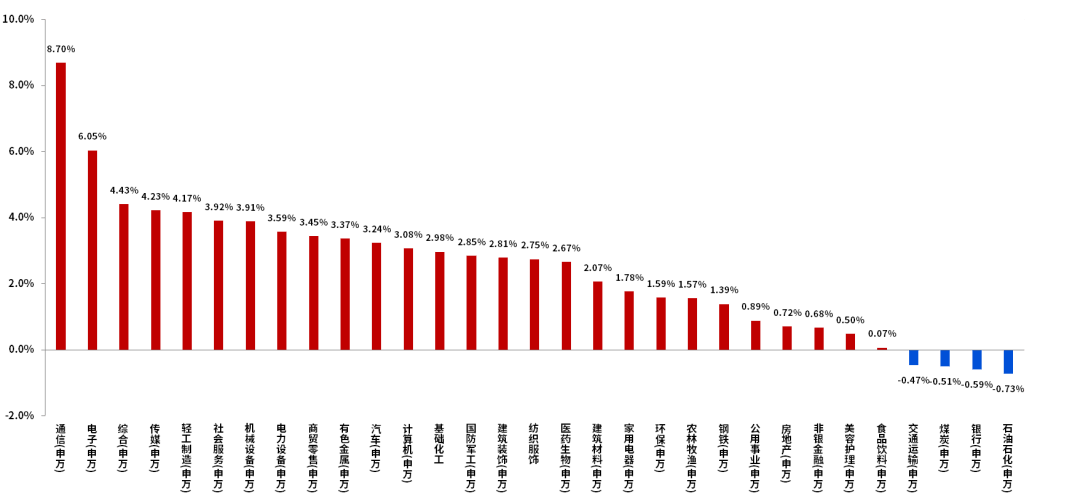
Domestic Macro - The cumulative year-on-year growth rate of profits for industrial enterprises above designated size from January to October is 1.9%, down 0.6 percentage points from 2.4% in January to September. In October, the year-on-year growth rate turned negative at -5.5%, compared to 21.6% in September. This decline is attributed to a high base from the previous year and rising raw material prices under the "anti-involution" trend, coupled with weak demand affecting profit margins [4][5][6] - Industries such as non-ferrous metals, electronic equipment, food, beverages, and automobiles still maintain positive year-on-year growth, while other sectors show negative profit growth. Profit recovery will depend on demand improvement and policy support [4][5] Foreign Macro - The expectation for a Federal Reserve interest rate cut in December has risen, with an 86.9% probability of a 25 basis point cut. Even if no cut occurs, its impact on the market is expected to be limited. The U.S. unemployment rate has increased to 4.4% despite a significant rise in non-farm employment in September [5][6] - Federal Reserve officials indicate that a substantial rate cut is necessary for economic development, suggesting a high likelihood of a rate cut in December [5] Bond Market - In the short term, the bond market is expected to maintain a range-bound oscillation due to reduced expectations for interest rate cuts this year. However, with the central bank restarting bond purchases, liquidity is likely to remain loose, leading to a market characterized by structural and speculative opportunities [6][13] - The central bank's net fund withdrawal last week was significant, with a total net withdrawal of 164.2 billion yuan through reverse repos. Despite this, the overall funding situation remains stable due to substantial mid-to-long-term fund injections [6][7] Equity Market - The market style has shifted back to technology growth, with significant gains in sectors such as telecommunications, electronics, and media, while industries like petrochemicals, banking, and coal have seen corrections. The overall market risk appetite has stabilized, leading to a rebound in margin trading activity [14][22] - The Shanghai Composite Index rose by 1.40%, the Shenzhen Component Index by 3.56%, and the ChiNext Index by 4.54% last week, indicating a strong performance in the equity market [14][15] Investment Strategy - Emerging technology is expected to remain a key investment theme, with a focus on undervalued consumer stocks and brokerage firms. The anticipated Federal Reserve rate cut and the need for policy support in response to weak economic data are driving this strategy [23] - The current market conditions may present an opportune moment to position for a spring rally, with potential in sectors such as technology, consumer goods, and non-ferrous metals [23]

长城宏观:前瞻布局春季行情
Sou Hu Cai Jing· 2025-12-01 07:55
Market Overview - In November, the A-share market exhibited a volatile pattern, with the Shanghai Composite Index declining by 1.67%, while the ChiNext Index and the STAR Market 50 Index fell by 4.23% and 6.24% respectively. Notably, there was a significant shift in market structure as funds sought to rebalance their portfolios, with banking, petrochemicals, textiles, and light industry sectors showing the highest gains, while electronics, computers, and automotive sectors experienced notable pullbacks [1] Macro Analysis - Domestic industrial profits weakened in October, with the cumulative year-on-year growth rate for large-scale industrial enterprises at 1.9% for January to October, down from 2.4% in September, and October's year-on-year growth rate at -5.5%, a significant drop from September's 21.6%. This decline is attributed to a high base from the previous year and rising raw material prices under the "anti-involution" policy, coupled with weak demand, which has narrowed profit margins for enterprises [2] - The expectation for a Federal Reserve interest rate cut has increased, with recent U.S. non-farm payroll data exceeding expectations, yet the unemployment rate rose to 4.4%. Fed officials have indicated support for a rate cut in December, suggesting a significant likelihood of this occurring [2] Investment Strategy - Following the market correction since October, there has been a notable decline in margin trading activity, but recent stabilization in market risk appetite has led to a rebound in margin trading. As risk factors begin to materialize, the market is entering a phase of emotional recovery, with expectations for a gradual increase in margin trading activity [4] - The current environment is seen as an opportune time to position for a spring market rally, with emerging technologies likely to regain prominence. Attention should also be given to undervalued consumer stocks and brokerage firms. Key areas of focus include technology growth, consumer goods, and non-ferrous metals, with the latter expected to benefit from easing monetary policy and showing relative valuation advantages [5]