
油运

Search documents
中远海能港股延续强势,年内累涨逾八成,据报美国考虑扣押涉伊朗油轮以施压
Zhi Tong Cai Jing· 2026-02-12 02:06
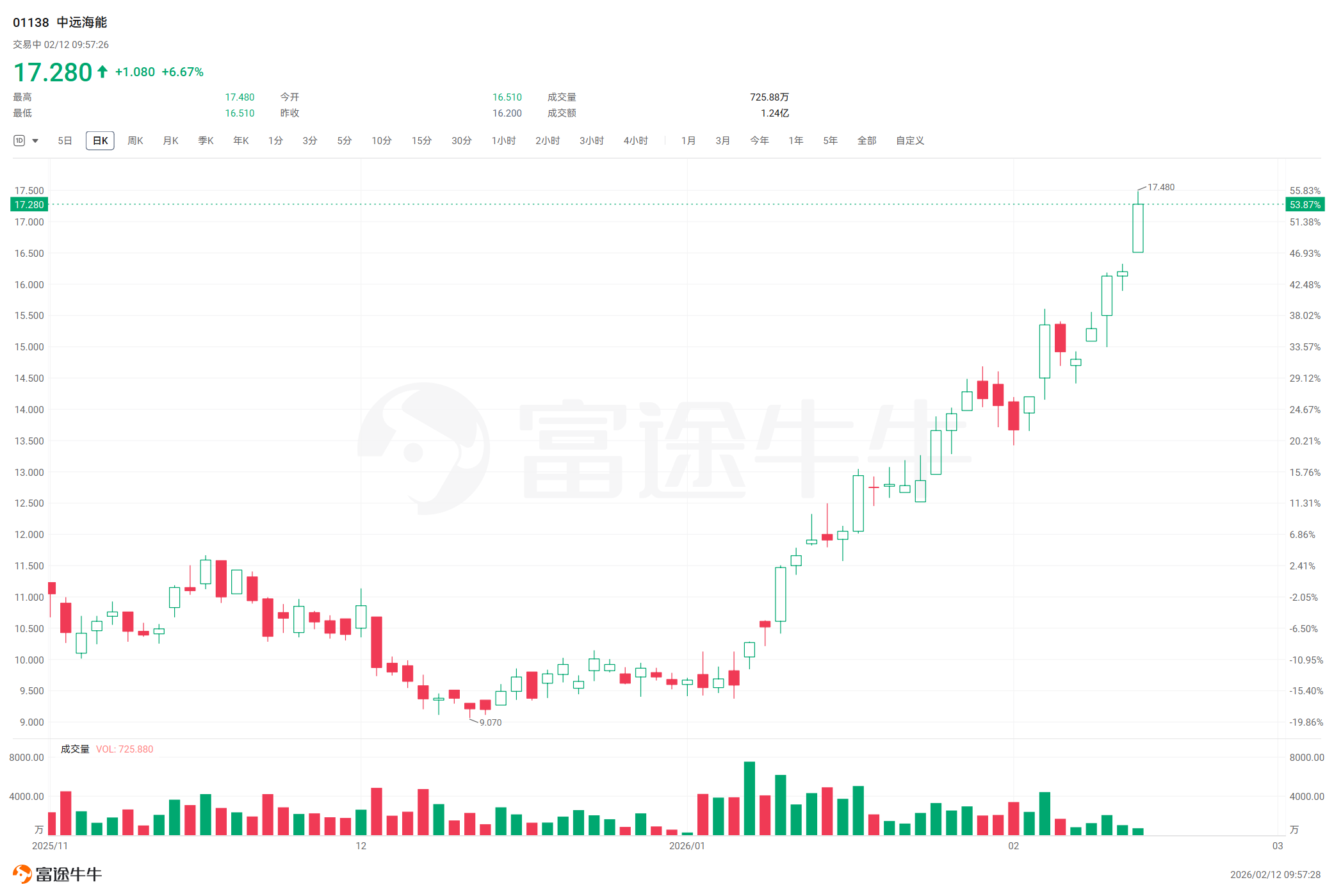
国泰海通证券发布研报称,自2025年8月,原油增产与俄油制裁趋严,驱动油轮产能利用率高企,油运运价中枢显著上升且运价弹性增大。2026年以来地缘 局势紧张,船东情绪高涨,且有海外船东加大租船控制市场,近期油运运价维持高位。上周中东-中国VLCCTCE维持在12万美元以上高位。提示船东情绪仍 将可能持续影响短期运价,该行建议关注运价中枢同比上升趋势,该行预计2026Q1油轮盈利将同比大增数倍。 2月12日, 再涨超6%,年内累计涨幅已超80%。截至发稿,涨6.67%,报17.28港元,成交额1.24亿港元。 编辑/KOKO 消息面上,据新华社报道,美国政府官员正考虑扣押运输伊朗石油的油轮,以对伊朗施压,但美方也担心此举可能引发伊朗的报复行动。报道说,今年已有 超过20艘运输伊朗石油的船只被美国财政部制裁,使其成为可能的扣押目标。 ...

卡比海运股价上涨5.45%,机构看好油运市场景气度
Jing Ji Guan Cha Wang· 2026-02-11 16:58
近期受关注事件 值得关注的事件可能包括公司定期财务报告(如2025年全年业绩)的发布、行业运价波动对业务的影响, 以及潜在的战略动态(如船舶更新或市场拓展)。具体事件日程需以公司官方公告为准。 经济观察网卡比海运(KEX.us)近期股价出现波动,单日上涨5.45%,截至当日收盘报118.00美元/股。公 司最新财报数据显示,营业收入为8.71亿美元,净利润9247万美元,每股收益1.66美元,市盈率21.81 倍。机构评级方面,88%的券商给予买入建议,无卖出建议。 行业政策与环境 油运市场预计2025-2026年维持较高景气度,供需关系偏紧,主要因原油轮在手订单处于历史低位、地 缘政治因素推动合规市场需求提升,这可能对油轮运输企业形成宏观环境支撑。 以上内容基于公开资料整理,不构成投资建议。 ...

国泰海通:春运启动票价向好 油运运价维持高位
智通财经网· 2026-02-10 06:40
Group 1: Aviation Industry - The aviation sector is expected to enter a "super cycle" with high passenger load factors and low ticket prices, driven by strong demand and limited supply growth [1] - During the 2026 Spring Festival, ticket prices are anticipated to rise, supported by a 6% year-on-year increase in air travel volume in early February [1] - The airline industry is projected to achieve significant profitability in Q1 2026, with a favorable ticket pricing trend and a decrease in oil prices [1] Group 2: Oil Shipping Industry - The oil shipping sector is experiencing high freight rates due to geopolitical tensions and increased oil production, with freight rates remaining above $120,000 [2] - The sentiment among shipowners is optimistic, contributing to sustained high freight rates, and the sector is viewed as having a long-term bullish outlook [2] - The aging fleet of oil tankers is expected to maintain a rigid supply of compliant capacity, supporting demand growth in the oil shipping market [2] Group 3: Express Delivery Industry - The express delivery sector is projected to see a recovery in profitability, with a year-on-year growth of 13.6% in parcel volume for 2025, despite a slowdown in December [3] - The industry is experiencing a narrowing decline in unit prices, with a 2% decrease in December, indicating a potential easing of competitive pressures [3] - The "anti-involution" trend in 2026 is expected to exceed expectations, leading to a gradual recovery in price levels and sustained improvement in profitability [3]

中远海能再涨超5% 年初至今股价累涨超六成 油运运价维持高位
Zhi Tong Cai Jing· 2026-02-10 05:55
Core Viewpoint - COSCO Shipping Energy (中远海能) has seen its stock price increase by over 60% year-to-date, with a recent rise of 5.04% to HKD 16.06, reflecting strong market performance and investor interest [1] Group 1: Company Overview - COSCO Shipping Energy has undergone significant business restructuring, establishing an integrated operational model encompassing oil, gas, chemicals, and storage [1] - The core business of oil transportation has consistently contributed over 80% of the company's revenue for the past decade, with foreign trade crude oil and refined oil transportation being the main profit drivers [1] - As of September 2025, the company's fleet capacity distribution is projected to be 83.2% for oil tankers, 16.5% for LNG carriers, 0.3% for chemical tankers, and 0.1% for LPG carriers [1] Group 2: Industry Insights - Guotai Junan Securities highlights a two-phase development leading to a "super bull market" in oil transportation. The first phase is characterized by geopolitical conflicts that have restructured global crude oil trade, increasing shipping distances and driving up oil transportation demand for over three years [1] - The second phase is marked by a global increase in crude oil production, further boosting oil transportation demand [1] - Oil transportation rates have surged since September and are expected to remain high, with tanker profits projected to reach a ten-year high in Q4 2025 and for the entire year [1] - The outlook for 2026 suggests that the oil transportation market will continue to exceed expectations, with potential benefits from falling oil prices [1]
高盛闭门会-地缘冲突-影子油轮制裁-油运有望迎来超级周期-看好vlcc和原油运输
Goldman Sachs· 2026-02-10 03:24
Investment Rating - The report maintains a positive outlook on the oil shipping industry, particularly for Very Large Crude Carriers (VLCC) and crude oil transportation, anticipating a super cycle driven by geopolitical factors and sanctions on shadow tankers [1]. Core Insights - Global crude oil supply is expected to stagnate in 2024, but will see an increase of approximately 1.5 million barrels per day from non-OPEC countries starting mid-2025, followed by OPEC countries joining the production increase [1][4]. - Geopolitical factors significantly impact the tanker market, with issues such as U.S.-China port fee disputes leading to vessel delays and increased demand asymmetry [2][5]. - China plays a crucial role in global oil reserves, with an expected addition of at least 100 million barrels of storage capacity by mid-2026, which will boost demand for mainstream raw material imports and vessels [1][6]. - High refining margins are prompting regions like the Middle East, India, Japan, and South Korea to activate idle capacities, with a projected net increase of 1 million barrels per day in refining capacity by 2026 [1][8]. - The global oil supply-demand outlook shows uncertainty, with an expected daily surplus of around 1 million barrels in 2026, potentially lasting into 2027 [1][9]. Summary by Sections Current Oil Tanker Market Drivers - Key drivers include the growth in crude oil production and exports, increased transportation distances, and geopolitical factors affecting demand [2]. Supply and Demand Dynamics - The oil tanker market is characterized by a complex supply-demand situation, with supply growth expected at 3% in 2026, but actual growth at only 2% due to aging fleets [3][10]. - Demand is projected to grow by 6% in 2026, with a slight decrease in growth rate expected in 2027 [10]. Geopolitical Influences - Geopolitical events, such as potential sanctions relief on Iranian oil, could shift demand from shadow fleets to mainstream fleets, positively impacting VLCC demand [11][12]. Regional Inventory Behaviors - Japan and South Korea are critical regions, with significant increases in crude oil imports, which will impact global oil demand [13]. Clean vs. Dirty Transportation Analysis - The clean and dirty transportation sectors are highly interchangeable, with expected growth rates of 5% to 5.8% for dirty transportation and 2.1% for clean transportation [14].
未知机构:华创交运美伊谈判仍存分歧地缘紧张支撑运价继续看好油运上行景气-20260210
未知机构· 2026-02-10 02:20
Summary of Conference Call Notes Industry Overview - The focus is on the oil transportation industry, specifically the dynamics surrounding the U.S.-Iran negotiations and geopolitical tensions affecting freight rates [1][2]. Key Points and Arguments - The Clarkson VLCC TD3C-TCE index reported a rate of $118,000 per day, reflecting a week-on-week increase of 2% [1][2]. - The Middle East to China route maintained a freight rate of $127,000 per day, showing no change week-on-week, indicating sustained high rates in the market [1][2]. - The completion of cargo bookings for mid-February on the Middle East route has led to a gradual tightening of available shipping capacity as lower-tier capacity is being absorbed [1][2]. - Geopolitical risks are rising, which has positively influenced market sentiment and freight rates [1][2]. U.S.-Iran Negotiation Insights - As of February 6, the U.S.-Iran negotiations have not reached a consensus, leaving the geopolitical situation complex [2]. - The U.S. has intensified sanctions, with the Office of Foreign Assets Control (OFAC) announcing sanctions against 15 entities and 14 vessels involved in illegal trade of Iranian oil, refined products, and petrochemicals [2]. Geopolitical Factors Impacting Oil Transportation - Two potential scenarios are outlined regarding geopolitical risks: 1. If geopolitical tensions escalate, such as disruptions in the Strait of Hormuz, insurance rates and risk premiums could significantly increase freight rates. Additionally, if Iranian oil exports are hindered, Asian buyers may seek compliant market alternatives, boosting demand in those markets [2]. 2. Conversely, if geopolitical risks ease, similar to the situation with Venezuelan oil transitioning to compliant markets, the potential for sanctions on Iran to be lifted could lead to a clearing of shadow fleets and a shift from black to white oil [2]. Market Outlook - The outlook for the oil transportation market remains positive, with expectations for upward trends in freight rates driven by supply dynamics and amplified by geopolitical factors. Recommendations include investing in companies such as China Merchants Energy Shipping and COSCO Shipping Energy Transportation [2].

未知机构:财通交运祝玉波李翔宇中远海能深度报告全球油运龙头弹性可期LNG稳定-20260210
未知机构· 2026-02-10 01:50
Company and Industry Summary Company: 中远海能 (COSCO Shipping Energy) Key Points - **Industry Context**: The company is positioned as a global leader in oil transportation, benefiting from a high level of activity in the foreign trade crude oil transportation sector, which is currently experiencing a favorable market environment [1] - **Performance Outlook**: The company is expected to see a release of performance opportunities due to favorable supply-demand dynamics driven by upstream production expansion, geopolitical events, and tightening sanctions [1] - **Price Trends**: The report anticipates that the central price of freight rates is likely to maintain an upward trend, providing greater performance elasticity for the company [1] - **Initial Coverage Rating**: The company has been given an "Overweight" rating in the initial coverage [1] - **Capacity Structure Analysis**: The report provides an in-depth analysis of the company's capacity structure and potential profit elasticity, discussing the future trends in the crude oil transportation industry [1] - **Demand Drivers**: Two major drivers on the demand side are identified, while the supply side is expected to see limited net increases, suggesting a resonance in supply and demand that could support rising freight rates [1] Financial Projections Key Points - **Revenue Forecast**: The company is projected to achieve revenues of 24.31 billion, 27.86 billion, and 29.89 billion yuan for the years 2025, 2026, and 2027 respectively [2] - **Net Profit Forecast**: Expected net profits attributable to the parent company are forecasted to be 4.68 billion, 6.72 billion, and 7.38 billion yuan for the same years [2] - **Price-to-Earnings Ratio**: Corresponding P/E ratios are projected to be 18.7, 13.0, and 11.8 times for the years 2025, 2026, and 2027 respectively [2] Risk Factors Key Points - **Demand Risks**: A significant decline in crude oil demand poses a risk to the company's performance [2] - **OPEC+ Production Changes**: The risk that OPEC+ may not increase production as expected or may shift to production cuts [2] - **Sanction Implementation**: The potential for sanctions to not be implemented as anticipated [2] - **Environmental Policies**: Risks associated with the advancement of environmental policies that could impact operations [2] - **Geopolitical Risks**: Ongoing war risks and the potential for lock-up shares to be released [2]
华源证券:长锦商船重金押注VLCC 有望重塑定价逻辑
智通财经网· 2026-02-09 07:50
Core Viewpoint - Sinokor (长锦商船) plans to sell all its container ships to Mediterranean Shipping Company (MSC) for approximately $2.5 billion to $3 billion, reallocating funds to the VLCC sector to rapidly expand capacity through "second-hand acquisitions and long-term leases" [1][2] Group 1: Company Strategy - Sinokor aims to exit the container shipping market and heavily invest in VLCC, which is expected to support asset prices and time-charter rates [2] - The company is acquiring second-hand VLCCs at prices 10%-15% above mainstream valuations, with plans to purchase at least 39 second-hand VLCCs by January 2026 [2] - Sinokor is also extending existing charter agreements and entering new leasing contracts with major shipowners [2] Group 2: Market Impact - Sinokor's aggressive expansion is likely to increase industry concentration and reshape pricing logic in the VLCC market [3] - By early 2025, Sinokor and Trafigura may control over 100 VLCCs, representing about 12% of the market share, with actual control potentially reaching 120-130 VLCCs, accounting for 25% of the compliant spot market fleet [3] - The VLCC market is highly sensitive to supply-side disruptions, as evidenced by a significant price spike following sanctions on a major oil transport company [4] Group 3: Long-term Outlook - The VLCC supply side is expected to face challenges, with a significant portion of the fleet aging and new deliveries insufficient to meet replacement needs, which may support market conditions in the long term [5] - The current VLCC fleet has 33.8% of its capacity delivered between 2006-2012, which will start reaching 20 years of age in 2026, leading to potential supply shortages [5] Group 4: Investment Recommendations - The fundamentals of oil transportation are improving, and geopolitical changes may catalyze a "big era" for oil shipping [6] - Sinokor's focus on VLCC is expected to stabilize and elevate VLCC freight rates, with recommendations to pay attention to companies like China Merchants Energy Shipping (601872.SH), COSCO Shipping Energy Transportation (600026.SH, 01138), and China Merchants Jinling Shipyard (601975.SH) [6]
中远海能涨超4% 近期油运运价维持高位 美印贸易合作利好油运合规市场
Zhi Tong Cai Jing· 2026-02-09 05:59
消息面上,特朗普2月3号发文称已与印度总理莫迪达成共识,印度将停止购买俄罗斯石油,转而大幅增 加从美国采购能源等产品;美印双方达成贸易协议,美国对印度的对等关税将从25%下调至18%。财通 证券(601108)认为,后续伴随政策落地,印度将停止购买俄油,国内需求转向合规原油,有望进一步 支撑合规市场运价。中期来看,伴随上游扩产&地缘事件&制裁收紧利好供需,运价中枢有望保持上 涨。 国泰海通证券指出,2026年以来地缘局势紧张,船东情绪高涨,且有海外船东加大租船控制市场,近期 油运运价维持高位。上周中东-中国VLCCTCE维持在12万美元以上高位。提示船东情绪仍将可能持续影 响短期运价,建议关注运价中枢同比上升趋势,该行预计2026Q1油轮盈利将同比大增数倍。重点提示 油运不是短炒地缘局势,而是具有"超级牛市"长逻辑。看好全球原油增产继续驱动油运需求增长,油轮 加速老龄化将保障合规运力供给刚性持续。 中远海能(600026)(01138)涨超4%,截至发稿,涨4.26%,报15.43港元,成交额1.05亿港元。 ...
国泰海通交运周观察:春运启动票价向好,油运运价维持高位
GUOTAI HAITONG SECURITIES· 2026-02-09 02:40
Investment Rating - The report assigns an "Accumulate" rating for the transportation industry [4]. Core Insights - The aviation sector is experiencing a strong demand during the Spring Festival travel season, with an upward trend in ticket prices expected to continue. The report suggests a long-term investment strategy based on a "super cycle" logic [3][4]. - In the oil shipping sector, freight rates remain high, with expectations for tanker profits to increase significantly year-on-year in Q1 2026, indicating a potential "super bull market" [3][4]. - The express delivery industry is anticipated to see a recovery in profitability, driven by a reduction in competitive pressure and a gradual increase in price levels [4]. Summary by Sections Aviation - The Spring Festival travel season officially began on February 2, 2026, with a year-on-year increase in passenger flow of 2% as of February 6, 2026. Air travel saw a 6% increase, while rail travel decreased by 1% [4][10]. - The report highlights that the aviation market's load factor and ticket prices are both showing positive year-on-year growth. The limited increase in train and bus services is expected to benefit airline revenue management [4]. - The report anticipates a significant improvement in airline profitability during the Spring Festival season, with Q1 2026 expected to show industry-wide profitability due to favorable ticket price trends and a decrease in oil prices [4]. Oil Shipping - The report notes that geopolitical tensions have kept shipping rates elevated, with tanker utilization rates remaining high since August 2025 due to increased oil production and stricter sanctions on Russian oil [4]. - The average freight rate for VLCCs (Very Large Crude Carriers) on the Middle East to China route has maintained above $120,000 per day [20]. - The report emphasizes that the oil shipping sector is not merely a short-term play on geopolitical events but has a long-term bullish outlook due to ongoing global oil production increases and the aging of tanker fleets [4]. Express Delivery - The report indicates that the express delivery sector is expected to see a recovery in profitability, with a year-on-year growth in parcel volume of 13.6% for 2025, although December's growth slowed to 2% due to high operational costs and a warm winter [4]. - The report highlights a narrowing decline in industry pricing, with December's average revenue per parcel decreasing by only 2% year-on-year, suggesting a potential easing of competitive pressures [4]. - The report recommends focusing on leading express companies that are optimizing their business structures and building differentiated competitive advantages, such as SF Express and ZTO Express [4].