
科技成长

Search documents
节前波动有所放大,持股还是持币过节?
HWABAO SECURITIES· 2025-09-29 05:06
Group 1 - The report indicates that the bond market is expected to maintain a relatively stable trend before the holiday, with seasonal pressures being manageable due to central bank support for liquidity [10][13]. - In the stock market, the approach to the upcoming holiday is characterized by increased volatility, with some investors opting to take profits and hold cash, while the risks during the holiday period are deemed manageable [3][10]. - The technology growth sector remains a focal point for investors, particularly in the context of economic pressures, with expectations of policy catalysts following significant meetings in October [3][13]. Group 2 - The report highlights that the A-share market has shown a mixed performance, with the ChiNext board continuing to perform strongly, while the overall market remains in a phase of fluctuation [10][13]. - The report notes that the average daily trading volume in the two markets has decreased to 23,132 billion yuan, reflecting a decline of 2,047 billion yuan compared to the previous week, as market activity slows ahead of the holiday [20]. - The domestic macro multi-asset model has achieved a year-to-date return of 10.82%, outperforming the benchmark by 3.72%, with a Sharpe ratio of 2.63, significantly higher than the benchmark's 1.32 [21].
写给新老基民:“9·24”一周年之际的复盘与思考
Sou Hu Cai Jing· 2025-09-24 11:16
Core Viewpoint - The A-share market has experienced significant changes since September 24, 2024, marking a new cycle characterized by a strong recovery and confidence in the domestic technology sector [1][12]. Market Review - The market can be divided into three phases since September 24, 2024: 1. From September 24 to October 8, 2024, the Shanghai Composite Index surged from around 2700 points to 3674 points, an increase of nearly 1000 points [4]. 2. From October 8, 2024, to April 7, 2025, the market experienced fluctuations, testing investor confidence while hovering above 3000 points [6]. 3. From April 7, 2025, to the present, the market has seen a steady rise of nearly 900 points, moving from 3040 points to nearly 3900 points, indicating a "slow bull" market [6][12]. Market Dynamics - The overall market valuation has shifted from excessive pessimism to reasonable correction, with the technology growth sector gaining optimistic expectations [12]. - The annualized volatility of the Shanghai Composite Index has decreased to 15.9% over the past five years, down 2.8 percentage points from the previous five years, indicating a more stable investment environment [5][12]. Investment Trends - The technology sector has emerged as the strongest driver of the current market rally, with its market capitalization exceeding 25% of the total market [9][12]. - The ChiNext Index and the Science and Technology Innovation 50 Index have both seen significant gains, reflecting the success of the new policies introduced since September 24, 2024 [9][12]. Future Outlook - Historical analysis suggests that the CSI 300 Index could reach around 5500 points, indicating a potential upside of 22% from its current level of approximately 4500 points [18]. - The current dividend yield of the CSI 300 is 2.2%, suggesting a potential increase of 46% based on historical bull market dividend yields [21]. Investor Sentiment - Recent data indicates that while there has been an increase in retail investor activity, it remains below the levels seen during the previous bull market [13][15]. - The market sentiment has shown signs of improvement, but it is still not at the levels experienced during the peak of previous bull markets [13][15].

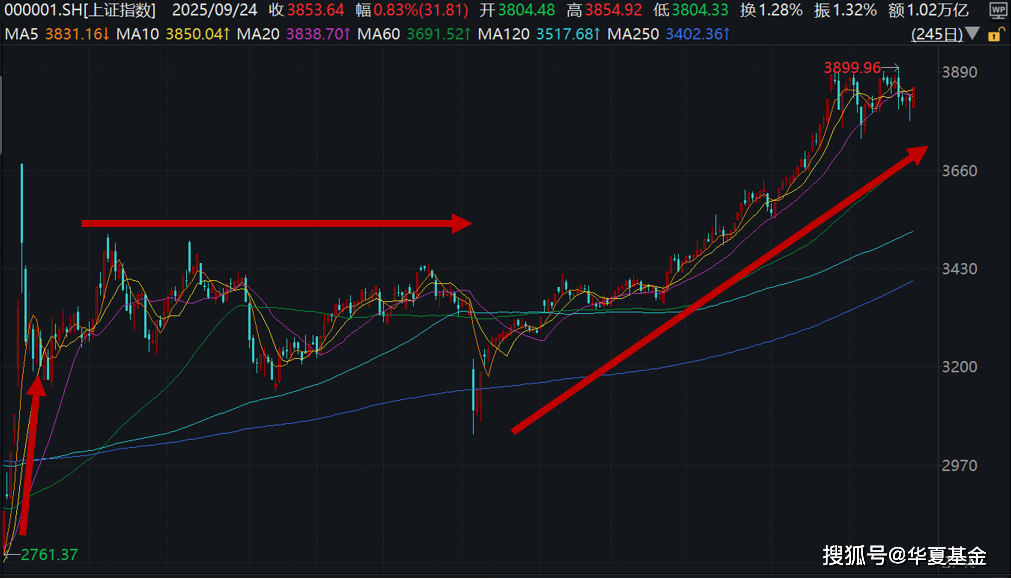
市场环境因子跟踪周报(2025.09.24):假期临近,市场延续震荡-20250924
HWABAO SECURITIES· 2025-09-24 10:21
Quantitative Factors and Construction 1. Factor Name: Market Style Factors - **Construction Idea**: The market style factors track the performance and volatility of different market styles, such as large-cap vs. small-cap and value vs. growth, to identify prevailing market trends and shifts in investor preferences [12][14] - **Construction Process**: - **Size Style**: Measure the relative performance of small-cap stocks versus large-cap stocks - **Value-Growth Style**: Measure the relative performance of value-oriented stocks versus growth-oriented stocks - **Volatility Metrics**: Calculate the volatility of each style to assess the stability of the trend - **Evaluation**: These factors provide insights into the dominant market style and its stability, which can guide portfolio allocation strategies [12][14] 2. Factor Name: Market Structure Factors - **Construction Idea**: These factors analyze the dispersion and concentration of returns across industries and stocks to understand market breadth and sector rotation [12][14] - **Construction Process**: - **Industry Excess Return Dispersion**: Measure the spread of excess returns across industry indices - **Sector Rotation Speed**: Quantify the rate at which different sectors outperform or underperform - **Stock Concentration**: Calculate the proportion of total market turnover contributed by the top 100 stocks and the top 5 industries - **Evaluation**: These factors help identify whether the market is driven by a few sectors or stocks, or if performance is more evenly distributed [12][14] 3. Factor Name: Market Activity Factors - **Construction Idea**: These factors measure the overall activity and liquidity in the market, including volatility and turnover rates, to gauge investor participation and sentiment [13][14] - **Construction Process**: - **Market Volatility**: Calculate the standard deviation of market returns over a specific period - **Turnover Rate**: Measure the trading volume relative to the total market capitalization - **Evaluation**: These factors are useful for assessing market sentiment and liquidity conditions, which are critical for timing and risk management [13][14] 4. Factor Name: Commodity Market Factors - **Construction Idea**: These factors track trends, momentum, and liquidity in commodity markets to identify opportunities and risks in different commodity sectors [24][30] - **Construction Process**: - **Trend Strength**: Measure the directional movement in commodity prices for sectors like metals, energy, and agriculture - **Basis Momentum**: Calculate the change in the basis (spot price minus futures price) over time - **Volatility**: Assess the price fluctuations in commodity indices - **Liquidity**: Measure the trading volume and bid-ask spread in commodity markets - **Evaluation**: These factors provide a comprehensive view of commodity market dynamics, aiding in asset allocation and hedging strategies [24][30] 5. Factor Name: Option Market Factors - **Construction Idea**: These factors analyze implied volatility and skewness in option markets to infer market expectations and risk sentiment [33][34] - **Construction Process**: - **Implied Volatility**: Measure the market's expectation of future volatility for indices like SSE 50 and CSI 1000 - **Option Skewness**: Calculate the difference in implied volatility between out-of-the-money calls and puts to assess directional bias - **Evaluation**: These factors are valuable for understanding market sentiment and hedging demand, especially during periods of uncertainty [33][34] 6. Factor Name: Convertible Bond Market Factors - **Construction Idea**: These factors evaluate the valuation and liquidity of convertible bonds to identify market trends and investment opportunities [36][39] - **Construction Process**: - **Conversion Premium**: Measure the difference between the market price of the bond and its conversion value - **Low Premium Proportion**: Calculate the proportion of bonds with low conversion premiums - **Market Liquidity**: Assess the trading volume and turnover in the convertible bond market - **Evaluation**: These factors provide insights into the attractiveness and liquidity of convertible bonds, which are important for fixed-income and hybrid strategies [36][39] --- Backtesting Results of Factors 1. Market Style Factors - **Size Style**: Small-cap outperformed large-cap during the week [12][14] - **Value-Growth Style**: Growth stocks outperformed value stocks during the week [12][14] - **Volatility**: Size style volatility decreased, while value-growth style volatility increased [12][14] 2. Market Structure Factors - **Industry Excess Return Dispersion**: Remained stable compared to the previous week [12][14] - **Sector Rotation Speed**: Decreased compared to the previous week [12][14] - **Stock Concentration**: Top 100 stocks and top 5 industries maintained their turnover proportions [12][14] 3. Market Activity Factors - **Market Volatility**: Slightly decreased during the week [13][14] - **Turnover Rate**: Remained at a high level over the past year [13][14] 4. Commodity Market Factors - **Trend Strength**: Increased for metals and precious metals, decreased for energy commodities [24][30] - **Basis Momentum**: Declined across all commodity sectors [24][30] - **Volatility**: Increased slightly across all commodity sectors [24][30] - **Liquidity**: Showed mixed performance across different sectors [24][30] 5. Option Market Factors - **Implied Volatility**: SSE 50 and CSI 1000 remained in a range-bound state [33][34] - **Option Skewness**: Call skewness decreased, indicating reduced bullish sentiment [33][34] 6. Convertible Bond Market Factors - **Conversion Premium**: Stable for bonds priced around par value [36][39] - **Low Premium Proportion**: Increased significantly, indicating rising demand for low-premium bonds [36][39] - **Market Liquidity**: Maintained healthy trading levels [36][39]
【金融工程】假期临近,市场延续震荡——市场环境因子跟踪周报(2025.09.24)
华宝财富魔方· 2025-09-24 09:14
Group 1 - The core viewpoint of the article indicates that as the long holiday approaches, the market is expected to continue its oscillating and structural trends, with a focus on growth styles supported by industry trends and performance outlooks [2][5] - The macro strategy team suggests that the market may maintain a balanced approach, recommending investments in large-cap indices and the ChiNext, while high-risk investors should consider opportunities in technology, new energy, and Hang Seng Technology sectors [2][5] Group 2 - In the stock market, the small-cap style is favored, and the growth style is showing stronger performance, while the volatility of small-cap styles has decreased and the volatility of growth styles has increased [7] - The market's trading concentration remains stable, with the top 100 stocks and the top 5 industries maintaining their share of total trading volume [7][8] - Market activity has seen a slight decrease in volatility, while turnover rates remain at a high level compared to the past year [8] Group 3 - In the commodity market, the trend strength of black and precious metals has increased, while the trend strength of energy and chemical sectors has decreased [19] - All sectors have experienced a slight increase in volatility, and liquidity performance has shown divergence across different sectors [19] Group 4 - In the options market, both the SSE 50 and CSI 1000 are in a state of oscillation, with a gradual decline in bullish option skew, indicating a lack of confidence for further upward movement in the market [22] Group 5 - The convertible bond market experienced a slight adjustment, with a notable increase in the proportion of low conversion premium bonds, indicating a trend of oscillation and elevation [24]

市场量价齐升预期稳定
Jin Rong Shi Bao· 2025-09-24 02:54
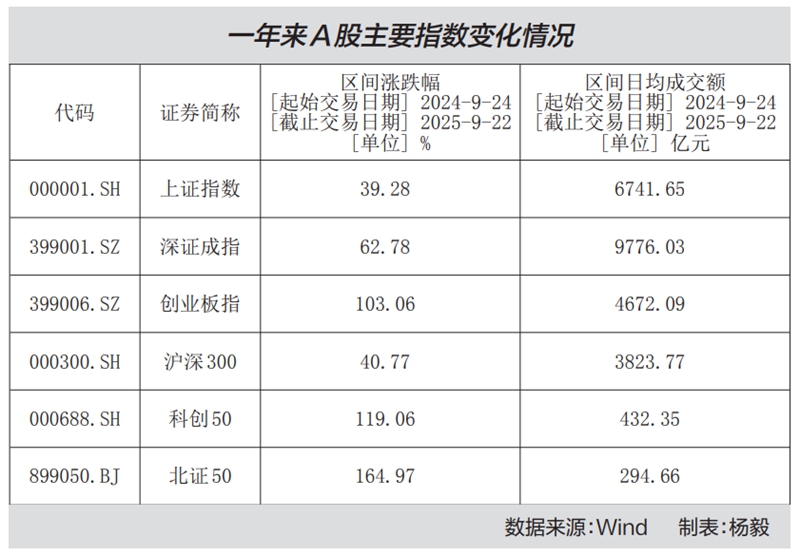
Core Viewpoint - The A-share market has experienced a significant upward trend over the past year, with major indices showing remarkable gains and a substantial increase in market capitalization and trading volume [1][3][6]. Market Performance - Since September 24, 2024, the A-share market has seen impressive index performance, with the Shanghai Composite Index rising by 39.28%, the Shenzhen Component Index by 62.78%, and the ChiNext Index by 103.06% [2][3]. - The total market capitalization of A-shares surpassed 100 trillion yuan for the first time in August 2025, increasing from approximately 78.57 trillion yuan to about 117.75 trillion yuan within a year [6]. Trading Volume - Daily average trading volume has significantly increased, from approximately 552.9 billion yuan before the current uptrend to 1.65 trillion yuan during the uptrend, and reaching 2.43 trillion yuan in September 2025, marking over a threefold increase year-on-year [5][6]. Investor Activity - The number of new investor accounts has surged, with 6.8468 million new accounts opened in October 2024, a 274.67% increase compared to September. In total, 17.21 million new accounts were opened in the first eight months of 2025, representing a 48% year-on-year growth [6]. Market Stability and Support - The market has seen increased participation from long-term funds, including insurance capital, which has contributed to a more stable funding environment. Regulatory measures such as buybacks and increased liquidity support have also bolstered market confidence [7]. - Analysts predict that A-share companies are likely to return to positive earnings growth in 2025, ending a four-year decline, driven by favorable market conditions and policy support [7].
美联储降息25基点!37万亿债务压顶,特朗普提线木偶操控利率决议
Sou Hu Cai Jing· 2025-09-21 08:43
Group 1: Federal Reserve's Monetary Policy - The Federal Reserve announced a rate cut of 25 basis points, reflecting a complex economic landscape with conflicting signals from employment and inflation data [2][4] - The U.S. economy is showing a dual picture, with non-farm payrolls growing by only 22,000 in August, significantly below the expected 75,000, and the unemployment rate rising to 4.3%, the highest in nearly two years [4] - Inflation remains a concern, with the CPI rising 2.9% year-on-year and core CPI at 3.1%, both above the Fed's 2% target, complicating the Fed's decision-making process [4] Group 2: Political Influence and Economic Pressure - The rapid confirmation of Stephen Milan as a Fed governor has introduced political dynamics into monetary policy, as he is aligned with the Trump administration's pro-growth agenda [1][6] - The current U.S. national debt has surpassed $37 trillion, and a 25 basis point rate cut could save nearly $100 billion in interest payments annually, highlighting fiscal pressures as a significant factor in policy decisions [5][9] - The Congressional Budget Office projects a fiscal deficit of $1.9 trillion for FY2025, which is 6.2% of GDP, further intensifying the pressure for rate cuts as a means to alleviate fiscal burdens [9] Group 3: Market Reactions and Investment Opportunities - The market has already begun to price in rate cuts, with gold prices reaching a historical high of $3,730 per ounce, reflecting a 48.94% increase since the last rate cut cycle began [10] - Historical data suggests that during initial rate cut cycles, technology growth stocks tend to outperform value stocks, indicating potential short-term gains for the tech sector if the Fed proceeds with cuts [10] - Commodity markets are showing divergent trends, with precious metals like gold benefiting from the anticipated cuts, while industrial metals' performance will depend on the strength of global economic recovery [12]

【UNFX 课堂】摩根士丹利突发修正预测美联储降息节奏大提速2026 年路径首次曝光
Sou Hu Cai Jing· 2025-09-13 11:26
Core Viewpoint - Morgan Stanley has significantly revised its forecast for the Federal Reserve's interest rate cuts, now predicting three consecutive 25 basis point cuts in September, November, and December 2024, along with additional cuts in 2026, which is more aggressive than market expectations [1][2]. Group 1: Reasons for the Aggressive Shift - Inflation is cooling faster than expected, with key indicators like CPI and PCE showing a quicker decline, particularly in stubborn areas like housing inflation, providing data support for earlier and faster rate cuts [2]. - The labor market is showing signs of significant cooling, with non-farm employment, job openings, and unemployment rate data indicating a return to a balanced state, alleviating concerns about a wage-inflation spiral [3]. - There are increasing risks of economic recession, as leading economic indicators suggest a weakening momentum in the U.S. economy, prompting the Fed to adopt a preemptive rate cut strategy to avoid a hard landing [4]. Group 2: Comparison with Market Expectations - Morgan Stanley's new prediction of three rate cuts in 2024 contrasts with the previous market expectation of only two cuts [5]. - For 2025, while the market anticipated 2-3 cuts, Morgan Stanley forecasts four cuts, indicating a faster pace [5]. - Morgan Stanley's forecast includes three rate cuts in 2026, a prediction rarely made by other institutions, highlighting a more aggressive approach compared to the market's cautious stance [5]. Group 3: Implications for Global Markets - If Morgan Stanley's predictions materialize, global asset prices could undergo significant revaluation, with gold being the biggest beneficiary, potentially reaching historical highs due to lower real interest rates and a weaker dollar [6][7]. - U.S. stocks may experience a liquidity-driven rally, although concerns about economic recession could limit gains, particularly affecting bank stocks due to narrowing interest margins [8][9]. - The dollar's dominance may face challenges, with a faster rate cut path leading to a narrowing of interest rate differentials, potentially resulting in a long-term decline in the dollar index and a rebound for non-U.S. currencies [10]. - Cryptocurrencies may see a resurgence in demand as global liquidity expectations improve, benefiting from both their status as risk assets and as "digital gold" [11][12]. Group 4: Investment Strategies - Long-term investors are advised to accumulate "rate cut beneficiary" assets, such as gold, which should constitute 5%-10% of their portfolio [13]. - Investors should focus on high-quality tech and growth stocks with strong cash flows for long-term holding [14]. - Short-term traders should monitor economic data closely, as stronger-than-expected data could challenge Morgan Stanley's aggressive predictions, necessitating risk management strategies [15]. - All investors should maintain flexibility and avoid heavy bets based on a single prediction, ensuring a balanced and adaptable asset allocation [16].

方正证券:美股当下估值和集中度重新回偏高区间 短期继续上涨空间或相对有限
Ge Long Hui A P P· 2025-09-04 00:56
Core Insights - Since July, the market's expectations for the annual EPS growth of US stocks have been significantly revised upward due to the easing of tariff policy risks and the relative resilience of the US economy [1] - The US economy may trend towards moderate decline in the second half of the year, which could exert some pressure on US stock earnings [1] - Despite the ongoing AI boom and relatively low recession risks in the US economy, US stock earnings still require continued observation [1] Market Dynamics - The concentration of the US stock market has reached a new high, largely reflecting the sustained high growth of technology stocks represented by AI, but this also increases market vulnerability [1] - Current valuations and concentration levels of US stocks have returned to a relatively high range, suggesting limited short-term upside potential [1] - The probability of sector rotation is increasing, while the medium to long-term outlook remains positive [1]

金鹰基金:资金博弈加剧市场波动 外围流动性改善添底气
Xin Lang Ji Jin· 2025-09-01 06:37
Group 1 - The A-share market experienced high volatility with increased trading volume, driven by policy support and mid-term performance catalysts, particularly in real estate, agriculture, and power equipment sectors [1] - The ChiNext index showed strong performance, with average daily trading volume rising to 2.98 trillion yuan, indicating a shift in market dynamics [1] - The market style favored growth sectors over cyclical, consumer, and financial sectors, with technology growth leading the gains [1] Group 2 - Jin Ying Fund suggests focusing on sectors with potential for future profit improvement, including technology, innovative pharmaceuticals, non-bank financials, and non-ferrous metals [2] - In the technology sector, AI is at a high emotional trading point, with both domestic and overseas developments being encouraged, particularly in AI applications and advanced semiconductor processes [2] - The military industry may see rotation opportunities due to upcoming events like the September 3 military parade and the formulation of the 14th Five-Year Plan [2] Group 3 - As the market strengthens, non-bank financial sectors such as brokerage, insurance, and financial IT are expected to see improvements in both valuation and performance [2] - With expectations of a Federal Reserve rate cut and a dual easing of overseas monetary and fiscal policies by 2026, sectors benefiting from external demand, such as innovative pharmaceuticals and non-ferrous metals, may present investment opportunities [2] - The focus on policy-driven industries like photovoltaics is anticipated to strengthen in the future, reflecting a shift away from internal competition [2]
券商密集召开秋季策略会 研判最新投资机遇
Zheng Quan Ri Bao· 2025-08-29 15:53
Group 1 - Multiple brokerages are holding autumn strategy meetings to provide insights on market trends and investment opportunities, indicating a generally optimistic outlook for the A-share market supported by various positive factors [1][2] - Key themes from the strategy meetings reflect confidence in the market, with titles such as "Planning for the Long Term" and "New Engines for Bull Markets," showcasing a strong belief in future growth [1] - Analysts emphasize the importance of these meetings in reducing information asymmetry, stabilizing market expectations, and enhancing rationality and resilience in the market [1] Group 2 - Analysts from various brokerages suggest that the A-share market is expected to continue its upward trajectory, with reasonable valuations and new positive factors emerging [2] - Investment focus areas include technology self-sufficiency, domestic consumption, and dividend stocks, with short-term attention on sectors poised for recovery [2][3] - The anticipated recovery in manufacturing and improvements in profitability are seen as key drivers for the market, with specific asset classes recommended for investment, including industrial metals and consumer-related sectors [3]




