
锡矿

Search documents
中金:供需紧平衡且供给扰动频发 继续看涨锡价和锡板块估值扩张
智通财经网· 2025-11-25 09:00
Core Viewpoint - The demand for tin solder is expected to accelerate due to AI-driven computing infrastructure, innovation cycles in smart devices, and the electrification/intelligentization of automobiles, with a projected CAGR of 7% from 2024 to 2030 [1][2]. Group 1: Demand Drivers - The demand for tin solder is driven by AI advancements, smart device innovation, and the automotive sector's shift towards electrification and intelligence [2]. - Traditional demand is also expected to benefit from global fiscal and monetary policy easing, with a growing urgency for "safety stock" in the context of de-globalization, leading to a projected global tin demand CAGR of 4.3% from 2024 to 2030 [2]. Group 2: Supply Constraints - Major tin-producing regions are facing resource constraints and frequent disruptions, with China's tin reserves and static reserve-to-production ratio declining due to insufficient prior exploration [3]. - Indonesia is experiencing multiple issues, including shrinking tin reserves, declining grades, and increased mining difficulties, compounded by frequent policy changes that exacerbate supply disruptions [3]. - Myanmar's previous extensive mining practices have led to significant declines in grade and output, with uncertainties surrounding the resumption of production in the Wa region [3]. - Other regions have projects mostly in early stages, and the supply elasticity of recycled tin is limited due to the miniaturization of solder [3]. Group 3: Supply-Demand Balance and Price Outlook - The supply-demand balance is expected to remain tight, with projected supply-demand ratios for tin from 2025 to 2030 being -6%, -1%, +1%, +1.6%, +1%, and -0.3% respectively [4]. - The continuous decline in global tin ore grades is pushing up industry cost lines, alongside rising global inflation expectations and geopolitical risk premiums, which may elevate the incentive prices for potential global tin mining projects [4]. Group 4: Investment Recommendations - Since 2020, the central price of tin has increased, leading to overall improved industry profitability and valuation normalization, with the current industry PE at the 21st percentile of the past five years [5]. - The industry remains bullish on tin prices and valuation expansion, recommending a focus on companies like Tin Industry Co., Ltd. (000960.SZ) that have strong resource endowments and growth potential [5].

有色金属海外季报:TIMAH2025Q3锡金属产销量分别环比增加6%、12%至3,985吨、3,486吨
HUAXI Securities· 2025-11-24 14:51
Investment Rating - The industry rating is "Recommended" indicating a positive outlook for the sector [5]. Core Insights - The company reported a tin production of 5,200 tons in Q3 2025, a year-on-year increase of 5% and a quarter-on-quarter increase of 37% [1]. - The average selling price of tin metal for the first three quarters of 2025 was $33,596 per ton, an 8% increase compared to $31,183 per ton in the same period last year [1]. - The electronic manufacturing industry is expected to be the main driver of tin demand, with a projected increase in tin usage of 0.6% in 2025, reaching 380,160 metric tons [7]. Production and Sales Summary - In Q3 2025, the company’s tin metal production was 3,985 tons, a 16% decrease year-on-year but a 6% increase quarter-on-quarter [1]. - The sales volume of tin metal in Q3 2025 was 3,486 tons, reflecting a 32% year-on-year decrease but a 12% quarter-on-quarter increase [1]. - Domestic refined tin sales accounted for 7% of total sales, while export sales made up 93%, with Japan and Singapore being the largest markets [2]. Financial Performance Summary - The company’s revenue for Q3 2025 was 2.38 trillion Indonesian Rupiah, a 22% year-on-year decrease but a 12% quarter-on-quarter increase [3]. - EBITDA for Q3 2025 was 662 billion Indonesian Rupiah, down 24% year-on-year but up 46% quarter-on-quarter [3]. - Net profit for Q3 2025 was 301.93 billion Indonesian Rupiah, a 36% year-on-year decrease but a 65% quarter-on-quarter increase [3]. Asset and Liability Overview - As of the end of Q3 2025, total assets increased by 7% to 13.7 trillion Indonesian Rupiah compared to the end of 2024 [3]. - Total liabilities grew by 14% to 6.1 trillion Indonesian Rupiah, primarily due to increases in accounts payable and short-term bank loans [3]. - The company’s net assets stood at 7.61 trillion Indonesian Rupiah [4]. Market Outlook - The tin market is expected to remain tight due to limited supply from key producing regions, with projected tin prices in 2025 ranging from $32,254 to $34,000 per ton [7]. - The demand for tin is anticipated to be influenced by growth in electronics, semiconductors, and AI sectors, alongside macroeconomic factors such as fiscal stimulus in China and U.S. Federal Reserve policies [7].
锡周报-20251123
Guo Tai Jun An Qi Huo· 2025-11-23 13:19
1. Report Industry Investment Rating - Not provided in the content 2. Core Viewpoints of the Report - This week, tin prices have declined, returning to around the 290,000 yuan central level. The recent fundamentals of tin are relatively strong. Domestic social inventories are continuously decreasing, and supply bottlenecks are obvious, with the resumption of production in Myanmar still uncertain and a significant reduction in Indonesia's export volume due to year - end and first - quarter export quota restrictions. Demand benefits from AI development, and macro funds are enthusiastic about AI metals. Tin price increases recently are mainly affected by macro sentiment. While its fundamentals are not weak, there is good elasticity. Without macro factors, the fundamental contradictions of tin prices are insufficient to support a breakthrough above 300,000 yuan, but the overall price remains resilient. The strength analysis is neutral, and the price range is 288,000 - 295,000 yuan/ton [3][6] 3. Summary by Relevant Catalogs 3.1 Transaction Aspect (Price, Spread, Inventory, Funds, Transaction, Position) - **Spot**: This week, the LME 0 - 3 premium is 95 US dollars/ton, and the domestic spot premium is 600 yuan/ton. Overseas premium has declined, while premiums in Baltimore and Taiwan regions have increased [10][11][16] - **Spread**: This week, the tin inter - month structure has changed from the previous B structure to the C structure [19][20] - **Inventory**: This week, domestic social inventories have increased by 211 tons, and futures inventories have decreased by 26 tons. LME inventories have increased by 20 tons, and the cancelled warrant ratio has risen to 7.78% [25][26][31] - **Funds**: As of this Friday, the precipitated funds for Shanghai tin are 228.888 million yuan, and the fund flow in the past 10 days has been in the inflow direction [36] - **Transaction and Position**: This week, the trading volume and position of Shanghai tin have slightly declined, while the position volume has slightly increased. The trading volume of LME tin has slightly rebounded, and the position has continued to rise [38][39][43] - **Position - to - Inventory Ratio**: This week, the position - to - inventory ratio of Shanghai tin has slightly rebounded [48] 3.2 Tin Supply (Tin Ore, Refined Tin) - **Tin Ore**: In July 2025, the output of tin concentrates was 6,409 tons, a year - on - year increase of 7.63%. In October 2025, 11,632 tons were imported, a year - on - year decrease of 22.54%, and a cumulative year - on - year decrease of 25.72%. This week, the processing fee for 40% tin ore in Yunnan remained at 12,000 yuan/ton, while the processing fee for 60% tin ore in Guangxi, Jiangxi, and Hunan decreased to 8,000 yuan/ton. The import profit and loss level of tin ore has slightly rebounded [52][53] - **Smelting**: In September 2025, the domestic tin ingot output was 16,090 tons, a year - on - year decrease of 4.25%. This week, the combined operating rate of Jiangxi and Yunnan provinces was 68.93%, a slight decline from last week [58][60] - **Import**: In October 2025, China imported 526 tons of tin ingots and exported 1,480 tons, with a net export of 945 tons. Among them, 124 tons of tin ingots were imported from Indonesia to China. The latest import profit and loss is - 25,012 yuan/ton [63][64] 3.3 Tin Demand (Tin Materials, End - users) - **Consumption Volume**: In October 2025, the apparent consumption volume of tin ingots was 15,136 tons, and the actual consumption volume was 16,342 tons [72] - **Tin Materials**: This week, the downstream processing fees have slightly declined. The operating rate of monthly solder enterprises in October has increased to 73.1%. The output and sales volume of major tin - plated sheet enterprises in August have slightly rebounded [75] - **End - user Consumption**: In October 2025, the output of end - user products has shown different performances. The monthly output of integrated circuits, electronics, smartphones, and household appliances such as air conditioners has declined. However, the consumption of household appliances and new energy has rebounded month - on - month. This week, the Philadelphia Semiconductor Index has rebounded, showing the same trend as tin prices [82][84][89]
【财经分析】出口回升但隐忧犹存 印尼锡产业迎来重构窗口期
Xin Hua Cai Jing· 2025-11-15 07:56
Group 1 - The core viewpoint of the article highlights that Indonesia's tin exports are experiencing a recovery due to rising international tin prices and the restoration of domestic production capacity, despite ongoing governance issues that hinder the industry's competitiveness [1][2][4] Group 2 - From January to September, Indonesia exported 37,600 tons of refined tin, reaching 68% of the government's annual export quota, with a 25.8% increase in export value in the third quarter, amounting to $1.16 billion [2] - The international tin price has been driven up by the closure of 1,000 illegal tin mines in Bangka-Belitung province, which raised concerns about global tin supply tightening, leading to a surge in London Metal Exchange (LME) tin prices, with November contracts exceeding $37,000 per ton [2][3] - The recovery of Indonesia's tin exports is supported by the approval of project plans and export licenses for 23 companies, indicating a restoration of order in the industry [3] Group 3 - Governance reforms are identified as a critical variable affecting the long-term competitiveness of Indonesia's tin industry, with a consensus on the need for a unified and transparent tin benchmark price system [4][5] - The Indonesian parliament is accelerating the legislative process for the benchmark price system, aiming to establish a national pricing formula by January 1, 2026, to address issues of price manipulation and resource outflow [4] - PT Timah, as a leading company, is initiating pilot projects for the legalization of artisanal miners and is advocating for the government to expedite the introduction of relevant regulations to enhance the tin industry's compliance and stability [4][5] Group 4 - The political landscape shows a strong stance against illegal mining, with President Prabowo indicating that illegal tin mining and smuggling have caused Indonesia an annual loss of approximately 40 trillion Indonesian rupiah (around $2.4 billion) over the past 20 years [5]
10月印尼锡锭出口显著减少
Wen Hua Cai Jing· 2025-11-12 10:00
数据来源:印尼贸易部 印尼贸易部公布的数据显示,印尼10月出口2,643.05吨精炼锡,较去年同期减少53.89%,环比下降 46%。受印尼打击非法锡矿及6家被查封冶炼厂移交国企PT Timah的影响,10月印尼锡锭出口显著减 少。 ...

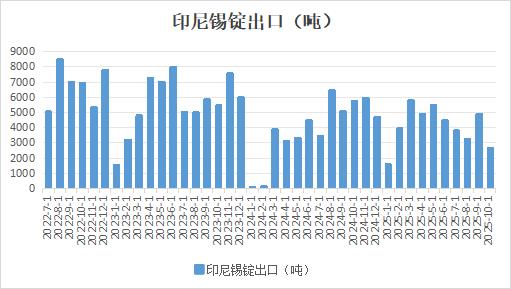
美元指数走强及流动性偏紧或使沪锡价格承压
Hong Yuan Qi Huo· 2025-11-04 10:24
1. Report Industry Investment Rating No relevant information provided. 2. Core View of the Report The slow resumption of tin mines in Wa State, Myanmar, has led to an expectation of tight supply and demand. However, due to the hawkish shift in the Fed's interest - rate cut expectations, the strengthening of the US dollar index, and tight liquidity, the Shanghai tin price may be adjusted. It is recommended that investors try short - selling the main contract at high levels with a light position in the short term, and pay attention to the support and resistance levels of Shanghai tin and London tin [3]. 3. Summary by Relevant Catalogs 3.1 First Part: Spread and Inventory Situation - The Shanghai tin basis is positive and the monthly spread is negative, both within the reasonable range. This is due to the slow resumption of tin mines in Wa State, Myanmar, leading to an expected tight supply, and a decline in the total inventory of refined tin at home and abroad. However, with the hawkish shift in the Fed's future interest - rate cut expectations, the strengthening of the US dollar index, tight liquidity, and the arrival of the domestic traditional consumption off - season, investors are advised to temporarily wait and see for arbitrage opportunities [7][9]. - The LME tin (0 - 3) and (3 - 15) contract spreads are positive and within the reasonable range. The Shanghai - London tin price ratio is lower than the 50% quantile of the past five years. This is because the manufacturing PMI in Europe and the US in October was weak, and the inventory of refined tin in the LME is increasing but still at a relatively low level. It is recommended to temporarily wait and see for arbitrage opportunities in the LME tin (0 - 3) and (3 - 15) contract spreads [11]. - The inventory of refined tin in the Shanghai Futures Exchange has increased compared to last week; the social inventory of tin ingots in China has decreased compared to last week; the inventory of refined tin in the LME has increased compared to last week; the total inventory of refined tin at home and abroad has decreased compared to last week [13]. 3.2 Second Part: Mid - upstream Supply Situation - The daily processing fee of domestic tin ore has decreased, indicating an expected tight supply of domestic tin ore [19][20]. - The production (import) volume of domestic tin ore in November may increase month - on - month. Reasons include the closure of 1000 illegal tin mines in Bangka Belitung by the Indonesian president, the commissioning of the second concentrator of the Uis mine in Namibia, the resumption of mining in Wa State, Myanmar, the phased resumption of the Bisie tin mine in the DRC, and the suspension of the transit export of Myanmar tin ore through Thailand [22][24]. - The production volume of recycled tin in China in November may increase month - on - month [25][26]. - The capacity utilization rate of refined tin in Yunnan and China (Jiangxi) has decreased (remained flat) compared to last week; the production (inventory) volume of refined tin in China in November may increase (decrease) month - on - month [29]. - The import volume of refined tin in China in November may increase month - on - month. The export volume of refined tin from Indonesia is expected to increase, which may lead to an increase in China's refined tin imports [30][32]. 3.3 Third Part: Downstream Demand Situation - The daily processing fee of photovoltaic solder strips has decreased month - on - month, which may lead to an increase in the capacity utilization rate (inventory) of tin solder in China in November [36]. - The import (export) volume of solder strips in China in November may decrease (increase) month - on - month [37][39]. - The production (import, export) volume of tin - plated sheets in China in November may decrease (decrease, increase) month - on - month [40]. - The capacity utilization rate of lead - acid batteries in China has decreased compared to last week. Since tin is an important additive in lead - acid batteries, this may affect the demand for tin [42][44].
有色金属周报:缅甸锡矿复产缓慢和中美经贸谈判缓和支撑锡价-20251027
Hong Yuan Qi Huo· 2025-10-27 08:34
1. Report Industry Investment Rating No relevant content provided. 2. Core Viewpoints of the Report - The slow resumption of tin mines in Myanmar and the easing of Sino-US economic and trade negotiations support tin prices. The expectation of future interest rate cuts and the halt of balance - sheet reduction by the Fed, along with the initial agreement in Sino - US economic and trade negotiations, suggest that the resumption of tin mines in Myanmar may not change the tight supply - demand situation. The Shanghai tin price is expected to be cautiously bullish. Investors are advised to build long positions after price pullbacks, paying attention to support and resistance levels [3]. - The negative basis and monthly spread of Shanghai tin are due to high tin prices suppressing downstream demand with only rigid procurement. Given the Fed's future policies and the slow resumption of tin mines in Myanmar, investors are advised to focus on short - term, light - position, low - buying arbitrage opportunities for the Shanghai tin basis. For LME tin, the positive (0 - 3) and (3 - 15) contract spreads are in a reasonable range, and it is recommended to temporarily wait and see for arbitrage opportunities [9][10]. 3. Summary by Directory 3.1 First Part: Spread and Inventory Situation - Shanghai tin basis is negative and at a relatively low level, and the monthly spread is negative and basically within a reasonable range. LME tin (0 - 3) and (3 - 15) contract spreads are positive and in a reasonable range, and the Shanghai - London tin price ratio is at the 50% quantile of the past five years [9][10]. - The inventory of refined tin on the Shanghai Futures Exchange decreased compared to last week; the social inventory of tin ingots in China decreased compared to last week; the inventory of refined tin on the London Metal Exchange increased compared to last week; the total inventory of refined tin at home and abroad decreased compared to last week [12]. 3.2 Second Part: Mid - upstream Supply Situation - The daily processing fee of domestic tin concentrates is oscillating downward, indicating a tight supply expectation of domestic tin mines. The production (import) volume of domestic tin mines in October increased (increased) month - on - month. The production volume of recycled tin in China in October may increase month - on - month [19][21][24]. - The capacity utilization rate of refined tin in China increased compared to last week. The production (inventory) volume of refined tin in China in October increased (decreased) month - on - month, and the import volume may increase month - on - month [26][28][29]. 3.3 Third Part: Downstream Demand Situation - The daily processing fee of photovoltaic solder strips decreased month - on - month, which may lead to an increase in the capacity utilization rate (inventory) of tin solder in China in October. The import (export) volume of solder strips in China in October may decrease (decrease) month - on - month [35][38]. - The production volume of tin - plated sheets in China in October may increase month - on - month, while the import and export volumes may decrease month - on - month. The capacity utilization rate of lead - acid batteries in China increased compared to last week [41][43][46].

有色金属周报:缅甸锡矿复产缓慢但中美关税谈判不确定性使锡价承压-20251021
Hong Yuan Qi Huo· 2025-10-21 10:24
Report Information - Report Title: Non-ferrous Metals Weekly - Tin [1] - Date: October 21, 2025 [2] - Author: Wang Wenhu [2] - Contact: 021 - 51801878 [2] Investment Rating - Not provided in the report Core View - The uncertainty of China - US tariff negotiations weighs on tin prices, but the expectation of the Fed's future interest rate cuts and halt of balance - sheet reduction, along with the slow resumption of tin mines in Wa State, Myanmar, is unlikely to change the tight supply - demand situation. The Shanghai tin price is expected to be weak first and then strong. Investors are advised to mainly buy on price dips, paying attention to support and resistance levels [3]. Summary by Directory Part 1: Spread and Inventory Situation - The basis of Shanghai tin is positive and the monthly spread is negative, both within a reasonable range. Due to the Fed's future interest rate cut and halt of balance - sheet reduction expectations and the slow resumption of tin mines in Wa State, Myanmar, investors are advised to wait and see for arbitrage opportunities [7][9] - The (0 - 3) contract spread of LME tin is negative and the (3 - 15) contract spread is positive, both within a reasonable range. The Shanghai - London tin price ratio is below the 50% quantile of the past five years. Due to the Fed's expectations and the decreasing inventory of refined tin in LME, investors are advised to wait and see for arbitrage opportunities [10] - The inventory of refined tin in SHFE decreased compared with last week; the social inventory of tin ingots in China decreased compared with last week; the inventory of refined tin in LME increased compared with last week; the total inventory of refined tin at home and abroad decreased compared with last week [12] Part 2: Mid - upstream Supply Situation - The daily processing fee of domestic tin concentrate is oscillating downward, indicating a tight supply expectation of domestic tin mines [18][19] - The production (import) volume of Chinese tin mines in October increased (increased) month - on - month. Factors include the resumption of mines in Myanmar, Indonesia's mine policies, and the situation in other countries [21][23] - The production volume of Chinese recycled tin in October increased month - on - month [24][25] - The capacity utilization rate of Chinese refined tin increased compared with last week. The production (inventory) volume of Chinese refined tin in October increased (decreased) month - on - month [26][28] - The import volume of Chinese refined tin in October may increase month - on - month due to the production plans of foreign mines and export forecasts [29][31] Part 3: Downstream Demand Situation - The daily processing fee of photovoltaic solder strips decreased month - on - month, which may lead to an increase in the capacity utilization rate (inventory) of Chinese tin solder in October [35] - The import (export) volume of Chinese solder strips in October may decrease month - on - month [38][40] - The production (import, export) volume of Chinese tin - plated sheets in October may increase (decrease, decrease) month - on - month [41][43] - The capacity utilization rate of Chinese lead - acid batteries increased compared with last week. As tin is an important additive in lead - acid batteries, this may affect tin demand [44][46]
锡矿进口维持低位 沪锡小幅走高【10月21日SHFE市场收盘评论】
Wen Hua Cai Jing· 2025-10-21 08:07
Core Viewpoint - The tin market is experiencing a tight supply situation, but expectations for marginally looser supply in the long term are increasing due to the gradual resumption of production in Myanmar's Wa State tin mines. Demand recovery is slow, leading to limited overall demand growth and continued price fluctuations in the tin market [1][2]. Group 1: Supply Dynamics - The domestic tin ore market remains relatively tight, with a slight decline in tin concentrate imports in September. Imports from Myanmar are increasing, while imports from other major producing countries like the Democratic Republic of Congo are decreasing but still within normal ranges [1]. - Tin processing fees are maintaining low levels, and the raw material inventory of major domestic tin smelting enterprises is generally below 30 days, indicating a tight supply situation [1]. - The increase in operating rates in Yunnan is primarily due to seasonal maintenance completion at large smelting plants, but the driving force for sustained recovery in operating rates remains insufficient due to ongoing tight raw material supply [1]. Group 2: Demand Trends - Recent declines in tin prices have led to increased willingness among downstream buyers to inquire and purchase, resulting in slight improvements in spot trading. However, overall consumption recovery remains limited, particularly in the home appliance sector [2]. - There has been a notable increase in domestic mobile phone shipments in July, indicating a recovery in demand in the mobile market, with consumer purchasing willingness strengthening. The release of new products may further boost electronic product order levels, contingent on improvements in terminal order levels [2]. - The overall performance of consumption is currently poor, with the recovery in the terminal market during the peak season not meeting expectations. International trade tensions are negatively impacting the semiconductor market [2].
供需紧平衡,关注缅甸锡矿复产进展
Wu Kuang Qi Huo· 2025-10-21 01:08
Group 1: Report Industry Investment Rating - No information provided Group 2: Core Viewpoints of the Report - The supply - demand of tin is in a short - term tight balance. In the global macro - loose cycle, the medium - term demand is not pessimistic. However, in the short term, there is an expected increase in supply due to the resumption of tin mines in Myanmar, and the growth of tin demand from consumer electronics is not obvious. So, it is not recommended to chase high prices, and buying on dips may have a higher probability of success [2][16] Group 3: Summary by Relevant Catalogs Supply - side - In September 2025, the refined tin output was 9,770 tons, a month - on - month decrease of 34.69% and a year - on - year decrease of 2.3%. From January to September 2025, the cumulative refined tin output was 127,400 tons, with a cumulative year - on - year decrease of 0.95%. The smelter's operating rate in September was 38.6%, and some enterprises had maintenance in September [5] - In Yunnan, most smelters' output decreased month - on - month, with some having maintenance and production stagnation, and the tin ore supply was still tight. In Guangxi, enterprises' output decreased significantly due to maintenance and tight raw materials. In Jiangxi, the smelter output decreased slightly due to tight raw materials and policy reasons [5] - In October 2025, as large smelters resume production and most sample enterprises maintain stable operation, the domestic refined tin output is expected to rise to about 14,500 tons [5] - Due to the slow increase in the output of tin mines in Wa State, Myanmar, China's overall tin ore imports remain at a low level, and tin ingot supply has been low. In the fourth quarter, tin ingot supply may increase significantly after the supply of tin mines in Myanmar gradually expands [2][16] Demand - side - In Q3 2025, the global PC shipments increased by 10% year - on - year, the highest since the peak demand during the 2022 pandemic. The growth rate of mobile phone consumption rebounded slightly, with a year - on - year increase of 2%. IDC predicts that the global smartphone shipments in 2025 will increase by 0.6% year - on - year to 1.24 billion units. The emerging 3C electronic consumption areas driven by AI are still in the initial stage and have little impact on overall demand [8] - The construction of 5G communication equipment and large - scale data center servers requires a large number of circuit boards and connection components, and the tin consumption is increasing steadily. With continuous investment in global AI - related capital expenditure, the server scale is growing rapidly. IDC data predicts that AI server shipments will increase by 26% year - on - year to 1.895 million units in 2025 and continue to grow in 2026 [8] - In September 2025, China's automobile sales reached 3.226 million, a record high for the same period, with a year - on - year increase of 14.9%. New energy vehicle sales were 1.604 million, a year - on - year increase of 24.6% [8] - Other non - semiconductor demand is relatively stable. Tin consumption in the tinplate field has declined slightly as aluminum cans have almost completely replaced tinplate cans in the beverage packaging field. The output of PVC has increased slightly year - on - year in the first three quarters, and PVC stabilizers are a major consumer of tin compounds [12] - Downstream new energy vehicles and AI servers continue to be booming, traditional consumer electronics and home appliances are experiencing a mild recovery, while the photovoltaic field is relatively weak due to over - capacity and trade frictions [2][16]