
生猪养殖

Search documents
申万宏源:猪价底部震荡亏损延续 关注11月宠物食品线上销售情况
智通财经网· 2025-12-15 05:59
Group 1: Swine Breeding Industry - The swine breeding sector is experiencing intensified losses, with the average loss per head for self-breeding sows exceeding 120 CNY [1] - As of December 14, the national average selling price of external three-yuan pigs is 11.54 CNY/kg, reflecting a week-on-week increase of 2.9% [1] - The losses are expected to continue, with self-breeding sows under 50 heads facing an average loss of approximately 128.3 CNY per head, and those with 5000-10000 heads facing about 146.5 CNY per head [1] - The industry is likely to see accelerated capacity reduction due to the ongoing losses and seasonal disease outbreaks [1] - Recommended stocks for left-side investment opportunities include Muyuan Foods, Wens Foodstuff Group, Dekang Agriculture, and Tiankang Biological [1] Group 2: Pet Food Industry - The pet food industry continues to show growth, with online GMV for October-November increasing by 17% year-on-year [2] - The combined sales for Tmall, JD, and Douyin platforms in October-November reached 7.02 billion CNY, reflecting a 17% year-on-year increase [2] - Notable growth in specific brands includes a 40% increase for Guibao Pet, and 76% for Zhongchong Co., with individual products showing significant year-on-year growth [2] Group 3: Broiler Chicken Industry - The price of broiler chickens has seen a slight rebound, with the average selling price of broiler chicks at 3.33 CNY per chick, up 1.22% week-on-week [3] - The average selling price of broiler meat is 3.57 CNY/kg, reflecting a week-on-week increase of 0.85% [3] - The industry is expected to maintain a focus on leading enterprises and long-term value, with an emphasis on demand-side improvements [3] Group 4: Beef Industry - Prices for beef and calves have shown slight increases, with the average price for fattened bulls at 25.56 CNY/kg, up 0.08% week-on-week [4] - The average price for calves is 32.12 CNY/kg, reflecting a week-on-week increase of 0.09% [4] - However, the wholesale market price for beef has decreased to 66.17 CNY/kg, down 0.59% week-on-week [4]



农林牧渔周观点:猪价底部震荡亏损延续,关注11月宠物食品线上销售情况-20251215
Shenwan Hongyuan Securities· 2025-12-15 05:29
Investment Rating - The industry investment rating is "Overweight" indicating a positive outlook for the agricultural sector compared to the overall market performance [2][3]. Core Insights - The agricultural sector is experiencing intensified losses, with a gradual acceleration in capacity reduction. The report recommends focusing on left-side investment opportunities in the pig farming sector as pig prices remain at a low and fluctuating level [2][3]. - The report highlights that the online sales of pet food have shown a year-on-year increase of 17% for October and November, suggesting a resilient market despite previous adjustments [2][3]. Summary by Sections Market Performance - The Shenwan Agricultural Index decreased by 0.1%, mirroring the decline in the CSI 300 index. The top five gainers included *ST Zhengbang (19.4%), Shengtai Bio (17.2%), and Pingtan Development (13.8%), while the top five losers included Xiwang Food (-15.4%) and Haili Bio (-13.0%) [2][3]. Pig Farming - The average selling price of three-way cross pigs was reported at 11.54 CNY/kg, with a week-on-week increase of 2.9%. Losses are expected to continue, with self-breeding operations reporting losses exceeding 120 CNY per head for various scales [2][3]. - The report indicates that the industry is entering a phase of accelerated capacity reduction, driven by increasing losses and seasonal factors affecting confidence in the market [2][3]. Pet Food Sector - The pet food industry has shown resilience, with a combined sales figure of 7.02 billion CNY for October and November, reflecting a 17% year-on-year growth. Notable brands like Guai Bao Pet and Zhongchong Co. reported significant increases in their sales [2][3]. Chicken Farming - The price of white feather broiler chicks has seen a slight rebound, with the average selling price at 3.33 CNY/chick, indicating stable pricing since September. The report suggests that the supply remains ample, which will be a key theme for 2025-2026 [2][3]. Beef Market - The prices for beef and calves have shown slight increases, with the average price for fattened bulls at 25.56 CNY/kg, while wholesale beef prices decreased slightly to 66.17 CNY/kg [2][3].

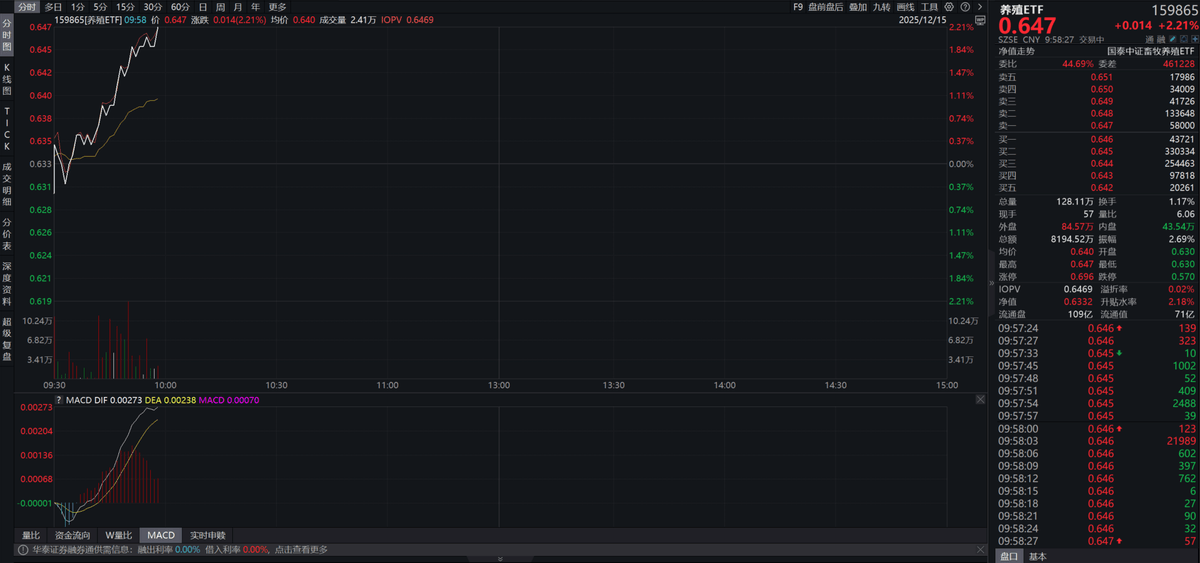
母猪产能去化提速,养殖ETF(159865)领涨超2%,含“猪”量约60%,同类规模第一
Sou Hu Cai Jing· 2025-12-15 02:38
Core Insights - The dual drivers of "policy + fundamentals" are expected to sustain the reduction in sow production, benefiting the pig farming industry and presenting investment opportunities in the livestock ETF (159865) [1][3]. Group 1: Market Dynamics - In December, the inventory of large pigs is expected to partially relieve pressure as the second batch of pigs is marketed, with a reported 16.99% decrease in the total number of second-batch pigs compared to the previous month [3]. - The national breeding sow capacity remains high until mid-2025, with a continuous increase in the number of newborn piglets from January to October, suggesting an oversupply of market pigs until April 2026 [3]. - By the third quarter of 2025, a reduction in breeding sow capacity is anticipated, with a reported decrease in the national sow inventory to 39.9 million heads in October, reflecting a 1.1% month-on-month and 2.1% year-on-year decline [3][4]. Group 2: Industry Outlook - The pig farming industry is expected to enter a prolonged profit cycle with reduced volatility, driven by ongoing capacity reduction and improved efficiency in farming practices [4]. - The current market is characterized by high supply levels, with expectations of weak price performance in the short term due to high inventory levels and seasonal pressures [4]. - Long-term projections indicate that the pig farming sector may stabilize after capacity reductions, supported by enhanced farming efficiency, cost control, and steady consumer demand [4]. Group 3: Investment Opportunities - The livestock ETF (159865), which has a pig content of approximately 60% and a scale of nearly 7 billion, ranks first among similar products, attracting significant attention for potential investment [5]. - The industry is viewed as entering a favorable configuration window, with current valuations at historical lows, making it an attractive investment opportunity [5].

金融“护盾”为关中养殖户托起“稳稳的幸福”
Xin Lang Cai Jing· 2025-12-15 02:35
Core Viewpoint - The "Insurance + Futures" project in Shaanxi Weinan successfully supports local pig farmers by providing financial protection against market price fluctuations, showcasing a mature model of agricultural risk management [1][5]. Group 1: Project Overview - The project, supported by the Dalian Commodity Exchange (DCE) and Huishang Futures in collaboration with Anbang Property Insurance, has delivered 3.27 million yuan in compensation to farmers, reinforcing their financial stability [1][5]. - In the first half of 2025, the pig output in the Lingwei District reached 133,800 heads, marking an 8.5% year-on-year increase, highlighting the significance of pig farming in the local economy [1][5]. Group 2: Challenges Faced by Farmers - Local pig farmers face significant survival challenges due to price volatility caused by rising feed costs, seasonal demand fluctuations, and pandemic impacts, which can erase profits [2][5]. - Many small to medium-sized farmers express concerns about selling their pigs at a loss, indicating the precarious nature of their livelihoods [2][5]. Group 3: Financial Solutions and Impact - The project implemented a tailored "Insurance + Futures" scheme that utilized enhanced Asian put options to cover 15,000 pigs, creating a risk protection barrier valued at 20.84 million yuan [2][6]. - The total premium for the project was 1 million yuan, with a multi-faceted support system involving 350,000 yuan from DCE and 300,000 yuan in subsidies from local governments, effectively reducing the financial burden on farmers [2][5]. Group 4: Compensation and Confidence Restoration - When market prices fell below the agreed protection range, the project initiated a compensation process, resulting in a payout rate of 327%, which not only compensated for losses but also restored farmers' confidence to expand their operations [6][8]. - The financial tools introduced through this project have transformed risk management for farmers, allowing them to secure their earnings and encouraging agricultural growth [8]. Group 5: Broader Implications for Rural Development - The project represents a sustainable agricultural risk management system, integrating professional financial derivatives into farming practices, thus enhancing the resilience of farmers accustomed to traditional methods [8]. - By connecting larger enterprises with smaller farms, the project promotes employment and financial inclusion, ensuring that financial services reach more ordinary farmers [8].

迎接产业变革新时代——农林牧渔行业2026年度投资策略
2025-12-15 01:55
Summary of Industry Research Conference Call Industry Focus - The conference call primarily discusses the **Agriculture, Forestry, Animal Husbandry, and Fishery** industry, with a specific focus on three sub-sectors: **pig farming**, **feed**, and **pet food** [1][2]. Key Insights and Arguments Pig Farming - The pig farming industry is experiencing significant challenges due to **policy adjustments** aimed at capacity reduction, leading to accelerated de-capacity [1][2]. - As of October, the average national price of pigs dropped to its lowest level since 2021, falling below **10 yuan per kilogram** [1][4]. - The government has mandated a reduction in the number of breeding sows and the weight of pigs at slaughter, which is expected to continue exerting supply pressure until at least the first half of 2026, with a potential price turning point anticipated in the third quarter [2][4]. - Current losses in the industry are severe, with average losses reported at **122 yuan** per pig and over **200 yuan** for purchased piglets [4]. - Investment opportunities are highlighted for low-cost, high cash flow companies such as **Muyuan Foods** and **Wens Foodstuff Group** [1][5]. Feed Industry - The feed industry is facing intensified domestic competition and overcapacity, prompting companies to seek growth through **international expansion** [1][6]. - In the first three quarters of 2025, total feed production reached approximately **247 million tons**, marking a **7% year-on-year increase** [3][6]. - Companies like **Haida Group** are expanding into overseas markets, with expectations of reaching **3.3 million tons** in sales by 2025, a **40% increase** from the previous year, and potentially exceeding **4 million tons** in the future [1][6]. Pet Food Sector - The pet food sector has shown resilience despite challenges from trade wars, with external sales pressures easing as production shifts to Southeast Asia [1][3][8]. - The sector is experiencing a shift in product innovation, moving from cost-effectiveness to high-quality meat and category innovation, aligning with evolving consumer demands [2][10]. - The concentration of leading domestic brands and the trend towards product upgrades are key focal points for future growth [9][11]. Additional Important Insights - The overall market for Chinese feed accounts for **23%** of the global total, indicating significant potential for growth in international markets [1][6]. - The pet food industry is expected to continue its stable growth trajectory, with a focus on supply chain adjustments to mitigate external shocks [8][11]. - Investment strategies should prioritize companies with strong brand matrices and competitive advantages, particularly in the pig farming and pet food sectors [12]. This comprehensive overview captures the essential developments and strategic insights from the conference call, providing a clear picture of the current state and future outlook of the agriculture-related industries.
消费行业2026年最看好的细分子板块策略
2025-12-15 01:55
Summary of Key Points from Conference Call Records Industry Overview 1. Innovative Pharmaceuticals - Investment strategy should focus on companies in the growth certainty phase, particularly those with phase III clinical data, market applications submitted, or stable market positions. [2] - Key companies to watch include BeiGene, Innovent Biologics, and WuXi AppTec, with a focus on those transitioning to commercialization. [2] - The innovative drug sector is expected to continue thriving in 2026, driven by a strong pipeline and demand for high-quality assets. [12] 2. Tea Beverage Industry - The tea beverage sector showed strong performance in Q4 2025, with same-store sales growth maintaining double digits. [4] - The industry is expected to continue its positive trend into 2026, with head brands enhancing supply chain capabilities and new product success rates improving. [4][5] - Coffee products are anticipated to penetrate further into the market, contributing to overall growth. [4] 3. Hotel Industry - The hotel sector is recovering from pandemic-induced volatility, with expectations for stable growth in 2026 as supply growth slows and demand rises. [7] - Key players include Huazhu, Jinjiang, and ShouLai, with predictions for RevPAR to remain stable or slightly increase. [7][8] - The industry is transitioning to a more stable growth phase, with a focus on business and tourism demand. [7] 4. Baijiu (Chinese Liquor) Sector - The baijiu sector faces challenges with declining prices and weak demand, particularly for high-end brands like Kweichow Moutai, which is expected to see a slowdown in performance in early 2026. [9][10] - Recommendations include focusing on resilient stocks such as Luzhou Laojiao and Gujing Gongjiu, which may benefit from a potential rebound in demand. [11] 5. Swine Industry - The swine sector is undergoing capacity reduction, leading to a profit recovery cycle. However, prices are expected to remain low in early 2026, with predictions of prices nearing or dropping below 10 yuan. [30][31] - Companies like Muyuan and Wens Foodstuffs are highlighted for their cost leadership in a challenging market. [36] Additional Insights 6. Cross-Border E-commerce - The cross-border e-commerce sector is seeing significant growth, particularly in categories like cleaning appliances and traditional brands. [13][14] - Companies such as Ugreen and Roborock are noted for their strong performance, with Ugreen experiencing a doubling in growth in October and November. [15] 7. Market Trends and Predictions - The overall market sentiment is cautiously optimistic, with expectations for various sectors to recover and grow in 2026, driven by consumer demand and strategic investments. [24][25] - The impact of tax cuts and interest rate reductions is expected to bolster consumer spending, particularly in home goods. [23] 8. Investment Recommendations - Investors are advised to focus on companies with strong growth potential and cost leadership, particularly in the swine and innovative pharmaceutical sectors. [36] - Specific recommendations include companies with resilient business models and those positioned for recovery in the upcoming year. [26][29] This summary encapsulates the key insights and recommendations from the conference call records, providing a comprehensive overview of the current state and future outlook of various industries.
如何看待猪价与产能分歧
2025-12-15 01:55
Summary of the Conference Call on the Swine Industry Industry Overview - The swine industry is experiencing significant losses in 2025, with self-breeding operations facing a theoretical loss of 200 RMB per head and fattening pig losses ranging from 270 to 300 RMB per head. The average price of pigs has dropped from 15-16 RMB per kilogram at the beginning of the year to 11-11.5 RMB per kilogram, hitting a low of around 10 RMB in early October [1][3][4]. Key Points and Arguments Price and Production Capacity - Official data indicates a decline in the number of breeding sows since July, but third-party monitoring shows that production capacity remained stable from July to September, suggesting limited effectiveness in reducing capacity. It is expected that the number of pigs slaughtered will be affected in the second half of 2026 [1][4]. - The average weight of pigs traded nationwide is approximately 124.59 kg, which is lower than the same period in previous years. The slaughtering rate of enterprises is around 41%, down from over 50% last year, indicating weak consumer demand [7][8]. Cost Structure and Responses - The domestic breeding cost is concentrated between 12-12.5 RMB per kilogram, with some leading companies managing to keep costs below 12 RMB. The current losses have led some medium-sized breeders to extend breeding cycles and use lower-quality feed, while smallholders are adjusting biosecurity measures without significant capacity reduction [5][16]. - Most smallholders are expected to withstand losses until the Spring Festival, aided by credit sales and discounts from feed service companies, which alleviate financial pressure [2][17]. Market Expectations - The overall market situation in 2025 is expected to be weaker than in 2023, with predictions of a gradual reduction in pig slaughtering volumes starting in July and August 2026. However, a supply-demand imbalance is necessary for price increases, with anticipated average prices for 2026 ranging from 12 to 12.5 RMB per kilogram [8][19]. - The price forecast for early 2025 remains low, around 11 RMB, with expectations of a significant drop post-Spring Festival [9][10][11]. Inventory and Weight Changes - The decline in average weight by 2 kg is considered normal as producers aim to minimize losses when prices fall below cost. However, the reduction primarily affects larger pigs awaiting slaughter, and it will take time to lower the overall inventory across all age groups [13][14]. Capacity Reduction and Future Trends - Group companies and medium-sized farms are slightly reducing capacity, but the overall decline is limited. Most smallholders are not engaging in significant capacity reduction due to expectations of better market conditions around traditional consumption peaks [15][18]. - The swine industry still has room for cost reduction, particularly in production efficiency and feed alternatives. The use of high-quality breeding stock and improved feed conversion ratios could significantly lower costs [21]. Regional Insights - The free-range breeding model in Shandong shows advantages such as shorter cycles and lower capital costs, but it also faces risks related to procurement and management capabilities. The optimal scale for operations is between 1,000 to 5,000 heads [22]. Cost Variance and Market Dynamics - Cost variance is expected to narrow as production methods converge, particularly in free-range systems. The differences between large group farms and smallholders are also diminishing as operational scales become more uniform across regions [23]. Additional Important Insights - The overall sentiment in the industry is cautious, with most companies opting to maintain current scales rather than expand, reflecting a wait-and-see approach in light of uncertain market conditions [19].
关注冬季动物疫病变化,看好牧业大周期
SINOLINK SECURITIES· 2025-12-14 12:39
Investment Rating - The report indicates a neutral investment rating for the agricultural sector, with expectations of limited price fluctuations in the near term [2][13]. Core Insights - The agricultural sector is currently experiencing a mixed performance, with the agricultural index underperforming compared to the Shanghai Composite Index [2][13]. - The pig farming industry is facing a downward price trend, with the average pig price at 11.48 yuan/kg, indicating a continued loss across the sector [21][22]. - Poultry farming shows signs of stabilization, with white feather chicken prices at 7.33 yuan/kg, reflecting a slight increase, while yellow feather chicken prices are improving due to better demand [28][31]. - The beef market is expected to see price increases as it enters the consumption peak season, with live cattle prices at 26.68 yuan/kg [33]. - The planting sector is experiencing tight supply conditions, with corn prices rising to 2238.57 yuan/ton, indicating potential for price increases if crop yields decline [37][38]. - Feed prices are stabilizing, with pig feed prices at 3.32 yuan/kg, while aquatic product prices are showing upward trends [51][55]. Summary by Sections 1. Swine Farming - The average weight of pigs at market is 129.63 kg, with prices expected to continue declining due to excess supply and ongoing losses in the industry [22][21]. - The report suggests focusing on low-cost, high-quality enterprises such as Muyuan Foods and Wens Foodstuffs [22][24]. 2. Poultry Farming - The white feather chicken market is under pressure, but yellow feather chicken prices are improving due to better demand and reduced supply [28][31]. - The overall profitability in poultry farming is expected to improve if consumer demand recovers [28][31]. 3. Livestock - The beef market is anticipated to rise as it enters the peak consumption season, with live cattle prices showing a year-on-year increase [33]. - The dairy sector is experiencing a reduction in stock, with raw milk prices expected to stabilize in the coming year [33]. 4. Planting Chain - Corn prices are on the rise, with a current price of 2238.57 yuan/ton, indicating a tightening supply situation [37][38]. - The planting sector is expected to improve if there are significant reductions in crop yields due to adverse weather conditions [37][38]. 5. Feed & Aquatic Products - Feed prices are stabilizing, with pig feed prices at 3.32 yuan/kg, while aquatic product prices are showing positive trends [51][55]. - The report highlights the importance of monitoring price movements in the feed and aquatic sectors for investment opportunities [51][55].
美国农业部(USDA)月度供需报告数据分析专题:美国牛肉 2026 年进口预估大增,全球玉米期末库存环比调减-20251213
Guoxin Securities· 2025-12-13 07:07
Investment Rating - The report maintains an "Outperform" rating for the agricultural sector, particularly focusing on livestock and feed companies [7]. Core Insights - The USDA's December supply and demand report indicates a tightening supply-demand balance for corn, with prices expected to maintain a moderate upward trend [15][18]. - For soybeans, the report suggests a recovery in U.S. imports, which is likely to support price recovery [33][35]. - The beef market is projected to see a price increase in 2026, driven by reduced production and strong domestic demand [3][6]. - The dairy sector is expected to experience a price reversal due to a combination of reduced supply and increased demand for both meat and milk [4][6]. - The pork market is anticipated to face a decline in prices in the latter half of 2026, despite a positive outlook for the first half [6][7]. Summary by Sections Corn - The USDA report predicts a reduction in global corn production by 3.27 million tons, leading to a decrease in global ending stocks and a tightening supply-demand ratio [15][16]. - Domestic corn prices are currently at a historical low, with expectations for a gradual recovery supported by low trader inventories [18][19]. Soybeans - The global soybean ending stocks are expected to increase slightly, with a projected rise in U.S. imports and a positive outlook for domestic soybean meal prices [33][35]. - The report highlights the importance of monitoring U.S.-China trade relations and South American weather conditions for future price movements [38]. Wheat - The global wheat supply remains ample, with an increase in production forecasts from major exporting countries, leading to a slight rise in the global ending stocks ratio [2][45]. - Domestic wheat prices are expected to stabilize, influenced by the overall supply situation and potential government storage interventions [48][52]. Beef - The USDA forecasts a decrease in U.S. beef production, with prices expected to rise due to strong domestic demand and reduced imports [3][6]. - The report anticipates a turning point in the domestic beef cycle by 2025, with prices likely to trend upwards [3][6]. Dairy - The report indicates a potential reversal in the dairy market, driven by reduced cow inventories and a tightening supply-demand balance [4][6]. - Domestic raw milk prices are expected to rise as a result of these factors [4][6]. Pork - The U.S. pork market is projected to see a decline in prices in the latter half of 2026, despite a positive outlook for the first half of the year [6][7]. - Domestic breeding sow inventories are stabilizing, which may help support industry profitability [6][7]. Poultry - The U.S. poultry market is expected to recover, with increased production and consumption anticipated as avian influenza impacts diminish [6][7]. - Domestic chicken supply is projected to stabilize, with a focus on internal demand recovery [6][7].



深圳市金新农科技股份有限公司第六届董事会第十八次临时会议决议公告
Shang Hai Zheng Quan Bao· 2025-12-12 19:06
Core Viewpoint - The company, Shenzhen Kingsino Technology Co., Ltd., has approved several proposals during its 18th temporary board meeting, including plans for futures and derivatives hedging, investment activities, and expected guarantees for 2026, which will be submitted for shareholder approval [1][2][3][4][5][6]. Group 1: Futures and Derivatives Hedging - The company plans to engage in futures and derivatives hedging activities in 2026, with a maximum trading margin and rights amounting to 100 million yuan, valid from January 1, 2026, to December 31, 2026 [2][25]. - The hedging aims to manage price volatility risks associated with raw materials and products, particularly in the pig farming and feed production sectors [25][26]. Group 2: Futures and Derivatives Investment - The company intends to conduct futures and derivatives investment activities in 2026, with a maximum trading margin and rights amounting to 60 million yuan, also valid for the same period [2][39]. - This investment is aimed at effectively utilizing idle funds and obtaining investment returns while controlling risks [39][40]. Group 3: Expected Guarantees - The company plans to provide guarantees for cooperative farmers to secure bank financing, with a total guarantee amount not exceeding 100 million yuan [4][12]. - Additionally, the company will provide guarantees for its wholly-owned or controlled subsidiaries for various financing activities, with a total guarantee amount not exceeding 2.9 billion yuan [4][12][20]. Group 4: Comprehensive Credit Financing - The company aims to apply for a comprehensive credit financing limit of up to 5 billion yuan from banks and leasing institutions for 2026, with the actual financing amount determined by operational needs [5][64]. - This financing is expected to support the company's operational development without harming the interests of shareholders [68]. Group 5: Related Transactions - The company anticipates engaging in related transactions with its indirect controlling shareholder's subsidiaries, estimating sales of live pigs not exceeding 10 million yuan with one subsidiary and 20 million yuan with another [3][54][55]. - These transactions are considered normal business operations and are expected to contribute positively to the company's business development [59][60].
