金融

Search documents
加仓超22亿港元,科技龙头获净买入第一
Zheng Quan Shi Bao· 2026-01-25 05:36
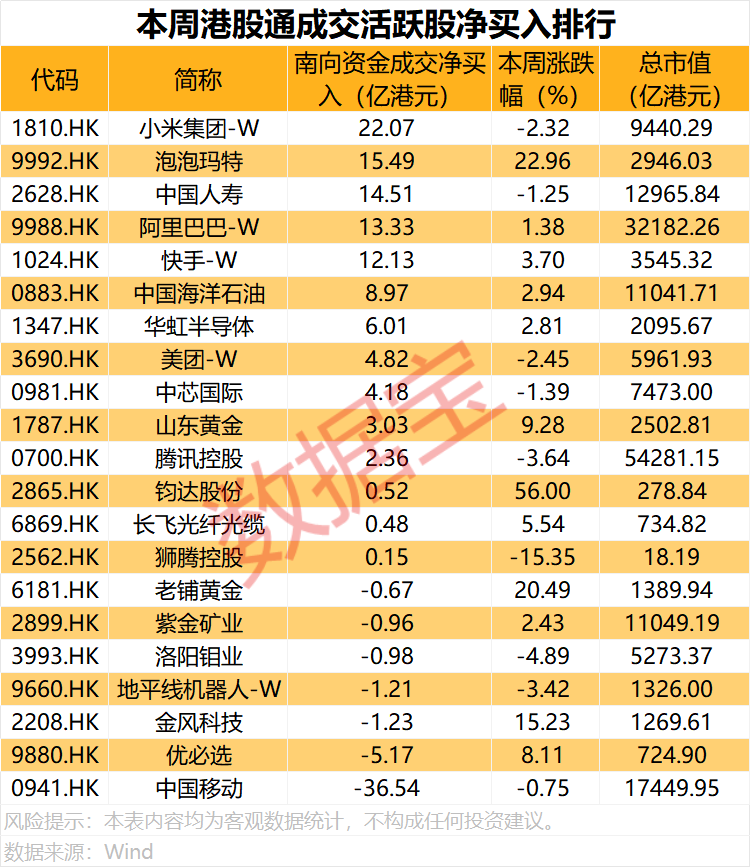
本周南向资金合计成交净流入235.23亿港元。 | | | 本周港股通成交活跃股净买入排行 | | | | --- | --- | --- | --- | --- | | 代码 | 简称 | 南向资金成交净买 本周涨跌 | | 息市值 | | | | 入 (亿港元) | 幅 (%) | (亿港元) | | 1810.HK | 小米集团-W | 22.07 | -2.32 | 9440.29 | | 9992.HK | 泡泡玛特 | 15.49 | 22.96 | 2946.03 | | 2628.HK | 中国人寿 | 14.51 | -1.25 | 12965.84 | | 9988.HK | 阿龍巴巴-W | 13.33 | 1.38 | 32182.26 | | 1024.HK | 快手-W | 12.13 | 3.70 | 3545.32 | | 0883.HK | 中国海洋石油 | 8.97 | 2.94 | 11041.71 | | 1347.HK | 华虹半导体 | 6.01 | 2.81 | 2095.67 | | 3690.HK | 美团-W | 4.82 | -2.45 | 5961.93 ...

市长殷勇作政府工作报告:2025年北京市数字经济增加值增长8.7%
Xin Lang Cai Jing· 2026-01-25 01:47
Core Insights - Beijing aims to accelerate the construction of a global benchmark city for the digital economy, with significant progress in artificial intelligence ecosystem development [1] - The digital economy's added value grew by 8.7%, highlighting the city's focus on modern service industries [1] Digital Economy Development - Major advancements in AI applications, with the number of registered large models in Beijing ranking first in the country [1] - Establishment of the Beijing Data Group and the launch of the Smart Beijing Innovation Center [1] Future Industry Initiatives - Beijing hosted the world's first humanoid robot marathon and the World Humanoid Robot Games, showcasing its leadership in robotics [1] - The city has successfully built a small-scale experimental network for 6G technology [1] - The Zhuque-3 reusable rocket made its inaugural flight, marking a milestone in aerospace innovation [1] - Several leading achievements in brain-computer interface technology were presented [1] Contribution of Modern Service Industries - The software information, technology services, and business services sectors contributed over 50% to economic growth [1] - The efficiency of financial services supporting the real economy continues to improve [1] - The Beijing Stock Exchange has 288 listed companies with a total market capitalization exceeding 860 billion yuan [1]
2025年北京市数字经济增加值增长8.7%
Xin Lang Cai Jing· 2026-01-25 01:47
Core Insights - Beijing aims to accelerate the construction of a global benchmark city for the digital economy, with significant progress in the key ecosystem for artificial intelligence [1] - The digital economy's added value has increased by 8.7% [1] Digital Economy Development - Major application pilot bases in healthcare, manufacturing, and science have been established in Beijing [1] - The number of registered large models remains the highest in the country [1] - The Beijing Data Group has been formed, and the Smart Beijing Innovation Center is now operational [1] Future Industry Initiatives - Beijing hosted the world's first humanoid robot marathon and the World Humanoid Robot Games, attracting global attention [1] - A small-scale experimental network for 6G has been established [1] - The Zhuque-3 reusable rocket successfully completed its first flight [1] - Several leading achievements in brain-computer interface technology were showcased [1] Modern Service Industry Growth - The software information, technology services, and business services sectors contributed over 50% to economic growth [1] - The efficiency of financial services to the real economy continues to improve [1] - The number of listed companies on the Beijing Stock Exchange has reached 288, with a total market capitalization exceeding 860 billion yuan [1]
速读2026年北京市政府工作报告| 2025年北京市数字经济增加值增长8.7%
Bei Jing Shang Bao· 2026-01-25 01:33
Group 1 - Beijing aims to accelerate the construction of a global benchmark city for the digital economy, with significant progress in the key ecosystem of artificial intelligence [1] - The number of large models registered and launched in Beijing ranks first in the country, and the Beijing Data Group has been established [1] - The added value of the digital economy has grown by 8.7% [1] Group 2 - The city is promoting the development of future industries, highlighted by the world's first humanoid robot marathon and the World Humanoid Robot Games [1] - A small-scale experimental network for 6G has been established, and the Zhuque-3 reusable rocket has successfully completed its first flight [1] - Several leading achievements in brain-computer interfaces have been showcased [1] Group 3 - The modern service industry is being vigorously developed, with software information, technology services, and business services contributing over 50% to economic growth [1] - The efficiency of financial services to the real economy continues to improve, with 288 companies listed on the Beijing Stock Exchange and a total market value exceeding 860 billion yuan [1]
非遗和“国潮”拉满体验感
Liao Ning Ri Bao· 2026-01-25 00:54
Core Insights - The "Ninety-Nine Consumption Season" in Liaoning will launch a themed consumption activity called "Five-Nine" on January 26, focusing on intangible cultural heritage, "Guochao" consumption, and livelihood discounts to stimulate winter consumption potential [1] Group 1: Thematic Activities - The event will feature various cultural and consumption experiences, including traditional customs, intangible cultural creations, and specialty dining, with discounts and cultural experience projects to promote the integration of "old customs" and "new consumption" [1] Group 2: Participation and Coverage - Local businesses across various sectors, including retail, dining, tourism, and automotive, will participate by offering discounts, rebates, and subsidies to enhance the impact of the "Ninety-Nine Consumption Season" and boost the winter consumption market [2] - Major attractions and commercial complexes will launch promotional activities, including special ticket offers and cultural performances, to enrich consumer experiences [2] - Financial institutions, such as Postal Savings Bank of Liaoning, will introduce various consumer discounts and services to support over 20,000 merchants, enhancing policy coverage and convenience [2]
“五九”主题消费活动即将开启 非遗和“国潮”拉满体验感
Xin Lang Cai Jing· 2026-01-25 00:45
Core Insights - The "Ninety-Nine Consumption Season" in Liaoning will launch a themed consumption event on January 26, focusing on intangible cultural heritage, "Guochao" consumption, and livelihood discounts [1] - The event aims to create new consumption scenarios and unleash winter consumption potential through multi-scenario and multi-business collaboration [1] Group 1: Event Details - The event will feature various local businesses, including traditional markets and cultural creative industries, offering discounts and cultural experience projects [1] - Key participating locations include Shenyang, Dalian, Anshan, Fushun, Dandong, Jinzhou, and Yinkou, promoting the integration of traditional customs with new consumption [1] Group 2: Participation and Promotions - Businesses across multiple sectors, including retail, dining, tourism, and automotive, will participate by offering discounts and subsidies to stimulate winter consumption [2] - Notable promotions include discounted tickets for local attractions and special offers from commercial complexes, enhancing consumer experience through cultural performances and exhibitions [2] Group 3: Financial Institution Involvement - Financial institutions, such as Postal Savings Bank of Liaoning, are actively participating by providing various consumer discounts and services, benefiting over 20,000 merchants [2]
虚空价值、青年震荡文化、流体工作态…26个商业新词
吴晓波频道· 2026-01-25 00:21
Core Insights - The article discusses 26 trends identified by Peter Fisk that will reshape global business in the "post-AI era," focusing on consumer culture, technology, business models, leadership, economics, marketing, and brand behavior [3][5]. Group 1: Consumer Trends - The shift from transactional behavior to cultural participation is highlighted, with emerging affluent classes in Southeast Asia, Africa, and Latin America becoming key growth drivers by 2026 [7]. - The new middle class is expected to grow by 1.2 billion by 2027, with unique consumption patterns that skip traditional stages experienced by Western consumers, creating opportunities for brands offering high value and digital experiences [8]. - The economic impact of Generation Alpha is projected to reach $5.46 trillion by 2029, influencing family technology consumption decisions [11]. - The "lipstick effect" has evolved into "micro-luxury," where consumers seek small indulgences that provide sensory pleasure and identity statements [12]. - Consumers are increasingly making choices that reflect personal, social, and ethical identities, with a focus on authenticity and transparency in brands [15]. Group 2: Technological Trends - Technology is evolving from tools to an invisible, intelligent environment, with significant growth expected in synthetic biology, projected to exceed $30 billion by 2026 [17]. - Quantum computing is gaining traction, with over $35 billion invested globally, impacting sectors like pharmaceuticals and finance [18]. - Health management is entering a "longevity era," with a focus on precision medicine and anti-aging technologies becoming standard expenditures for the new middle class [19]. - Human enhancement technologies are expected to proliferate, integrating wearable devices and AI into everyday life [20]. Group 3: Business Model Trends - Business models are shifting from products to ecosystems, emphasizing cognitive design and market integration [32]. - The concept of "zero friction experience" is becoming crucial for customer loyalty, with seamless shopping experiences being a key competitive advantage [37]. - The trend of "de-bundling choices" is emerging, where consumers prefer pay-per-use models over traditional bundled offerings [39]. Group 4: Brand Evolution - Brands are evolving into community and cultural participants, with nostalgia and sustainability becoming significant factors in consumer loyalty [40][43]. - The decentralized network concept is revolutionizing trust and engagement, allowing brands to connect directly with consumers without intermediaries [44]. - The focus on lightweight growth emphasizes intangible assets like brand stories and community influence as key drivers of future value creation [46][47]. Group 5: Action Guidelines - Seven urgent action guidelines are proposed, including reshaping value around meaning and health, integrating environmental intelligence, and designing for niche markets [48].

基金研究周报:回暖!混合型基金募集规模创近4年新高(1.19-1.23)
Wind万得· 2026-01-24 22:24
Market Overview - The A-share market exhibited a structurally differentiated pattern last week, with the Shanghai Composite Index closing at 4136.16 points, up 0.84% for the week, while the CSI 300 and SSE 50 fell by 0.62% and 1.54% respectively [1] - The small and mid-cap growth style performed strongly, with the CSI 500 and CSI 1000 rising by 4.34% and 2.89% respectively [1] - The ChiNext Index declined by 0.34%, indicating internal differentiation within the growth sector [1] - The CSI Dividend Index increased by 2.15%, showing some defensive characteristics [1] Industry Performance - Most sectors in the Wind first-level industry index rose, benefiting from policy expectations and cyclical recovery, with materials and real estate leading with increases of 6.36% and 5.09% respectively [12] - The financial sector lagged with a decline of 2.05% due to pressure from the interest rate environment [12] - Overall, the market remained volatile, with funds rotating towards cyclical sectors [12] Fund Issuance - A total of 42 new funds were established last week, including 16 equity funds and 15 mixed funds, raising 22.8 billion units, marking a near four-year high [16] - The total issuance volume reached 44.454 billion units [16] Fund Performance - The Wind All-Fund Index rose by 0.90% last week, with the ordinary equity fund index up 1.45% and the equity-mixed fund index up 1.65% [7] - The bond fund index saw a slight increase of 0.27%, indicating that equity funds significantly outperformed bond funds [7] Global Market Overview - The three major U.S. stock indices experienced slight declines, with the Dow Jones down 0.53%, the S&P 500 down 0.35%, and the Nasdaq down 0.06% [3] - European indices saw deeper declines, with the German DAX down 1.57%, the French CAC 40 down 1.40%, and the UK FTSE 100 down 0.90%, reflecting increased risk aversion in Europe [3] - In Asia, the South Korean Composite Index surged by 3.08%, while the Hang Seng Index and Nikkei 225 saw slight declines [3] Commodity Market - The commodity market showed strong performance, with natural gas soaring by 64.35%, gold rising by 8.44%, and silver increasing by 16.63% [3] - The CRB Commodity Index rose by 3.37%, indicating a surge in demand for energy and safe-haven assets [3] Bond Market - The bond market sentiment was positive, with the CSI Convertible Bond Index rising by 2.92% [14] - The 10-year and 30-year government bond futures saw slight increases of 0.12% and 1.02% respectively, supported by the central bank's increased MLF and reverse repo net injections [14]

宏观经济周报:经济结构优化接力赛-20260124
Guoxin Securities· 2026-01-24 14:46
Economic Performance - In 2025, China's GDP grew by 5.0% year-on-year, achieving the target of around 5%[1] - The GDP growth rate in Q4 2025 fell to 4.5%, marking a new low in recent years[1] - Monthly GDP growth rates for October to December were approximately 4.5%, 4.3%, and 4.7% respectively, indicating signs of recovery in December[1] Structural Changes - A notable shift occurred in the economic structure: the secondary industry (industrial and construction sectors) saw a decline, while the tertiary industry (services) experienced growth[1] - The acceleration of the service sector is expected to create more jobs and increase income, providing sustainable support for domestic demand[1] Policy Outlook for 2026 - The newly announced fiscal and financial policies focus on stimulating private investment, with four out of six specific policies aimed at supporting private investment[2] - The emphasis on private investment over government-led infrastructure projects signals a shift towards "investing in people" rather than "investing in things"[2] Risks and Challenges - The report highlights potential risks from overseas market volatility, which could introduce uncertainties into the economic outlook[2] - Domestic consumption remains weak, with significant declines in key indicators such as movie ticket sales (down 26.9%) and automobile sales (down 32.0%) compared to the previous year[21] Trade and External Factors - Port cargo throughput increased by 6.23% year-on-year, influenced by the timing of the Spring Festival[24] - Geopolitical risks are rising, potentially affecting global trade dynamics and pricing systems[25]
金本位的衰落与国际体系的裂痕:为什么大萧条之后是世界大战
Xin Lang Cai Jing· 2026-01-24 12:26
Core Argument - Keynes' book "The Economic Consequences of the Peace" critiques the Treaty of Versailles, arguing that the reparations imposed on Germany are excessive and will lead to economic collapse, ultimately threatening the stability of Europe [4][10]. Group 1: Keynes' Critique of the Treaty - Keynes expresses strong dissatisfaction with the reparations demanded from Germany, estimating that Germany could only afford £20 billion, while the treaty demands £80 billion, which is unsustainable [10]. - He argues that the treaty's punitive measures against Germany will not only devastate the German economy but also have dire consequences for the entire European economy, leading to inefficiency, high unemployment, and social unrest [5][11]. - The book emphasizes the need for a more equitable approach to reparations, suggesting that the treaty should reflect a more generous political attitude rather than punitive measures [4][18]. Group 2: Economic Context Pre- and Post-War - Before World War I, Europe experienced significant economic growth, with Germany playing a central role in the continent's economic stability and prosperity [7][8]. - The war disrupted this balance, leading to a decline in production efficiency and a breakdown of trade networks, which Keynes argues will have long-lasting negative effects on European economies [9][10]. - Keynes highlights the importance of international economic connections and a stable monetary system for trade and investment, which were severely disrupted by the war [6][15]. Group 3: Recommendations for Recovery - Keynes proposes four measures to mitigate the negative impacts of the treaty: revising the treaty, addressing inter-Allied debts, providing international loans, and improving relations with Russia [18][19]. - He suggests that the United States should provide loans to European countries, including Germany, to help stabilize their economies, which foreshadows the later Marshall Plan [19]. - The book concludes with a call for a more cooperative international economic framework to prevent future conflicts and promote stability [20].