
调味品

Search documents
交银国际:首予海天味业“买入”评级目标价39港元
Xin Lang Cai Jing· 2025-11-20 03:05
Core Viewpoint - The report from CMB International initiates a "Buy" rating for Haitian Flavor Industry (03288) with a target price of HKD 39, driven by the recovery in the catering channel, product innovation, and overseas expansion, projecting approximately 8% compound annual growth in revenue from 2024 to 2027 [1] Group 1: Company Overview - Haitian Flavor Industry is expected to have over 6,700 distributors by the end of 2024, ensuring comprehensive coverage of major regions in the country [1] - The company's strong distribution network guarantees stable sales nationwide [1] Group 2: Product and Market Trends - The ongoing trend towards health-conscious products is driving an upgrade in the product structure [1]

糟粕醋,从渔家酸汤到非遗名片
Ren Min Ri Bao· 2025-11-20 02:20
Core Insights - The article highlights the rising popularity and cultural significance of Zhaompo vinegar, a traditional condiment from Hainan, which is gaining recognition both locally and internationally [2][3][4] Industry Development - The Zhaompo vinegar industry in Hainan is evolving from traditional craftsmanship to a modern industrial model, supported by policy initiatives and market demand [2][3] - A modern production facility in Ding'an County exemplifies the integration of traditional fermentation techniques with modern biotechnology, enhancing product quality and shelf life [3] - The industry has seen significant growth, with an estimated market value of approximately 100 million yuan in 2024 and over 270 related businesses established in the province, more than half of which were founded in the last five years [4] Cultural and Market Expansion - Zhaompo vinegar has been recognized as an intangible cultural heritage, with efforts to promote its production techniques at municipal, provincial, and national levels [3][4] - The product is being marketed internationally, with exports to countries such as the United States, Canada, Australia, and New Zealand, facilitated by local government support [3] - Innovative culinary applications of Zhaompo vinegar are emerging, with restaurants offering themed dining experiences and fusion dishes to attract younger consumers [4] Tourism Integration - There are ongoing initiatives to integrate Zhaompo vinegar with tourism, including the development of cultural experience centers and industry parks to educate visitors about its unique flavors and cultural significance [4]


交银国际:首予海天味业“买入”评级 目标价39港元
Zhi Tong Cai Jing· 2025-11-20 02:15
Core Viewpoint - The report from CMB International initiates a "Buy" rating for Haitian Flavor Industry (603288) with a target price of HKD 39, driven by recovery in the restaurant channel, product innovation, and overseas expansion, projecting an approximately 8% compound annual growth rate (CAGR) in revenue from 2024 to 2027 [1] Revenue and Growth Projections - Revenue is expected to achieve about 8% CAGR from 2024 to 2027 [1] - Net profit is anticipated to maintain a growth rate of around 10% [1] Profitability and Efficiency - Improvement in gross margin and operating profit margin is expected due to declining raw material costs and enhanced efficiency [1] Market Position and Distribution - By the end of 2024, the company is projected to have over 6,700 distributors, ensuring comprehensive coverage across major regions in China [1] - Strong distribution capabilities are expected to support stable nationwide sales [1] Product Innovation and Health Trends - The ongoing health trend is driving product structure upgrades, with the company leveraging its leading R&D capabilities to continuously innovate [1] Overseas Expansion Potential - The company primarily serves overseas markets through a trade model, with short-term overseas expansion likely benefiting from the trend of domestic restaurant brands going global [1] - The overseas business is still in its early stages, with expectations of double-digit CAGR in overseas revenue over the next three years, increasing the proportion of overseas revenue [1]
交银国际:首予海天味业(03288)“买入”评级 目标价39港元
智通财经网· 2025-11-20 02:14
Core Viewpoint - The report from CMB International initiates a "Buy" rating for Haitian Flavor Industry (03288) with a target price of HKD 39, driven by the recovery in the catering channel, product innovation, and overseas expansion, projecting an approximate 8% compound annual growth rate (CAGR) in revenue from 2024 to 2027 [1] Revenue and Growth Projections - Revenue is expected to achieve about 8% CAGR from 2024 to 2027 due to multiple drivers including catering channel recovery, product innovation, and overseas expansion [1] - The company is projected to maintain a net profit growth rate of around 10% [1] Profitability and Efficiency - There is potential for improvement in gross margin and operating profit margin, driven by declining raw material costs and efficiency enhancements [1] Market Position and Distribution - As of the end of 2024, the company will have over 6,700 distributors, ensuring comprehensive coverage of major regions in the country, which supports stable national sales [1] Product Innovation and Health Trends - The ongoing health trend is driving product structure upgrades, with the company leveraging its leading R&D capabilities to continuously innovate products, thereby consolidating its competitive advantage [1] Overseas Expansion Strategy - The company primarily serves overseas markets through a trade model, and short-term overseas expansion is expected to benefit from the trend of domestic catering brands going abroad [1] - The overseas business is still in its early stages, with expectations of double-digit CAGR in overseas revenue over the next three years, which will increase the proportion of overseas revenue [1]
交银国际每日晨报-20251120
BOCOM International· 2025-11-20 01:42
Core Insights - The report highlights the strong leadership position of Haitian Flavor Industry in the Chinese condiment market, emphasizing its robust brand barriers and significant market share in soy sauce (13.2%) and oyster sauce (40.2%) [1][2] - The company is expected to benefit from the ongoing health-oriented product upgrades and the integration of online and offline channels, which are reshaping the industry [1][2] - The report initiates a "Buy" rating with a target price of HKD 39.00, indicating a potential upside of 19.8% from the current price of HKD 32.64 [1][2] Industry Overview - The Chinese condiment industry is characterized by steady growth and low concentration, presenting opportunities for consolidation [1] - The industry is undergoing a transformation towards healthier products, which is likely to optimize product structures and expand niche markets [1][2] - The distribution network is extensive, with over 6,700 distributors ensuring stable sales across major regions in China [2] Company Performance and Projections - Haitian Flavor Industry is projected to achieve approximately 8% compound annual growth rate (CAGR) in revenue from 2024 to 2027, driven by restaurant channel recovery, product innovation, and overseas expansion [2] - The company’s overseas revenue is expected to grow at a double-digit CAGR over the next three years, increasing its share of total revenue [2] - Improvements in gross margin and operating profit margin are anticipated due to declining raw material costs and efficiency enhancements, with net profit expected to maintain a growth rate of around 10% [2]
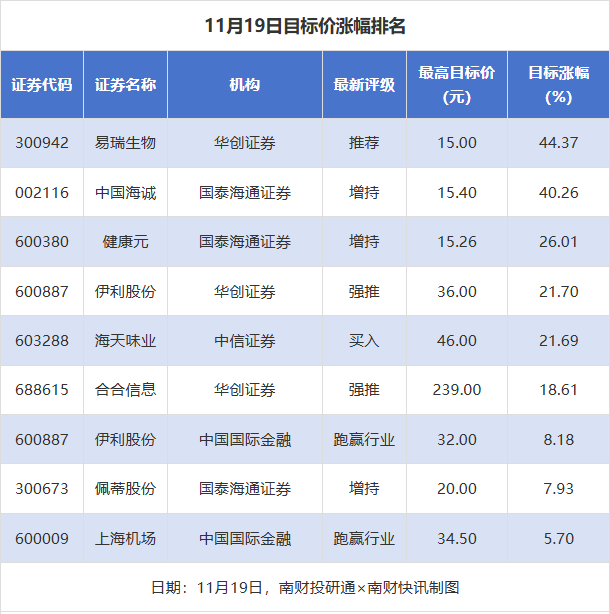
易瑞生物目标价涨幅达44% 37家公司获推荐|券商评级观察
2 1 Shi Ji Jing Ji Bao Dao· 2025-11-20 01:37
Core Insights - On November 19, brokerages provided target prices for listed companies, with notable increases for 易瑞生物 (Yirui Biotech), 中国海诚 (China Haicheng), and 健康元 (Health元), showing target price increases of 44.37%, 40.26%, and 26.01% respectively, across the medical device, professional engineering, and chemical pharmaceutical industries [1][2]. Group 1: Target Price Increases - 易瑞生物 (Yirui Biotech) received a target price of 15.00 yuan with a target increase of 44.37% from 华创证券 (Huachuang Securities) [2]. - 中国海诚 (China Haicheng) has a target price of 15.40 yuan, reflecting a 40.26% increase from 国泰海通证券 (Guotai Junan Securities) [2]. - 健康元 (Health元) was assigned a target price of 15.26 yuan, indicating a 26.01% increase from 国泰海通证券 (Guotai Junan Securities) [2]. Group 2: Brokerage Recommendations - A total of 37 listed companies received brokerage recommendations on November 19, with 伊利股份 (Yili Group) receiving recommendations from 3 brokerages, 南方航空 (Southern Airlines) from 1, and 易瑞生物 (Yirui Biotech) from 1 [3]. - 伊利股份 (Yili Group) closed at 29.58 yuan and was recommended by 3 brokerages in the beverage and dairy industry [3]. Group 3: First Coverage - On November 19, 6 companies received initial coverage from brokerages, including 潮宏基 (Chao Hong Ji) with a "Buy" rating from 首创证券 (Shouchuang Securities) [4]. - 海容冷链 (Hairong Cold Chain) received an "Increase" rating from 兴业证券 (Industrial Securities) [4]. - 风华高科 (Fenghua High-Tech) was rated "Buy" by 中邮证券 (China Post Securities) [4].





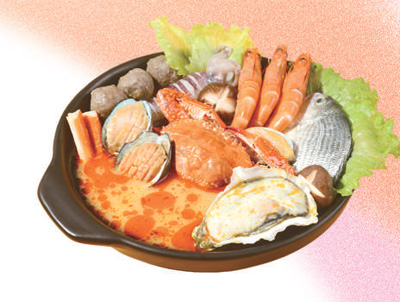
糟粕醋,从渔家酸汤到非遗名片(神州看点·一方水土一方味)
Ren Min Ri Bao· 2025-11-19 22:20
Core Insights - The article highlights the rising popularity and cultural significance of "Zao Po Vinegar," a traditional condiment from Hainan, which is gaining traction both domestically and internationally [2][3][4]. Industry Development - The Zao Po Vinegar industry in Hainan is experiencing rapid growth, with an estimated industry output value of approximately 100 million yuan in 2024 [4]. - Over 270 production and dining entities related to Zao Po Vinegar have been established in Hainan, with more than half founded in the last five years [4]. - The local government is actively promoting the Zao Po Vinegar production techniques as part of the provincial and national intangible cultural heritage initiatives, aiming to enhance the industry's development [3][4]. Technological Integration - Modern food technology is being integrated with traditional fermentation methods to extend the shelf life of Zao Po Vinegar and improve quality control [3]. - Companies are utilizing advanced techniques to ensure precise control over acidity and flavor, facilitating the export of Zao Po Vinegar products to international markets, including the USA, Canada, Australia, and New Zealand [3][4]. Cultural Promotion - There is a push to combine Zao Po Vinegar with tourism, with projects like cultural experience centers and industry parks being developed to educate visitors about its unique flavor and cultural background [5]. - Restaurants in Haikou are innovating by creating themed dining experiences that incorporate Zao Po Vinegar, appealing to younger consumers and enhancing its status as a representative symbol of Hainan cuisine [5].
食品饮料行业2025年三季报综述:白酒报表端承压,关注高质量增长的大众品龙头
CHINA DRAGON SECURITIES· 2025-11-19 13:01
Investment Rating - The report maintains an investment rating of "Recommended" for the food and beverage industry [3][8]. Core Insights - The food and beverage industry experienced a slight revenue increase of 0.17% year-on-year in the first three quarters of 2025, but the net profit attributable to shareholders declined by 4.58% [3][15]. - The third quarter of 2025 saw a significant decline in both revenue and profit, with revenues dropping by 4.75% year-on-year and net profits decreasing by 14.61% [3][15]. - The report highlights that the macroeconomic policies aimed at boosting domestic demand are expected to lead to a recovery in performance and valuation for the food and beverage sector [16]. Summary by Sections 1. Industry Overview - The food and beverage sector's overall revenue for the first three quarters of 2025 was CNY 8309.16 billion, with a net profit of CNY 1711.64 billion [3][15]. - The third quarter alone generated revenue of CNY 2500.62 billion, with a net profit of CNY 434.96 billion [3][15]. 2. Subsector Performance 2.1 Baijiu (Chinese liquor) - The baijiu sector faced significant pressure, with revenues and net profits declining in the third quarter of 2025 [24]. - Major brands like Moutai and Fenjiu performed relatively well despite the overall downturn [24]. - The report notes a 20%-30% decline in sales during traditional festive periods, with regional variations in performance [24]. 2.2 Beer - The beer sector maintained steady demand, achieving a revenue of CNY 620.52 billion in the first three quarters, up 2.02% year-on-year, and a net profit of CNY 94.84 billion, up 11.82% [29]. - The third quarter saw revenues of CNY 203.20 billion, with a net profit increase of 11.30% [29]. 2.3 Snacks - The snack sector showed positive growth, with revenues and net profits increasing in the third quarter [3][29]. 2.4 Soft Drinks - The soft drink sector experienced a strong performance, particularly in the third quarter, with leading companies showing significant growth [3][29]. 2.5 Dairy Products - The dairy sector continued to face demand challenges, but there were signs of marginal improvement as raw milk prices stabilized [4][29]. 2.6 Condiments - The condiment sector is undergoing intense competition, but leading companies are outperforming the overall market [4][29]. 3. Investment Recommendations - The report suggests focusing on resilient companies with strong growth potential, such as Dongpeng Beverage, Yili, and Moutai, among others [8][24].




【IPO前哨】火锅调料卖不动了!天味食品创始人夫妇却“赚”翻了
Sou Hu Cai Jing· 2025-11-19 12:42
Core Viewpoint - Tianwei Food has initiated the process for a dual listing in Hong Kong, aiming to raise funds primarily for marketing and sales network expansion amidst declining sales in hot pot and recipe-based condiments [2][5]. Group 1: Company Overview - Tianwei Food is a leading compound condiment company in China, holding a market share of 9.7% in recipe-based condiments and 4.8% in hot pot condiments as of 2024 [3]. - The company operates under six major brands, including "Haorenjia" and "Dahongpao," and its business encompasses traditional retail, online retail, and catering customization [3]. Group 2: Financial Performance - The company's revenue and net profit for 2024 are projected to reach 3.447 billion RMB and 625 million RMB, respectively, but there has been a decline in both metrics in the first half of 2025 [5]. - In the first three quarters of this year, overall revenue growth has been weak, with net profit decreasing by 9% year-on-year [5]. - Sales volume for the three main condiment products has declined in the first half of this year, indicating weak market demand [5][9]. Group 3: Market Environment - The external environment has negatively impacted Tianwei Food's performance, with a significant drop in sales across its product lines [5][7]. - The domestic restaurant consumption recovery has been sluggish, with retail sales growth slowing down since June, and restaurant income growth lagging behind overall retail sales [7][9]. - The competitive landscape in the compound condiment sector is intense, with over 1,000 participants, exacerbating the challenges faced by Tianwei Food [9]. Group 4: Shareholder Actions - The company's ownership structure is characterized by a high concentration of shares held by the founding couple, who control approximately 74.64% of the voting rights [10][11]. - The founders have benefited from a generous dividend policy, with cash dividends increasing from 37.7 million RMB in 2022 to 585 million RMB in the first half of 2025 [12]. - The founders have frequently sold shares, cashing out nearly 1 billion shares since June 2022, totaling approximately 1.62 billion RMB [13]. Group 5: Future Outlook - Tianwei Food's attempt to raise funds through a Hong Kong listing comes at a challenging time, with declining sales and increased competition [14]. - The ability of Tianwei Food to reverse its performance decline and succeed in the Hong Kong market remains to be seen [14].

颐海国际20251118
2025-11-19 01:47
Summary of the Conference Call for Yihai International Company Overview - **Company**: Yihai International - **Industry**: Food and Seasoning Industry Key Points and Arguments Revenue and Growth Expectations - The company anticipates a slowdown in third-party revenue growth for the year, with overall revenue expected to remain flat or slightly increase due to the performance of related parties like Haidilao [2][22] - Profit growth is expected to outpace revenue growth, benefiting from a return to normal tax rates [2][22] Product Performance - Butter remains the largest single product, with a 20% sales increase in the first half of the year due to low-priced product launches, although this affected average price and gross margin [2][7] - The company plans to adjust its strategy in the second half, promoting low-priced butter only in price-sensitive areas, expecting gross margin to remain flat or slightly increase for the year [2][7] - The overseas third-party business grew nearly 50% in the first half, reaching 190 million yuan, but is expected to slow to a growth rate of 20%-30% for the year [2][24] Competitive Landscape - The convenience food business faces intense competition, with only slight growth in third-party channels in the first half and a decline expected in the second half [2][11][12] - The company aims to maintain stable development in this segment, making it difficult to expand further [2][13] B2B and B2C Market Insights - In the B2B market, large clients saw a doubling in growth in the first half, but growth may slow in the second half due to the impact of the pre-made dish incident [2][5][21] - A dedicated team for small B clients has been established, but contributions are expected to be low this year, with significant growth anticipated next year [2][21] New Product Launches - New regional flavor products were launched in 2025, receiving good local acceptance but limited national impact compared to established flavors [2][6] Cost and Margin Management - The company has locked in raw material prices, minimizing cost impacts, and expects gross margins to remain flat or slightly increase due to the "Two Direct" system optimizing channel margins [2][14] - The "Two Direct" system aims to improve profit margins by reducing intermediary costs and is expected to cover 60% of the market by next year [2][16][17] Online Business and Marketing Strategy - The company has shifted its online strategy to focus on display and interaction rather than as a primary sales channel, leading to reduced advertising expenses [2][19] International Expansion - The company is expanding its overseas business, particularly in Southeast Asia, and plans to explore markets in the Middle East, Central America, and Africa [2][26] - Direct engagement with large KA channels in Southeast Asia has been established, with expectations of maintaining stable growth rates of 20-30% over the next 2-3 years [2][27] Challenges and Risks - The company faces competition from domestic peers in the overseas market and local brands in Southeast Asia, which may impact growth [2][28] - The utilization rate of the Thai factory is currently low, with plans to improve it by the end of the year [2][29] Future Outlook - The company expects revenue growth to be driven by overseas and B2B segments, with a forecast of double-digit growth in third-party business next year [2][25] Additional Important Information - The gross margin for related party business remains around 14%, with stable pricing mechanisms in place [2][23] - The company is cautious about potential impacts from shipping costs and tariffs as it expands its international operations [2][31][32]