
贵金属

Search documents
国际银价距历史高点累计跌幅一度近50%
新华网财经· 2026-02-06 06:07
Group 1 - The core viewpoint of the article highlights the significant decline in international gold and silver prices, with silver prices dropping nearly 50% from their historical highs reached on January 29 [2][3] - On March 5, silver futures prices fell over 9%, while gold futures dropped more than 1%, with silver hitting a low of $63.9 per ounce and gold falling below $4670 per ounce [2] - The volatility in gold and silver prices is attributed to the neutral monetary policy stance of global central banks, which has made it difficult for the gold market to find support [3] Group 2 - The current silver price trends are primarily driven by capital flows rather than physical fundamentals, leading to increased volatility compared to gold [4] - A report from the Canadian Imperial Bank of Commerce predicts that the average gold price will reach $6000 per ounce and silver will average around $105 per ounce this year, supported by geopolitical uncertainties and a weakening dollar [4]

2026年白银是否还会涨价
Sou Hu Cai Jing· 2026-02-06 05:57
Core Conclusion Summary - The silver price in 2026 is expected to exhibit a "strong first half, weak second half" trend, driven by explosive demand from the photovoltaic industry and an expanding global supply-demand gap. The macroeconomic environment will be significantly influenced by the Federal Reserve's monetary policy and global economic growth rates. Goldman Sachs predicts silver prices may reach $120 per ounce in Q2, while UBS expects prices to hit $100 per ounce in the first half and decline to $75 per ounce by year-end. Short-term trading structure adjustment risks should be monitored, but long-term industrial demand presents structural opportunities [1]. Understanding Phase: Key Drivers and Basic Information - The core drivers of the silver price increase in 2026 include explosive industrial demand, an expanding supply-demand gap, and macroeconomic support. The photovoltaic industry is the main growth driver, with global installed photovoltaic capacity expected to grow over 25% year-on-year, leading to an 18% increase in silver demand in this sector, which accounts for 32% of total industrial demand. On the supply side, silver production growth is limited, with only a 1.9% increase expected in 2026, while London deliverable stocks have fallen to 233 tons, sufficient for only 15 days of industrial consumption [2]. - The relationship between silver prices and macroeconomic factors is strong. The global economic growth rate is projected to decline to 2.6% in 2026, affecting industrial demand for silver. If the economy underperforms, safe-haven demand may temporarily support silver prices. Monetary policy from the Federal Reserve and other central banks will also significantly impact silver prices, with potential dollar index fluctuations influencing market dynamics [3]. Analysis Phase: Supply-Demand Dynamics and Institutional Predictions - The supply-demand gap for silver is expected to continue widening. Supply growth is rigid, with a projected 0.6% decline in silver production in 2025 and a 1.9% increase in 2026. Industrial demand is anticipated to exceed 60%, primarily driven by the photovoltaic sector, with significant increases in silver consumption per unit of energy produced [5]. - Major institutions have differing short-term and long-term views on silver prices. Goldman Sachs expects silver prices to surge to $120 per ounce in Q2 2026 due to industrial demand, while UBS predicts a peak of $100 per ounce in the first half, followed by a decline to $75 per ounce in the second half. Both institutions caution about the volatility of silver compared to gold and the risks associated with capital withdrawal [6]. Decision-Making Phase: Investment Opportunities and Risk Management - Key investment opportunities in 2026 are concentrated in the first half due to the photovoltaic supply replenishment cycle and potential short-term gains from geopolitical tensions and Federal Reserve rate cuts. The silver demand explosion in the photovoltaic supply chain presents opportunities for silver futures and ETFs. Additionally, if global inflation rebounds, silver's anti-inflation properties may enhance its appeal as a hedge [9]. - The main risks include macroeconomic policy risks, demand shortfalls, and short-term trading risks. If U.S. inflation remains sticky, the Federal Reserve may delay rate cuts, leading to a stronger dollar and suppressed silver prices. A decline in photovoltaic installation growth or advancements in silver alternatives could also weaken industrial demand [10]. Practical Phase: Investment Products and Timing - Mainstream investment products for silver include silver futures, ETFs, physical silver, and silver stocks, each catering to different investor needs. Silver futures are suitable for high-risk investors due to their leverage and volatility, while silver ETFs offer a more stable investment for medium-risk investors. Physical silver is ideal for long-term value retention, and silver stocks are linked to silver prices and company performance [12]. - Entry points for investment should focus on the photovoltaic supply replenishment period in early 2026 and the timing around Federal Reserve rate cuts. Exit strategies should be aligned with institutional target prices and risk signals, with gradual profit-taking recommended as prices approach $95-$100 per ounce [14].
首席点评:贵金属再度下挫
Shen Yin Wan Guo Qi Huo· 2026-02-06 05:10
1. Report Industry Investment Rating - The report provides a table indicating the investment rating possibilities for various varieties, including "cautiously bearish" and "cautiously bullish" assessments [6]. 2. Core View of the Report - The report analyzes multiple key financial and commodity markets, including precious metals, crude oil, and stock indices. It suggests that the long - term upward trend of gold remains intact despite recent volatility. The stock market is expected to continue its short - term positive trend in February, but potential risks from overseas markets during the Spring Festival need to be watched. For other markets, it provides detailed analyses of supply - demand relationships, price trends, and influencing factors [2][4][20]. 3. Summary by Relevant Catalogs 3.1 Daily Main News Focus - **International News**: The European Central Bank maintained its benchmark interest rate, pausing rate cuts for the fifth consecutive time since June last year. It did not signal the next policy direction, strengthening the market's expectation of a stable monetary policy. Officials are monitoring the impact of the euro's appreciation on export competitiveness and inflation [7]. - **Domestic News**: Eight departments jointly issued an implementation plan for the high - quality development of the traditional Chinese medicine industry, aiming to achieve certain goals by 2030, such as cultivating high - standard raw material bases and new large - scale Chinese patent medicines [8]. - **Industry News**: In January, China's logistics industry prosperity index was 51.2%, indicating an expansion of logistics business, with key sub - indices in the expansion range [9]. 3.2 Daily Earnings of Overseas Markets - The report presents the daily earnings of various overseas market indices and commodities on February 4th and 5th, including the S&P 500, European STOXX50, and others. Most showed declines, except for the US dollar index and some commodities like CBOT soybeans [10]. 3.3 Morning Comments on Major Varieties - **Financial**: - **Stock Indices**: US stock indices declined. The A - share market also fell, with the beauty and care sector leading the gain and the non - ferrous metal sector leading the loss. The stock market's positive trend since 2026 is due to multiple factors. It is expected to continue its short - term positive trend in February, but potential risks from overseas markets during the Spring Festival need attention [4][11]. - **Treasury Bonds**: Treasury bonds rose slightly, with the yield of the 10 - year Treasury bond active bond falling. The central bank's open - market operations and the expected "rate - cut and balance - sheet reduction" policy in the US, along with domestic economic data, have influenced the Treasury bond market [12]. - **Energy and Chemicals**: - **Crude Oil**: SC crude oil fell 0.73% at night. The US and Iran plan to hold nuclear - issue talks, but reaching an agreement is considered difficult. The strengthening US dollar and volatile precious metal prices have negatively affected the commodity market [3][14]. - **Methanol**: Methanol fell 1.46%. The operating rate of coal - to - olefin plants increased, as did the overall methanol plant operating rate. Coastal methanol inventories decreased slightly but were still at a relatively high level [15]. - **Natural Rubber**: Natural rubber futures declined. With domestic and some overseas production areas in different production states, and the inventory in Qingdao increasing, the price is expected to fluctuate and adjust [16]. - **Polyolefins**: Polyolefin futures mainly declined, with the market focusing on supply improvement expectations and macro - factors. The falling oil price also contributed to the cooling of the polyolefin market [17]. - **Glass and Soda Ash**: Glass and soda ash futures mainly declined. Glass production enterprise inventories increased slightly, and soda ash inventories also rose. The supply - demand situation is gradually adjusting, and the future market depends on the real - estate and photovoltaic industries [18][19]. - **Metals**: - **Precious Metals**: Precious metals fluctuated at night. Recent volatility was mainly due to the nomination of the Fed chair and capital stampede. In the long run, gold is expected to resume its upward trend, while investors are advised to wait and see for silver [2][20]. - **Copper**: Copper prices rose 0.15% at night. The concentrate supply is tight, and downstream demand is mixed. Copper prices may enter an adjustment phase [21]. - **Zinc**: Zinc prices rose 0.84% at night. The zinc concentrate processing fee decreased, and downstream demand is also mixed. Zinc prices may follow the overall trend of non - ferrous metals [22]. - **Aluminum**: Shanghai aluminum fell 0.23% at night. Short - term spot - level upward drivers are limited, but long - term factors such as low inventory and stable demand provide support [23]. - **Lithium Carbonate**: The lithium carbonate main contract touched the daily limit down and then slightly recovered. The market has high attention, and downstream buyers are cautious. Supply and demand factors are complex, and a cautious short - selling view is maintained [24][25]. - **Black Metals**: - **Coking Coal and Coke**: Coking coal and coke main contracts fluctuated at night. Steel production and demand are in a seasonal off - peak, but import disruptions and pre - holiday restocking provide support [26]. - **Steel**: Steel prices are expected to fluctuate before the Spring Festival. The macro - environment is improving, and raw - material costs provide support. The steel market is in a situation of weak supply and demand [27]. - **Iron Ore**: Iron ore prices are expected to fluctuate. Shipping volumes and port inventories have changed, and steel mills will continue to purchase on - demand [28]. - **Agricultural Products**: - **Protein Meals**: Bean and rapeseed meal prices fluctuated and rose at night. Brazilian soybean harvest is progressing, and the US - China soybean purchase plan affects the market. Domestic high inventories and sufficient supply expectations pressure prices [29]. - **Oils and Fats**: Bean and palm oils were weak, while rapeseed oil rose slightly. Malaysian palm oil exports are strong and production is falling, but market supply expectations affect prices [30][31]. - **Sugar**: Zhengzhou sugar futures fluctuated and were slightly stronger. With a seasonal supply increase and import pressure, prices are expected to remain low in the short term [32]. - **Cotton**: Zhengzhou cotton futures maintained a volatile trend. With approaching Spring Festival, the market has a certain demand support, but import factors may limit price increases [33]. - **Hogs**: The hog market continued to be weak and volatile, with regional differences. The market is in a "price - decline and reluctance - to - sell" game, and pre - holiday prices are expected to adjust [34]. - **Shipping Index**: - **Container Shipping to Europe**: The EC index rose 3.86%. Pre - holiday spot freight rates are expected to decline. The market has a large discount, and future price trends depend on factors such as the pre - April 1st export rush and shipping company price increases [35].
一边抢黄金疯涨,一边炒币爆仓!2026年最刺激理财大戏上演
Sou Hu Cai Jing· 2026-02-06 04:32
Group 1: Gold Market Dynamics - On February 4, gold prices surged, with New York gold futures reaching a peak of $5082.2 per ounce, marking a single-day increase of $53.4 [3][4] - The Shanghai gold spot market also reacted, with prices hitting a high of 1096.85 yuan per gram, reflecting a rebound of over $600 from a low of $4400 per ounce just two days prior [3][4] - The increase in gold prices is attributed to heightened "risk aversion" among investors, driven by geopolitical tensions and concerns over U.S. debt, leading to significant inflows into the gold market [5][6] Group 2: Cryptocurrency Market Challenges - On the same day, Bitcoin experienced a significant drop, falling 5.4% to a low of $72047, marking its lowest point since November 2024, with a year-to-date decline exceeding 16% [4][6] - Ethereum also faced a decline of over 5.8%, closing at $20.48, down nearly 60% from its peak last year [4][6] - The cryptocurrency market saw a total liquidation of approximately 18.6 million people, with a total liquidation amount of $8.87 billion (around 64 billion yuan), indicating severe market distress [4][6] Group 3: Investor Sentiment and Behavior - The contrasting performance of gold and cryptocurrencies is largely due to differing investor sentiments, with gold being viewed as a "safe haven" asset, while cryptocurrencies are seen as speculative investments [5][8] - Retail investors in the gold market reported significant profits, with one individual stating they earned over 4000 yuan in just two days from a gold purchase, highlighting the appeal of gold as a stable investment [6][8] - Conversely, many retail investors in the cryptocurrency market faced substantial losses, with reports of individuals losing significant amounts in a short period, reflecting the high volatility and risks associated with crypto trading [7][8]
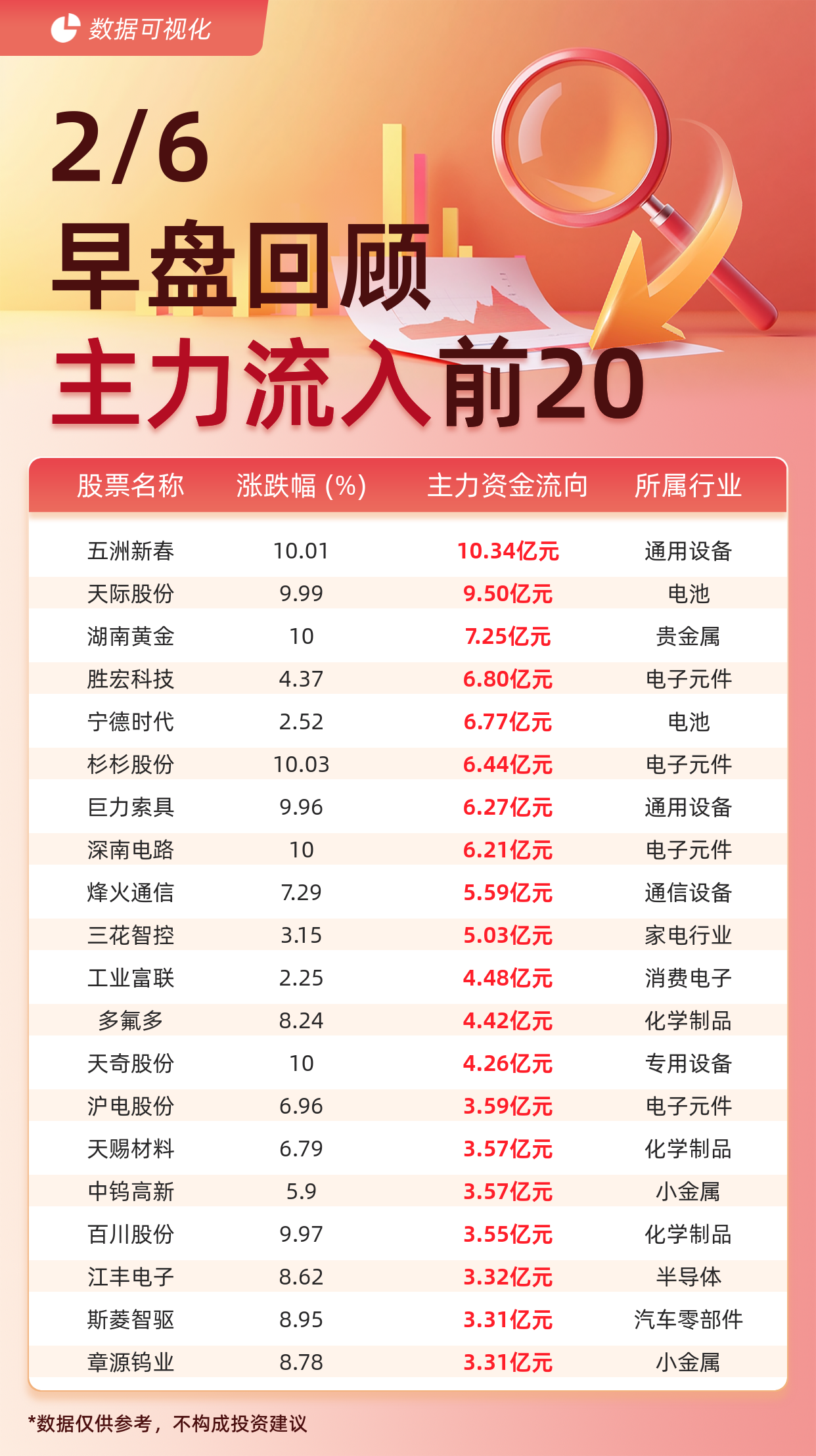
主力资金流入前20:五洲新春流入10.34亿元、天际股份流入9.50亿元
Jin Rong Jie· 2026-02-06 04:24
Group 1 - The top 20 stocks with significant capital inflow as of February 6 include Wuzhou Xinchun (1.034 billion), Tianji Co. (950 million), and Hunan Gold (725 million) [1] - Wuzhou Xinchun saw a price increase of 10.01%, while Tianji Co. increased by 9.99% [2] - Other notable stocks with high capital inflow include Shenghong Technology (680 million), Ningde Times (677 million), and Shanshan Co. (644 million) [1][2] Group 2 - The electronics sector is represented by Shenghong Technology, Deep South Circuit, and Industrial Fulian, with capital inflows of 680 million, 621 million, and 448 million respectively [2][3] - Chemical products are highlighted by Duofluo (442 million) and Tianqi Materials (357 million), both showing significant price increases [3] - The small metals sector includes Zhongtung High-tech and Zhangyuan Tungsten Industry, with capital inflows of 357 million each [3]

黄金回落,白银暴跌,投机者遭遇多头平仓潮
Sou Hu Cai Jing· 2026-02-06 04:13
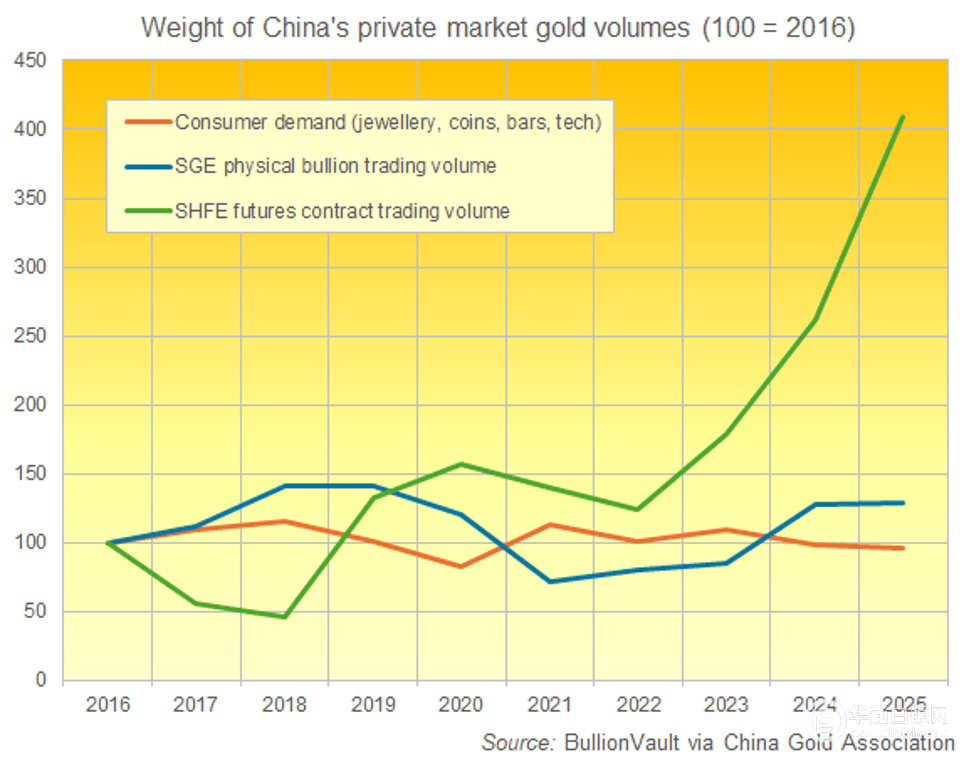
Core Viewpoint - The recent significant decline in gold and silver prices is attributed to market volatility, with gold down 1.1% and silver experiencing a dramatic drop of 12.8% this week, marking unusual fluctuations in the market [1]. Group 1: Market Trends - Shanghai silver futures have fallen over 10%, while platinum contracts in Guangzhou dropped nearly 8%, and Shanghai tin futures decreased by more than 7% [2]. - The latest data from the China Gold Association indicates that household gold demand is projected to decrease to 950 tons by 2025, with jewelry purchases by weight declining by 31.6%, while retail gold bar and coin sales increased by 35.1% [2]. - Retail investment products now account for 1.4 times the demand for jewelry, indicating a significant shift in household gold purchasing behavior that has been emerging since last spring [2]. Group 2: Trading Dynamics - The nominal value of gold traded through Shanghai Futures Exchange contracts has surged by 229.1% from 2022 to 2025, contrasting with the relatively stable annual total weight of end-user gold demand over the past decade [2]. - In a turbulent market environment, excessive bullish positions have exacerbated the decline in silver prices, with silver ETFs experiencing a significant drop, making it difficult for shareholders to trade at reference prices [4]. - The London gold price increased by $50 to $4,850 per ounce, while the London silver price fell by 60 cents to below $72 per ounce, a drop of nearly $50 from the historical high set the previous week [4]. Group 3: Investment Flows - The inflow of funds into North American gold exchange-traded funds (ETFs) is nearly three times that of Asian ETFs, which have seen their share of global gold-backed ETFs rise from 6.8% to 12.0% over the past 12 months [5]. - In contrast, European-listed ETFs have experienced a net reduction of over 5 tons, highlighting a stark difference in investment trends between regions [5].
美俄复谈军事黄金逆势反弹近1%
Jin Tou Wang· 2026-02-06 04:04
Core Viewpoint - The article discusses the recent developments in gold prices and the resumption of high-level military talks between the U.S. and Russia, indicating potential normalization of relations amid ongoing geopolitical tensions [1][2]. Gold Market Analysis - As of February 6, the spot gold price is reported at $4,823.53 per ounce, reflecting an increase of $47.90 or 1.00% from the previous trading day [1]. - The trading session opened at $4,776.99 per ounce, with a daily high of $4,845.13 and a low of $4,654.29 [1]. - The recent price fluctuations indicate a significant technical correction, with a notable buy support emerging at the $4,656 low, suggesting a potential bullish outlook [4]. U.S.-Russia Military Talks - High-level military talks between the U.S. and Russia, which had been suspended for over four years, are set to resume, seen as a step towards normalizing relations [1][2]. - The U.S. European Command announced the agreement to rebuild military dialogue following peace talks in Abu Dhabi, aimed at fostering "lasting peace" through continued military contact [1]. - Despite the resumption of talks, significant disagreements remain regarding key issues such as the status of Donbas and security guarantees for Ukraine [2][3]. Diplomatic Developments - The recent negotiations resulted in the exchange of 314 prisoners, marking the first such exchange in five months, although core issues remain unresolved [2]. - Russian Foreign Minister Lavrov emphasized the goal of ending the conflict, while Ukrainian officials acknowledged the importance of military cooperation before making significant political decisions [3]. - The U.S. is expected to provide intelligence to monitor ceasefire compliance, with further discussions anticipated in the coming weeks [3].
超3800股上涨
Di Yi Cai Jing Zi Xun· 2026-02-06 03:59
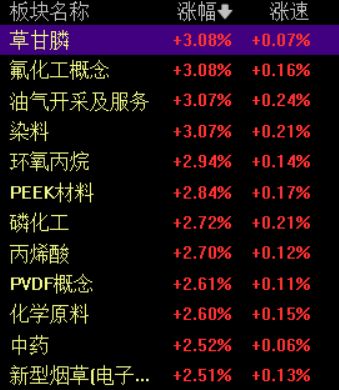
Market Overview - The A-share market showed mixed performance with the Shanghai Composite Index up by 0.11%, the Shenzhen Component Index up by 0.65%, and the ChiNext Index also up by 0.65% as of midday [1] - The total trading volume in the Shanghai and Shenzhen markets reached 1.38 trillion yuan, a decrease of 63.3 billion yuan compared to the previous trading day, with over 3,800 stocks rising [2] Sector Performance - Active sectors included lithium batteries, energy metals, humanoid robots, and fintech, while traditional sectors like liquor, retail, and AI application stocks weakened [1] - The Chinese medicine and chemical sectors showed notable gains, with the Chinese medicine sector rising by 2.52% [2][7] - The small metals sector rebounded, with stocks like Xianglu Tungsten and Zhangyuan Tungsten hitting the daily limit [7] Notable Stocks - Mingdiao Co. experienced significant trading activity, achieving a "limit-up" with nearly 700 million yuan in transactions and marking its fifth consecutive trading day of gains [3] - Jiangfeng Electronics saw a slight increase of 0.09% after announcing plans to acquire control of Kaide Quartz [9] Economic Indicators - The industrial development plan for traditional Chinese medicine aims for a collaborative development system by 2030, which may positively impact the sector [7]




超3800股上涨
第一财经· 2026-02-06 03:51
2026.02. 06 作者 | 一财阿驴 11:31 A股午盘丨创业板指半日涨0.65% 截至午盘,沪指涨0.11%,深成指涨0.65%,创业板指涨0.65%。科创综指涨0.51%。 盘面上,锂电池、能源金属、人形机器人、金融科技题材活跃,中药、化工板块涨幅靠前。白酒、零售、AI应用概念股走弱。 | 板块名称 | | 张幅� 张速 | | --- | --- | --- | | 草甘麟 | | +3.08% +0.07% | | 氟化工概念 | +3.08% | +0.16% | | 油气开采及服务 | +3.07% | +0.24% | | 染料 | +3.07% | +0.21% | | 环氧丙烷 | +2.94% | +0.14% | | PEEK材料 | +2.84% | +0.17% | | 磷化工 | +2.72% | +0.21% | | 丙烯酸 | +2.70% | +0.12% | | PVDF概念 | +2.61% | +0.11% | | 化学原料 | +2.60% | +0.15% | | 中药 | +2.52% | +0.06% | | 新型烟草(电子 ... | +2.51% | ...

国际黄金牛市未到终点 美联储政策仍是关键变量
Jin Tou Wang· 2026-02-06 03:25
Core Viewpoint - The recent fluctuations in gold prices are influenced by the Federal Reserve's policy direction, with the current bull market in gold not yet showing signs of ending despite recent volatility triggered by Kevin Warsh's nomination as Fed Chair [1][2]. Group 1: Market Analysis - As of February 6, the international gold price is $4783.50 per ounce, reflecting a slight increase of $7.87 or 0.16% from the previous trading day, with a trading range between $4654.29 and $4793.49 [1]. - The recent volatility in gold and silver prices, which saw declines of 20% and 40% respectively, was a reaction to Warsh's hawkish stance on interest rates and balance sheet reduction, leading to a stronger dollar and a global asset sell-off [1][2]. Group 2: Future Outlook - The end of the current bull market in gold may follow two potential paths: either the Federal Reserve halts interest rate cuts and begins balance sheet reduction, or an AI-driven economic growth in the U.S. leads to lower inflation [2]. - Despite recent price corrections, the expectation is that the gold bull market will continue as neither of the aforementioned conditions has yet materialized, with recommendations to strategically overweight gold and buy on dips [2]. Group 3: Technical Analysis - The daily chart indicates a shift to a weaker trend for gold, with prices breaking below previous support levels, suggesting continued downward pressure [3]. - Short-term resistance is noted in the $4790-$4800 range, while support is anticipated around $4590-$4600, indicating potential for minor rebounds but limited upward momentum [3].