服务业

Search documents
欧元区制造业表现分化
Sou Hu Cai Jing· 2025-10-10 22:45
Group 1 - The Eurozone's manufacturing PMI fell to 49.5 in September, indicating a return to recession and highlighting insufficient economic recovery momentum [1] - Germany's composite PMI rose to 52.4, surpassing analyst expectations, with services PMI reaching an 8-month high of 52.5, while manufacturing PMI dropped to 48.5, the lowest in four months [1] - France's manufacturing PMI declined to 48.1, and the composite PMI fell to 48.4, marking the fastest contraction since May, reflecting instability linked to domestic political uncertainty [2] Group 2 - The Eurozone's overall composite PMI for September was 51.2, indicating resilience in the services sector, but market sentiment remains low with deteriorating overseas orders [2] - Multiple factors contribute to the manufacturing sector's challenges, including trade tensions, rising energy costs, and a slowdown in global economic growth [3] - The decline in manufacturing is expected to ease commodity inflation pressures but increases the risk of economic slowdown, with the European Central Bank facing a delicate balance between preventing recession and avoiding excessive easing [4]
中国—西班牙贸易投资对接会在马德里成功举办
Shang Wu Bu Wang Zhan· 2025-10-10 02:12
Core Points - The China-Spain Trade and Investment Matching Conference was held in Madrid, attended by over 300 representatives from Chinese and Spanish enterprises and business associations, highlighting the strong engagement and interest in bilateral trade [1][2] - The conference is a concrete measure to implement the important consensus reached by the leaders of China and Spain, showcasing the vitality and potential of economic cooperation between the two countries amidst rising protectionism and unilateralism [1] - This year marks the 20th anniversary of the establishment of a comprehensive strategic partnership between China and Spain, with both countries expanding cooperation in various fields and establishing resilient supply chain relationships [1] - China plans to increase the procurement of Spanish agricultural and food products, innovate trade formats, expand imports through cross-border e-commerce, and enhance bilateral investment [1] - Spain expresses confidence in the economic development prospects of China and aims to deepen trade and investment cooperation in renewable energy and digital economy sectors [1] - Both countries signed 9 trade and investment cooperation agreements across sectors such as agricultural products, green economy, advanced manufacturing, and service trade [2]
美国政府关门,金价突破4000
Mei Ri Jing Ji Xin Wen· 2025-10-10 01:16
Group 1: Gold Market Dynamics - As of October 8, London spot gold closed at $4040.42 per ounce, with a cumulative increase of $281.64 per ounce since September 26, representing a rise of 7.49% [1] - The recent surge in gold prices was driven by the U.S. government shutdown, which has heightened macroeconomic uncertainty and increased demand for safe-haven assets [1][9] - The ongoing geopolitical tensions, including the Israel-Palestine conflict, and the trend of "de-dollarization" globally are expected to support gold prices in the medium to long term [9][11] Group 2: U.S. Economic Indicators - The U.S. ISM Manufacturing PMI for September was reported at 49.1, indicating resilience in manufacturing, although new orders showed a decline [2] - The Atlanta Fed's GDPNow model indicates a projected annualized GDP growth rate of 3.8% for Q3, while consumer spending remains robust with a 3.2% growth forecast [3] - Job market indicators show a mixed picture, with the ADP reporting a decrease in employment of 3,200 jobs in September, below market expectations [3][4] Group 3: Political and Economic Uncertainty - The U.S. government has been shut down since October 1 due to budget disagreements, which has led to delays in key economic data releases, further contributing to market uncertainty [5][7] - Political instability in France, highlighted by the resignation of Prime Minister Le Cornu, adds to the uncertainty in European markets [8] - The ongoing political polarization in the U.S. raises concerns about fiscal sustainability and could lead to prolonged market disruptions [7][9] Group 4: Federal Reserve Outlook - Market expectations for a rate cut by the Federal Reserve have increased, with a nearly 95% probability of a cut in October, driven by the government shutdown and labor market slowdown [6][9] - Some Federal Reserve officials express concerns about potential inflationary pressures, particularly in the services sector, which may influence future monetary policy decisions [6][9] Group 5: Central Bank Gold Purchases - China's central bank continues to increase its gold reserves, reaching 7,406 million ounces by the end of September, marking the eleventh consecutive month of gold accumulation [11] - The trend of central banks purchasing gold is expected to continue, driven by the need for asset diversification amid geopolitical and economic uncertainties [11]
“决胜‘十四五’续写新篇章”系列主题新闻发布会举行第三场发布 现代化产业体系不断优化
Si Chuan Ri Bao· 2025-10-10 00:18
Group 1: Agricultural Achievements - Sichuan has maintained national leadership in the production of 15 agricultural products, including pigs and rapeseed, contributing significantly to national food security [1][2] - The total grain production in 2024 is projected to reach 726.8 billion jin, maintaining a stable output above 700 billion jin for five consecutive years, with a historical high in both total and per unit yield [2] Group 2: Industrial Growth - The annual growth rate of industrial added value in Sichuan is 6.6%, with total industrial added value increasing from 1.34 trillion yuan to 1.79 trillion yuan, elevating its national ranking to seventh [1][2] - Research and development investments in large-scale industrial enterprises have increased by 50%, with R&D intensity rising by 41%, while the profit margin for these enterprises stands at 7.3%, ranking first among the top ten economic provinces [2] Group 3: Service Sector Development - The service sector's contribution to GDP has risen from 52.4% in 2020 to 56%, with its contribution to economic growth increasing from 42.5% to 60.5% [1][3] - Sichuan's service sector has shown significant growth, achieving its "14th Five-Year Plan" goals a year ahead of schedule [3]
用电量连续破万亿千瓦时,怎么看?
Ren Min Ri Bao· 2025-10-08 20:43
Core Insights - The total electricity consumption in China exceeded 1 trillion kilowatt-hours for the first time in July, reaching 10,226 billion kilowatt-hours, a year-on-year increase of 8.6%, followed by 10,154 billion kilowatt-hours in August, with a 5% year-on-year growth [1][2] Group 1: Electricity Consumption Data - In July, the first industry consumed 17 billion kilowatt-hours, up 20.2% year-on-year, while the second industry consumed 5,936 billion kilowatt-hours, reflecting a 4.7% increase [2] - The third industry saw a consumption of 2,081 billion kilowatt-hours, with a year-on-year growth of 10.7%, and residential electricity consumption reached 2,039 billion kilowatt-hours, growing by 18% [2][3] - In August, the first industry consumption grew by 9.7%, the second industry by 5%, and the third industry by 7.2%, while residential consumption was 1,963 billion kilowatt-hours, up 2.4% [3] Group 2: Factors Driving Electricity Consumption - High temperatures across the country have led to increased electricity loads, with a record peak load of 1.465 billion kilowatts in July, driven largely by air conditioning [4] - The macroeconomic recovery and various policies aimed at boosting consumption have also contributed to the rise in electricity consumption, with manufacturing electricity usage in August increasing by 5.5%, the highest for the year [5] - The recovery in high-energy-consuming industries, such as steel and chemicals, has shown significant growth, with high-tech and equipment manufacturing electricity usage increasing by 9.1% [5] Group 3: Energy Supply Stability - The stable electricity supply is attributed to strong energy self-sufficiency and robust operational capabilities, with over 90% of the consumption increase being supported by domestic production [6] - The installed power generation capacity reached 3.69 billion kilowatts by the end of August, marking an 18% year-on-year increase, with renewable energy sources contributing significantly [6][7] - A comprehensive energy supply and pricing mechanism has been established, ensuring stable electricity supply even during peak demand periods [7]
连续回升!9月制造业PMI为49.8%
Mei Ri Jing Ji Xin Wen· 2025-10-08 13:38
Core Insights - The September Purchasing Managers' Index (PMI) for China indicates a slight improvement in economic output, with the manufacturing PMI at 49.8%, up 0.4 percentage points from the previous month, while the non-manufacturing business activity index decreased to 50.0%, down 0.3 percentage points [1][2] Manufacturing Sector - The manufacturing PMI has shown a continuous recovery, with a production index of 51.9%, up 1.1 percentage points, reaching a six-month high, and a new orders index of 49.7%, up 0.2 percentage points [2] - Factors contributing to the recovery include seasonal improvements, the implementation of consumer loan subsidies, and a more active domestic capital market, which has boosted market confidence [2][3] - The prices of major raw materials have decreased, with purchasing prices down 0.1 percentage points to 53.2% and factory prices down 0.9 percentage points to 48.2% [3] - Key manufacturing sectors such as equipment manufacturing, high-tech manufacturing, and consumer goods are expanding, with PMIs of 51.9%, 51.6%, and 50.6% respectively, all above the manufacturing average [3] Non-Manufacturing Sector - The non-manufacturing business activity index fell to 50.0%, with the service sector index at 50.1%, both indicating a decline [4][5] - The drop in service sector activity is attributed to the seasonal effects post-summer and the timing of the Mid-Autumn Festival, which has delayed consumer activities [4][5] - Despite the overall decline, sectors such as postal, telecommunications, and financial services remain in a high-growth zone with indices above 60.0% [5] Construction Sector - The construction business activity index is at 49.3%, showing a slight increase of 0.2 percentage points, but still below the expansion threshold [6] - The construction activity is weak, particularly in civil engineering and housing, indicating a need for improved project coordination and funding [6] - Recent data shows a 9.0% month-on-month increase in housing transactions in 30 major cities, and a 14.4% increase in land transactions, reflecting typical seasonal patterns [6]
冠通期货2025年9月PMI数据
Guan Tong Qi Huo· 2025-10-08 07:00
Group 1: Report Summary Report Industry Investment Rating - Not provided in the document Report's Core View - In September 2025, China's manufacturing PMI was 49.8%, up 0.4 percentage points from the previous month, indicating continued improvement in manufacturing sentiment; the non - manufacturing business activity index was 50.0%, down 0.3 percentage points from the previous month, with overall stable non - manufacturing business volume; the composite PMI output index was 50.6%, up 0.1 percentage points from the previous month, showing continued acceleration of overall expansion in Chinese enterprises' production and business activities [2][3] Summary by Category Manufacturing PMI - Overall: The manufacturing PMI in September was 49.8%, up 0.4 percentage points from the previous month. Large - scale enterprises had a PMI of 51.0%, up 0.2 percentage points; medium - scale enterprises had a PMI of 48.8%, down 0.1 percentage points; small - scale enterprises had a PMI of 48.2%, up 1.6 percentage points [2] - Classification Index: Among the 5 classification indexes, the production index and supplier delivery time index were above the critical point, while the new order index, raw material inventory index, and employment index were below the critical point. The production index was 51.9%, up 1.1 percentage points; the new order index was 49.7%, up 0.2 percentage points; the raw material inventory index was 48.5%, up 0.5 percentage points; the employment index was 48.5%, up 0.6 percentage points; the supplier delivery time index was 50.8%, up 0.3 percentage points [2] Non - manufacturing PMI - Overall: The non - manufacturing business activity index in September was 50.0%, down 0.3 percentage points from the previous month. The construction business activity index was 49.3%, up 0.2 percentage points; the service business activity index was 50.1%, down 0.4 percentage points [3] - Industry Details: Industries such as postal, telecommunications, radio, television, and satellite transmission services, and monetary and financial services were in a high - level boom range above 60.0%, while industries such as catering, real estate, and culture, sports, and entertainment were below the critical point [3] Composite PMI Output Index - In September, it was 50.6%, up 0.1 percentage points from the previous month, indicating continued acceleration of overall expansion in Chinese enterprises' production and business activities [3]
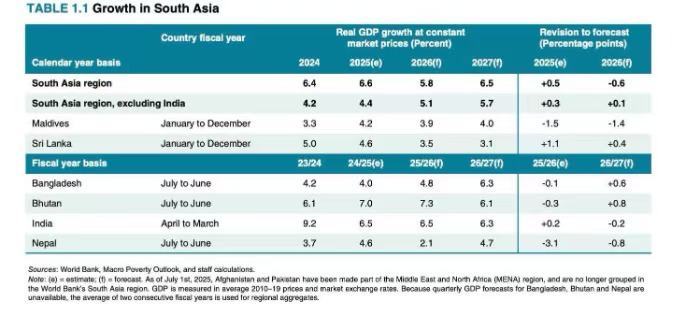
因特朗普关税世行大幅下调明年南亚增长预期至5.8%,印度情况如何?
Di Yi Cai Jing· 2025-10-07 07:44
Core Insights - The World Bank predicts that India will remain the fastest-growing major economy globally, driven by strong consumption growth, increased agricultural output, and rising rural wages [1][3] - South Asia's economic growth is expected to slow down significantly, with a forecast of 5.8% for 2026, marking the lowest growth rate in 25 years [1][4] - The report emphasizes the need for trade liberalization and technology adoption to create job opportunities and stimulate growth in the region [1][6] Economic Growth Projections - South Asia's GDP growth is projected at 6.4% for 2024, 6.6% for 2025, and 5.8% for 2026, with a downward revision of 0.6 percentage points for 2026 [2] - India is forecasted to grow at 9.2% in 2024, 6.5% in 2025, and 6.5% in 2026, with a slight upward revision of 0.2 percentage points for 2025 [2] - Bangladesh's growth is expected to accelerate to 4.8% in 2025/26 and 6.3% in 2026/27, while Sri Lanka's growth forecast for 2026 has been raised to 3.5% [3][4] Impact of U.S. Tariffs - The report discusses the impact of U.S. tariffs on South Asian economies, with India facing a 50% tariff, Bangladesh and Sri Lanka facing 20%, and Nepal, Bhutan, and Maldives facing 10% [3][4] - The tariffs have resulted in significant increases in the effective tax rates on exports, with Bangladesh's exports facing a total of 35% tariffs and Sri Lanka's at 30% [3] Trade and Investment Recommendations - The World Bank suggests that South Asian countries should lower trade barriers, particularly on intermediate goods, to enhance manufacturing and job creation [4][5] - The report highlights that the service sector, which has lower tariffs, has contributed to three-quarters of job growth in the past decade [5] Artificial Intelligence Potential - The report advocates for leveraging AI to boost productivity and income, noting that demand for AI skills is rapidly increasing, with a wage premium of nearly 30% compared to other professions [6] - It emphasizes that trade openness and AI application could transform the South Asian region, necessitating policies that facilitate labor reallocation to productive sectors [6]

2025年三边经济报告
Sou Hu Cai Jing· 2025-10-05 07:44
Core Insights - The 2025 Trilateral Economic Report highlights the resilience and opportunities of the East Asian economic circle amid global uncertainties, emphasizing the importance of trilateral cooperation among China, Japan, and South Korea [1][6]. Economic Scale and Trade - In 2024, the combined GDP of China, Japan, and South Korea reached USD 24.21 trillion, a 2.7% increase from 2023, accounting for over 24% of global GDP [2][40]. - The total population of these three countries is approximately 1.584 billion, representing nearly 20% of the global population, making it one of the most promising consumer markets [2][40]. - The goods trade volume among the three countries is estimated at USD 8.93 trillion in 2024, which is 18.8% of global trade, highlighting their role as stabilizers in global supply chains [2][40]. Demographic Challenges - The aging population is a significant challenge, with Japan having 30% of its population aged 65 and older, South Korea at 18%, and China nearing 14%, all exceeding the global average of 10% [3]. - Fertility rates are critically low, with South Korea at 0.7, Japan at 1.2, and China at 1.0, indicating potential long-term population decline [3]. Economic Outlook - The report predicts that the economic growth rate for the ASEAN+3 region may fall below 4% in 2025 due to global trade shocks, with growth for China, Japan, and South Korea expected to decrease from 4.1% in 2024 to 3.7% [3][40]. - Long-term projections suggest that potential economic growth for ASEAN+3 and the CJK economies could decline to 2.8% and 3.0% by 2050, respectively [3][40]. Regional Economic Integration - The Regional Comprehensive Economic Partnership (RCEP) has shown positive impacts on trade and investment, with the trade volume reaching USD 13 trillion in 2023, accounting for 30% of global exports [4]. - However, challenges remain, such as small and micro enterprises struggling to benefit from RCEP, and the need for improved customs facilitation [4]. Semiconductor Industry Collaboration - The semiconductor industry is highlighted as a critical area for trilateral cooperation, with South Korea leading in memory chips, Japan dominating in manufacturing equipment, and China rapidly advancing [5]. - Recommendations include establishing a trilateral semiconductor supply chain dialogue platform and joint research initiatives to enhance regional supply chain resilience [5]. Future Cooperation Directions - The report emphasizes the need for accelerated negotiations on the China-Japan-Korea Free Trade Agreement (CJKFTA) and collaboration in emerging sectors like electric vehicles and renewable energy [5]. - Strengthening regional cooperation is deemed essential to navigate uncertainties and promote sustainable growth across the region [6].