纯碱

Search documents
黑色建材日报:宏观情绪消退,钢价延续震荡-20250827
Hua Tai Qi Huo· 2025-08-27 07:43
Report Industry Investment Rating No relevant content provided. Core Viewpoints - The steel price continues to fluctuate after the macro - sentiment fades, and the glass and soda ash markets fluctuate due to repeated market sentiment. The double - silicon market sentiment cools down, and ferroalloy futures decline slightly [1][3] - For glass, the supply - demand contradiction is large, and it needs low prices and low profits to reduce supply. For soda ash, the supply - demand imbalance will intensify, and it needs to limit capacity release through losses [1] - Both the silicon manganese and silicon iron industries have obvious over - supply, and need to limit production through losses. Their prices are expected to fluctuate with the sector [3] Market Analysis Glass and Soda Ash - **Glass**: The glass futures oscillated weakly yesterday, with the main 2601 contract down 1.76%. Spot trading sentiment is average. Supply is stable in production and sales, but factory inventories are growing. The supply - demand contradiction is large, and short - term premium suppresses prices. Later, attention should be paid to the performance of peak - season demand [1] - **Soda Ash**: The soda ash futures declined yesterday, with the main 2601 contract down 1.8%. Spot prices were adjusted downwards, and downstream buyers purchase at low prices. Supply is increasing as summer maintenance nears the end. Consumption is currently stable but is expected to weaken with new capacity coming online. The supply - demand imbalance will intensify, and losses are needed to limit capacity release. Attention should be paid to the impact of "anti - involution" policies on the photovoltaic sector [1] Double - Silicon - **Silicon Manganese**: The silicon manganese futures declined yesterday. The main contract closed at 5862 yuan/ton, down 36 yuan/ton from the previous day. The spot market oscillated. Production and sales increased month - on - month, and inventories decreased. The cost increased slightly due to a small increase in manganese ore prices. The industry has obvious over - supply, and losses are needed to limit production. Prices are expected to follow the sector, and attention should be paid to manganese ore cost support, inventory, and ore shipments [3] - **Silicon Iron**: The silicon iron futures declined slightly yesterday. The main contract closed at 5656 yuan/ton, down 24 yuan/ton from the previous day. The spot market sentiment was average, and prices were slightly adjusted. Production and sales increased, and factory inventories decreased, but absolute inventories are still high, suppressing prices. The industry has obvious over - supply, and losses are needed to limit production. Prices are expected to follow the sector, and attention should be paid to steel mill production restrictions, cost support, and industrial policies [3] Strategies - **Glass**: Oscillate weakly [2] - **Soda Ash**: Oscillate weakly [2] - **Silicon Manganese**: Oscillate [4] - **Silicon Iron**: Oscillate [4]
缺乏驱动,上冲乏
Zhong Xin Qi Huo· 2025-08-27 06:51
Report Industry Investment Rating - The mid - term outlook for the black building materials industry is "oscillation" [5]. - The mid - term outlooks for individual varieties such as iron ore, coke, etc. are also "oscillation" [7][8][10][11] Core Viewpoints - The black market has limited upside potential due to weak terminal demand expectations, but there is support from supply disruptions and downstream restocking needs. The market will mainly oscillate, and attention should be paid to policy implementation and terminal demand performance [5]. Summary by Related Catalogs Overall Market Analysis - The black market's upward movement lacks drive, with the previous day's gains mostly erased and coking coal leading the decline. Supply constraints for furnace materials remain, and the downside space for prices is limited. Steel apparent demand is weak, and it is in the restocking window before the peak season. If there is topic - driven news, there is a small rebound space; otherwise, it will oscillate. Attention should be paid to future demand and furnace material supply recovery [1]. By Variety Iron Ore - Overseas mine shipments decreased, 45 - port arrivals slightly declined, and total supply is relatively stable. Iron ore demand is expected to remain high as iron - making water production increases slightly. Port inventories decreased slightly. With limited negative driving factors in the fundamentals, prices are expected to oscillate [2][7][8]. Coking Coal - Some coal mines have resumed production, but some are still restricted by accidents and safety inspections. Import volumes are high but have recently declined briefly. Coking coal's short - term rigid demand has slightly decreased, and some mines have inventory accumulation, but overall inventory pressure is not significant. The short - term futures market still has support [2][12]. Coke - The eighth round of price increases has started, with regional differentiation. Some areas' coking production is restricted. Upstream coking enterprises' inventories are still low, and short - term supply and demand remain tight under simultaneous coking and steel production restrictions. Before the parade, the futures market still has support [11]. Alloys - **Manganese Silicon**: Before the parade, manufacturers' raw material restocking is nearly finished, port prices are loosening, and supply pressure is increasing. In the long - term, the supply - demand relationship may become looser, and prices may face downward pressure [2]. - **Silicon Iron**: The current market inventory pressure is not large, and short - term prices are expected to oscillate. However, in the long - term, the supply - demand gap is expected to be filled, and there are concerns in the fundamentals [2]. Glass - After the futures price decline, the spot market sentiment has cooled. Supply is expected to remain stable, and there is some inventory accumulation upstream. Cost support has strengthened due to rising coal prices, but the fundamentals are still weak, and short - term futures and spot prices are expected to oscillate widely [2][13]. Soda Ash - The supply surplus pattern remains unchanged. After the futures price decline, spot trading volume has increased slightly. In the long - term, the price center will decline to promote capacity reduction [2][5][15]. Scrap Steel - The arrival volume at steel mills has decreased, and the fundamentals' contradictions are not prominent. Due to the pressure on finished product prices, electric furnace profits are low, but resources are still tight, and short - term prices are expected to oscillate [9].
8.26纯碱日评:纯碱供应趋紧 成交灵活推进
Sou Hu Cai Jing· 2025-08-27 03:14
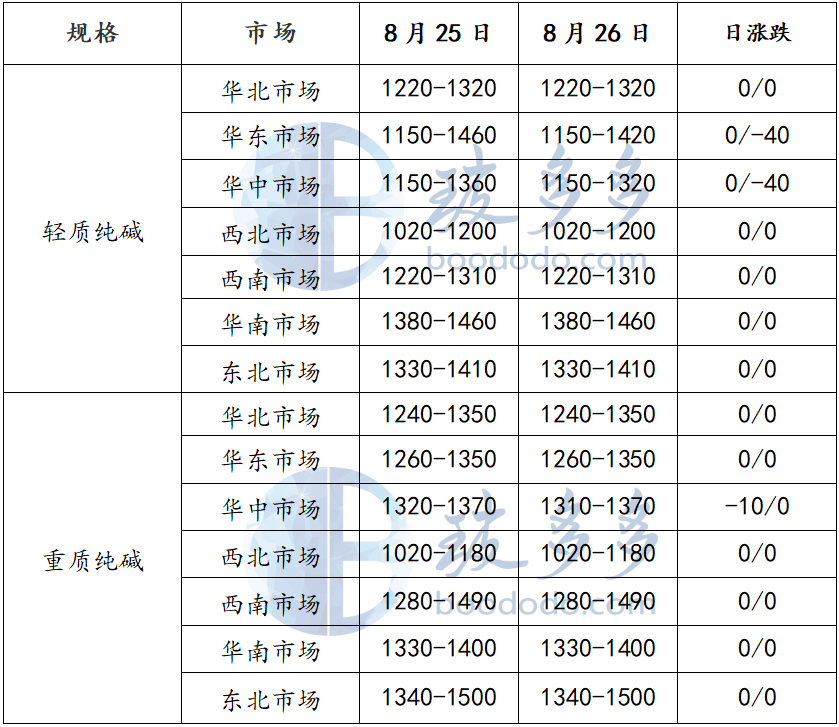
Core Viewpoint - The domestic soda ash market is experiencing a stable yet weak trend, with prices showing little fluctuation across various regions [2][3]. Price Summary - Light soda ash prices in North China range from 1220 to 1320 CNY/ton, while heavy soda ash prices are between 1240 and 1350 CNY/ton [2]. - Northeast region prices for light soda ash are between 1330 and 1410 CNY/ton, and for heavy soda ash, they range from 1340 to 1500 CNY/ton [2]. - The soda ash price index for light soda ash is 1210, remaining unchanged, while the heavy soda ash index is 1254.29, reflecting a decrease of 1.43, or -0.11% [3]. Supply and Demand Analysis - Supply is tightening as companies like Wucai Soda Industry are undergoing maintenance, and Shaanxi Xinghua has plans for repairs, leading to an overall contraction in supply [2]. - Downstream demand remains limited, with companies primarily maintaining just-in-time inventory, which does not provide substantial support to the market [2]. Futures Market Dynamics - On August 26, the main contract for soda ash (SA2601) opened at 1336 CNY/ton and closed at 1311 CNY/ton, showing a daily decline of 1.80% [5]. - The market sentiment is affected by a general decline in the chemical sector, with high inventory levels persisting despite supply-side maintenance [5]. Future Market Predictions - There are upcoming maintenance plans from some companies, which may cause slight fluctuations in supply [6]. - Demand is expected to remain cautious, with limited order releases, and the overall inventory in the industry is still high [6].

大越期货纯碱早报-20250827
Da Yue Qi Huo· 2025-08-27 01:52
Report Investment Rating No information provided on the industry investment rating. Core View The fundamentals of soda ash show strong supply and weak demand. In the short term, it is expected to mainly oscillate weakly. The supply of soda ash is at a high level, terminal demand is declining, inventory is at a high level compared to the same period, and the pattern of supply - demand mismatch in the industry has not been effectively improved [2][5]. Summary by Directory 1. Daily View - Fundamentals: There are few maintenance works at soda ash plants, supply remains at a high level; the daily melting volume of downstream float glass is stable, while that of photovoltaic glass is declining, and terminal demand is weakening. The inventory of soda ash plants is at a historical high, indicating a bearish outlook [2]. - Basis: The spot price of heavy - quality soda ash in Hebei Shahe is 1,200 yuan/ton, the closing price of SA2601 is 1,311 yuan/ton, and the basis is - 111 yuan, with the futures at a premium to the spot, which is bearish [2]. - Inventory: The national in - plant inventory of soda ash is 1.9108 million tons, an increase of 0.90% from the previous week, and the inventory is running above the 5 - year average, suggesting a bearish trend [2][36]. - Market trend: The price is running below the 20 - day moving average, and the 20 - day moving average is downward, showing a bearish sign [2]. - Main positions: The net position of the main players is short, and the short positions are decreasing, which is bearish [2]. - Expectation: Due to the strong supply and weak demand of soda ash fundamentals, it is expected to mainly oscillate weakly in the short term [2]. 2. Influencing Factors - Bullish factors: The peak season for summer maintenance is coming, and production will decline [3]. - Bearish factors: Since 2023, the production capacity of soda ash has expanded significantly, and there are still large production - launch plans this year, with industry output at a historical high for the same period; the production of heavy - alkali downstream photovoltaic glass has been reduced, weakening the demand for soda ash; the positive sentiment from the "anti - involution" policy has faded [5]. 3. Soda Ash Futures Market - The closing price of the main contract decreased by 1.94%, the low - end price of heavy - quality soda ash in Shahe decreased by 1.64%, and the basis of the main contract decreased by 5.13% [6]. 4. Soda Ash Spot Market - The low - end price of heavy - quality soda ash in Hebei Shahe is 1,200 yuan/ton, a decrease of 20 yuan/ton from the previous day [12]. - The production profit of heavy - quality soda ash using the North China ammonia - soda process is - 48.10 yuan/ton, and that using the East China combined - soda process is - 58 yuan/ton. The production profit of soda ash has rebounded from a historical low [15]. - The weekly industry operating rate of soda ash is 88.48%, and the seasonal decline in the operating rate has been postponed [18]. - The weekly output of soda ash is 771,400 tons, including 425,200 tons of heavy - quality soda ash, with the output at a historical high [20]. - From 2023 to 2025, there has been a large - scale increase in new production capacity of soda ash, with a total planned increase of 1.57 billion tons, and the actual production launched in 2025 is 1 million tons [21]. 5. Fundamental Analysis - Demand - The weekly production - sales ratio of soda ash is 97.80% [24]. - In the downstream of soda ash, the national daily melting volume of float glass is 159,600 tons, and the operating rate is stable at 75.34% [27]. - The price of photovoltaic glass has been continuously falling. Under the influence of the "anti - involution" policy, the industry has cut production, and the in - production daily melting volume has continued a significant downward trend [33]. 6. Fundamental Analysis - Inventory The national in - plant inventory of soda ash is 1.9108 million tons, an increase of 0.90% from the previous week, and the inventory is running above the 5 - year average [36]. 7. Fundamental Analysis - Supply - Demand Balance Sheet The report provides the annual supply - demand balance sheets of soda ash from 2017 to 2024E, including data on effective production capacity, output, operating rate, imports, exports, net imports, apparent supply, total demand, supply - demand difference, and growth rates of various indicators [37].
研究所晨会观点精萃-20250827
Dong Hai Qi Huo· 2025-08-27 01:10
1. Report Industry Investment Ratings No specific industry - wide investment ratings are provided in the given report. 2. Core Viewpoints of the Report - The short - term macro upward drive is marginally strengthening, with the market focusing on domestic incremental stimulus policies and easing expectations. Attention should be paid to the progress of Sino - US trade negotiations and the implementation of domestic incremental policies [2][3]. - Different asset classes are expected to show short - term range - bound trends, and specific investment strategies vary according to different sectors. 3. Summary by Relevant Catalogs Macro Finance - Overseas: The attempt to remove Fed Governor Cook has raised concerns about central bank independence, leading to a decline in the US dollar index and US Treasury yields, and an increase in global risk appetite. - Domestic: China's economic data in July slowed down and fell short of expectations. Policy stimulus has been strengthened, and the short - term external risk uncertainty has decreased while domestic easing expectations have increased, resulting in an overall increase in domestic risk appetite. - Asset Recommendations: Stocks are expected to oscillate strongly at a high level in the short term, and short - term cautious long positions are recommended; bonds are expected to oscillate at a high level, and cautious observation is advised; commodities in different sectors are generally expected to oscillate in the short term, and cautious observation is recommended [2]. Stock Index - Affected by sectors such as rare earth concepts, biomedicine, and small metals, the domestic stock market declined slightly. - With the strengthening of policy stimulus, the reduction of short - term external risk uncertainty, and the increase in domestic easing expectations, the short - term macro upward drive is marginally strengthening. Short - term cautious long positions are recommended [3]. Precious Metals - Gold prices are supported in the short term due to increased concerns about independence, rising risk of stagflation, and strengthened rate - cut expectations. However, attention should be paid to the Fed's attitude changes, and the market focus is on the upcoming US PCE data [4][5]. Black Metals - **Steel**: The spot and futures markets of steel continued to be weak. Demand was weak, inventory increased, and supply was expected to decline in the future. With strong cost support, a range - bound approach is recommended in the short term [6]. - **Iron Ore**: The spot and futures prices of iron ore declined. With strong northern production - restriction expectations, cautious procurement by steel mills, and increasing supply pressure, a range - bound approach is expected in the short term [6]. - **Silicon Manganese/Silicon Iron**: The spot prices were flat, and the futures prices declined slightly. Supply in some regions was increasing, but there were potential production - cut plans. A range - bound approach is recommended in the short term [7][8]. - **Soda Ash**: There is a situation of high supply, high inventory, and weak demand. The supply - side contradiction is the core factor suppressing prices. It is expected to oscillate in a range in the short term [9]. - **Glass**: Supply is stable, demand is difficult to increase significantly, and it is expected to oscillate in a range in the short term under the boost of real - estate news [9]. Non - ferrous Metals and New Energy - **Copper**: The impact of Trump's attempt to remove Cook on the copper market is expected to be small in the short term, and domestic demand is expected to weaken marginally [10][11]. - **Aluminum**: The price declined slightly. The fundamentals changed little, and it is expected to oscillate in the short term with limited upward space [11]. - **Aluminum Alloy**: The supply of scrap aluminum is tight, production costs are rising, and demand is weak. It is expected to oscillate slightly stronger in the short term with limited upward space [11]. - **Tin**: Supply is expected to be relatively loose in the long term, and demand is weak. It is expected to oscillate in the short term, with limited upward space [12]. - **Lithium Carbonate**: After the previous sentiment subsided, it is expected to oscillate in a wide range, with a short - term bearish and long - term bullish outlook [13]. - **Industrial Silicon**: It is expected to oscillate in a range, considering the high - level oscillation of black metals and polysilicon [13]. - **Polysilicon**: It is facing a game between strong expectations and weak reality, and is expected to oscillate at a high level in the short term [14]. Energy and Chemicals - **Crude Oil**: Concerns about the Fed's independence and the potential impact of US tariffs on India's oil imports have affected oil prices. There is still some support for oil prices in the near term [16]. - **Asphalt**: Supported by anti - involution in the petrochemical industry and rising crude oil prices, but with limited inventory reduction, it is expected to remain weakly oscillating in the near term [16]. - **PX**: It is in a tight situation in the short term and is expected to oscillate while waiting for changes in PTA device operations [16]. - **PTA**: Driven by capacity adjustments and increased downstream demand, it is expected to maintain a relatively strong oscillating pattern in the short term [17]. - **Ethylene Glycol**: Port inventory has decreased slightly. Supported by downstream demand recovery, but facing supply pressure, short - term buying on dips should pay attention to crude oil cost fluctuations [18][19]. - **Short - fiber**: Driven by sector resonance, its price increased slightly. It is expected to follow the polyester sector and may be shorted on rallies in the medium term [19]. - **Methanol**: The fundamentals are showing marginal improvement, but the oversupply situation remains. It is expected to oscillate in price [19]. - **PP**: Supply pressure is increasing, but there is policy support. The 09 contract is expected to oscillate weakly, and the 01 contract should focus on peak - season inventory - building [19]. - **LLDPE**: Supply pressure remains, and demand shows signs of turning. The 09 contract is expected to oscillate weakly, and the 01 contract should focus on demand and inventory - building [19]. Agricultural Products - **US Soybeans**: The selling pressure of US Treasuries has increased, and the weakening of the US dollar has provided some support to commodities. The expected Sino - US trade negotiations have boosted the export sales expectations of US soybeans [20]. - **Soybean and Rapeseed Meal**: The pressure of continuous inventory accumulation of domestic soybean and soybean meal in oil mills has eased. Rapeseed meal still has the basis for upward fluctuations. Attention should be paid to the development of Sino - Canadian trade relations [21]. - **Oils**: Rapeseed oil inventory is decreasing, and the supply is expected to shrink; soybean oil is expected to have a low - valuation price - increase market; palm oil is expected to enter an oscillating phase [21]. - **Corn**: The national corn price is running weakly. The futures price has entered a relatively low - valuation range, and there is a low possibility of breaking through the previous range [21]. - **Pigs**: The weight of pigs has declined, and the second - fattening market is cautious. The market's pessimistic sentiment about the fourth - quarter outlook has increased [22].
黑色建材日报-20250827
Wu Kuang Qi Huo· 2025-08-27 01:04
1. Report Industry Investment Rating No relevant content provided. 2. Core Viewpoints of the Report - The overall atmosphere in the commodity market cooled yesterday, and the prices of finished steel products declined slightly. The demand for finished steel products is clearly weak, the profits of steel mills are gradually shrinking, and the weak characteristics of the market are becoming more prominent. If the subsequent demand cannot be effectively improved, the prices may continue to decline. [3] - The supply and demand contradictions of iron ore are not prominent for the moment, and its price is expected to fluctuate in the short - term. Attention should be paid to the subsequent shipping progress and the impact of safety inspections and environmental protection restrictions. [6] - The prices of ferrous alloys have dropped rapidly. In the short - term, it is not recommended for speculative funds to participate excessively, while hedging funds can seize hedging opportunities. The fundamental problems of over - supply in the manganese - silicon and silicon - iron industries remain. [7][8][9] - Industrial silicon is expected to fluctuate between 8300 - 9300 yuan/ton. Polysilicon continues the pattern of "weak reality, strong expectation" and is expected to have high - volatility. [12][13][14] - The price of glass is expected to fluctuate weakly in the short - term, and the price of soda ash is expected to fluctuate. In the long - term, the price of soda ash may gradually rise, but the increase is limited. [16][17] 3. Summary by Related Catalogs Steel - **Price and Position Data**: The closing price of the rebar main contract was 3113 yuan/ton, down 25 yuan/ton (-0.79%) from the previous trading day. The closing price of the hot - rolled coil main contract was 3367 yuan/ton, down 22 yuan/ton (-0.64%) from the previous trading day. [2] - **Market Analysis**: The export volume of steel increased slightly this week but remained in a weak and volatile pattern. The output of rebar decreased significantly this week, demand improved slightly but remained weak, and inventory continued to accumulate. The demand for hot - rolled coils continued to rise, production increased rapidly, and inventory increased for six consecutive weeks. [3] Iron Ore - **Price and Position Data**: The main contract of iron ore (I2601) closed at 776.50 yuan/ton, with a change of -1.33% (-10.50), and the position changed to 45.29 million hands. The weighted position was 80.85 million hands. The spot price of PB fines at Qingdao Port was 770 yuan/wet ton, with a basis of 41.52 yuan/ton and a basis rate of 5.08%. [5] - **Market Analysis**: Overseas iron ore shipping was stable. Australian shipping increased, Brazilian shipping decreased, and non - mainstream shipping decreased slightly. The recent arrival volume decreased. The daily average pig iron output was basically flat, the steel mill profitability rate continued to decline, port inventory increased slightly, and steel mill imported ore inventory decreased slightly. [6] Manganese Silicon and Silicon Iron - **Price and Position Data**: On August 26, the main contract of manganese silicon (SM601) closed down 0.61% at 5862 yuan/ton, and the main contract of silicon iron (SF511) closed down 0.42% at 5656 yuan/ton. [7] - **Market Analysis**: The prices of ferrous alloys dropped rapidly due to the weakening of the "anti - involution" sentiment. The over - supply situation of manganese silicon remained unchanged, and production continued to rise. There were no obvious fundamental contradictions in silicon iron, and supply also continued to increase. [8][9] Industrial Silicon and Polysilicon - **Industrial Silicon** - **Price and Position Data**: The closing price of the main contract of industrial silicon (SI2511) was 8515 yuan/ton, with a change of -1.84% (-160). The weighted contract position changed to 526046 hands. [11] - **Market Analysis**: The problems of over - capacity, high inventory, and insufficient demand of industrial silicon remained. Production continued to rise, and the support from the demand side was limited. It was expected to fluctuate between 8300 - 9300 yuan/ton. [12] - **Polysilicon** - **Price and Position Data**: The closing price of the main contract of polysilicon (PS2511) was 50985 yuan/ton, with a change of -1.15% (-595). The weighted contract position changed to 320439 hands. [13] - **Market Analysis**: Polysilicon continued the "weak reality, strong expectation" pattern. Production continued to increase, and the number of warehouse receipts increased rapidly. It was expected to have high - volatility. [14] Glass and Soda Ash - **Glass** - **Price and Inventory Data**: The spot price in Shahe was 1138 yuan, unchanged from the previous day, and the spot price in Central China was 1070 yuan, up 10 yuan from the previous day. As of August 21, 2025, the total inventory of national float glass sample enterprises was 63.606 million heavy boxes, up 180,000 heavy boxes (0.28%) from the previous period. [16] - **Market Analysis**: The production of glass remained high, inventory pressure increased slightly, and downstream real - estate demand did not improve significantly. The price adjustment space was limited, and the market expected policy support. It was expected to fluctuate weakly in the short - term. [16] - **Soda Ash** - **Price and Inventory Data**: The spot price of soda ash was 1200 yuan, down 20 yuan from the previous day. As of August 25, 2025, the total inventory of domestic soda ash manufacturers was 1.8881 million tons, down 22,700 tons (1.19%) from last Thursday. [17] - **Market Analysis**: The price of soda ash fluctuated with the coal - chemical sector. The downstream demand was difficult to improve quickly, and the price was expected to fluctuate in the short - term and gradually rise in the long - term, but the increase was limited. [17]
凯盛资源:实现从风险对冲到产融协同的进阶
Qi Huo Ri Bao Wang· 2025-08-26 20:55
Core Viewpoint - The glass industry is undergoing transformation, and effective risk management through financial tools like futures is essential for survival and cost optimization [1][2]. Group 1: Industry Changes and Risk Management - The glass and soda ash industries are experiencing significant changes, making risk management a necessity for survival rather than an option [2]. - Futures tools have been introduced in various sectors, including float glass and polysilicon, providing new opportunities for businesses to hedge against price volatility [2][3]. - The initial engagement with futures began in 2020, evolving from indirect participation to direct hedging strategies by 2024 [2][3]. Group 2: Operational Strategies and Achievements - The company established a dedicated team to enhance its understanding of futures trading, transitioning from passive risk management to proactive profit generation [3][4]. - In April 2024, the company successfully locked in a price of 1800 CNY/ton for soda ash, mitigating the impact of rising prices on procurement costs [4]. - By utilizing flexible pricing models, the company managed to lower procurement costs by over 200 CNY/ton during a price decline, ensuring continuous production and effective inventory management [4][5]. Group 3: Risk Control and Systematic Management - The integration of futures with physical trading has transformed the glass industry, allowing participants to actively manage price and inventory risks [5][6]. - A comprehensive risk control system has been established, including daily and weekly reports to monitor market trends and manage risks effectively [6][7]. - The company emphasizes the importance of aligning futures trading with actual business operations to avoid speculative behaviors and ensure risk is manageable [7]. Group 4: Future Outlook and Industry Collaboration - The company aims to enhance collaboration within the supply chain by leveraging financial tools to address price fluctuations and reduce operational costs [7]. - There is a strong belief that futures will become a common language within the industry, facilitating better communication and cooperation among businesses [7].
银河期货玻璃纯碱调研报告
Yin He Qi Huo· 2025-08-26 14:39
大宗商品研究所 能化研发报告 玻璃纯碱调研报告 2025 年 8 月 26 日 青海纯碱调研报告 第一部分 核心观点 1. 青海作为盐、煤、石灰石产地,原材料供应稳定性强、价格波动小。当地多数纯 碱企业自有盐湖及石灰石矿,仅部分未覆盖原材料需外采。据调研,当前核心原材料到厂价 约为:盐 81-96 元/吨,石灰石 56-64 元/吨;煤炭通过新疆或本地长期协议采购,到厂价 415 元/吨。青海纯碱企业生产成本相对稳定,生产成本推测在 800 元/吨上下(具体成本因企业 资源禀赋、生产规模各有差异)。企业在原材料采购与成本控制上自主权较高,其成本波动 风险主要集中于运输费用变化。 2. 青海纯碱企业虽具备显著成本优势,但需承担运输价格波动风险。预计四季度受 季节性因素影响,火运、汽运价格通常上涨,将直接抬升青海纯碱运至主销区的综合成本, 需重点关注青海纯碱价格走势。尤其 10 月之后,冬季西藏铁路完成年度运输指标后,运费 优惠政策将逐步收窄。从当前运价来看,青海至河北地区火运 260 元/吨、汽运 280-300 元 /吨(含税),发往西南地区汽运价格则在 300 元/吨左右;此外,汽运价格存在明显季节性 特征 ...
华昌化工:8月26日召开董事会会议
Mei Ri Jing Ji Xin Wen· 2025-08-26 09:45
Group 1 - The core point of the article is that Huachang Chemical (SZ 002274) held its second board meeting on August 26, 2025, to discuss the proposal for the second extraordinary shareholders' meeting of 2025 [1] - For the year 2024, Huachang Chemical's revenue composition is as follows: fine chemicals account for 41.25%, fertilizers account for 32.22%, soda ash accounts for 17.51%, and other industries account for 9.01% [1] - As of the report, Huachang Chemical has a market capitalization of 6.6 billion yuan [1] Group 2 - The pet industry is experiencing a significant boom, with a market size of 300 billion yuan, leading to a surge in stock prices for related companies [1]

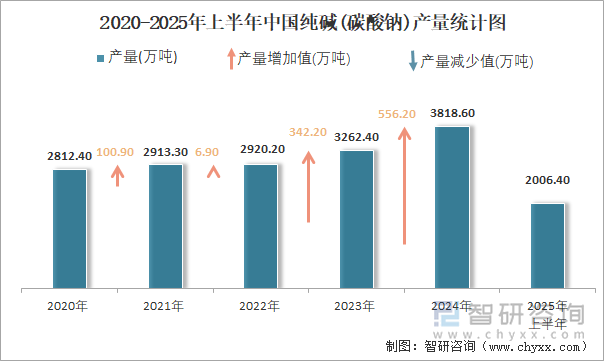
2025年1-6月中国纯碱(碳酸钠)产量为2006.4万吨 累计增长5.7%
Chan Ye Xin Xi Wang· 2025-08-26 02:45
Group 1 - The core viewpoint of the news highlights the growth in China's soda ash (sodium carbonate) production, with a reported output of 3.48 million tons in June 2025, reflecting a year-on-year increase of 4.7% [1] - In the first half of 2025, the cumulative production of soda ash in China reached 20.064 million tons, marking a cumulative growth of 5.7% [1] Group 2 - The companies mentioned in relation to the soda ash industry include Yuanxing Energy, Sanyou Chemical, Shandong Haihua, Shuanghuan Technology, Chlor-alkali Chemical, Jinjing Technology, Hubei Yihua, Yuntu Holdings, and Hebang Bio [1] - The report referenced is the "2025-2031 China Soda Ash Industry Market Special Research and Competitive Strategy Analysis Report" published by Zhiyan Consulting [1][3]