
通信

Search documents
CPO等算力硬件股继续走强,“易中天”权重占比超25%的通信ETF广发(159507)盘中最高涨近4%
Xin Lang Cai Jing· 2026-02-03 05:17
Group 1 - CPO and other computing hardware stocks continue to strengthen, with companies like Robotech and Tianfu Communication seeing over 10% gains, reaching historical highs [1] - The optical module sector is performing strongly, with companies like Zhongji Xuchuang and Xinyi Sheng releasing better-than-expected earnings forecasts, indicating sustained high demand for global computing infrastructure [1] - Zhongji Xuchuang expects a net profit of 9.8–11.8 billion yuan for 2025, a year-on-year increase of 89.5%–128.2%, while Xinyi Sheng anticipates a net profit of 9.4–9.9 billion yuan, a significant increase of 231.2%–248.9% [1] Group 2 - Starting in 2026, the value-added tax rate for certain telecom services will increase from 6% to 9%, which will accelerate the transformation of operators from traditional telecom service providers to comprehensive information service providers [2] - Major telecom operators are focusing on integrating communication, computing, and intelligent services, with China Mobile proposing three growth curves and China Telecom deepening its AI initiatives [2] - The computing sector is expected to remain one of the most prosperous technology directions in 2026, with a projected shortage of optical modules, indicating strong market demand [2] Group 3 - As of February 3, 2026, the Guozheng Communication Index rose by 1.82%, with the Guangfa Communication ETF increasing by 1.84%, reaching a peak of nearly 4% during the day [3] - The top ten weighted stocks in the ETF account for 54.9%, with notable increases in stocks like Xunwei Communication and Tianfu Communication [3] - The Guangfa Communication ETF has seen a recent scale growth of 22.88 million yuan and a net inflow of 2.1731 million yuan, indicating strong investor interest [3]
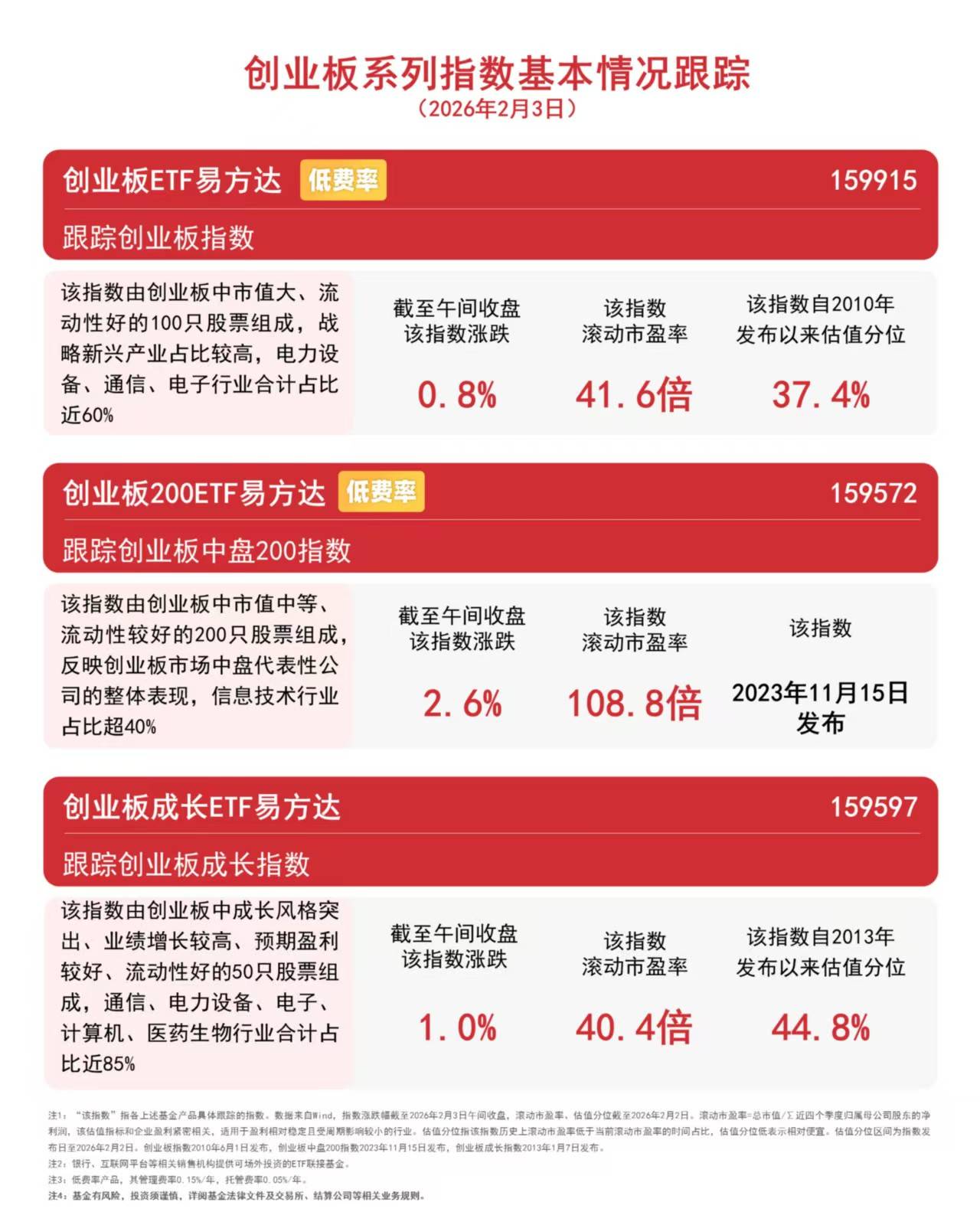
科技股回暖,创业板指半日涨0.8%,创业板ETF易方达(159915)昨日净流入超5亿元
Sou Hu Cai Jing· 2026-02-03 05:13
Core Viewpoint - The article discusses various ETFs tracking the ChiNext Index, focusing on their composition, performance, and sector allocations, highlighting investment opportunities in emerging industries. Group 1: ChiNext ETFs Overview - The ChiNext Index consists of 100 stocks with large market capitalization and good liquidity, primarily in emerging industries [2] - The ChiNext 200 ETF tracks the mid-cap 200 index, reflecting the overall performance of mid-cap companies in the ChiNext market [2] - The ChiNext Growth ETF tracks the growth index, composed of 50 stocks with high performance growth and good liquidity [2] Group 2: Performance Metrics - As of the latest midday close, the ChiNext Index showed a slight increase, with a rolling P/E ratio of 41.6 times [2] - The ChiNext 200 Index increased by 2.6%, with a rolling P/E ratio of 108.8 times [2] - The ChiNext Growth Index increased by 1.0%, with a rolling P/E ratio of 40.4 times [2] Group 3: Sector Allocations - The ChiNext Index has a high concentration in emerging industries, with nearly 60% in sectors like power equipment, communications, and electronics [2] - The information technology sector accounts for over 40% of the ChiNext 200 Index [2] - The growth index has approximately 85% of its composition in sectors such as communications, power equipment, electronics, computers, and biomedicine [2]


重视供需反转下的光纤光缆板块
HTSC· 2026-02-03 04:30
Investment Rating - The report maintains an "Overweight" rating for the communication industry and communication equipment manufacturing sector [9]. Core Insights - The G.652.D single-mode fiber price in China reached a nearly seven-year high of over 35 yuan per core kilometer in January 2026, driven by significant changes in supply and demand dynamics [1][2][13]. - Demand for optical fibers is surging due to global AI data centers and military applications, with a notable $6 billion contract signed between Meta and Corning for AI data center cabling [2][15]. - Supply constraints are expected as the production capacity of upstream optical fiber preform materials cannot be quickly adjusted, leading to sustained high prices for optical fibers [20][22]. Summary by Sections Market Overview - The communication index rose by 5.83% last week, while the Shanghai Composite Index fell by 0.44% and the Shenzhen Component Index dropped by 1.62% [1][13]. - The price increase of G.652.D single-mode fiber reflects a significant market shift, with a 75% increase in January alone [14]. Demand Drivers - The demand surge is primarily attributed to AI data centers and military applications, particularly FPV drones, which require high-performance optical fibers [15][19]. - The contract between Meta and Corning exemplifies the strong demand from AI data centers, with the order size comparable to Corning's entire revenue from optical communications in 2025 [15]. Supply Constraints - The global supply of optical fiber preform is nearing full capacity, with major manufacturers operating at high utilization rates [20]. - The expansion cycle for preform production is lengthy, indicating that supply shortages may persist, supporting high optical fiber prices [20][22]. Investment Opportunities - The report suggests focusing on the optical fiber and cable sector for potential earnings growth and valuation recovery, as price increases are expected to enhance profitability for leading manufacturers [22]. - Key recommended companies include ZTE Corporation, Walden Material, China Mobile, Ruijie Networks, Xinyi Technology, and Zhongji Xuchuang, all rated as "Buy" or "Overweight" [9][60].
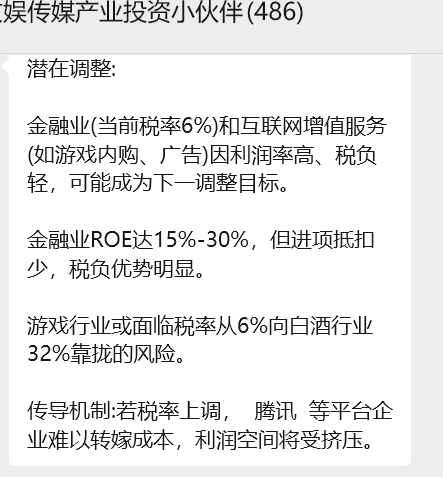
腾讯大跌6%,游戏要加税这个事是不是真的?
Xin Lang Cai Jing· 2026-02-03 03:19
Group 1 - The core rumor about a tax increase from 6% to 32% for the gaming industry is deemed unreliable, as the actual tax rates for major companies range from 15% to 25% [3][10] - The recent decline in Tencent's stock price, dropping 6% to 560, is attributed to market reactions to the tax rumors and other factors, leading to significant selling pressure from large investors [2][8] - The comparison of the gaming tax situation to the recent increase in value-added tax for telecommunications companies has contributed to market fears, although the gaming tax structure is more complex [3][10] Group 2 - The issuance of red envelopes by Yuanbao has been criticized in the tech community, with concerns that it disrupts users and questions Yuanbao's technical capabilities, but this should not justify a drop of over 5% in stock price [5][11] - There are concerns regarding capital expenditures, particularly in AI, with rumors suggesting a significant downward revision of revenue expectations for HWJ by 50-100%, indicating potential reductions in AI spending by major domestic companies [6][12]

华安基金:光模块业绩预告乐观,创业板50指数上周逆势上涨
Xin Lang Cai Jing· 2026-02-03 02:57
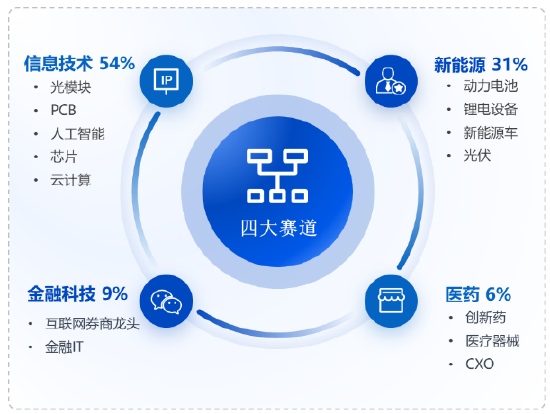
Market Overview - The A-share market exhibited a mixed trend last week, with the Shanghai Composite Index rising by 0.08%, while the CSI 500 and CSI 1000 fell by 2.56% and 2.55% respectively. The ChiNext 50 increased by 0.99% [1][10] - Daily trading volume in the A-share market averaged around 3 trillion yuan, indicating high investor enthusiasm. Market hotspots are rotating quickly, including sectors like commercial aerospace, precious metals, photovoltaic, AI applications, chip industry, and resource cyclical stocks [1][10] ChiNext 50 Index Insights - The ChiNext 50 Index serves as a direct financing platform for innovative enterprises focusing on "three innovations (innovation, creation, creativity)" and "four new (new technologies, new industries, new business formats, new models)" [1][10] - The index emphasizes sectors such as information technology, new energy, financial technology, and pharmaceuticals, showcasing pure technology growth attributes [1][10] Key Sectors Performance Technology, AI, and Communication - The ChiNext 50 Index includes 54% of the information technology sector, with significant weights in optical modules and AI application companies. Last week, optical modules performed notably well [3][13] - Key stocks like Zhongji Xuchuang and Xinyi Sheng are expected to benefit from the anticipated increase in 1.6T optical module production, with Xinyi Sheng projecting a net profit of 9.4-9.9 billion yuan for 2025, a 231% year-on-year increase [3][13] New Energy Photovoltaics - The new energy photovoltaic sector saw frequent hotspots last week, with SpaceX's "Million Starlink" plan emphasizing space solar energy as a long-term energy support. Silicon and perovskite technologies are prioritized for benefiting from this trend [4][14] - The capacity pricing mechanism has been implemented in multiple regions, improving the economic viability of large storage projects, benefiting system integrators as project initiation accelerates [4][14] Pharmaceutical and Biotechnology - The innovative drug industry chain is showing a positive trend across various dimensions, including investment data, order acquisition, and performance. The CRO sector is expected to see a turning point with new orders showing an increase in both volume and price [5][14] - The CDMO sector continues to experience strong growth, with a full order book and robust performance, alleviating previous concerns about geopolitical risks [5][14] ChiNext 50 ETF Overview - The ChiNext 50 ETF (code: 159949) tracks the ChiNext 50 Index, focusing on high-quality leading companies in five key technology sectors: new energy vehicles, biomedicine, electronics, photovoltaics, and internet finance [6][15] - The ETF has a substantial liquidity profile, with an average daily trading volume of 1.512 billion yuan over the past year, ranking among the top ETFs on the Shenzhen Stock Exchange [6][15] Recent Performance of ChiNext 50 ETF - The top ten weighted stocks in the ChiNext 50 ETF showed varied performance, with Ningde Times (19.80% weight) rising by 0.86%, while other stocks like Sunshine Power (4.93% weight) fell by 7.38% [7][16]
CPO反复活跃,天孚通信再创新高,低费率创业板人工智能ETF华夏(159381)盘中一度涨4%
Xin Lang Cai Jing· 2026-02-03 02:54
Group 1 - The CPO concept sector is active, with notable gains in stocks such as Zhishang Technology (up over 13%) and Tianfu Communication (up over 7%) [1] - Major players in the optical module sector, including Zhongji Xuchuang, Xinyi Sheng, and Tianfu Communication, have released earnings forecasts indicating significant profit growth, reflecting the acceleration of the AI industry and global data center construction [1] - Zhongji Xuchuang expects a net profit of 9.8 billion to 11.8 billion yuan for 2025, representing a year-on-year increase of 89.50% to 128.17% [1] - Xinyi Sheng anticipates a net profit of 9.4 billion to 9.9 billion yuan for 2025, with a year-on-year growth of 231.24% to 248.86% [1] - Tianfu Communication projects a net profit of 1.881 billion to 2.150 billion yuan for 2025, reflecting a year-on-year increase of 40.00% to 60.00% [1] - Changcheng Securities expresses optimism about the communication industry, highlighting the ongoing positive news across various sectors and the potential for investment in new directions such as commercial aerospace and quantum computing by 2026 [1] Group 2 - The Huaxia AI ETF (159381) tracks an index with nearly 50% weight in CPO and covers domestic software and AI application companies, providing high elasticity [2] - The top three weighted stocks in the Huaxia AI ETF are Zhongji Xuchuang (15.64%), Xinyi Sheng (15.57%), and Tianfu Communication (6.85%) [2] - The on-market comprehensive fee rate for the Huaxia AI ETF is only 0.20%, the lowest among similar products [2] - The Huaxia Communication ETF (515050) focuses on electronic components and communication hardware, with major holdings including Zhongji Xuchuang and Xinyi Sheng [2] - The Huaxia Cloud Computing ETF (516630) emphasizes domestic AI software and hardware, with a combined weight of 83.7% in computer software, cloud services, and computer equipment [2]

数说公募主动权益基金四季报:规模/份额双降、周期/金融配置权重上升
SINOLINK SECURITIES· 2026-02-03 02:53
1. Report Industry Investment Rating - No relevant content provided 2. Core Viewpoints of the Report - In Q4 2025, after nearly a year of upward trend, the A - share market started to move sideways and fluctuate, with wide - based indices showing mixed performance. Large and mid - cap value indices significantly outperformed growth indices, and the active equity fund scale and share decreased while the issuance quantity and scale slightly increased [3][8]. - The average stock position of equity funds slightly shrank, and the Hong Kong stock position also declined. Institutions increased the allocation in cyclical and financial sectors and adjusted the allocation in technology, medicine, and consumption sectors [3]. - The performance of theme funds in various industries was differentiated. Cyclical theme funds performed the best, while pharmaceutical theme funds performed the worst [3]. - Among the top 20 fund companies in terms of active equity fund scale, the scale changes compared to Q3 were mixed, with some companies' rankings changing [3]. - In Q4, the active equity fund most heavily held by FOF in terms of holding ratio and quantity was "Fuguo Steady Growth" [3]. 3. Summary by Related Catalogs 3.1 Fund Market Overview - **Performance Review**: In Q4 2025, the A - share market moved sideways and fluctuated after a year - long upward trend. Only the Shanghai Composite Index rose by 2.22% among wide - based indices, while others like the Shenzhen Component Index and the ChiNext Index declined. In terms of style, large and mid - cap value indices outperformed growth indices. The Hang Seng Index and related Hong Kong stock indices also declined [8]. - **Industry Index Performance**: Except for 9 industries such as medicine and beauty care, the remaining 22 industries in the Shenwan 31 - industry index achieved positive returns in Q4. Resources and military industries performed well, while the pharmaceutical industry was weak overall. The top 5 industries in terms of increase were non - ferrous metals (16.25%), petroleum and petrochemicals (15.31%), communication (13.61%), national defense and military industry (13.1%), and light industry manufacturing (7.53%) [11]. - **Equity Fund Performance**: In Q4 2025, ordinary stock - type funds, partial - stock hybrid funds, and flexible allocation funds declined by 1.94%, 1.60%, and 0.04% respectively, while balanced hybrid funds rose by 0.87%. In terms of risk, balanced hybrid funds with lower stock positions had the best drawdown performance, and flexible allocation funds showed better risk - return performance in the long - term [31]. - **Scale and Share**: By the end of Q4 2025, the total scale of active equity funds was 3.81 trillion yuan, a slight decrease of 4.53pct compared to the previous quarter, and the total share was 2.56 trillion shares, a decrease of 2.91pct. Among them, partial - stock hybrid funds had the largest scale, and balanced hybrid funds had the smallest scale [34]. - **Newly Issued Fund Situation**: In Q4, the number and scale of newly issued active equity funds slightly increased. A total of 100 funds were newly issued, with a total scale of 441.67 billion yuan, an increase of 4.72 billion yuan compared to the previous quarter. Partial - stock hybrid funds had the largest newly issued scale [36]. 3.2 Fund Holding Characteristics - **Stock/Hong Kong Stock Position**: In Q4 2025, the equity fund position slightly shrank, with the average stock position at 88.05%, a decrease of 0.88 percentage points compared to the end of the previous quarter. The Hong Kong stock position also decreased, with the average investment market value of Hong Kong stocks accounting for 11.62% of the net value, a decrease of 1.85 percentage points compared to the previous quarter [43]. - **Heavy - Holding Stock Sector Allocation**: In Q4, technology was the most heavily held sector by active equity funds. Except for cyclical, manufacturing, and financial sectors, the proportion of other sectors decreased. Institutions increased the allocation in cyclical and financial sectors and adjusted the allocation in technology, medicine, and consumption sectors [48]. - **Heavy - Holding Stock Industry Allocation**: The electronics industry was still the largest heavily - held industry by equity funds, but the allocation ratio decreased, and non - ferrous metals were significantly increased. The concentration of the top five industries slightly decreased from 58.58% in Q3 to 58.40% [50]. - **Individual Stock Level**: The top 10 individual stocks in terms of heavy - holding market value accounted for by equity funds were Zhongji Innolight, Xinyisheng, CATL, Tencent Holdings, Zijin Mining, Alibaba - W, Cambricon - U, Luxshare Precision, SMIC, and Kweichow Moutai. The market value proportion of Zhongji Innolight, Xinyisheng, and Ping An of China increased significantly, while that of Industrial Fuxing, Alibaba - W, and EVE Energy decreased relatively more [52]. - **Heavy - Holding Stock Market Value and Concentration**: The market value style of equity fund holdings continued to strengthen towards mid - and large - cap stocks. The concentration of the top 50, 100, and 200 heavy - holding stocks slightly decreased, but basically continued the previous trend [61]. 3.3 Fund Company Analysis - **Scale Ranking**: In Q4 2025, the scale changes of the top 20 fund companies in terms of active equity fund scale compared to Q3 were mixed. The top 5 institutions were E Fund, China Europe Asset Management, GF Fund, Fuguo Fund, and Huatai - PineBridge Fund. Among the companies ranked 6 - 20, the equity scale of Yongying Fund further increased, and its ranking rose by 2 places [64]. - **TOP20 Fund Company Heavy - Holding Industries**: The first - largest heavily - held industries of the top 20 fund companies were mainly electronics and medicine and biology. Dacheng Fund's first - largest heavily - held industry was non - ferrous metals, showing certain differences [65]. - **TOP20 Fund Company Heavy - Holding Stocks**: In Q4, the average concentration of the top three heavy - holding stocks of the top 20 fund companies in terms of active equity fund scale was 14.27%, and the concentration of the top five heavy - holding stocks was 21.04%, slightly increasing compared to the previous quarter. Xingquan Fund had the highest concentration of the top three heavy - holding stocks [67]. 3.4 Theme Fund Analysis - **Fund Performance**: In Q4, the performance of theme funds in various industries was differentiated. Cyclical theme funds performed the best, with a quarterly increase of 10.10%, followed by financial and manufacturing theme funds. Pharmaceutical theme funds had the worst performance, with a quarterly decline of 13.15% [71]. - **Pharmaceutical and Consumption Themes**: In pharmaceutical theme funds, the sub - sectors with a relatively high market value proportion in heavy - holding stocks were chemical preparations and other biological products. The sub - sectors with a relatively large increase in heavy - holding proportion were medical R & D outsourcing and traditional Chinese medicine. In consumption theme funds, the sub - sectors with a relatively high market value proportion were liquor and agriculture, forestry, animal husbandry, and fishery. The sub - sectors with a relatively large increase in heavy - holding proportion were food processing and social services [75]. - **Technology and New Energy Themes**: In technology theme funds, the sub - sectors with a relatively high market value proportion in heavy - holding stocks were artificial intelligence and consumer electronics industries. The sub - sectors with a relatively large increase in heavy - holding proportion were optical modules and IDC. In new energy theme funds, the sub - sectors with a relatively high market value proportion were energy storage and solid - state batteries. The sub - sectors with a relatively large increase in heavy - holding proportion were resource stocks and solid - state batteries [79]. 3.5 FOF Holding Analysis - **High - Holding - Ratio Funds**: In Q4 2025, the active equity fund with the highest holding ratio among FOF heavy - holding funds was "Fuguo Steady Growth", with a fund manager of Fan Yan. The fund's holding market value accounted for 2.53% of the total market value of all heavy - holding funds, an increase of 0.13% compared to the previous quarter [81]. - **High - Holding - Quantity Funds**: In Q4 2025, the active equity fund most heavily held by FOF in terms of quantity was still "Fuguo Steady Growth", followed by "Bodaojiu Hang" and "China Europe Dividend Premium Selection" [83]. - **Ratio/Quantity Changes**: In Q4 2025, the active equity funds with the largest increase in holding ratio and quantity among FOF heavy - holding funds were "Huatai - PineBridge Extended Growth Theme" and "China Europe Dividend Premium Selection" respectively [85]. - **New - Generation Fund Managers**: Among the active equity funds managed by new - generation fund managers with less than 3 years of management experience, the fund with the highest holding ratio among FOF heavy - holding funds in Q4 was "Rongtong Industrial Trend Selection", with a fund manager of Li Jin. The fund's holding market value accounted for 0.70% of the total market value of all heavy - holding funds, a quarter - on - quarter increase of 0.37% [87]. - **Holding Own Funds**: Different FOF institutions such as E Fund, China Europe Asset Management, Invesco Great Wall, Fuguo Fund, Huatai - PineBridge Fund, and Xingzheng Global Fund had different situations in holding their own equity funds, with different scales and top - held funds [89][91][94][96][98].




ETF周度配置指南2026.01.30(总04期)
申万宏源证券上海北京西路营业部· 2026-02-03 02:15
Core Viewpoint - The market is currently experiencing a "slow bull" characteristic with rapid thematic rotation, and there are potential investment opportunities in resource competition and domestic technology self-reliance strategies [2][19]. Market Performance - The A-share market showed volatility with the Shanghai Composite Index having the highest weekly gain of 1.13%, while the National 2000 Index experienced the largest decline of 2.76% [9][10]. - The performance of major indices includes: - Shanghai Composite Index: 3066.50, +1.13% weekly, +18.69% yearly [10] - CSI 300: 4706.34, +0.08% weekly, +23.30% yearly [10] - ChiNext Index: 3346.36, -0.09% weekly, +62.14% yearly [10]. Industry Performance - The oil and petrochemical, communication, and coal industries performed notably well with weekly gains of +7.96%, +5.83%, and +3.68% respectively [12][19]. - The non-ferrous metals sector saw significant adjustments due to decreased expectations of Federal Reserve interest rate cuts and short-term technical corrections, but the core drivers remain intact [2][19]. Investment Strategy - The company recommends focusing on long-term trend advantages and avoiding short-term speculation, with an emphasis on sectors benefiting from resource competition and technological self-reliance [2][19]. - Key areas for long-term investment include: 1. Resource competition driven by U.S. policies leading to increased self-sufficiency in defense, resources, finance, and supply chains, with commodity prices in an upward cycle [2][19]. 2. The acceleration of domestic technology self-reliance strategies due to intensified global tech competition, presenting opportunities for A-share technology growth sectors [2][19].
2月2日有色金属、电子、通信等行业融资净卖出额居前
Sou Hu Cai Jing· 2026-02-03 02:00
Summary of Key Points Core Viewpoint - As of February 2, the market's latest financing balance is 26,926.79 billion yuan, showing a decrease of 6.01 billion yuan compared to the previous trading day. Industry Financing Changes - 15 out of 31 industries reported an increase in financing balance, with the basic chemical industry seeing the largest increase of 0.69 billion yuan. Other notable increases were in the construction decoration, automotive, and building materials industries, which rose by 0.56 billion yuan, 0.25 billion yuan, and 0.17 billion yuan respectively [1][2] - Conversely, 16 industries experienced a decrease in financing balance, with the non-ferrous metals, electronics, and communications sectors showing the most significant declines of 3.27 billion yuan, 2.32 billion yuan, and 1.97 billion yuan respectively [1][2] Percentage Changes in Financing Balance - The construction decoration industry had the highest percentage increase in financing balance at 1.31%, followed by building materials, coal, and light manufacturing industries with increases of 1.18%, 0.96%, and 0.87% respectively [1] - The non-ferrous metals, petroleum and petrochemicals, and communications industries had the largest percentage decreases in financing balance, with declines of 2.09%, 1.95%, and 1.45% respectively [1][2]
中观行业比较月报(2026年1月):轮动中把握景气线索,关注涨价与科技-20260203
Ping An Securities· 2026-02-03 01:13
Group 1 - The report indicates that in January, the A-share market experienced a strong upward trend, with both cyclical and technology sectors performing well, leading to a significant increase in major indices [8][9] - The report highlights that 26 out of 31 sectors in the Shenwan index saw gains, with non-ferrous metals, oil and petrochemicals, and basic chemicals benefiting the most from rising commodity prices, showing increases between 12% and 23% [8][12] - The report notes that the semiconductor sector, particularly storage, is leading the price increase cycle, driven by sustained demand for AI hardware and software [3][12] Group 2 - The upstream cycle is characterized by significant price increases in non-ferrous metals, with many commodities reaching over 90% of their two-year high percentile range, while oil and chemical products are also seeing price increases, albeit remaining below historical averages [2][16] - The midstream manufacturing sector is experiencing price hikes in materials related to the new energy industry, with exports supporting the demand in certain sectors, although domestic demand remains weak [2][3] - The consumer sector shows signs of marginal improvement, with prices for live pigs and liquor stabilizing, while the real estate market continues to face challenges with negative sales area and price growth [3][4] Group 3 - The valuation comparison indicates that the non-ferrous and TMT sectors have seen significant valuation expansion, currently positioned at historically high percentiles, while valuations in banking and certain consumer sectors have contracted [5][6] - The report suggests that the spring market trend is likely to continue, with structural opportunities emerging, particularly in sectors with price increases and technology [5][6] - The report emphasizes the importance of monitoring the cyclical and semiconductor sectors for potential investment opportunities, as well as focusing on competitive midstream manufacturing companies [5][6]