
家电

Search documents
人机协同 质效双升 海信QC小组重筑制造质量防线引领智能检验新浪潮
Zhong Guo Zhi Liang Xin Wen Wang· 2026-02-03 07:59
转自:中国质量报 这个转变始于一个简单的疑问:人检得再快再准,总有极限,为什么不让机器学会自己检,让数据学会 自己判断?这个看似直白的问题,却引领QC小组走上了一条充满挑战的革新之路。 海信QC小组重筑制造质量防线引领智能检验新浪潮 QC小组并未满足于对现有流程的优化。他们与产品研发端紧密协同,共同研究推出了"主动式质量检 验"新模式。这一模式颠覆了"一刀切"式的检测标准,实现了根据不同类型、不同系列产品的独特技术 特点,自定义专属的检测方案与参数。这意味着,质量检验不再是一个被动验证的终点,而是深度融入 产品设计链条的主动环节,从源头上确保产品性能得到最优展现,实现质量保障能力的又一次维度提 升。 □ 本报记者 朱文达 在制造业的生产流程中,质量检验常常被视为产品流向市场前的最后一道关卡,关乎企业的生命与声 誉。而这一环节依赖人工操作与经验判断,效率受限、数据孤岛成为常态。在海信,有这样一个团队 ——空气产业黄岛工厂质量管理(QC)小组(以下简称"QC小组"),正通过技术创新重新定义这一环 节,将传统依赖人工的检验模式,改造为自动化、智能化的新型检测体系。 "我们不是简单地解决技术问题。"QC小组组长在接受 ...

国信证券:原材料价格上涨对白电龙头影响有限 白电排产表现有所修复
智通财经网· 2026-02-03 07:32
Core Viewpoint - Recent increases in raw material prices, particularly copper and aluminum, have raised concerns about the profitability of leading white goods companies, but historical data suggests that the negative impact on gross margins may diminish over time [1][2] Group 1: Raw Material Price Impact - Since 2008, the home appliance industry has experienced three significant raw material price increase cycles, with the impact on gross margins decreasing over time: the highest quarterly gross margin decline was 5-7 percentage points during 2009-2011, around 5 percentage points in 2016-2017, and approximately 2 percentage points from 2020-2022 [1] - In January 2026, copper and aluminum prices increased by 36.7% and 20.9% year-on-year, respectively, which is lower than the increases seen from 2020-2022, suggesting that the current raw material cost impact on white goods companies may be less severe [2] Group 2: Production and Demand Trends - In February, the total production of white goods in China reached 23.79 million units, a 22.1% decrease compared to the same period last year, with a projected 5.0% decline for January-February combined [3] - The production performance of white goods has shown signs of recovery, with the impact of the Spring Festival timing affecting February production, but cumulative growth for January-February has slightly improved [3] Group 3: Retail Market Performance - In 2025, the retail scale of China's home appliance market is expected to decline by 4.3% year-on-year to 893.1 billion yuan, with specific categories like air conditioners and refrigerators experiencing declines of 0.4% and 11.5%, respectively [4] - Small home appliances are expected to perform better, with an overall retail growth of 3.8%, indicating a relative resilience compared to larger appliances [4] Group 4: Key Data Tracking - In January, the home appliance sector experienced a relative return of -2.6%, with raw material prices for copper and aluminum increasing by 7.8% and 4.8% month-on-month, respectively [5] Group 5: Investment Recommendations - Recommended stocks in the white goods sector include Midea Group, Haier Smart Home, TCL Smart Home, and Hisense Home Appliances, while TCL Electronics and Hisense Visual are recommended in the black goods sector [6]




财通策略、多行业:2026年2月金股月度金股-20260203
CAITONG SECURITIES· 2026-02-03 07:16
Core Insights - The report emphasizes the historical positioning of silver indicators, noting that 93% of historical dates are below 200%, while the current level exceeds 1800%, indicating potential price adjustments during the decline phase of silver [11] - It highlights the macroeconomic narratives, including geopolitical tensions and the impact of the new Federal Reserve chair, suggesting that the current market is less influenced by overseas factors [3][12] - The investment strategy focuses on three main areas: core growth assets, global competitive advantages, and emerging growth sectors, with specific recommendations for companies in these categories [14] Company Summaries TCL Electronics (01070) - TCL Electronics is forming a joint venture with Sony, where TCL will hold 51% and Sony 49%, aiming to leverage cost and technology advantages in the large-size and mini LED sectors [15] - The joint venture is expected to enhance TCL's high-end product series capabilities [15] Mao Geping (01318) - The brand is expanding its global presence with a new store in Hong Kong and a focus on integrating Eastern aesthetics with modern art, enhancing its international brand narrative [16] Anjuke Food (603345) - The company is shifting from a reliance on large B2B clients to a selective supermarket customization strategy, collaborating with major retailers to launch tailored products, resulting in a 28.1% year-on-year revenue increase in the supermarket channel [17] Chengda Pharmaceutical (301201) - Chengda is transitioning towards biocell therapy, developing innovative drug pipelines and forming strategic partnerships, including a significant collaboration with Chiron Pharma, which has led to clinical advancements [19] Xinquan Co., Ltd. (603179) - The company has established strong partnerships with major domestic truck manufacturers and is focused on expanding its automotive component offerings, leveraging over 20 years of industry experience [20] Jianghuai Automobile (600418) - Jianghuai is developing a new generation of high-end intelligent electric vehicles, integrating advanced technologies from partnerships with high-tech companies like Huawei [21] Chip Origin (688521) - The company reported significant growth in its chip design and mass production businesses, with a 290.82% quarter-on-quarter increase in design revenue and a 132.77% increase in mass production revenue [22] Tencent Holdings (00700) - Tencent's performance exceeded expectations with a 15.4% year-on-year revenue growth, driven by strong sales and R&D efficiency, leading to a notable increase in net profit [23] China Resources Land (01109) - The company is transitioning its real estate service platform to offer comprehensive lifecycle services, enhancing customer engagement through a new digital platform [24] China Merchants Energy Shipping (601872) - The company is benefiting from rising oil shipping rates, with Q4 2025 VLCC average rates reaching $94,000 per day, marking a significant increase in operational profits [26]




“新国补”落地首月 绿色、智能、健康成为家电消费新趋势
Xin Hua She· 2026-02-03 06:42
"旧的平板电脑用了4年,其实可换可不换,但补贴下来价格挺划算,还是换了新的。"重庆市民李思思给记者算了笔账,她看好的一款平板电脑售 价4399元,旧的平板电脑经评估可抵扣600元,叠加500元的政府补贴,最终实际支付3299元,节省了1100元。 "领券、以旧换新、核销购买一站式完成,还支持分期支付,全程也就10多分钟。"李思思说。 河南漯河的一家汽车销售4S店里,销售人员正为消费者讲解车辆信息。新华社记者杨金鑫 摄 2026年,汽车、家电、数码和智能产品等消费品以旧换新政策持续加力实施。"新国补"落地首月,消费者更新需求加快释放,与产业转型良性互 动,推动消费市场扩容"焕新"。 "看好了一辆17万元的车,厂家补贴了1万块钱,自己的旧车也符合报废标准,以旧换新又帮我省了近2万块钱,相当于14万多元就拿下了新 车。"在河南漯河的一家汽车销售4S店里,开了多年燃油车的消费者于女士,在详细了解"新国补"相关政策和优惠活动后,当即决定购买一辆新能 源汽车。 销售经理邱明嘉告诉记者,今年汽车"新国补"已全面落地,消费者报废符合条件的旧车并购买新能源乘用车,按新车销售价格的12%给予补贴, 最高补贴2万元。 "国家补贴、 ...


家电渠道扁平化的业务机遇
Xin Lang Cai Jing· 2026-02-03 06:33
家电产业链,下游渠道 ★ ★ 转 载 声 明 转载请联系market-service@cib.com.cn邮箱,我们尽快给予回复。本报告相关内容未经我司书面许可,不得进行引用或转载,否则我司保留追诉权利。 服 务 支 持 人 员 经过近四十年代的发展,家电渠道已从"广覆盖"的扩张时代,迈入"提效率"的深耕阶段。20世纪90年代至2013年"家电下乡"政策结束前,家电销售增长高 度依赖渠道扩张,因此渠道建设以提高覆盖面为目标,企业往往依托代理商进行渠道扩张。自2013年以来,主流家电企业渠道建设基本完成,叠加电商平 台迅猛发展,渠道竞争重心开始转向提高效率,旨在降低流通成本、提升价格竞争力。 提高渠道效率的关键在于扁平化。格力着力重构厂商关系,在推动线上发展、强化对线下渠道管控的基础上,于2025年建立"恒信系"渠道体系,迈出扁平 化关键一步。美的以提升供应链效率与数字化能力为驱动,继2017年推行网批模式后,于2024年启动直达消费者模式(Direct to Consumer,DTC),有效 支撑中小型零售渠道的扁平化拓展。海尔智家通过私有化海尔电器,消除产销职能的交叉,又于2025年推进"数字库存"变革,实 ...

美的全屋智能走俏 这些功能备受用户推崇
Jiang Nan Shi Bao· 2026-02-03 05:26
拍一拍,卧室就懂你要睡了 美的全屋智能的"魔法"究竟有多神奇?拍一拍,我是就知道你要睡觉了。在美的全屋智能的卧室场景里,入睡不 是一件需要手动操作的事,系统通过无感感知你的状态,轻拍一下小夜灯,灯光渐暗、空调调温、窗帘闭合、新 风静启,整个空间自动进入最适合入眠的微气候。重点是,系统还能识别你的睡眠阶段,深睡时保持安静稳定, 浅睡时用轻柔音乐帮你延续好梦,从此再也不用手动关灯、调温,因为你的一"拍",美的全屋智能就已经帮你想 好要做的事情,主动提供一系列服务了。 快节奏的工作与生活,令好好睡觉成为都市白领的一个难题。如今,随着科技的进步,是时候启用美的全屋智能 的"拍拍安睡"魔法了。困了?拍一拍床头的小夜灯,窗帘主动闭合、主灯自动关闭、空调开启睡眠模式、加湿器 开始补湿……脑子还没反应过来,身体已经进入晚安模式。从此早睡,真的可以很简单。 美的全屋智能,让家处处会思考 当然,美的全屋智能的用心不止于这两个场景,厨房里的烟灶联动、食材提醒,阳台上的洗衣晾晒自动衔接,客 厅里的光影、空气调节,卫浴里热水器、灯光联动,人们每一个生活场景都有着主动服务的巧思,甚至当你开车 回家,系统通过地理围栏提前开启回家模式,推门 ...

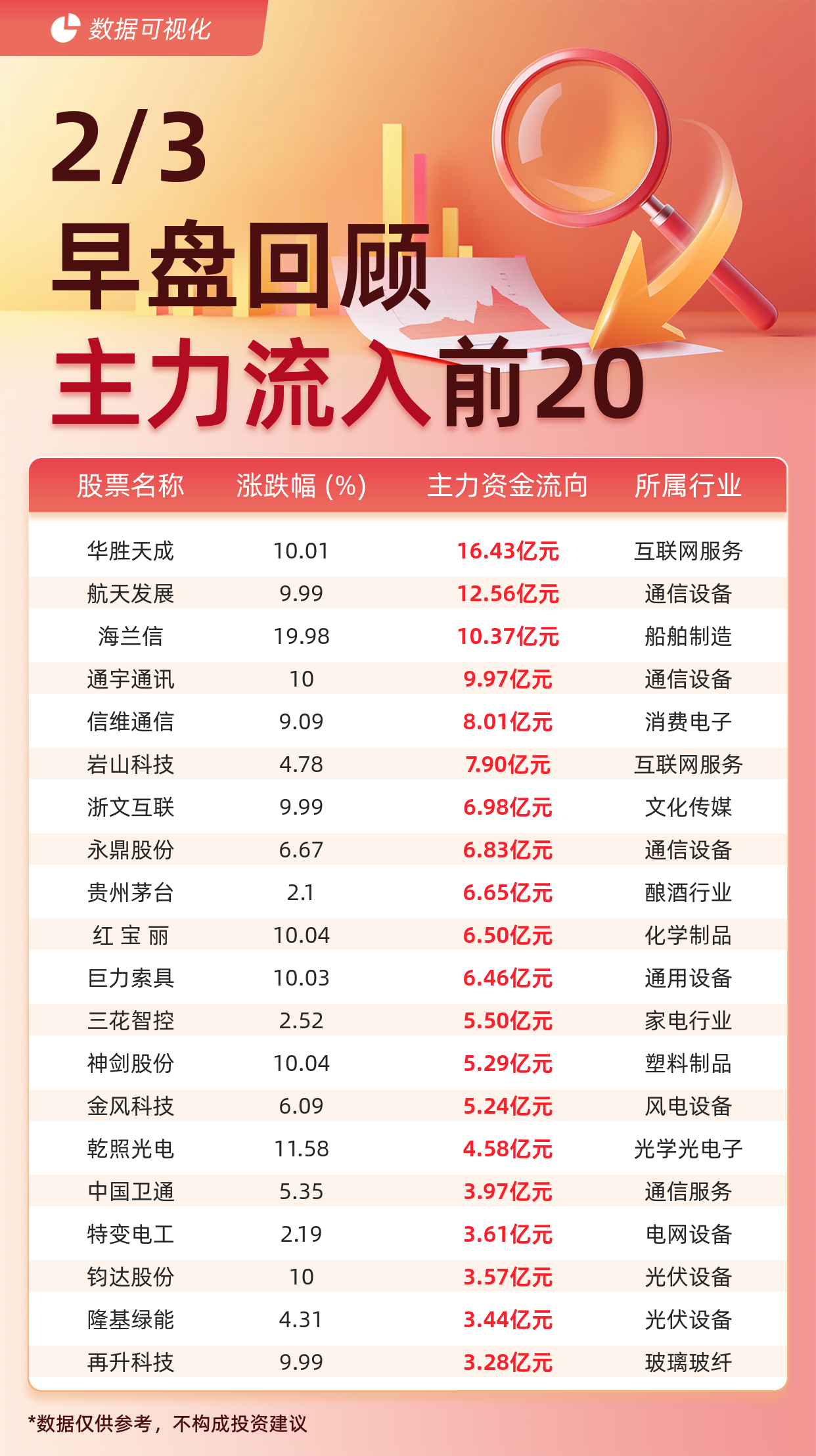
主力资金流入前20:华胜天成流入16.43亿元、航天发展流入12.56亿元
Jin Rong Jie· 2026-02-03 04:08
Group 1 - The top 20 stocks with significant capital inflow as of February 3 include Huasheng Tiancheng (1.643 billion), Aerospace Development (1.256 billion), and Hailanxin (1.037 billion) [1] - Huasheng Tiancheng saw a price increase of 10.01%, while Hailanxin experienced a notable rise of 19.98% [2][3] - Other notable stocks with substantial capital inflow include Tongyu Communication (0.997 billion), Xinwei Communication (0.801 billion), and Yonding Co. (0.683 billion) [1][2] Group 2 - The sectors represented among the top inflow stocks include Internet Services, Communication Equipment, and Consumer Electronics [2] - Guizhou Moutai, a major player in the liquor industry, attracted 0.665 billion with a price increase of 2.1% [2] - Companies like Junda Co. and Longi Green Energy, both in the photovoltaic equipment sector, also saw significant capital inflow of 0.357 billion and 0.344 billion respectively [3]



中金:黄金巨震,A股如何反应?
Xin Lang Cai Jing· 2026-02-03 03:14
Market Performance - The A-share market showed weakness today, with the Shanghai Composite Index falling by 2.5% [1][5] - Major indices experienced declines, including the CSI 300 down 2.1%, the STAR 50 down 3.9%, and the ChiNext Index down 2.5% [1][5] - The trading volume today was 2.6 trillion yuan, a decrease of approximately 0.26 trillion yuan compared to the previous trading day [1][5] External Factors - The adjustment in the A-share market is primarily attributed to increased external uncertainties, including the nomination of Kevin Walsh as the next Federal Reserve Chairman, which has affected expectations for U.S. monetary policy [2][6] - Global commodity prices have sharply declined, impacting market sentiment and risk appetite, with significant drops in gold and other commodities [2][6] Investment Strategy - The current market volatility presents opportunities for bottom-fishing, as the underlying positive factors such as ample liquidity and improving performance remain unchanged [3][7] - The market is expected to continue supporting Chinese assets in 2026, driven by the restructuring of international order and domestic industrial innovation trends [3][7] Sector Focus - Suggested areas for investment include: 1. Growth sectors such as AI technology, cloud computing, and innovative pharmaceuticals, which are entering a growth cycle [4][8] 2. Export-oriented sectors, particularly in home appliances, engineering machinery, and gaming, which are seen as stable growth opportunities [4][8] 3. Cyclical sectors like chemicals and renewable energy, which may benefit from improving supply-demand dynamics [4][8] 4. High-dividend stocks, which are attractive for long-term investors seeking stable cash flow [4][8]
未知机构:中信家电2025Q4基金重仓专题预期改善Q4基金重仓家电比例环比回暖-20260203
未知机构· 2026-02-03 02:20
Summary of Key Points from the Conference Call Industry Overview - The focus is on the home appliance industry, specifically the performance of major appliance segments including white goods, black goods, kitchen appliances, and small appliances [1][2][5]. Core Insights - **Fund Holdings in Home Appliances**: In Q4 2025, the proportion of actively managed equity funds holding home appliances increased, but it remains at a historically low level [1][3]. - **White Goods Performance**: The proportion of funds invested in white goods has seen a recovery, with a notable increase in the number of funds holding these stocks [5]. The market anticipates a continuation of national subsidies in 2026, which is expected to support domestic demand [5]. - **Black Goods Stability**: The proportion of funds in black goods remained stable, attributed to significant pressure on domestic sales due to the depletion of demand from previous subsidies [6][7]. - **Diverse Segment Performance**: Kitchen appliances, small appliances, and lighting segments are experiencing varied levels of attention, with some remaining underweight due to weak demand in the real estate sector [8]. Financial Metrics - **Fund Holdings Data**: - In Q4 2025, the proportion of actively managed equity funds in home appliances was 2.05%, up by 0.11 percentage points from the previous quarter [5]. - The allocation to white goods was 1.58%, an increase of 0.23 percentage points, with a significant rise in the number of funds holding these stocks [5]. - The underweight status for kitchen appliances, small appliances, and lighting was noted, with respective allocations of 0.03%, 0.03%, and 0.02% [8]. Future Outlook - **Market Expectations**: The outlook for leading home appliance companies is positive, with expectations of steady growth in performance [2][5]. - **Investment Recommendations**: - Focus on leading white goods companies that are expected to benefit from continued national subsidies in 2026 [8]. - Consider companies with manufacturing and brand advantages in overseas markets, such as Midea Group, Haier Smart Home, and TCL Electronics [8]. - Opportunities in MiniLED technology and commercial cold chain sectors are highlighted, with specific companies like Hisense and TCL leading in these areas [8][9]. Risks and Considerations - Potential risks include geopolitical trade risks, intensified industry competition, significant fluctuations in raw material prices, and the possibility of market demand recovery falling short of expectations [11].

港股概念追踪|以旧换新政策带动消费需求释放 机构普遍看好家电产业链估值回暖(附概念股)
Zhi Tong Cai Jing· 2026-02-03 01:32
Core Viewpoint - The "trade-in for new" policy is expected to significantly boost consumer demand in the home appliance sector, with sales revenue for various categories projected to grow substantially by 2025 [1][2]. Group 1: Consumer Demand and Market Trends - The National Taxation Administration's analysis indicates that by 2025, retail sales for home appliances like refrigerators, kitchen appliances, and communication devices are expected to increase by 17.4%, 12.9%, and 18.6% year-on-year, respectively [1]. - A new round of trade-in activities is actively taking place across various regions, with local governments providing subsidies to encourage participation, leading to high consumer turnout [1]. Group 2: Industry Outlook and Valuation - Current valuations in the home appliance sector are at historical lows, presenting a compelling investment opportunity due to stable growth and high dividend characteristics [2]. - Expectations for improved performance are noted, with a projected increase in the proportion of actively managed equity funds invested in home appliances by Q4 2025, although still at low historical levels [2]. Group 3: Key Companies in the Home Appliance Sector - Notable companies in the home appliance industry include Midea Group (00300), Haier Smart Home (06690), Hisense Home Appliances (00921), TCL Electronics (01070), Skyworth Group (00751), and Xiaomi Group-W (01810) [3].

