
券商

Search documents
国证国际港股晨报-20251215
Guosen International· 2025-12-15 09:36
Group 1: Market Overview - The Hong Kong stock market experienced a collective rebound, with the Hang Seng Index rising by 1.75%, the Hang Seng China Enterprises Index increasing by 1.62%, and the Hang Seng Tech Index up by 1.87% [2] - Market sentiment improved significantly, with major sectors contributing to the upward movement, leading to a total trading volume of approximately HKD 242.7 billion [2] - Despite the overall market rebound, southbound capital flow (Northbound) continued to weaken, with a net outflow of approximately HKD 5.3 billion, marking the weakest day since early October [2] Group 2: Sector Performance - The power equipment and wind power sectors showed remarkable performance, with leading companies like Dongfang Electric (1072.HK) and Harbin Electric (1133.HK) seeing gains exceeding 10% [3] - The financial sector also performed well, with Chinese brokerage and insurance stocks rising, as regulatory changes allowed insurance companies to reduce capital requirements for holding certain quality equity assets [3] - Precious metals continued to show strength, with spot gold nearing USD 4,300 and silver reaching a historical high, contributing to significant gains for related stocks like China Silver Group (815.HK) and Zijin Mining (2899.HK) [3] Group 3: Company Analysis - Lenovo Group (992.HK) - Lenovo's performance in Q2 2026 exceeded expectations, with the Intelligent Devices Group (IDG) revenue growing by 11.8% year-on-year to USD 15.11 billion, benefiting from increased AI computer shipments and strong sales of high-end products [7] - The Infrastructure Solutions Group (ISG) revenue surged by 23.7% year-on-year to USD 4.09 billion, driven by AI infrastructure business, although it reported an operating loss of USD 120 million [7] - The Solutions and Services Group (SSG) achieved record performance with an 18.1% revenue increase to USD 2.56 billion, and an operating profit margin of 22.3%, reflecting strong demand for digital workplace solutions and hybrid cloud services [8] Group 4: Strategic Initiatives - Lenovo is shifting its AI strategy to focus on user-centric and enterprise-centric applications, aiming to create "personal intelligent twins" and "enterprise intelligent twins" to enhance user experience and data insights [8] - The company is prepared to address storage supply shortages and price increases by securing long-term agreements with key suppliers and leveraging its cost advantages to manage potential cost pressures [9] - The forecast for adjusted net profit for the fiscal years 2025/26 and 2026/27 is USD 1.62 billion (up 12.5% year-on-year) and USD 1.78 billion (up 9.9% year-on-year), respectively, with a target price of HKD 12.3, indicating a "buy" rating [9]
长城投研速递:政策预期有望上修,跨年攻势或渐启动
Sou Hu Cai Jing· 2025-12-15 09:00
Policy Direction - The Central Economic Work Conference emphasizes the need to "consolidate and expand the economic momentum" and requires a "more proactive" fiscal policy with "domestic demand as the main driver" [1][3] - The conference introduces the goal of "stopping the decline in investment" for the first time in ten years and revisits the concept of "de-stocking" in real estate [1][3] Domestic Macro - In November, the CPI rose by 0.7% year-on-year, while the PPI fell by 2.2% year-on-year, influenced by food prices, consumer subsidies, and rising gold prices [5][6] - November's export growth was 5.9% (previous value -1.1%), and import growth was 1.9% (previous value 1.0%), indicating strong export momentum for non-US and non-re-export capital goods [5][6] Foreign Macro - The Federal Reserve lowered interest rates by 25 basis points to a range of 3.50%-3.75% in December, aligning with expectations and indicating a more optimistic outlook on the US economy and inflation [8] - The Fed's cautious stance on future rate cuts reflects internal divisions and a focus on managing short-term market pressures [8] Bond Market - The bond market is expected to maintain a range-bound pattern without significant trend reversals, with key variables such as inflation data and policy tool implementation being closely monitored [9][16] - Recent trends show a mixed performance in the bond market, with government bond yields fluctuating and credit bonds experiencing an increase in issuance [12][16] Equity Market - The equity market shows a preference for technology growth, with the Shanghai Composite Index down 0.34% and the ChiNext Index up 2.74% [17][18] - Growth styles outperformed value styles, with mid-cap stocks leading the performance [18][26] Investment Strategy - The company recommends increasing offensive positions in investments, particularly in technology, brokerage, and consumer sectors, as policy expectations may improve [2][27] - The upcoming spring market is viewed as a potential opportunity for investment, with a focus on large-cap growth stocks and sectors showing signs of recovery [28][29]

午后爆发,603601,六连板
Zheng Quan Shi Bao· 2025-12-15 08:19
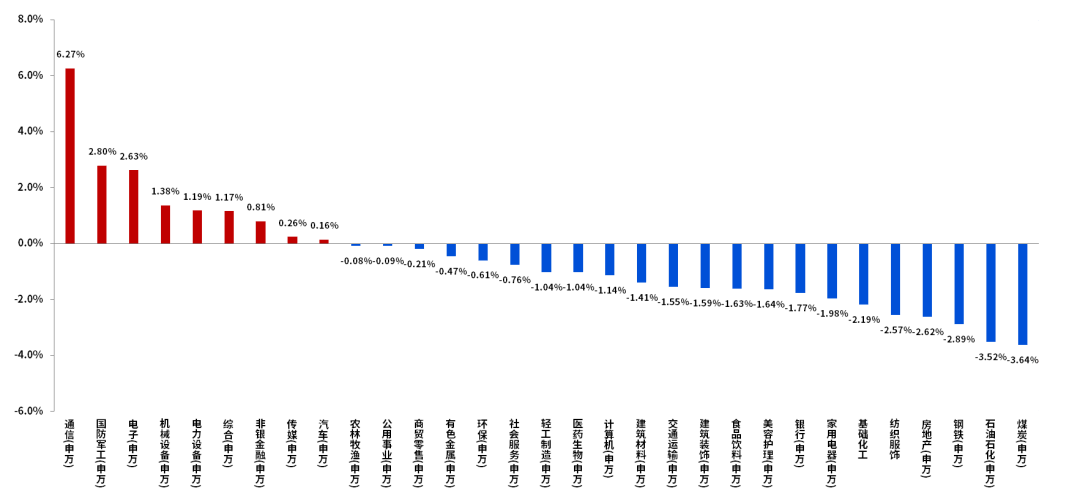
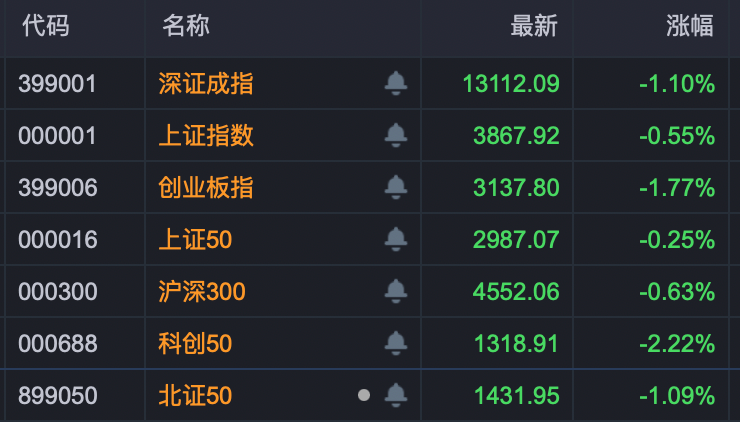
Market Overview - On December 15, the A-share market experienced fluctuations, with the Shanghai 50 index losing and regaining the 3000-point mark, while the Sci-Tech 50 index fell over 2%. Other indices such as the Shenzhen Component, ChiNext, and North 50 also dropped more than 1%. Market turnover decreased to 1.79 trillion yuan [1]. Index Performance - The Shenzhen Component Index closed at 13,112.09, down 1.10% - The Shanghai Composite Index closed at 3,867.92, down 0.55% - The ChiNext Index closed at 3,137.80, down 1.77% - The Sci-Tech 50 Index closed at 1,318.91, down 2.22% - The North 50 Index closed at 1,431.95, down 1.09% [2]. Sector Performance - The aerospace equipment, insurance, glass fiber, and consumer sectors showed the highest gains, while components, high-priced stocks, motor manufacturing, and communication equipment faced the largest declines [2]. Capital Flow - Defense and military industry saw a net inflow of over 6.1 billion yuan, while non-bank financials and basic chemicals each received over 4 billion yuan. Retail, non-ferrous metals, and other sectors also gained over 2 billion yuan. Conversely, the electronics sector experienced a net outflow of over 12.7 billion yuan, and the power equipment sector saw a net outflow of over 2.6 billion yuan [3]. Market Outlook - According to Zhonghang Securities, the "spring market" often extends beyond the Spring Festival, with a median duration of 35 trading days and a median return of 11% over the past decade. The pre-Spring Festival period typically sees a median return of 6.87%, while the post-Festival period averages a return of 7.10% [3]. - Haitong International believes that the overall space for future corrections is limited, suggesting that it remains a window for bargain hunting. Recent support for domestic consumption is expected to yield relative returns in a volatile environment. The brokerage sector, with low valuations, may provide market support [3]. Sector Highlights - The glass fiber sector saw significant activity, with stocks like Zhaosheng Technology hitting a new four-year high after a six-day consecutive rise. Other companies in the sector also experienced notable upward movements [4]. - Glass fiber is identified as a core reinforcement material for wind turbine blades, with demand projected to reach 800,000 tons in 2024 and 1.55 million tons by 2030 in the wind power sector [6]. - CITIC Securities anticipates continued growth in the glass fiber industry, particularly for high-end products, with leading companies expected to see profit increases due to favorable product structure and market positioning [6]. Consumer Sector Developments - Recent favorable policies in the consumer sector include a joint notification from several government departments aimed at boosting consumption through financial support and innovative consumption models [7]. - The notification encourages financial institutions to enhance services for various consumption sectors, including upgrading goods and expanding service consumption [7]. - Century Securities highlights the integration of AI technology in enhancing consumer experiences and suggests focusing on leading companies in the elderly products and consumer electronics sectors [7].

开放式基金周报(20251214)-20251215
Haitong Securities International· 2025-12-15 07:16
1. Report Industry Investment Rating - Not provided in the given content 2. Core View of the Report - It is recommended to allocate in a balanced and growth - oriented style, emphasizing technology growth - style funds and also considering large - financial and pro - cyclical assets [1][3][15] 3. Summary According to Relevant Catalogs 3.1 Last Week's Market Review - **A - shares**: A - shares fluctuated last week. The communication, national defense and military industry, and electronics sectors performed well. The Shanghai Composite Index fell 0.34% to 3889.35 points, and the Shenzhen Component Index rose 0.84% to 13258.33 points. The trading volume of the two A - share markets increased by about 1256.4 billion yuan compared with the previous week [6] - **Bond market**: The bond market rose. The CPI in November 2025 rebounded year - on - year to 0.7%, and the PPI fell year - on - year to - 2.2%. The yield of most bonds declined, and the main bond indexes showed a mixed performance [7] - **US stocks and commodities**: US stocks fluctuated. The Dow Jones Industrial Average rose 1.05%, the S&P 500 Index fell 0.63%, and the Nasdaq Index fell 1.62%. Oil prices fell, and gold and silver prices rose [8] 3.2 Last Week's Fund Market Review - **Stock - type funds**: Stock - type funds rose 0.38% overall. Some funds heavily invested in overseas computing power, chip semiconductors and other sectors performed well. Index funds related to communication equipment, artificial intelligence, and semiconductors also had good performance [10] - **Bond - type funds**: Bond - type funds rose 0.07% overall. Partial - debt bond funds and convertible - bond funds with equity assets in electronics, military industry and other sectors performed well [11] - **QDII funds**: The overall performance of QDII equity - hybrid funds declined by 1%, while some funds mainly investing in the global technology field performed well. QDII bond funds fell 0.07% [11] - **Other funds**: The annualized yield of money market funds was 1.21%. Gold ETFs and their linked funds rose 0.8%, and commodity - type funds rose 0.84% [11][12] 3.3 Future Investment Strategy - **Macro aspect**: The Fed cut interest rates by 25BP, and internal differences increased. It was more optimistic about the US economy and inflation, and started technical balance - sheet expansion. It is expected that interest rate cuts will continue in 2026, and US bond yields will first decline and then rise [12] - **Stock market**: The Chinese stock market is expected to enter a cross - year offensive. It is optimistic about technology, brokerage, and consumption sectors. It is recommended to invest in technology growth, large - financial, and pro - cyclical assets [13][15] - **Bond market**: In 2026, credit risk is expected to be generally controllable. It is recommended to focus on short - to - medium - term credit sinking to explore coupon payments and pay attention to trading opportunities of medium - and long - term bonds [13][14][15] - **Fund investment**: For stock - hybrid funds, allocate in a balanced and growth - oriented style, emphasizing technology growth - style funds and considering large - financial and pro - cyclical assets. For bond funds, focus on flexible - operation fixed - income products. For money market funds, there is no trend investment opportunity. For commodity funds, appropriately allocate gold ETFs [15] 3.4 Fund Market Latest Developments - **Regulatory policy**: The regulatory authorities issued a draft for soliciting opinions on standardizing the sales behavior of public - offering funds, including requirements for fund performance display [16][18] - **Industry development**: The public - offering index - enhancement business has developed rapidly. As of December 10, 168 new index - enhancement funds have been established this year, with a total new - issuance scale exceeding 92 billion yuan [19] - **New product issuance**: 23 new funds were established last week, with an average subscription period of about 13 days and an average raised share of 792 million shares [20] - **Fund dividends**: 84 funds will conduct equity registration in the coming days, and the most notable one is Huashang Advantage Industry A, with a dividend of 2.347 yuan per 10 shares [21]
港股午评 恒生指数早盘跌0.92% 黄金股逆市走高
Jin Rong Jie· 2025-12-15 05:01
Market Overview - The Hang Seng Index fell by 0.92%, down 238 points, closing at 25,737 points, while the Hang Seng Tech Index dropped by 1.79% [1] - The early trading volume in the Hong Kong stock market was HKD 108.2 billion [1] Gold Sector - Gold stocks rose against the market trend due to increased central bank purchases and growing investment demand, with Zijin Mining International (02259) up 6.94% and Chifeng Jilong Gold Mining (06693) up 3% [1] Resource Sector - Jiexin International Resources (03858) increased by over 6% as tungsten prices reached new highs, with institutions expecting a continued upward trend across the entire industry chain [2] - Chinese securities firms, including China Merchants Securities (06099) and Dongwu Securities, saw stock price increases due to announcements of higher margin trading limits [2] Insurance Sector - Domestic insurance stocks continued to rise, with expectations of double-digit growth in new business premiums and NBV, leading to Xinhua Insurance (01336) rising nearly 4% and China Pacific Insurance (02601) up 2.6% [2] Sportswear Sector - The sportswear sector saw collective gains, with Yuyuan Group (00551) up 6% and Li Ning (02331) up 5%, attributed to improved textile and apparel exports in November [2] Dairy Sector - Dairy stocks were active, with Yuran Dairy (09858) rising over 6% and Modern Dairy (01117) up over 5%, following government efforts to boost consumption [2] Technology Sector - Goldwind Technology (02208) rose over 4% as the market showed interest in commercial aerospace concepts, with institutions optimistic about the wind power equipment landscape [3] Pharmaceutical Sector - The pharmaceutical sector faced declines, with the Hang Seng Biotechnology Index down 3.95% and the Hang Seng Innovative Drug Index down 3.83%, highlighted by a drop of over 8% for Gilead Sciences (01672) [4] Optical Communication Sector - The optical communication sector experienced a significant downturn, with Yangtze Optical Fibre and Cable (06869) falling over 8% due to Oracle's delay in OpenAI data center construction [5] Semiconductor Sector - Concerns over an AI bubble resurfaced, leading to declines in semiconductor stocks, with Hua Hong Semiconductor (01347) down over 6% and SMIC (00981) down over 2% [6]
大金融盘中发力,券商ETF基金(515010)逆市上涨超1%
Sou Hu Cai Jing· 2025-12-15 03:56
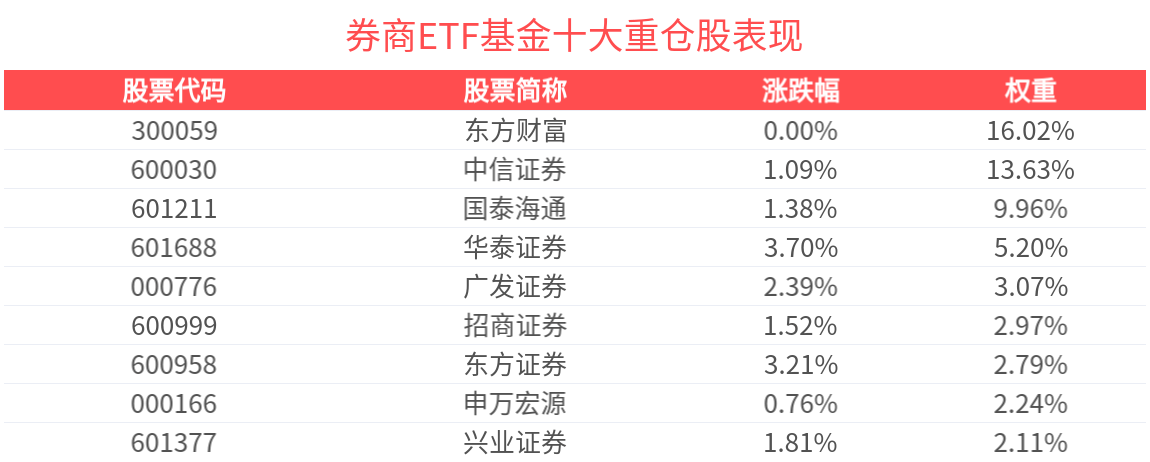
Core Viewpoint - The A-share market showed a collective strength on December 15, with significant performance from the financial sector, particularly insurance and brokerage stocks, indicating a potential investment opportunity in this area [1]. Financial Sector Performance - The brokerage ETF fund (515010) rose by 1.09%, with notable increases in its constituent stocks such as Huatai Securities (up 3.70%), Dongfang Securities, GF Securities, and Bank of China Securities [1]. - The financial technology ETF (Hua Xia, 516100) increased by 0.15%, with Star Ring Technology surging over 19% [1]. Valuation Insights - The latest price-to-earnings ratio (PE-TTM) for the index tracked by the brokerage ETF is 17.13, which is in the 5.26% percentile over the past year, indicating that the valuation is lower than 94.74% of the time in the last year, suggesting historical low valuations [1]. ETF Composition and Management Fees - The top ten weighted stocks in the brokerage ETF, as of November 28, 2025, include Dongfang Wealth, CITIC Securities, Guotai Junan, Huatai Securities, GF Securities, and others, collectively accounting for 60.23% of the index [1]. - The management and custody fee rate for the brokerage ETF (515010) is 0.2%, making it one of the lowest fee investment options in the market, which may attract investors looking for cost-effective exposure to the brokerage sector [1].






金鹰基金:“靴子落地”奠定政策基调 “跨年行情”逐步开启
Xin Lang Cai Jing· 2025-12-15 03:24
上周A股市场延续震荡格局,指数表现分化、科技成长占优。尽管重要会议强调对拉动内需的支持,11 月M2和社融规模增速保持稳定,CPI数据也有所回暖,但当前资金依然更青睐科技板块。周内A股交投 活跃度有所回升,日均成交额升至1.95万亿元。风格上看,科技成长领涨而周期、消费普遍下跌。整体 体现为:成长>周期>消费>金融。 金鹰基金表示,近期多项重要会议与数据落地,国内方面,上周政治局会议、中央经济工作会议先后举 行,初步奠定政策基调并明确"扩大内需"、"人工智能+"、"着力稳定房地产市场"等结构性方向。数据 上,11月CPI有所回暖、M2和社融规模增速保持稳定,但居民消费动力仍不足。后续需关注财政提效、 货币适度宽松与结构性政策落地对市场的持续提振。 海外方面,美联储超预期鸽派降息,但联储内部分歧加剧,提前重启技术性扩表应对流动性紧张,资本 市场在降息呵护下软着陆。但上周五科技板块集体下挫,市场对AI泡沫的担忧仍存,市场或呈阶段性 震荡。后续关注本周将公布的11月非农数据、明年初美联储新任主席的提名情况,我们认为美联储在明 年年初降息暂歇后,仍会持续开启降息,温和通胀和疲弱就业或依然支持美联储保持降息路径。 关注 ...
A股开盘速递 | 指数弱势震荡!白酒板块集体反弹 零售股反复活跃
智通财经网· 2025-12-15 02:00
展望后市,中信证券认为,明年外需继续超预期的难度在加大,但内需可期待的因素在增多。 热门板块 12月15日,指数弱势震荡。截至9:37,上证指数跌0.45%,深证成指跌0.64%,创业板指跌1.02%。 盘面上,白酒板块反弹,皇台酒业领涨,酒鬼酒、古井贡酒、舍得酒业等跟涨;零售概念反复活跃,百 大集团3连板,东百集团、爱婴室、全新好、广百股份跟涨。下跌方面,影视院线、海南自贸区等板块 回调。 机构观点 1、中信证券:明年外需继续超预期的难度在加大,但内需可期待的因素在增多 中信证券研报称,从此次中央经济工作会议内容来看,做大内循环仍是重心,定位和去年相似。但对于 股票市场而言,内需品种和外需品种的预期和定价与去年存在巨大差异:去年底投资者对外需普遍谨 慎,对内需充满期待,但最终外需的表现大超预期;今年是重仓布局外需敞口品种,预期相对充分,但 对内需品种欠缺信心;实际上,明年外需继续超预期的难度在加大,但内需可期待的因素在增多。 1、白酒板块反弹 白酒板块反弹,皇台酒业领涨,酒鬼酒、古井贡酒、舍得酒业等跟涨。 点评:消息面上,12日晚间,有消息人士称,贵州茅台近期将推出一个涵盖短期和中长期的控量政策。 短期方面 ...
向阳花开,乘势而上——2026年A股年度策略
2025-12-15 01:55
Summary of Key Points from the Conference Call Industry Overview - The report focuses on the A-share market and macroeconomic trends in China for 2026, highlighting the expected recovery of the Producer Price Index (PPI) and its implications for corporate profitability and market performance [1][2][4]. Core Insights and Arguments - **2025 Market Performance**: The market was primarily driven by liquidity, with the Wind All A Index rising by 25%. Valuation improvements contributed 20%, while profit support was only 5%. Key drivers included state support, insurance capital inflows, and the migration of household deposits [1][3]. - **2026 PPI Expectations**: A significant recovery in PPI is anticipated, with a neutral forecast suggesting it may reach around -0.7 by the end of the year. This recovery is expected to align with the profit growth rate and return on equity (ROE) of non-financial enterprises, which is projected to be around 10% [1][5][4]. - **Market Space and ERP**: In a weak recovery scenario for PPI, the equity risk premium (ERP) for the CSI 300 Index could drop to negative one standard deviation, suggesting a potential index increase of about 10%, from approximately 4,000 points to around 4,500 points [1][6]. - **Liquidity Sources**: Micro-level liquidity is heavily reliant on foreign capital and the migration of household deposits. The return of foreign capital is limited, necessitating a focus on attracting domestic funds through bank wealth management products and declining yields [1][7]. - **Role of Brokerage Firms**: Brokerage firms are crucial for guiding retail investor participation in the market. Historical data indicates that rapid increases in brokerage stocks often correlate with higher net inflows from retail investors. A resurgence in brokerage stocks is expected in Q1 2026 [1][9][10]. - **Q1 2026 Outlook**: The first quarter of 2026 is viewed as the most certain window for investment, with anticipated policy support, optimistic economic expectations, and liquidity easing. Key events, such as the visit of a U.S. official and the full rollout of the "15th Five-Year Plan," are expected to boost market sentiment [1][11][12]. - **Second Half of 2026**: The second half may see a verification phase for economic data and corporate earnings, with potential uncertainties arising from U.S. midterm elections impacting risk appetite. The market is expected to remain volatile [1][13]. Additional Important Insights - **Spring Rally Timing**: The spring rally is expected to start earlier than usual, potentially from late 2025 to early 2026, driven by liquidity shifts and early signs of market enthusiasm [1][14]. - **Sector Focus for 2026**: Key sectors to watch include software, media (especially gaming), robotics, innovative pharmaceuticals, and energy storage, with a focus on growth styles [1][16]. - **Investment Strategies**: The chemical industry is highlighted as a key area for investment, particularly in the context of rising external demand and AI materials. The report suggests that the chemical sector has a high probability of outperforming during the early stages of PPI recovery [1][21]. - **Brokerage Sector Performance**: The brokerage sector is expected to perform well in Q1 2026, with a potential rally that could attract retail investment and push indices higher [1][23]. - **Overall Market Outlook for 2026**: The overall market outlook for 2026 is positive, with expectations of reaching 4,500 points if PPI recovers, household deposits migrate, and brokerage stocks rally. Recommended sectors include industrial metals, energy storage, and domestic computing capabilities [1][24].
廖市无双:“春季攻势”会提前到来吗?
2025-12-15 01:55
Summary of Conference Call Records Industry or Company Involved - The discussion primarily revolves around the Chinese stock market, focusing on various indices such as the Shanghai Composite Index, ChiNext Index, Hang Seng Technology Index, and the STAR Market (科创50). Core Points and Arguments 1. **Market Outlook and Risks** - The market may face short-term correction risks, with the period around the Chinese New Year potentially being a peak. The Shanghai Composite Index rebounded to 3,936 points, nearing resistance levels, while the ChiNext Index's sustainability is questioned due to reliance on optical module stocks [1][2][3]. 2. **Performance of Major Indices** - The Shanghai Composite Index has rebounded from a low of 3,800 points to 3,936 points, approaching expected resistance levels. The ChiNext Index has recovered 70%-80% of its previous decline, indicating potential for new highs, driven by leading optical module stocks [3][10]. 3. **Sector Performance** - The communication sector has shown strong performance, primarily led by optical module stocks. The defense and military sector has strengthened due to geopolitical factors, while hard technology sectors like electronics, machinery, and battery cells have also performed well [6][7]. 4. **Brokerage Sector Analysis** - The brokerage sector is currently in a structural adjustment phase, with limited potential for significant market movements in the short term. Regulatory allowances for increased leverage do not guarantee immediate bullish trends [5][11]. 5. **Investment Strategy Recommendations** - Investors are advised to reduce positions if the market rises directly before the Chinese New Year. If the market consolidates, opportunities may arise in the ChiNext and Hang Seng Technology Index, particularly in stocks that have seen significant declines [15][16]. 6. **Future Market Trends** - The ChiNext Index is expected to undergo a period of consolidation, with a high likelihood of downward adjustments due to concentrated capital in optical modules and lack of healthy rotation among sectors [10][12]. 7. **Focus Areas for 2025** - Key areas for investment in 2025 should include domestic demand-related sectors such as chemicals and black commodities, which align with cyclical recovery logic. Additionally, sectors like home appliances, pharmaceuticals, and AI applications are highlighted for their potential [22][17]. 8. **Market Dynamics and Style Rotation** - The market is experiencing rapid style rotation, with growth and cyclical stocks currently favored. The end of the year typically sees a preference for large-cap value stocks, but growth-oriented technology and certain consumer stocks are becoming more active [18][20]. 9. **Impact of New Regulations** - New public fund regulations are expected to have medium to long-term effects on market styles, with high-beta sectors currently in favor. Investors should consider these changes when selecting benchmarks and strategies [24]. 10. **International Market Insights** - International trends, such as liquidity from overseas rate cuts, may influence domestic investment strategies, particularly in resilient sectors like innovative pharmaceuticals and robotics [21]. Other Important but Possibly Overlooked Content - The historical performance of the home appliance sector in December shows an 80% success rate over the past decade, indicating potential for seasonal investment opportunities [17]. - The current market sentiment reflects a lack of enthusiasm for traditional industries like coal and real estate, suggesting a shift in investor focus towards more innovative sectors [8][19].