能源

Search documents
智通港股早知道 | 国办印发《关于全链条打击涉烟违法活动的意见》 隔夜美股三大股指集体上涨
智通财经网· 2025-12-19 00:14
Group 1 - Two studies published in Nature confirm the efficacy and safety of a new diabetes drug, Masitide, developed by China's Innovent Biologics and Eli Lilly, showing superior blood sugar control and weight loss compared to placebo and Dulaglutide [1] - The studies involved Phase III clinical trials with Chinese type 2 diabetes patients, demonstrating improvements in cardiovascular, liver, and kidney-related indicators [1] - Masitide is a dual receptor agonist for glucagon-like peptide-1 and glucagon, providing high-quality evidence for overweight, obese, and diabetic patients, highlighting China's research capabilities in this field [1] Group 2 - U.S. stock indices rose collectively, with the Dow Jones up 65.88 points (0.14%), S&P 500 up 53.33 points (0.79%), and Nasdaq up 313.04 points (1.38%), driven by gains in large tech stocks [2] - Notable stock performances included Tesla rising over 3%, and Micron Technology increasing over 10% [2] - Chinese concept stocks also saw gains, with Zhihu up over 3% and XPeng Motors up over 2% [2] Group 3 - The State Council of China issued an opinion to combat illegal tobacco activities, focusing on countering counterfeit and smuggled tobacco products, and enhancing law enforcement collaboration with other countries [3] - The opinion aims to purify the tobacco market environment and protect national interests and consumer rights [3] Group 4 - BHP CEO Mike Henry emphasized the critical role of copper in the economy and its demand surge, predicting a bull market for copper due to supply constraints [4] - The annual market size for copper is estimated between $300 billion and $400 billion, with a projected 70% increase in demand by 2050, while new mining discoveries are becoming rarer and more challenging to develop [4] Group 5 - Meituan released and open-sourced a state-of-the-art virtual human video generation model, LongCat-Video-Avatar, which supports multiple tasks and has undergone significant upgrades in realism and stability [5] Group 6 - Zhihui Mining's shares rose 126.16% in dark trading, with a planned global offering of 122 million H-shares at HKD 4.51 each, focusing on zinc, lead, and copper mining in Tibet [6] Group 7 - Evergrande Auto announced a change in the registered shareholder of its subsidiary to Guangzhou Juliyi, with stock trading suspended pending further notice [7] Group 8 - Wasion Holdings' subsidiary won a contract worth over RMB 80 million for a project with CPFL, a leading power company in Brazil, and expects significant growth in AI data center revenues [8] - The company anticipates a doubling of AI data center revenue from RMB 1 billion in 2025 to RMB 2 billion in 2026, with new orders expected to grow significantly [8] Group 9 - Citigroup raised its profit forecasts for Wasion Holdings by 1% to 5% for 2025-2027, increasing the target price from HKD 15.5 to HKD 21, maintaining a "buy" rating [9]




能源化工期权:能源化工期权策略早报-20251219
Wu Kuang Qi Huo· 2025-12-19 00:08
Report Summary 1. Report Industry Investment Rating No relevant content provided. 2. Core Viewpoints - The energy - chemical sector includes energy, alcohols, polyolefins, rubber, polyesters, alkalis, and others. Strategies mainly involve constructing option portfolios with sellers as the main part, along with spot hedging or covered strategies to enhance returns [3][9]. 3. Summary by Relevant Catalogs 3.1 Futures Market Overview - The report provides the latest prices, price changes, price change rates, trading volumes, volume changes, open interests, and open interest changes of various energy - chemical futures contracts such as crude oil, liquefied gas, and methanol [4]. 3.2 Option Factors - **Volume and Open Interest PCR**: The report presents the volume PCR and open interest PCR of different option varieties, which are used to describe the strength of the option underlying market and the turning point of the underlying market respectively [5]. - **Pressure and Support Levels**: It shows the pressure points, support points, and their offsets of various option varieties from the perspective of the strike prices with the largest open interest of call and put options [6]. - **Implied Volatility**: The report provides the at - the - money implied volatility, weighted implied volatility, and its changes, annual average, call and put implied volatilities, historical volatility, and the difference between implied and historical volatilities of different option varieties [7]. 3.3 Strategies and Recommendations - **Crude Oil Options**: The fundamental situation is that the demand of US refineries has stabilized and rebounded, shale oil production has changed little, and OPEC's short - term supply is flat. The market has shown a weak trend recently. Directional strategies suggest constructing a bear spread of put options; volatility strategies recommend selling a call + put option combination with a short bias; spot long - hedging strategies involve constructing a long collar strategy [8]. - **Liquefied Gas Options**: The warehouse receipt volume has increased slightly this week, supply has increased, and demand has weakened. The market shows a bearish trend. Directional strategies suggest constructing a bear spread of put options; volatility strategies recommend selling a call + put option combination with a short bias; spot long - hedging strategies involve constructing a long collar strategy [10]. - **Methanol Options**: Inventory has decreased. The market has shown a weak trend. Directional strategies suggest constructing a bear spread of put options; volatility strategies recommend selling a call + put option combination with a short bias; spot long - hedging strategies involve constructing a long collar strategy [10]. - **Ethylene Glycol Options**: Polyester load has decreased, and port inventory has increased. The market has shown a weak trend. Directional strategies suggest constructing a bear spread of put options; volatility strategies recommend a short - volatility strategy; spot long - hedging strategies involve holding a spot long position + buying a put option + selling an out - of - the - money call option [11]. - **PVC Options**: Factory and overall inventories have increased. The market has shown a weak trend. Directional strategies suggest constructing a bear spread of put options; spot long - hedging strategies involve holding a spot long position + buying an at - the - money put option + selling an out - of - the - money call option [11]. - **Rubber Options**: Tire factory operating rates and inventory conditions are presented. The market has shown a weak consolidation trend. Volatility strategies recommend selling a call + put option combination with a neutral bias [12]. - **PTA Options**: PTA load is low. The market has shown a trend of rebound and then decline. Volatility strategies recommend selling a call + put option combination with a neutral bias [12]. - **Caustic Soda Options**: The average utilization rate of caustic soda production capacity has increased. The market has shown a weak bearish trend. Directional strategies suggest constructing a bear spread combination; spot long - hedging strategies involve constructing a long collar strategy [13]. - **Soda Ash Options**: Factory inventory has decreased. The market has shown a low - level weak oscillation trend. Directional strategies suggest constructing a bear spread combination; volatility strategies recommend a short - volatility combination; spot long - hedging strategies involve constructing a long collar strategy [13]. - **Urea Options**: Enterprise inventory has decreased, and port inventory has increased. The market has shown a short - term weak trend. Volatility strategies recommend selling a call + put option combination with a neutral bias; spot long - hedging strategies involve holding a spot long position + buying an at - the - money put option + selling an out - of - the - money call option [14].
内蒙古外贸行广州启动 全球并购基金与中关村支持产业赋能
Sou Hu Cai Jing· 2025-12-18 18:15
Core Viewpoint - The event held in Guangzhou on December 17 aimed to promote trade and economic cooperation between Inner Mongolia and international markets, showcasing Inner Mongolia's industrial clusters and development opportunities [1][3]. Group 1: Event Overview - The trade and economic negotiation event was organized by the China Council for the Promotion of International Trade and the Inner Mongolia government, with participation from representatives of various countries including the USA, Singapore, Spain, and others [1]. - The event gathered hundreds of political and business representatives to discuss collaboration and opportunities for open trade [1][3]. Group 2: Strategic Agreements - A tripartite agreement was signed between the Global M&A Fund, Zhongguancun Development Investment Co., and Inner Mongolia Tianyi International Cultural Trade Group to establish a long-term strategic partnership focused on industrial collaboration between Guangdong-Hong Kong-Macao Greater Bay Area and Inner Mongolia [4][6]. - The agreement aims to create a "Guangdong-Mongolia Industrial Collaborative Innovation Center" to attract enterprises from the Greater Bay Area to set up regional headquarters and R&D centers in Inner Mongolia [6]. Group 3: Empowering Local Enterprises - Regular events such as "Inner Mongolia Quality Products Promotion Conference" and "Supply Chain Matching Meetings" will be organized to connect Inner Mongolia enterprises with buyers and large corporations in the Greater Bay Area [7]. - The collaboration will provide comprehensive capital services for high-quality Inner Mongolia enterprises planning financing, mergers, or listings [7]. Group 4: Innovation and Productivity - The partnership will facilitate the establishment of "Guangdong-Mongolia Collaborative Innovation Industrial Parks" to support the production and regional business of Greater Bay Area enterprises in Inner Mongolia [8]. - A "New Quality Productivity Empowerment Plan" will be implemented to enhance the technological innovation capabilities and market competitiveness of local enterprises through expert consultations and training [8]. Group 5: Investment Fund Initiatives - The three parties are exploring the establishment of a market-oriented investment fund focused on "Guangdong-Mongolia Industrial Collaboration," targeting high-growth local enterprises in Inner Mongolia and modern service projects [9]. Group 6: Support for Cultural and Tourism Industries - The Global M&A Fund's chairman emphasized the importance of capital and mechanisms in commercializing and internationalizing Inner Mongolia's cultural and tourism resources, aligning with the "14th Five-Year Plan" to develop new quality productivity [11]. - The use of Real Data Assets (RDA) through blockchain technology is proposed to transform resources into marketable assets, providing new financing pathways for cultural tourism projects [13]. Group 7: Broader Collaborative Actions - Three major collaborative actions were proposed, including an "Asset Going Global Plan" to connect Inner Mongolia's quality cultural tourism projects with global capital, a "Platform Co-construction Action" to establish a promotion center in Hong Kong, and a "Fund Interaction Action" to support the upgrade and internationalization of Inner Mongolia's cultural tourism and agricultural industries [15].



阿布扎比证券交易所推出“FTSE ADX Dividend Stars 指数”
Shang Wu Bu Wang Zhan· 2025-12-18 16:01
Core Viewpoint - The Abu Dhabi Securities Exchange Group (ADX Group) has launched the FTSE ADX Dividend Stars Index, the first of its kind in the region, aimed at providing investors with high-dividend stocks from Abu Dhabi [1] Group 1: Index Details - The FTSE ADX Dividend Stars Index includes 17 companies from various sectors such as telecommunications, energy, industrial, and finance [1] - These companies are projected to achieve a 20% year-on-year growth in net profit by the third quarter of 2025 [1] - This index is the 17th in the FTSE ADX series and the fifth flagship index launched in collaboration with FTSE Russell [1] Group 2: Investment Strategy - The index is designed to complement existing indices focused on ESG and Islamic investments, thereby providing a diversified investment choice in Abu Dhabi [1]
美国11月核心CPI同比涨2.6%,创2021年以来最低增速,通胀降温信号显现
Zhi Tong Cai Jing· 2025-12-18 14:24
Core Insights - The core Consumer Price Index (CPI) for November increased by 2.6% year-over-year, down from 3% two months prior, indicating a slowdown in inflationary pressures [1] - The overall CPI for November rose by 2.7% year-over-year, marking the slowest potential inflation growth since early 2021 [1] - The report reflects a complex situation due to the government shutdown, which hindered data collection for October and limited the ability to assess broader inflation indicators [1][2] Inflation Trends - Core CPI increased by 0.2% month-over-month, primarily influenced by declines in hotel accommodations, entertainment, and clothing costs, while prices for household goods and personal care products rose [1] - Excluding food and energy, commodity prices rose by 1.4% year-over-year, slightly down from 1.5% in August and September [3] - New car prices increased by 0.2%, following a slight increase of 0.1% the previous month, while the growth rate for used car prices has slowed [4] Federal Reserve Considerations - The CPI report's impact on Federal Reserve policymakers remains uncertain, as they continue to have differing views on interest rate direction for the upcoming year [2] - Federal Reserve Chairman Jerome Powell noted that the CPI data may have been distorted due to the government shutdown, which affected data collection [2] - Powell anticipates that commodity inflation will peak in the first quarter, assuming no new significant tariff measures are introduced [5] Housing and Services Impact - Service prices, excluding energy, rose by 3% year-over-year, with airline tickets and hotel accommodation prices decreasing compared to the previous year [5] - Housing costs, a major driver of inflation, increased by 3% year-over-year, representing the smallest increase in over four years [5] - The CPI relies on extensive field visits to collect prices from thousands of goods, with about 60% of the sample gathered through in-person visits [5]
港股震荡分化,港股通医药ETF(513200)、恒生科技ETF易方达(513010)助力布局港股资产
Sou Hu Cai Jing· 2025-12-18 10:55
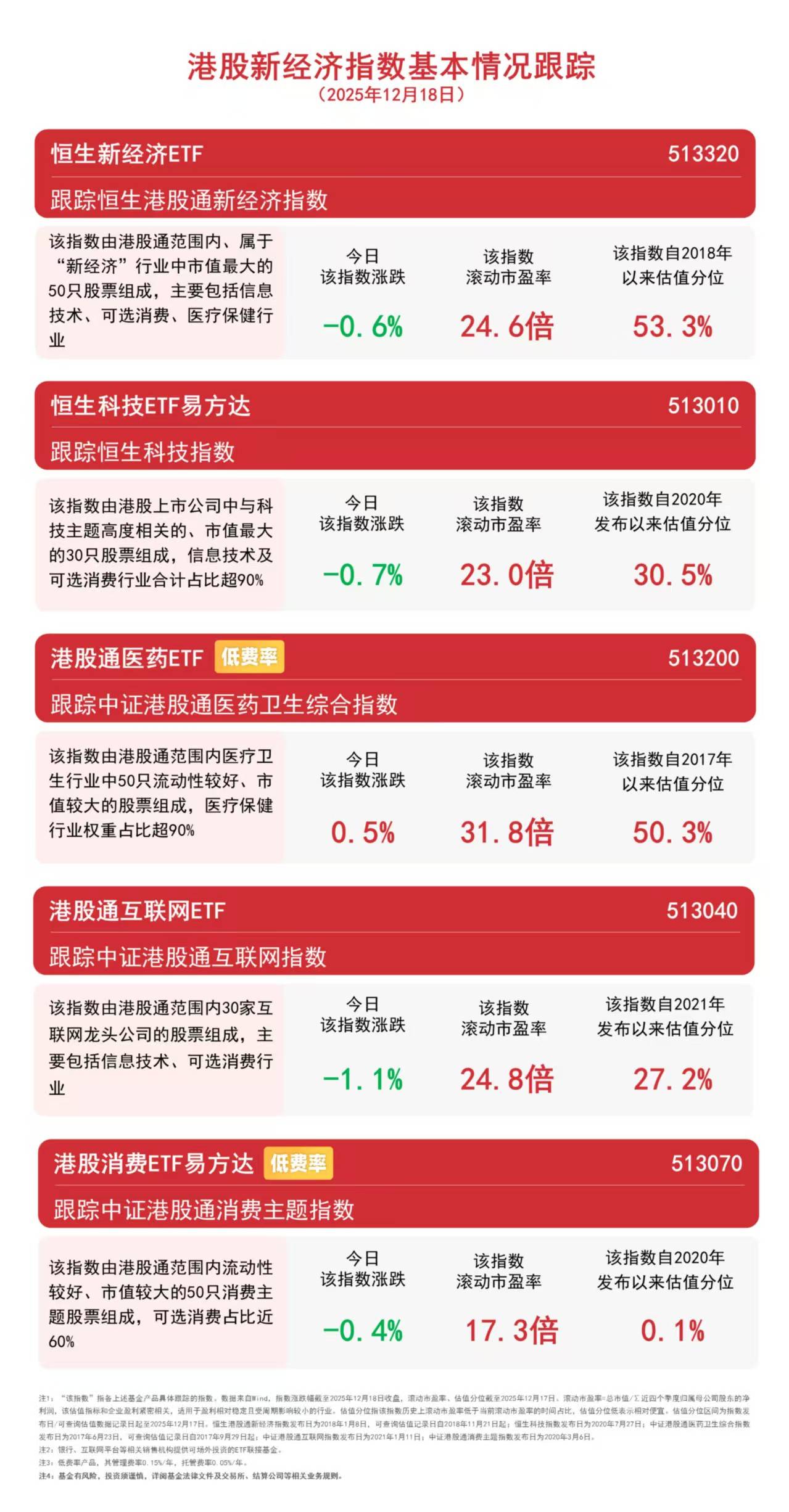
Group 1 - The Hong Kong stock market experienced fluctuations today, with a slight recovery in the afternoon, led by gains in the pharmaceutical, energy, and banking sectors, while technology stocks saw minor declines [1] - The CSI Hong Kong Stock Connect Pharmaceutical and Health Index rose by 0.5%, while the CSI Hong Kong Stock Connect Consumer Theme Index fell by 0.4%, the Hang Seng Hong Kong Stock Connect New Economy Index decreased by 0.6%, the Hang Seng Technology Index dropped by 0.7%, and the CSI Hong Kong Stock Connect Internet Index declined by 1.1% [1] - According to Wind data, as of yesterday, the net inflow of funds into the Hang Seng Technology ETP managed by Yi Fangda (513010) exceeded 2 billion yuan for the month, ranking among the top in its category [1] Group 2 - The Hang Seng New Economy Index tracks the 50 largest stocks within the "new economy" sectors listed under the Hong Kong Stock Connect, primarily including information technology, consumer discretionary, and healthcare [3] - The index decreased by 0.6% today, with a rolling price-to-earnings ratio of 24.6 times [3] - The Hang Seng Technology ETF tracks the Hang Seng Technology Index, which consists of the 30 largest stocks highly related to technology themes, with over 90% of the index comprising information technology and consumer discretionary sectors [4] - The index fell by 0.7% today, with a rolling price-to-earnings ratio of 23.0 times [4] Group 3 - The Hong Kong Stock Connect Pharmaceutical ETF tracks the CSI Hong Kong Stock Connect Pharmaceutical and Health Index, which is composed of 50 highly liquid and large-cap stocks in the healthcare sector, accounting for over 90% of the index [6] - The index rose by 0.5% today, with a rolling price-to-earnings ratio of 31.8 times [6] - The Hong Kong Stock Connect Internet ETF tracks the CSI Hong Kong Stock Connect Internet Index, which has seen a decline of 1.1% today, with a rolling price-to-earnings ratio of 24.8 times [8]
北水动向|北水成交净买入12.57亿 北水继续加仓小米 抛售盈富基金超14亿港元
Zhi Tong Cai Jing· 2025-12-18 10:04
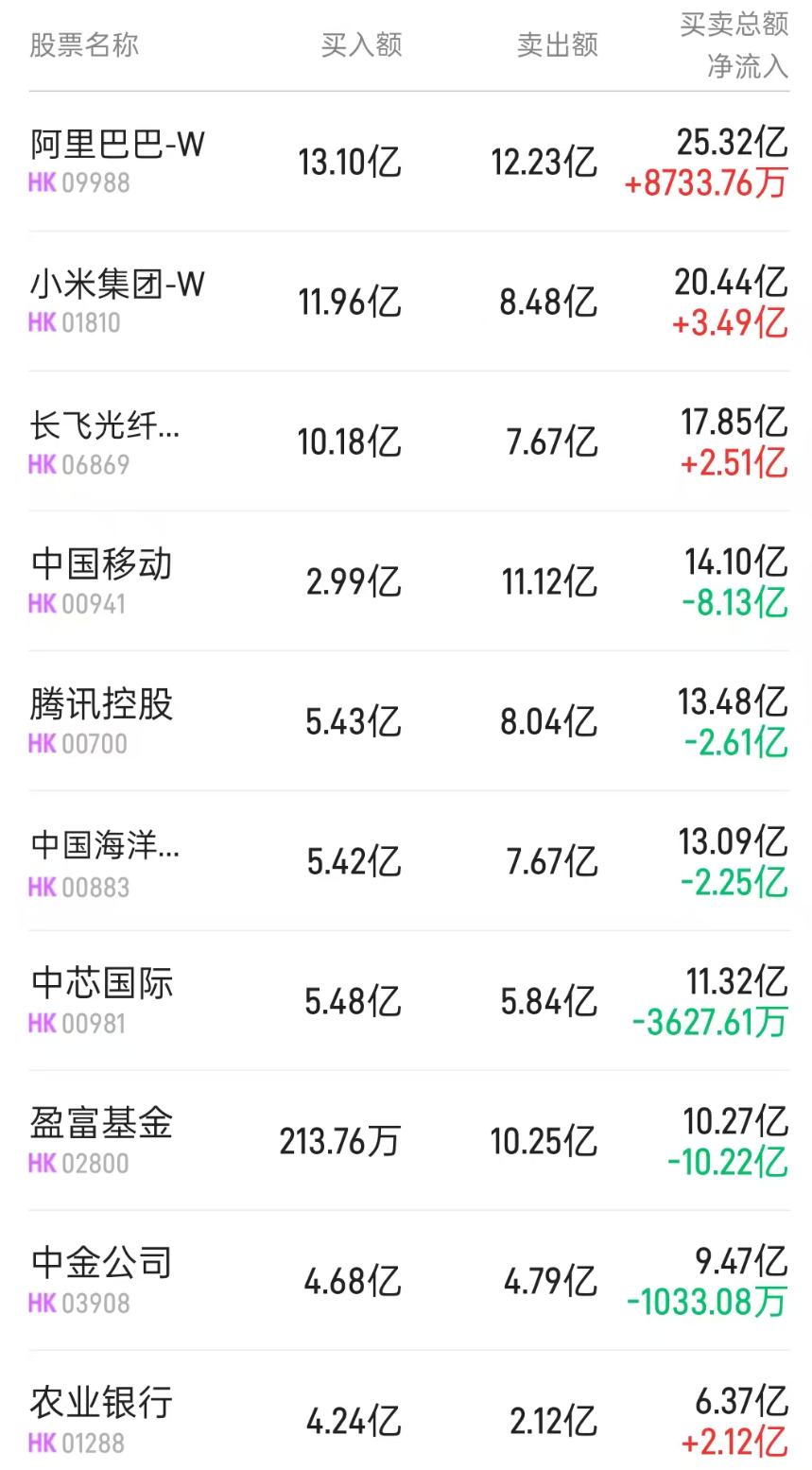
港股通(深)活跃成交股 小米集团-W(01810)获净买入9.03亿港元。消息面上,高盛发表研究报告指,小米正快速发展其人工智能基础设施与应用 能力,并崛起为顶级的开源模型开发者,将加速其"人、车、家全生态"的智能化整合。该行继续预期小米会带来更多人工 智能相关成果,并将人工智能应用拓展至其不断扩大的生态系统。 智通财经APP获悉,12月18日港股市场,北水成交净买入12.57亿港元,其中港股通(沪)成交净卖出10.95亿港元,港股通 (深)成交净买入23.53亿港元。 北水净买入最多的个股是小米集团-W(01810)、美团-W(03690)、长飞光纤光缆(06869)。北水净卖出最多的个股是盈富基金 (02800)、中国移动(00941)、中海油(00883)。 | 股票名称 | 买入额 | 卖出额 | 买卖总额 | | --- | --- | --- | --- | | | | | 净流入 | | 阿里巴巴-W | | | 25.32 乙 | | HK 09988 | 13.10亿 | 12.23亿 | +8733.76万 | | 小米集团-W | 11.96亿 | 8.48 亿 | 20.44 Z | ...


韩国计划孵化万家AI等硬科技初创企业
Xin Hua She· 2025-12-18 08:55
Core Viewpoint - The South Korean government plans to incubate 10,000 startups in hard tech fields such as artificial intelligence (AI) over the next five years, aiming to make these companies a significant force in the country's economic development [1]. Group 1: Government Initiatives - The Ministry of SMEs and Startups, along with relevant departments, released a comprehensive strategy titled "Towards Becoming One of the Global Four Venture Capital Powerhouses" [1]. - The strategy includes multiple goals, such as creating 50 unicorns and "decacorns," and facilitating connections to a global venture capital market estimated at approximately 40 trillion Korean Won (about 1.904 trillion RMB) annually [1]. Group 2: Resource Allocation - To achieve these goals, the South Korean government plans to acquire around 50,000 graphics processing units (GPUs) by 2030 to establish a large AI computing power node and manage resource allocation effectively [1]. - Priority will be given to supporting venture capital and hard tech startups through adjustments and improvements to the policy framework related to strategic industries such as AI, biomedicine, military, energy, and advanced manufacturing [1].
股价创新高之际,分析师警告特斯拉(TSLA.US)估值脱节:汽车业务仅值30美元,AI与机器人成核心支撑
智通财经网· 2025-12-18 08:31
Group 1 - Tesla's stock price has surged recently, driven by advancements in the robotaxi sector, while its core electric vehicle business represents only a small portion of its market value [1] - Analysts suggest that Tesla is increasingly viewed as an autonomous driving and energy company, with a significant disconnect in its valuation [1][2] - The recent stock price increase is attributed to reports of autonomous robotaxi testing in Austin, Texas, and growing investor confidence in Tesla's transition from a struggling EV manufacturer to a leader in autonomous driving [1] Group 2 - Current stock prices are largely based on unfulfilled promises, with the market now evaluating Tesla based on its progress in robotics and AI rather than electric vehicle deliveries [2] - Estimates indicate that autonomous driving technology accounts for over 70% of Tesla's total value, including the long-promised robotaxi platform and the Optimus humanoid robot project [2] - The growth of Tesla's energy business is now comparable to or slightly exceeds that of its automotive business, suggesting a potential undervaluation of the automotive segment if autonomous driving and energy expectations are separated [2] Group 3 - California regulators have questioned Tesla's marketing of "autopilot" features, giving the company 90 days to clarify or modify its statements, highlighting legal and technical challenges in achieving full autonomy [3] - Investors who bought shares near $480 have limited margin for error, as further delays in the robotaxi timeline could lead to a reassessment of the automotive business valued at only $30 per share [3] - The long-term outlook for Tesla's energy business remains optimistic, as it is seen as an underappreciated driver of future earnings [3]

长城人寿收警示函,“举牌大户”的投资扩张合规之题待解
Sou Hu Cai Jing· 2025-12-18 07:42
Core Viewpoint - The reliance of insurance companies on investment, particularly in equity assets, is increasing in a market characterized by low interest rates and high debt costs. This trend highlights the challenges of compliance and operational boundaries in investment expansion [2][10]. Group 1: Compliance and Regulatory Challenges - On December 9, 2025, the Hebei Securities Regulatory Bureau issued a warning letter to Great Wall Life Insurance Co., Ltd. for failing to halt trading after exceeding the 5% shareholding threshold in New Tian Green Energy Co., Ltd. [2][3] - The warning letter emphasizes the importance of maintaining a dynamic balance between investment operations and compliance boundaries, particularly for insurance companies that are significant shareholders in the market [2][10]. - Great Wall Life's response indicated that the violation was due to a technical execution issue, and the company plans to enhance its internal control and risk management processes to prevent future occurrences [6][9]. Group 2: Investment Strategy and Performance - Great Wall Life has actively engaged in equity investments, having made at least 12 significant shareholding actions since June 2023, which is notably high among life insurance companies [10]. - As of June 30, 2025, the company's equity assets amounted to 28.355 billion yuan, representing 18.84% of its total assets, significantly above the industry average [10]. - The company achieved an investment income of 4.262 billion yuan in 2024, a 106% increase year-on-year, and 3.502 billion yuan in the first three quarters of 2025, a 24.65% increase year-on-year, indicating strong performance in equity investments [11]. Group 3: Risks and Challenges in Investment Expansion - The increase in equity investment poses new challenges, including the need for dynamic tracking of the relationship between investment returns and risks, especially in a volatile market environment [12]. - The current portfolio structure of Great Wall Life is focused on long-term, stable revenue-generating assets, primarily in public utilities and energy sectors, which are relatively stable [12]. - The company must ensure that its growing equity investments align with its liability structure to avoid potential mismatches that could exacerbate risks [12][13].