煤炭

Search documents
A股煤炭股逆势上涨,兰花科创涨停,中煤能源涨超8%
Ge Long Hui A P P· 2026-03-09 02:02
Core Viewpoint - The coal sector in the A-share market is experiencing a significant upward trend, driven by geopolitical conflicts that are expected to raise international energy prices and increase demand for coal as a substitute, particularly in the domestic coal chemical industry due to high oil prices [1]. Group 1: Market Performance - Coal stocks are rising, with Lanhua Sci-Tech hitting a 10% limit up, while Yanzhou Coal, Jinkong Coal, and China Coal Energy have increased by over 8% [1]. - Other notable performers include Lu'an Environmental Energy up over 7%, Shaanxi Coal and Open Pit Mining up over 6%, and several companies including Meijin Energy and China Shenhua up over 5% [1]. Group 2: Company Specifics - Lanhua Sci-Tech has a market capitalization of 10.8 billion and a year-to-date increase of 23.86% [2]. - Yanzhou Coal has a market capitalization of 210 billion with a year-to-date increase of 59.09% [2]. - Jinkong Coal has a market capitalization of 30.8 billion and a year-to-date increase of 39.77% [2]. - China Shenhua has a market capitalization of 958.5 billion and a year-to-date increase of 48.24% [2].





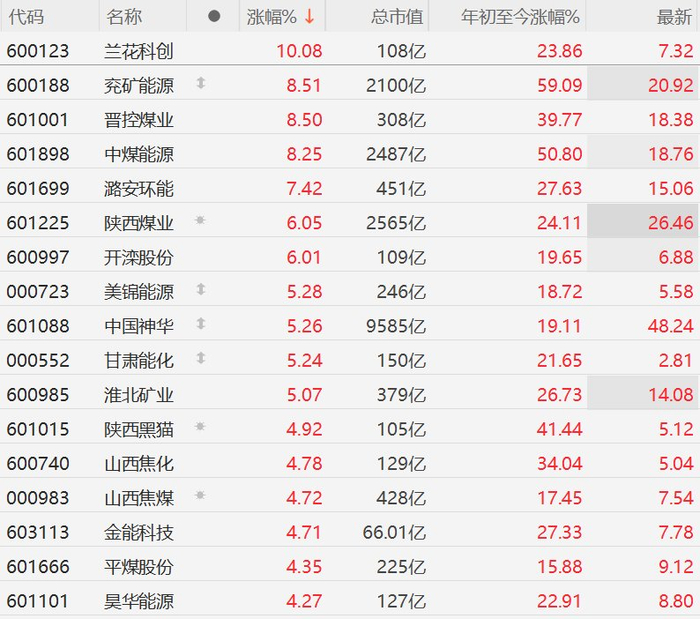
朝闻国盛:如何看待油价对债市冲击
GOLDEN SUN SECURITIES· 2026-03-09 01:17
Group 1: Oil Price Impact on Debt Market - The current oil price increase has limited impact on the debt market, with the main trend being bank-led allocation. After the quarter-end, this trend may become more pronounced [11] - Rising prices have not driven improvements in corporate profitability, and monetary policy is unlikely to respond effectively to external price changes, resulting in limited overall impact on interest rates [11] - Financing demand remains insufficient, leading to increased deposits and decreased loan growth, which creates a loose funding environment and constrains interest rate ceilings [11] Group 2: Fiscal Policy Observations - The 2026 fiscal revenue budget growth rate is slightly increased, while expenditure growth remains stable. The fiscal revenue growth target for 2026 is set at 2.2%, significantly lower than the nominal GDP growth rate [13] - The expenditure budget for 2026 is projected to grow by 4.4%, indicating a steady fiscal spending approach [13] Group 3: Coal and Energy Market Insights - Brent crude oil prices surged by 27.88% to $92.69 per barrel, while Newcastle coal prices increased by 15.61% to $137 per ton, driven by geopolitical tensions and supply constraints [18] - The demand for coal is expected to rise as countries shift towards coal power for energy security, particularly in East Asia, which may push Asian coal prices higher [18] - Investment recommendations include focusing on companies like China Coal Energy, Yanzhou Coal Mining, and China Shenhua Energy [18] Group 4: Real Estate Market Analysis - The 2026 government work report emphasizes a stable approach to real estate policies, with a focus on maintaining market stability and supporting major projects [24] - The report indicates that the fiscal policy will continue to support consumption and investment in human resources, with a significant amount of special bonds expected to be used for land acquisition [24] - Investment suggestions include real estate development companies such as Greentown China, China Overseas Land & Investment, and Poly Developments [25] Group 5: Textile and Apparel Sector - Bosideng is expected to achieve a revenue growth of 4-5% for FY2026, driven by effective cost management and product optimization [28] - The company anticipates a slight increase in gross margin due to structural improvements, with net profit growth expected to outpace revenue growth [28] - Investment outlook remains positive, with a "buy" rating maintained based on projected earnings growth [29]
中金:HALO的A股映射及延伸
中金点睛· 2026-03-08 23:36
Core Viewpoint - The market is experiencing a "scarcity revaluation" as it shifts towards a more rational assessment of AI technology, leading to a reevaluation of the value of heavy asset companies in the context of macroeconomic changes [1] Group 1: Market Trends and AI Impact - The perception of AI technology has shifted towards a more rational examination, with increasing concerns about "creative destruction" potentially disrupting existing industry dynamics [1] - The software sector in the US has seen a decline of over 30% from its peak, reflecting capital outflows from light asset industries that are easily replaceable by AI [1] - The previous low-interest-rate environment allowed growth assets to enjoy valuation premiums, but rising geopolitical risks and supply chain localization trends are increasing capital costs, highlighting the value of tangible production capabilities [1] Group 2: HALO Concept and Investment Focus - The "HALO" (Heavy Assets, Low Obsolescence) concept has gained significant attention, focusing on assets that are less likely to be replaced by AI and can withstand technological shocks, shifting investment logic from growth chasing to certainty and scarcity [2] - The HALO trading theme has deepened and expanded, with the energy sector in the S&P 500 rising over 25%, and various heavy asset sectors in the A-share market, such as oil, coal, and basic chemicals, showing strong performance [2] Group 3: Sectors Resistant to AI Replacement - Key sectors that are difficult to replace by AI include heavy asset industries with stable cash flows and those providing core support for AI technology, such as infrastructure and upstream strategic resources [3] - Typical HALO sectors are characterized by high barriers to entry, significant capital expenditures, and long asset renewal cycles, making them less susceptible to technological disruption [4] Group 4: Detailed Analysis of HALO Sectors - A detailed analysis indicates that typical HALO sectors in the A-share market are concentrated in the upstream, including energy raw materials like coal, basic chemicals, and non-ferrous metals, which have high fixed asset ratios and stable profitability [5] - Midstream manufacturing sectors such as utilities, power equipment, and transportation also exhibit high asset density and benefit from rigid demand, with many fixed assets accounting for over 30% of revenue [5] Group 5: AI "Shovel Sellers" and Infrastructure - The rapid advancement of AI technology is driving demand in hard tech sectors like computing power and semiconductors, which require significant upfront capital and have high technical barriers, aligning with HALO trading principles [6] - Upstream resource products are essential for AI industry chain construction and are expected to benefit from the rapid expansion of computing power demand, while being less susceptible to technological disruption [6] Group 6: Investment Strategy for HALO Trading - HALO trading is expected to continue enjoying scarcity revaluation premiums, with a focus on sectors that are less likely to be replaced by AI, such as utilities, transportation, and basic chemicals, which are currently undervalued [7] - The supply-demand dynamics, price increases, and geopolitical factors are expected to support market performance in these sectors, while hard tech sectors within the AI industry chain still hold long-term growth potential [8]

金融工程:AI识图关注电力、电网、公用事业
GF SECURITIES· 2026-03-08 23:30
- The report explores the use of convolutional neural networks (CNNs) to model price-volume data and predict future prices, mapping learned features to industry theme indices such as the National Green Power Index, CSI Green Power Index, and CSI Electric Power Equipment Theme Index[80][82] - The CNN-based approach involves constructing standardized charts of price-volume data for individual stocks over specific time windows, which are then used as input for the CNN model to identify patterns and trends[80] - The latest thematic allocation based on the CNN model includes sectors like electricity, power grids, and public utilities, with specific indices such as the CSI All-Electric Power Utility Index and CSI All-Public Utility Index being highlighted[80][82]
A股投资策略周报:美伊地缘冲突对A股的影响与投资策略展望-20260308
CMS· 2026-03-08 15:33
Core Insights - The report highlights that the geopolitical conflict between the US and Iran has shifted market focus from traditional economic cycles to supply security and strategic resource assurance, with oil and shipping sectors being the main areas of concern [3][4][31] - The impact of the conflict on the A-share market is primarily transmitted through risk appetite, commodity prices, and supply chain disruptions, with short-term negative effects expected if the conflict escalates [6][7][33] Geopolitical Conflict and Market Dynamics - The ongoing US-Iran conflict has led to a reassessment of global energy and trade systems, with market participants focusing on the vulnerabilities of various supply chains under extreme conditions [4][31] - Oil prices are seen as a surface variable, while deeper concerns revolve around energy supply security, particularly as the conflict disrupts oil supply expectations [5][31] Sector-Specific Impacts - The oil and gas sector, along with shipping, are expected to benefit from the current geopolitical tensions, particularly if the Strait of Hormuz remains blocked, leading to a revaluation of industry costs and energy alternatives [6][7][33] - Historical data indicates that military conflicts typically result in short-term impacts on the A-share market, with defense sectors often outperforming in the immediate aftermath of conflict [33][34] Investment Strategy Outlook - The report suggests that if the conflict de-escalates quickly, there could be a recovery in risk appetite and a return to normal liquidity conditions, which would benefit sectors like TMT (technology, media, telecommunications) and healthcare [11][13] - Conversely, if the conflict persists, the market may face prolonged high oil prices and a revaluation of risk assets, particularly affecting high-valuation sectors like technology [14][27] Historical Context and Future Projections - The report reviews past conflicts and their impacts on the A-share market, noting that the first trading day after major conflicts typically sees a decline, with an average drop of 1.1% [34][37] - Future scenarios include potential rapid resolutions leading to asset recovery, prolonged conflicts resulting in sustained high oil prices, or escalations into broader regional wars, each with distinct implications for market dynamics [10][21][14]
主题策略周报 20260308:外乱内稳,周期趋势加强-20260308
Orient Securities· 2026-03-08 15:26
Group 1 - The core viewpoint indicates that external disturbances lead to internal stability, and the overall market will continue to experience fluctuations, with a strengthened performance in mid-cap blue-chip stocks and a focus on resource sovereignty [7][10]. - The assessment of the domestic market's impact is manageable, and the oscillating situation remains unchanged, as the recent Middle Eastern events serve as a short-term stress test without altering the mid-term market dynamics [11][12]. - Global risk evaluation is on the rise, reinforcing existing trends, while short-term risk appetite is expected to decline but will likely recover in the mid-term as uncertainties resolve [11][12]. Group 2 - In terms of industry comparison, the short-term events are believed to have a limited negative impact on previously favored sectors, instead reinforcing existing trends, with continued optimism for cyclical sectors such as non-ferrous metals, chemicals, transportation, agriculture, coal, and natural gas [12]. - The theme of investment prioritizes resource sovereignty, emphasizing that strategic resource assets are being re-evaluated under the new geopolitical order, shifting demand from traditional economic cycles to "manufacturing upgrades" and "strategic security" [3][12]. - The technology manufacturing sector is closely following developments in AI and space, with a focus on domestic computing power advancements and the emerging space industry, which is expected to see significant growth due to increased satellite networking demands [4][13][14].
量化择时周报:行业间交易波动率升至高位,市场情绪得分进一步回落-20260308
Shenwan Hongyuan Securities· 2026-03-08 15:22
Group 1 - Market sentiment has declined, with the sentiment indicator dropping to 1.40 from 1.85, indicating a neutral to bearish outlook [2][8] - The inter-industry trading volatility has risen to high levels, suggesting increased sector rotation and a decline in market risk appetite [12][24] - The average daily trading volume for the entire A-share market decreased by 26.52% week-on-week, with an average of 17,932.48 billion yuan, indicating reduced market activity [18][23] Group 2 - The short-term score for industries shows that utilities, oil and petrochemicals, coal, environmental protection, and transportation are leading, with utilities scoring 100, the highest [41][44] - The correlation between industry congestion and weekly price changes is low at 0.39, indicating that high congestion sectors like oil and petrochemicals are experiencing significant price increases, but caution is advised for potential pullbacks [45][49] - The current model indicates a preference for large-cap and value styles, with signals suggesting a potential strengthening in the future [52][53]
煤炭行业周报:原油、天然气价格大幅上涨,煤炭反季节性涨价可期
Orient Securities· 2026-03-08 14:24
Investment Rating - The report maintains a "Positive" outlook on the coal sector, indicating a strong preference for investment in this area [3][8]. Core Viewpoints - The report highlights that the recent escalation of conflict between the US and Iran is expected to increase the value of call options in the coal sector, reflecting an upward elasticity and reinforcing the sector's investment value [3][8]. - Significant increases in crude oil and natural gas prices are anticipated to lead to a seasonal rise in coal prices, driven by higher shipping costs and a shift towards coal-fired power generation in some regions [8]. - Domestic demand for thermal coal remains weak, causing a slower transmission of price increases for imported coal, despite notable price rises in international markets [8]. - The report notes a temporary suppression of coking coal prices due to seasonal destocking by downstream users, but a rebound is expected as inventories are low [8]. Summary by Relevant Sections Industry Fundamentals - Thermal coal prices have seen increases both domestically and internationally, with Indonesian 4200 kcal thermal coal prices rising by 24.0% and Australian Newcastle 5500 kcal thermal coal prices increasing by 22.3% since the beginning of 2026 [8][9]. - Coking coal prices have slightly decreased, with independent coking plants showing a 4.0% reduction in inventory, indicating a low level compared to the same period last year [8][9]. - The report indicates that coal mining operations are in line with seasonal characteristics, with both thermal and coking coal mining rates reflecting typical seasonal patterns [29]. Supply and Demand - The report notes that iron and cement production has seen seasonal declines, contributing to a low demand environment for coal [29]. - Port coal inventories are reported to be rising, with some ports experiencing higher than normal levels, while others are at lower levels [36][41]. Shipping and Transportation - The CBCFI coal freight index has rebounded, and the daily shipping volume on the Daqin line has increased, indicating improved logistics for coal transportation [52][58]. Market Performance - Since the beginning of 2026, the coal mining index has outperformed both the CSI 300 and the ChiNext indices, with a cumulative increase of 20.2% compared to 0.7% and 0.8% for the respective indices [8][61]. - The report indicates that the coal sector's price-to-book ratio is at a historical median level, suggesting a favorable valuation compared to the broader market [8][61].
港股、海外周聚焦(3月第2期):HALO叙事能否指导A股投资
GF SECURITIES· 2026-03-08 13:48
Group 1 - The HALO framework (Heavy Assets & Low Obsolescence) emphasizes the revaluation of assets based on "physical scarcity," focusing on business models anchored in high-cost, long-cycle, and heavily regulated physical capital [2][7] - The framework is driven by three structural forces: rising real interest rates leading to a convergence of long-duration growth stock valuations, geopolitical fragmentation incorporating "sovereign security" into pricing, and the dual impact of the AI revolution compressing light asset moats while elevating heavy asset industries [2][11][14] - China is one of the most concentrated markets for HALO assets globally, with manufacturing value added accounting for about 30% of the world, and A-shares having a high proportion of tangible assets, providing strong credit backing and volatility resistance [2][17] Group 2 - The HALO narrative in China translates into four main lines: energy and public utilities as dividend bases, non-ferrous metals and chemicals as inflation assets, power grid infrastructure as the core of investment cycles, and AI hardware manufacturing as growth options [2][37] - Energy and public utilities are characterized by stable profitability due to enhanced pricing mechanisms, with coal and hydropower assets exhibiting bond-like attributes [2][38] - Non-ferrous metals and chemicals are positioned as inflation assets, with supply rigidities and AI demand elasticity driving their appeal [2][43] Group 3 - The investment strategy based on the HALO framework involves selecting A and H shares with high capital intensity and low obsolescence, aiming to capture excess returns from the revaluation of physical assets while balancing cyclical offensiveness and dividend defensiveness [2][49] - The selection criteria include evaluating companies based on six capital intensity metrics, ensuring that selected firms exceed market medians in these areas [2][50] - The resulting HALO stock portfolio includes companies like China Mobile, China Shenhua, and Huaneng Power, which align with the heavy asset, low obsolescence characteristics [2][52] Group 4 - The report highlights that the current PPI turning positive enhances the logic for inflation trades, suggesting that cyclical sectors can achieve excess returns [2][22] - High dividend and high ROE characteristics of HALO assets indicate their ability to withstand market volatility and provide stable returns over time [2][31] - The report emphasizes that the majority of HALO assets are cyclical and dividend stocks, which are expected to perform well in the current economic environment [2][21]
煤炭行业周报:地缘冲突或平抑淡季煤价下行波动,抬升均价
GUOTAI HAITONG SECURITIES· 2026-03-08 13:35
Investment Rating - The report rates the coal industry as "Buy" [1] Core Insights - Historical review indicates that geopolitical conflicts may stabilize seasonal price declines and elevate average prices [3] - The geopolitical tensions involving the US, Israel, and Iran have intensified, exceeding market expectations, leading to high oil and natural gas prices, which are expected to continue influencing energy prices upward [4] - The report emphasizes a strategic bullish outlook for the energy cycle over the next 5-10 years, recommending investments in global markets such as Yancoal Australia and leading A-share companies like Yanzhou Coal Mining, China Shenhua Energy, and others [4] Summary by Sections Market Tracking - As of February 27, 2026, the price of Q5500 coal at Huanghua Port is 749 CNY/ton, up 27 CNY/ton (3.7%) from the previous week [4] - Domestic supply remains stable while imports are expected to decline, with demand showing significant improvement during the off-season [4] - The report notes that the price of thermal coal is expected to rebound during the off-season, with Q3 profits anticipated to recover [4] Coal Price Trends - As of March 6, 2026, the price of main coking coal at Jingtang Port is 1610 CNY/ton, down 5.3% from the previous week [4] - The report highlights that the Australian Newcastle Port Q5500 offshore price has increased by 2 USD/ton (1.7%) [4] - The report indicates that the cost of domestic coal is lower than that of imported Australian coal by 85 CNY/ton [4] Inventory and Supply Chain - As of March 6, 2026, the inventory at Qinhuangdao Port is 5.67 million tons, an increase of 11.6% from the previous week [4] - The report notes a decrease in railway input and port throughput at Qinhuangdao Port, with a 6.3% reduction in railway input [4] - Domestic shipping rates have increased, with the Qinhuangdao-Guangzhou rate rising by 2.2% [4] Overall Market Performance - The coal sector outperformed the broader market, with a 3.50% increase compared to a 0.93% decline in the Shanghai Composite Index [4] - The report lists top performers in the coal sector, including Baofeng Energy and Zhongmei Energy, with significant weekly gains [4]