
房地产等

Search documents
事关中国经济 人民日报连续6天刊发“钟才文”署名文章 信息量很大
Hua Xia Shi Bao· 2025-10-05 01:14
Group 1 - The core argument emphasizes that China's economy has maintained strategic stability and high-quality development despite global uncertainties, showcasing resilience and vitality [3][4][6] - From 2012 to 2024, China's GDP is projected to grow from 54 trillion yuan to nearly 135 trillion yuan, with an average annual growth rate of 6%, nearly double the global average of 3.1% [3] - The contribution of consumption to economic growth is expected to reach around 63% during the 14th Five-Year Plan period, indicating a shift towards a consumption-driven economy [4] Group 2 - China's innovation index has significantly improved, rising from 34th in 2012 to 10th in 2025, with a notable increase in patent applications [4] - The country has become the world's largest market for industrial robots and is rapidly advancing in artificial intelligence and biotechnology [20][21] - The integration of technology and industry is accelerating, with high-tech manufacturing growth outpacing overall industrial growth [15] Group 3 - The rural population's income growth has consistently outpaced that of urban residents, reflecting successful poverty alleviation efforts [5] - Nearly 100 million rural poor have been lifted out of poverty, marking a significant achievement in social development [5] - The construction of new infrastructure and urban renewal projects is expected to create substantial investment opportunities [22][23] Group 4 - China's foreign trade has remained robust, with the total goods trade volume ranking first globally for several years [6] - The Belt and Road Initiative has positioned China as a key player in international cooperation and trade [6] - The country has established itself as a major trading partner for over 150 countries and regions [6] Group 5 - The focus on green development has led to significant improvements in environmental quality, with China ranking first in renewable energy capacity [36] - The country aims to achieve carbon neutrality and has implemented various ecological protection measures [36] - The energy transition index shows a substantial rise in China's ranking, reflecting progress in sustainable development [5]

人民日报刊发钟才文署名文章:科学客观看待我国当前经济发展态势
Ren Min Ri Bao· 2025-10-02 11:23
Economic Overview - The overall sentiment regarding China's economic situation is positive, with a belief in its resilience and potential for future growth [1] - Economic indicators such as growth, employment, prices, and international balance of payments are performing well, with GDP growth in the first half of the year significantly higher than most economies [1][3] - Exports have shown strong resilience, with an export growth rate of 6.9% in the first eight months, particularly in sectors like integrated circuits and new energy vehicles, which saw growth rates exceeding 20% [1] Innovation and Transformation - Innovation is highlighted as the primary driver of development, with significant advancements in key technologies and the emergence of notable tech products [2] - The transition from old to new economic drivers is accelerating, with high-tech manufacturing growth outpacing overall industrial growth [2] - The green and low-carbon transition is making progress, with a continued decrease in energy consumption per unit of GDP [2] Risk Management and Social Welfare - There are recognized risks in the current economic environment, including external uncertainties and domestic challenges such as weak consumer demand [3] - Despite these challenges, measures have been taken to safeguard livelihoods, with real disposable income growth for residents outpacing economic growth [3] - Social safety nets have been strengthened, with increases in pensions and healthcare subsidies, alongside efforts to ensure food and energy security [3] Sectoral Disparities - The process of industrial transformation is uneven, with some sectors and regions advancing more rapidly than others, leading to disparities in economic experiences [4] - Industries that effectively utilize technology, such as artificial intelligence, are seeing significant improvements in employee compensation compared to traditional sectors like real estate [4] - There is a call for policies to address these disparities and ensure broader access to economic benefits [4] Future Potential - China's economy still holds substantial potential in areas such as technology, labor, and capital, with a strong emphasis on research and development [5] - The complete and robust industrial system, along with significant consumer and investment potential, supports domestic circulation [5] - The leadership and institutional advantages of the socialist system are seen as critical for maintaining stable economic growth [5]
港股通红利低波ETF(520890)跌0.14%,成交额2620.47万元
Xin Lang Cai Jing· 2025-09-29 09:18
Group 1 - The core point of the news is the performance and current status of the Hong Kong Dividend Low Volatility ETF (520890), which has seen a significant decrease in both shares and scale since the beginning of the year [1][2] - As of September 26, 2024, the fund's latest shares were 62.508 million, with a scale of 86.2985 million yuan, reflecting a 49.18% decrease in shares and a 41.02% decrease in scale compared to December 31, 2024 [1][2] - The fund's management fee is 0.50% annually, and the custody fee is 0.10% annually, with its performance benchmark being the Hang Seng Hong Kong Stock Connect High Dividend Low Volatility Index [1] Group 2 - The current fund manager is Li Qian, who has managed the fund since its inception on September 4, 2024, achieving a return of 38.06% during her tenure [2] - The top holdings of the fund include Shougang Resources, Far East Horizon, Chongqing Rural Commercial Bank, and others, with the largest holding being Shougang Resources at 3.83% [2] - The fund has seen a total trading volume of 5.78 billion yuan over the last 20 trading days, with an average daily trading amount of 28.9219 million yuan [1][2]
“申”挖数据 | 估值水温表
申万宏源证券上海北京西路营业部· 2025-09-29 02:10
Core Viewpoint - The current PE valuations of the food and beverage and agriculture, forestry, animal husbandry, and fishery sectors are below the 20th percentile of the past decade, indicating potential investment opportunities [7]. Valuation Analysis - The current Buffett indicator for A-shares is 87.08%, which is relatively high and above the safe zone [5][22]. - Major broad market indices have PE valuations (TTM) above 20%, with the Shanghai Composite Index at 94.86% and the ChiNext Index at 190.32%, suggesting a higher relative valuation [6][30]. Industry Valuation Levels - The PE valuations for the food and beverage sector and agriculture, forestry, animal husbandry, and fishery sectors are at 7.84% and 10.96% of their historical percentiles, respectively, indicating they are undervalued compared to historical levels [7]. - Other sectors such as coal, automotive, steel, media, retail, electronics, computing, and real estate have PE valuations at 80.37% to 99.71% of their historical percentiles, suggesting caution in investment [7]. Market Overview - The total market capitalization for the Shanghai market is approximately 615.37 billion, with an average PE ratio of 15.64 [18]. - The Shenzhen market has a total market capitalization of about 416.68 billion, with an average PE ratio of 30.66 [20]. Industry-Specific Valuation Levels - The food and beverage sector has a current PE of 20.99, which is down by 4.94% [35]. - The agriculture, forestry, animal husbandry, and fishery sector has a PE of 14.95, reflecting a decrease of 4.54% [35]. - The coal sector shows a PE of 12.57, with an increase of 3.22% [37].

地方政府与城投企业债务风险研究报告:青海篇
Lian He Zi Xin· 2025-09-26 11:31
1. Report Industry Investment Rating No relevant content provided. 2. Core Viewpoints of the Report - Qinghai Province has a prominent strategic position and obvious resource endowment advantages, but its economic aggregate and per capita GDP are at a low level in the country, with a relatively low urbanization rate. The secondary industry develops steadily, and the tertiary industry plays an increasingly important role in economic growth. The province's fiscal strength is relatively weak, with a low fiscal self - sufficiency rate, and the central government provides continuous debt - reduction policy support [4]. - The economic development levels of cities and prefectures in Qinghai Province vary greatly, showing an unbalanced development pattern. Xining City has a much larger economic volume than other regions. Except for Hainan Prefecture and Haibei Prefecture, the GDP growth rates of other cities and prefectures in 2024 were lower than the national average. The fiscal strength of cities and prefectures shows a pattern of "strong in the north and weak in the south" [4]. - There are only 2 bond - issuing urban investment enterprises in Qinghai Province, both concentrated in Xining City. In 2024, the bond - issuing scale increased significantly year - on - year, but the net bond financing was negative. As of August 2025, the net financing scale remained negative. The short - term solvency of these enterprises has improved but is still weak, and the "comprehensive financial resources" of Xining City have a general support and guarantee ability for the "total debt of bond - issuing urban investment enterprises + local government debt" [4]. 3. Summary According to Relevant Catalogs 3.1 Qinghai Province's Economy and Fiscal Strength 3.1.1 Regional Characteristics and Economic Development Status of Qinghai Province - Qinghai Province is a link between Tibet, Xinjiang and the inland, with a prominent strategic position and rich resource endowments, including abundant water, mineral, salt lake, renewable, and animal and plant resources. However, the province has a small net outflow of permanent residents and a relatively low urbanization rate [5][7]. - In 2024, Qinghai Province's GDP was 395.079 billion yuan, ranking 30th in the country, with a GDP growth rate of 2.7%, lower than the national average. The per capita GDP was 66,600 yuan, ranking 24th. In the first half of 2025, the GDP was 187.568 billion yuan, with a year - on - year growth of 4.0% [8]. - The industrial structure of Qinghai Province shows a "three - two - one" pattern. The secondary and tertiary industries account for a relatively high proportion, and the tertiary industry has become an important force in economic development. Compared with the national industrial structure, the proportion of the first and second industries in Qinghai is relatively high, while that of the third industry is relatively low. In 2024, the industrial and service sectors in Qinghai both showed positive development trends, and emerging industries such as new energy and new materials are being cultivated [11]. - Multiple national - level planning policies have been implemented to support the development of Qinghai Province, and the central government provides financial transfer payments and special funds to support the province's development. In 2024, Qinghai Province also introduced a series of policies to promote economic development [12][14]. 3.1.2 Fiscal Strength and Debt Situation of Qinghai Province - In 2024, the general public budget revenue of Qinghai Province ranked low in the country, with relatively weak fiscal strength, a low fiscal self - sufficiency rate, and low government - funded revenue. The central government's subsidies contribute significantly to the comprehensive financial resources. The government debt ratio ranks in the middle of the country, and the government liability ratio ranks at the bottom [17][18]. - Qinghai Province, as one of the 12 key provinces for debt reduction, has continuously received central debt - reduction policy support. In 2023, 2024, and January - August 2025, the province issued special refinancing bonds worth 9.6 billion yuan, 8.2 billion yuan, and 7.3 billion yuan respectively. In 2024, it obtained a new government debt quota of 43 billion yuan, including a special debt quota of 26 billion yuan [21]. 3.2 Economic and Fiscal Conditions of Cities and Prefectures under Qinghai Province 3.2.1 Economic Development Status of Cities and Prefectures in Qinghai Province - The economic development levels of cities and prefectures in Qinghai Province vary greatly, with obvious head - gathering effects. Xining City, as the provincial capital, has a much larger GDP scale than other cities and prefectures. Except for Hainan Prefecture and Haibei Prefecture, the GDP growth rates of other cities and prefectures in 2024 were lower than the national average [22]. - Qinghai Province has formulated a "1 cluster, 2 zones, and multiple points" strategic layout. Different regions have different development focuses based on their resource endowments and geographical locations. In terms of industrial development, Xining City and Haixi Prefecture have relatively strong economic strength and more developed industries, while other regions are relatively backward [25][27]. 3.2.2 Fiscal Strength and Government Debt Situation of Cities and Prefectures in Qinghai Province - The fiscal strength of cities and prefectures in Qinghai Province shows a pattern of "strong in the north and weak in the south". In 2024, except for Xining City, Haixi Prefecture, and Haidong City, the general public budget revenues of other cities and prefectures increased. The fiscal self - sufficiency rates of most cities and prefectures are relatively low, and they rely heavily on central government subsidies [30]. - The scale of government - funded revenues of cities and prefectures in Qinghai Province varies significantly. The government - funded revenue of Xining City has been declining since 2022. The scale of central government subsidies received by each city and prefecture is large, and the central government subsidies contribute significantly to the local comprehensive financial resources [32][35]. - As of the end of 2024, the government debt scale of each city and prefecture in Qinghai Province increased compared with the previous year. Xining City has the largest debt balance. Most cities and prefectures have seen an increase in government liability ratios and debt ratios. The province has taken a series of measures to control debt risks and has achieved certain results [38][39]. 3.3 Debt - Repayment Ability of Urban Investment Enterprises in Qinghai Province 3.3.1 Overview of Urban Investment Enterprises - There are only 2 bond - issuing urban investment enterprises in Qinghai Province, both concentrated in Xining City. In 2024, the bond - issuing scale increased significantly year - on - year, but the net bond financing was negative. From January to August 2025, the bond - issuing scale decreased significantly compared with 2024, and the net financing scale remained negative [45]. 3.3.2 Analysis of Debt - Repayment Ability of Urban Investment Enterprises - The debt structure of bond - issuing urban investment enterprises in Qinghai Province is mainly indirect financing. As of the end of 2024, the short - term solvency indicators of these enterprises have improved but are still weak, and there is still relatively large short - term debt - repayment pressure. The net cash flow from financing activities of these enterprises has continued to flow out, but the scale has narrowed [48]. 3.3.3 Support and Guarantee Ability of Fiscal Revenue for the Debt of Bond - Issuing Urban Investment Enterprises - The ratio of Xining City's "comprehensive financial resources" to the "total debt of bond - issuing urban investment enterprises + local government debt" is 0.48 times, indicating that the "comprehensive financial resources" have a general support and guarantee ability for the debt [50].
风险月报 | 权益风险评分超过去年高点,情绪与预期出现分歧
中泰证券资管· 2025-09-25 11:30
Core Viewpoint - The overall market sentiment has significantly improved, with the market moving from a "neutral to slightly positive" state to a "significantly positive" range, indicating increased trading activity and investor confidence [4] Market Risk Assessment - The Zhongtai Asset Management risk system score for the stock market is 62.77, an increase from 59.65 last month, surpassing last year's highest score of 61.33 [2] - The valuation of the CSI 300 index has slightly risen to 61.90 from 59.68 last month, marking five consecutive months of upward movement in overall market valuation [2] - The market expectation score has dropped significantly to 50.00 from 60.00 last month, reflecting concerns over macroeconomic data and policy implementation [2] Sector Performance - Among the 28 Shenwan first-level industries, sectors such as steel, electronics, real estate, and defense have valuations above the historical 60th percentile, with real estate driven by fluctuating policy expectations [2] - The agriculture, forestry, animal husbandry, and fishery sector remains below the historical 10th percentile in valuation [2] Economic Indicators - August economic data shows a continued weak trend, with industrial output growth at 5.2% (down from 5.7%), retail sales growth at 3.4% (down from 3.7%), and fixed asset investment growth at 0.5% (down from 1.6%) [8] - The "anti-involution" policy is impacting production and investment, suggesting a potential overhang effect on data [8] Liquidity and Financing - In August, the social financing scale increased by 25,693 billion yuan, a decrease of 4,630 billion yuan year-on-year, while new RMB loans amounted to 5,900 billion yuan, down by 3,100 billion yuan year-on-year [9] - The M1 and M2 money supply growth rates were 6% and 8.8%, respectively, both exceeding market expectations [9] - The bond market remains stable under a loose liquidity environment, with the ten-year government bond yield around 1.8% and the thirty-year yield at 2.2% [9]

“9·24”一周年!A股总市值增超38万亿元,A500ETF基金(512050)拉升上涨1.05%,持仓股掀涨停潮
Mei Ri Jing Ji Xin Wen· 2025-09-24 08:15
Group 1 - The A-share market has shown significant growth over the past year, with the Shanghai Composite Index, Shenzhen Component Index, and ChiNext Index increasing by 39.03%, 62.31%, and 103.50% respectively from September 24, 2024, to September 23, 2025 [2] - As of September 23, 2025, the total market capitalization of A-shares reached 113.71 trillion yuan, reflecting an increase of over 38 trillion yuan in the past year [2] - The A500 ETF (512050) has gained popularity, with a trading volume exceeding 4.2 billion yuan, and it has been instrumental in helping investors access core A-share assets [1][2] Group 2 - The "9·24" policy introduced a comprehensive set of measures aimed at revitalizing the A-share market, which marked a turning point after three years of decline [1] - The A500 ETF tracks the CSI A500 Index, employing a dual strategy of industry balanced allocation and leading stock selection, covering all 35 sub-industries [2] - The ETF has a natural "barbell" investment characteristic, with a focus on sectors such as AI, pharmaceuticals, and renewable energy, providing a blend of value and growth attributes [2]
港股通红利低波ETF(520890)跌0.92%,成交额4295.31万元
Xin Lang Cai Jing· 2025-09-22 09:44
Group 1 - The core viewpoint of the news is the performance and current status of the Hong Kong Dividend Low Volatility ETF (520890), which has seen a significant decrease in both share count and total assets in 2024 [1][2] - As of September 19, 2024, the fund's latest share count is 58.08 million, with a total size of 82.26 million yuan, reflecting a 52.84% decrease in shares and a 43.79% decrease in size compared to December 31, 2024 [1][2] - The fund's management fee is 0.50% annually, and the custody fee is 0.10% annually, with its performance benchmark being the Hang Seng Hong Kong Stock Connect High Dividend Low Volatility Index [1] Group 2 - The current fund manager is Li Qian, who has managed the fund since its inception on September 4, 2024, achieving a return of 41.80% during her tenure [2] - The top holdings of the fund include Shougang Resources, Far East Horizon, Chongqing Rural Commercial Bank, and others, with the largest holding being Shougang Resources at 3.83% [2] - The fund has seen a trading volume of 394 million yuan over the last 20 trading days, with an average daily trading amount of 19.72 million yuan [1]


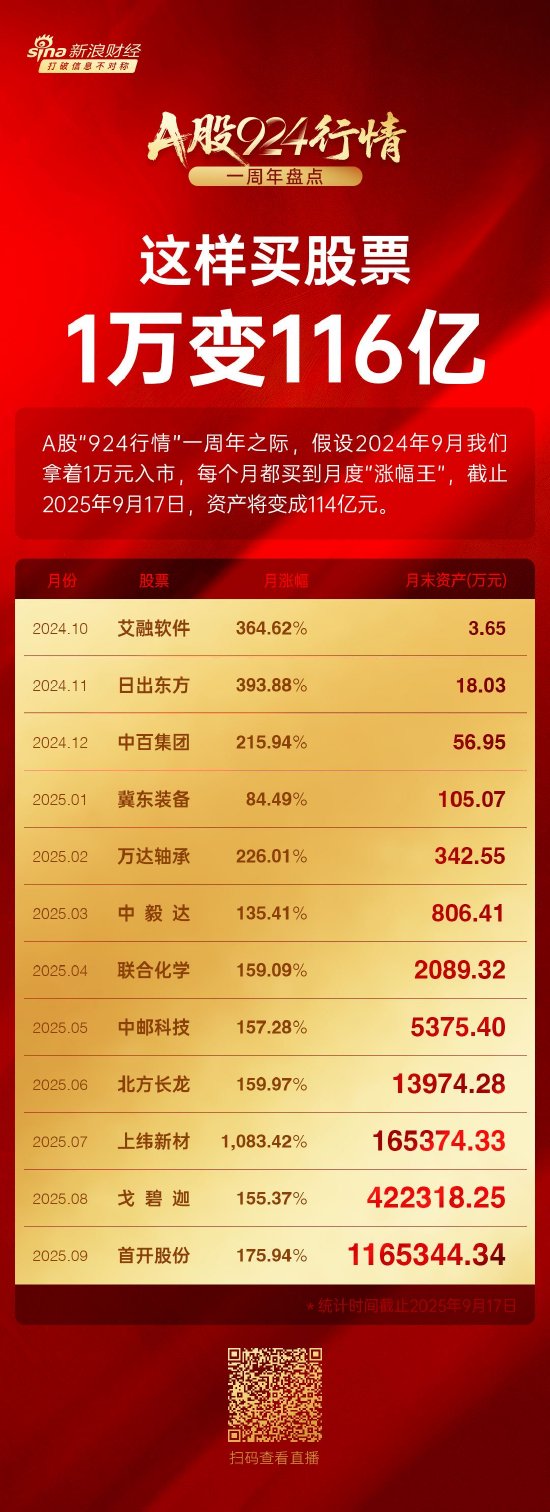
A股“924行情”一周年 这样买股票1万变116亿
Xin Lang Zheng Quan· 2025-09-19 05:56
Group 1 - The article discusses the one-year anniversary of the A-share "924 market" and presents a hypothetical investment scenario where an initial investment of 10,000 yuan could grow to 11.4 billion yuan by September 2025 if the monthly "top gainers" are consistently selected [1] - The report highlights significant stock performances, with notable monthly gainers such as Shangwei New Materials achieving a staggering increase of 1,083.42% in July 2025 [3] - The analysis indicates a positive market trend, supported by the formation of MACD golden cross signals, suggesting a favorable outlook for selected stocks [3]
9.19犀牛财经早报:多因素推动金价维持高位 山西证道私募被责令整改
Xi Niu Cai Jing· 2025-09-19 02:13
Group 1 - International gold prices have risen significantly, with the London spot gold price surpassing $3,700 per ounce, reaching a historical high of $3,703.13 per ounce [1] - The Federal Reserve's expected interest rate cuts are likely to maintain a favorable long-term trend for gold prices, supported by geopolitical tensions, high U.S. debt, and ongoing global central bank gold purchases [1] - China leads the global energy storage industry, accounting for over 40% of the total installed capacity, as highlighted in a report by the International Renewable Energy Agency [1] Group 2 - The securities industry is transitioning from a "human-driven" model to an "intelligent-driven" model, with AI being integrated into wealth management processes [2] - AI applications are enhancing efficiency and customer service in the wealth management sector, moving towards a full lifecycle support model for clients [2] - The approval of a new standard for medical devices using brain-computer interface technology is expected to facilitate the development and regulation of this field in China [2] Group 3 - Copper prices have recently reached new highs, with LME copper prices nearing $10,200 per ton, although a market correction is anticipated due to the completion of positive market factors [3] - The laser radar industry is experiencing growth as automotive manufacturers shift their focus to safety features, creating new opportunities for laser radar companies [3] Group 4 - A significant execution information of 358 million yuan has been reported by Zhengrong Real Estate, which may negatively impact the company's debt repayment capacity [4] - The private equity firm Shanxi Zhendao has been ordered to rectify its operations due to violations in fundraising practices [5] - Xipuni plans to issue shares at a price range of 27-29.6 HKD per share in its upcoming IPO, aiming to raise up to 314 million HKD [6] Group 5 - Li Auto has signed a comprehensive five-year strategic cooperation agreement with CATL to enhance battery technology and expand business operations [7] - The resignation of independent director Cheng Hua from Bichang Pharmaceutical has been announced due to personal reasons [8] - Shanshan Holdings has extended the deadline for submitting its restructuring plan to December 20, 2025, due to complex asset conditions [9] Group 6 - Zhengqiang Co. plans to transfer 8.9% of its shares through an agreement, with the total transfer price amounting to 273 million yuan [10] - Anhui Heli intends to acquire 51% of Jianghuai Heavy Industry for 274 million yuan, with the assessed value of Jianghuai Heavy Industry at 537 million yuan [11] - The shareholding structure of Shanggao Holdings is highly concentrated, with 92.46% of shares held by a small number of shareholders [12]

