财政

Search documents
吉林将退出债务高风险省份名单,有何影响?
Di Yi Cai Jing· 2025-11-22 02:27
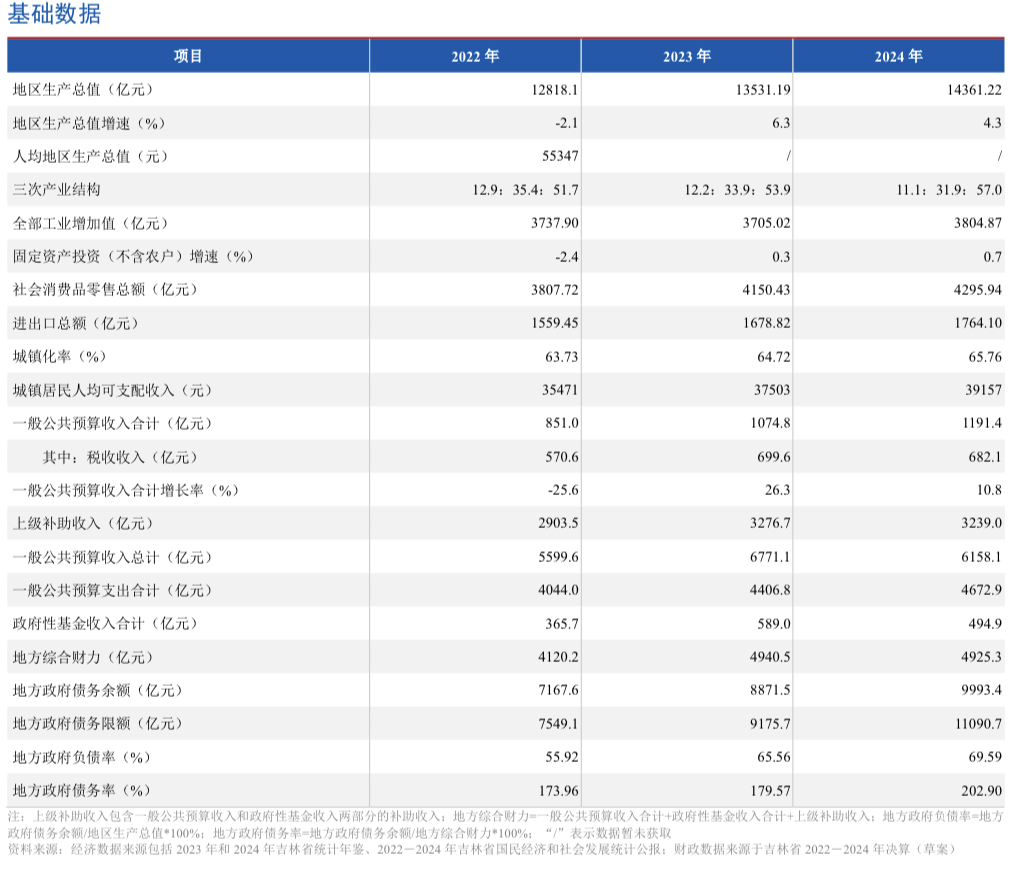
Core Viewpoint - Jilin Province has achieved a historic breakthrough in risk prevention and is set to exit the list of high-risk debt provinces, following Inner Mongolia, with a nearly 90% reduction in hidden debt by September 2025 [1][5]. Group 1: Debt Management and Economic Impact - Jilin's local government financing behavior will face fewer restrictions, promoting economic development and providing a replicable model for other provinces [1][5]. - The province's public budget revenue for the first ten months of 2025 reached 1110.7 billion yuan, a year-on-year increase of 12.6%, indicating robust fiscal growth [5][6]. - The local government debt balance is projected to be 9993.4 billion yuan by the end of 2024, with a debt ratio of 202.9%, remaining within the debt limit [7][8]. Group 2: Policy and Structural Changes - The central government has increased support for Jilin's debt resolution, with over 100 billion yuan allocated from a total of 6 trillion yuan for debt management [5]. - Jilin has conducted a comprehensive asset assessment, resulting in over 1000 billion yuan in activated assets, which supports risk prevention and economic stability [6]. - The exit from the high-risk debt list will enhance the flexibility and initiative of local governments and state-owned enterprises in investment and financing activities [6][7]. Group 3: Future Outlook and Challenges - While exiting the high-risk debt list reduces policy restrictions, it may also lead to decreased support for debt management, necessitating a balance between debt resolution and economic growth [7]. - Experts emphasize the need for improved local government debt management mechanisms to align with high-quality development goals [7][8]. - Other provinces, such as Ningxia, are also moving towards exiting the high-risk debt list, indicating a broader trend in debt management across the country [8].

鲁西新区财政金融工作交出亮眼答卷
Qi Lu Wan Bao· 2025-11-20 06:28
Core Insights - The news highlights the achievements of the Heze Luxi New District in financial and fiscal development during the "14th Five-Year Plan" period, focusing on high-quality development and addressing key issues such as financing for small and micro enterprises, budget performance management, and social welfare [1] Financial Performance - During the "14th Five-Year Plan" period, the district's general public budget revenue reached 25.646 billion yuan, with a tax revenue share of 69.54%, indicating high revenue quality [2] - The total public budget expenditure was 22.966 billion yuan, with 16.069 billion yuan allocated to social welfare, maintaining a stable 70% share over five years [2] - The district secured an additional 15.076 billion yuan in special bonds to support key projects in municipal services, social welfare, and water conservancy [2] Support for Small and Micro Enterprises - The district's financial bureau implemented three key measures to alleviate financing difficulties for small and micro enterprises, including enhancing bank-enterprise connections and establishing a financing demand database [3] - A credit integrity management system was introduced to encourage banks to adhere to regulations and promote honest repayment by enterprises [3] - The district is expanding direct financing channels and has created a reserve of potential listed companies to facilitate access to multi-tiered capital markets [3] Budget Performance Management - The district has established a comprehensive budget performance management system that includes pre-assessment, monitoring during execution, and post-evaluation of budgetary projects [4] - A mechanism links performance evaluation results to budget allocations, prioritizing funding for high-performing projects while reducing budgets for underperforming ones [4] - The district emphasizes transparency and social oversight in budget performance management [4] Social Welfare and Support - A multi-tiered social welfare system has been established, covering basic living assistance, special social aid, and various subsidies in education, healthcare, and housing [5] - The district has disbursed a total of 38.556 million yuan in assistance to 21,384 individuals since the beginning of the "14th Five-Year Plan," including various forms of support for low-income and vulnerable groups [5] - Future plans include continuing to enhance financial support and reform initiatives to ensure effective resource allocation and risk management [5]
加纳2026年政府预算着眼财政纪律和税收制度
Shang Wu Bu Wang Zhan· 2025-11-19 17:22
Core Viewpoint - The Ghanaian government aims to maintain fiscal discipline and structural reforms in its 2026 budget to ensure macroeconomic stability achieved in 2025, focusing on economic transformation and job creation [1] Fiscal Strategy - The budget emphasizes a comprehensive fiscal strategy based on prudent spending, improved tax compliance, and a fair tax system [3] - The government targets a primary surplus of 1.5% of GDP and aims to maintain single-digit inflation and stable exchange rates [1][2] Revenue Generation - The finance minister attributes economic improvement to stricter spending controls and effective tax collection, with non-oil tax revenue as a percentage of GDP rising from 7.8% to 8.7% [2] - The government plans to increase non-oil revenue from an estimated 15.1% of GDP in 2025 to 15.7% in 2026 through tax reforms [3] Tax Reforms - Key tax reforms include modernizing the VAT system, reducing the VAT rate from 21.9% to 20%, and raising the VAT registration threshold from 200,000 to 750,000 cedis [3] - The government expects these reforms to save businesses and households approximately 57 billion cedis in 2026 [3] Digital Tax Management - The Ghana Revenue Authority (GRA) plans to introduce new digital tools for tax management, including electronic devices for monitoring taxable transactions and a digital platform for VAT collection on cross-border e-commerce [4] - Comprehensive reviews of the Income Tax Act, Customs Act, and Excise Tax Act will align Ghana's tax system with global best practices [4] Customs and Trade Efficiency - To address tax losses at ports, the government will deploy an AI-driven pre-arrival inspection system to detect undervalued and misclassified goods, enhancing customs revenue [5] - The government aims to streamline spending by eliminating low-value projects and reallocating funds to infrastructure, energy, agriculture, and education [5] Social Programs and Public Spending - The budget reinforces commitments to social programs such as the Livelihood Empowerment Against Poverty (LEAP) and the National Health Insurance Scheme [6] - The government will integrate the Ghana Electronic Procurement System with the Ghana Integrated Financial Management Information System to improve public spending efficiency and transparency [6]
前10月财政收入稳步回升 重点领域支出得到保障
Yang Shi Xin Wen· 2025-11-18 00:32
Core Insights - The latest data from the Ministry of Finance indicates that from January to October, national fiscal revenue reached 18.65 trillion yuan, representing a year-on-year growth of 0.8%, with an increase of 0.3 percentage points compared to the growth rate from January to September [1] - In October alone, national fiscal revenue was 2.26 trillion yuan, showing a year-on-year increase of 3.2%, continuing the upward trend in monthly growth [1] - Tax revenue has been growing steadily, with total tax revenue from January to October amounting to 15.34 trillion yuan, a growth of 1.7%, which is an increase of 1 percentage point from the previous period [1] Fiscal Expenditure - Total national fiscal expenditure from January to October was 22.58 trillion yuan, reflecting a year-on-year increase of 2% [1] - The government has implemented more proactive fiscal policies, increasing expenditure intensity and optimizing expenditure structure, with a focus on key areas [1] - Notable increases in specific expenditure categories include social security and employment (up 9.3%), science and technology (up 5.7%), and education (up 4.7%) [1] Debt and Financing - The government has accelerated the use of bond funds, with total expenditures from various types of bonds, including local government special bonds and central financial institution special bonds, amounting to 4.54 trillion yuan [1]
发挥积极财政政策作用 推动中国式现代化开创新局面(权威访谈·学习贯彻党的二十届四中全会精神) ——访财政部党组书记、部长蓝佛安
Ren Min Ri Bao· 2025-11-14 22:49
Group 1 - The core viewpoint emphasizes the importance of active fiscal policy as a foundation for national governance and economic development, particularly in the context of the "14th Five-Year Plan" and the upcoming "15th Five-Year Plan" [1][4] - The Ministry of Finance has recognized the effectiveness of active fiscal policies in recent years, highlighting a 24% increase in general public budget expenditure, which is expected to exceed 136 trillion yuan during the "14th Five-Year Plan" [2][4] - Over 70% of national fiscal expenditure is directed towards people's livelihoods, with nearly 10 trillion yuan allocated for social welfare over the past five years [2][4] Group 2 - The Ministry of Finance plans to enhance counter-cyclical and cross-cyclical adjustments to address structural and deep-seated economic issues, thereby boosting long-term development potential [3][4] - The focus will be on both supply-side and demand-side management, utilizing tax policies and government procurement to support the modern industrial system and stimulate consumption [3][6] - The Ministry aims to innovate fiscal tools, such as long-term special government bonds and fiscal subsidies, to improve the effectiveness of fiscal policies [3][4] Group 3 - The "15th Five-Year Plan" will prioritize expanding domestic demand, with strategies to boost consumption and effective investment, while also promoting a unified national market [6][7] - The Ministry of Finance will work on optimizing resource allocation and enhancing fiscal management, including zero-based budgeting reforms to improve fund utilization [9] - There will be a focus on balancing efficiency and equity in tax policies, as well as strengthening the fiscal relationship between central and local governments [9]
【环球财经】土耳其财政部长:经济基本面改善支撑里拉长期前景
Xin Hua Cai Jing· 2025-11-11 12:26
Core Viewpoint - Turkey's Finance Minister, Mehmet Simsek, indicates that the Turkish lira is expected to gradually escape depreciation pressure due to a significant reduction in the current account deficit, recovery of international financing channels, and continuous improvement in macroeconomic indicators [1] Economic Indicators - In August 2023, Turkey achieved a current account surplus of $5.5 billion, with the annualized deficit decreasing to $18.3 billion, reducing the GDP ratio from 5.29% at the beginning of 2023 to 1.3% by the second quarter of 2025 [1] - Since the launch of economic reforms in September 2023, the five-year credit default swap for government bonds has decreased by approximately 460 basis points, allowing businesses and the treasury to secure lower financing costs in international markets [1] Debt and Fiscal Management - Turkey's total debt-to-GDP ratio is approximately 89%, which is significantly lower than the average of 242% for developing economies and 320% globally [1] - The government aims to improve the budget deficit by combating the gray economy and enhancing tax collection, with the deficit ratio expected to decrease to 3.1% by the end of this year [1] Future Plans - By 2026, Turkey plans to enter a new phase of structural transformation, accelerating railway infrastructure projects connecting industrial zones to ports, and deepening regional economic cooperation through free trade agreements and transport corridors [1] - Strategic priorities will include green energy, renewable resources, and local oil and gas development [1]
美国歇业警示,债务非36万亿,实达230万亿,美元信用面临挑战
Sou Hu Cai Jing· 2025-11-09 19:43
Core Insights - The article highlights the growing concern over the U.S. national debt, which officially stands at approximately $38 trillion, while the present value of unfunded obligations, including Social Security and Medicare, is estimated to be around $230 trillion, indicating a significant gap between reported debt and actual financial commitments [3][7][25]. Group 1: Debt and Financial Obligations - Officially reported U.S. debt is approximately $38 trillion, primarily consisting of national debt and short-term borrowings [3]. - Analysts are comparing the present value of future commitments, such as Social Security and Medicare, which are not included in current liabilities, revealing a deeper financial issue [3][5]. - The rising interest expense, which has increased from 10% to 25% of income, is attributed to higher interest rates, impacting the ability to manage debt sustainably [11]. Group 2: Political and Economic Implications - There is a political debate regarding proposals to raise the retirement age, reflecting the tension between fiscal responsibility and electoral considerations [9]. - Local governments are feeling the strain of reduced federal transfers, leading to potential cuts in welfare programs, which directly affect community services [9][17]. - International investors are diversifying away from U.S. debt, indicating a loss of confidence in the dollar, with some shifting towards gold and other currencies [11][21]. Group 3: Future Projections and Risks - The Social Security fund is projected to deplete by 2034, highlighting the urgency for reform amidst political resistance [25]. - The article suggests that if major countries cease large-scale purchases of U.S. debt, the pressure on the dollar could increase, complicating the financial landscape [21]. - The ongoing reliance on temporary measures to raise the debt ceiling is seen as a short-term fix that does not address the underlying structural deficits [17].
西藏前三季度GDP增长7.1% 多项经济指标增速位居全国前列
Zhong Guo Xin Wen Wang· 2025-10-31 13:33
Core Points - Tibet's GDP for the first three quarters reached 207.006 billion yuan, with a year-on-year growth of 7.1%, surpassing the national average by 1.9 percentage points, indicating a stable and progressive economic performance [1][3]. Economic Indicators - Industrial value added for large-scale enterprises grew by 12.5%, maintaining the highest growth rate in the country for eight consecutive months [3]. - Fixed asset investment increased by 18.6%, leading the nation for four months, significantly supporting economic stability [3]. - General public budget revenue was 23.275 billion yuan, up 14.2%, while expenditures reached 225.797 billion yuan, growing by 13.0%, both ranking first nationally [3]. - Total electricity consumption was 12.45 billion kWh, reflecting a 13.4% increase, indicating rising economic activity [3]. Social and Consumer Trends - Per capita disposable income for residents was 23,357 yuan, with a growth rate of 7.3%, exceeding the national average by 2.2 percentage points [3]. - The retail sales of consumer goods totaled 76.846 billion yuan, showing a year-on-year increase of 4.5%, indicating a steady recovery in the consumer market [3]. - The tourism sector thrived, with 63.7073 million domestic and international visitors, a growth of 11.2%, and total tourism expenditure reaching 73.673 billion yuan, up 9.9% [3]. Future Outlook - Tibet plans to continue implementing the decisions of the central government, focusing on stabilizing employment, businesses, markets, and expectations to promote high-quality economic development [4].
吴清、潘功胜、蓝佛安发文!事关“十五五”,信息量大
Sou Hu Cai Jing· 2025-10-31 06:09
Core Viewpoint - The recent articles by key financial leaders emphasize the need for reforms in China's capital market, monetary policy, and government debt management to enhance inclusivity, adaptability, and overall economic growth [1][3][20]. Group 1: Capital Market Reforms - The Chairman of the China Securities Regulatory Commission (CSRC), Wu Qing, highlights the importance of improving the inclusivity and adaptability of the capital market to better serve new productive forces and ensure that development benefits the broader population [3][4]. - Wu Qing advocates for more inclusive issuance and listing systems, particularly for technology companies, to support innovation and address the unique challenges they face [4][6]. - There is a call for a multi-layered market system that meets diverse investor needs and enhances the overall investment experience [4][5]. Group 2: Monetary Policy Enhancements - The Governor of the People's Bank of China (PBOC), Pan Gongsheng, stresses the need to strengthen the role of central bank policy rates and improve the transmission mechanism of monetary policy [14][15]. - Pan emphasizes the importance of maintaining a flexible exchange rate system and preventing excessive fluctuations to support macroeconomic stability [16][18]. - There is a focus on enhancing the financial system's ability to respond to economic fluctuations and ensuring the safety of significant financial institutions and foreign reserves [18][17]. Group 3: Government Debt Management - The Minister of Finance, Lan Fo'an, outlines plans to optimize government investment strategies and encourage private capital participation in major projects during the 15th Five-Year Plan period [20][21]. - Lan emphasizes the need for a long-term government debt management mechanism that aligns with high-quality development, including strict oversight of local government debt [22]. - The strategy includes increasing residents' income through various channels and optimizing the income distribution structure to boost consumption [21].

突发!美军轰炸机,出动!
券商中国· 2025-10-24 01:23
Core Points - The article discusses recent military actions by the U.S. near Venezuela, including the deployment of a B-1B bomber and potential ground military operations as stated by President Trump [1][2] - It highlights the ongoing U.S. government shutdown, which has led to significant disruptions in air travel and an increase in national debt, surpassing $38 trillion for the first time [4][6][7] Military Actions - On October 23, at least one U.S. B-1B bomber was reported near the Venezuelan coast, marking the second such military display within a week [2] - President Trump indicated that the U.S. would soon see ground military actions in Venezuela, citing dissatisfaction with the country [2] - The U.S. has been conducting operations against alleged drug trafficking vessels, with recent reports of military strikes resulting in multiple casualties [2] Venezuela's Response - Venezuela initiated "Independence Coast 200" defense exercises in response to perceived foreign military threats, focusing on strategic locations along its coast [3] - Venezuelan Defense Minister Padrino Lopez stated that any destabilizing actions from the U.S. would fail, emphasizing the readiness of the Venezuelan military [3] U.S. Government Shutdown - The U.S. government shutdown has entered its 23rd day, causing significant delays in air travel due to a shortage of air traffic controllers [4] - The Federal Aviation Administration (FAA) reported that 53% of flight delays were due to controller absenteeism, compared to a normal rate of 5% [4] - Approximately 13,000 air traffic controllers and 50,000 Transportation Security Administration officials are working without pay during the shutdown [4] National Debt - The U.S. national debt has reached over $38 trillion, with concerns that the shutdown will exacerbate the situation by delaying economic activities and increasing costs [6][7] - The Peter G. Peterson Foundation warned that interest payments on the national debt could surge to $14 trillion over the next decade, significantly impacting public and private spending [7]