
服务业

Search documents
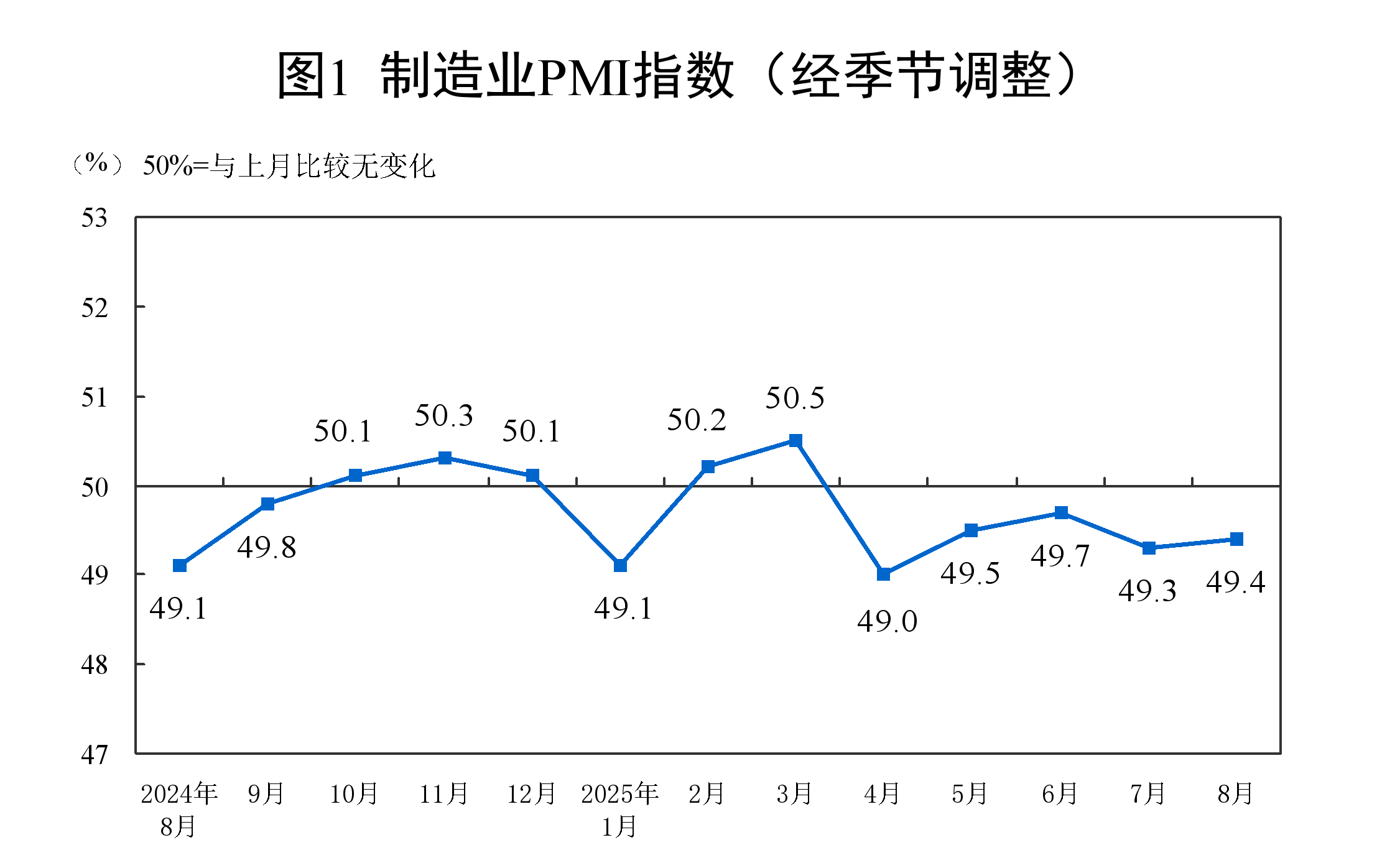
8月份,制造业采购经理指数(PMI)为49.4%
Yang Shi Wang· 2025-08-31 01:43
Manufacturing PMI Overview - In August, the Manufacturing Purchasing Managers' Index (PMI) was 49.4%, an increase of 0.1 percentage points from the previous month, indicating a slight improvement in manufacturing sentiment [1] - Large enterprises reported a PMI of 50.8%, up 0.5 percentage points, while medium-sized enterprises saw a PMI of 48.9%, down 0.6 percentage points, and small enterprises had a PMI of 46.6%, up 0.2 percentage points [1] Manufacturing Index Components - The production index was 50.8%, an increase of 0.3 percentage points, suggesting accelerated production expansion in the manufacturing sector [2] - The new orders index was 49.5%, up 0.1 percentage points, indicating a slight improvement in market demand [3] - The raw materials inventory index was 48.0%, up 0.3 percentage points, showing a narrowing decline in major raw material inventory levels [3] - The employment index was 47.9%, down 0.1 percentage points, reflecting a slight decrease in employment sentiment within manufacturing [4] - The supplier delivery time index was 50.5%, up 0.2 percentage points, indicating faster delivery times from suppliers [5] Non-Manufacturing PMI Overview - In August, the non-manufacturing business activity index was 50.3%, an increase of 0.2 percentage points, indicating continued expansion in the non-manufacturing sector [6] - The construction industry business activity index was 49.1%, down 1.5 percentage points, while the services industry index was 50.5%, up 0.5 percentage points [6] Non-Manufacturing Index Components - The new orders index for non-manufacturing was 46.6%, up 0.9 percentage points, indicating improved market demand [6] - The input prices index was 50.3%, unchanged from the previous month, indicating continued price increases for operating inputs [6] - The sales prices index was 48.6%, up 0.7 percentage points, showing a narrowing decline in overall sales prices [7] - The employment index for non-manufacturing was 45.6%, unchanged, indicating weak employment sentiment [7] - The business activity expectation index was 56.2%, up 0.4 percentage points, suggesting optimism among non-manufacturing enterprises regarding market prospects [7] Composite PMI Overview - The composite PMI output index for August was 50.5%, an increase of 0.3 percentage points, indicating an overall acceleration in production and business activities across enterprises [8]
国家统计局:8月份制造业采购经理指数小幅回升 非制造业商务活动指数扩张加快
Guo Jia Tong Ji Ju· 2025-08-31 01:37
Group 1: Manufacturing PMI Insights - In August, the Manufacturing PMI rose to 49.4%, indicating an improvement in economic conditions compared to the previous month [2] - The production index reached 50.8%, up by 0.3 percentage points, marking four consecutive months above the critical point, suggesting accelerated manufacturing production [2] - The new orders index increased to 49.5%, reflecting a slight rise in demand [2] - Large enterprises showed a PMI of 50.8%, up by 0.5 percentage points, indicating sustained expansion, while medium and small enterprises experienced declines [3] - High-tech manufacturing and equipment manufacturing sectors reported PMIs of 51.9% and 50.5%, respectively, indicating strong performance [3] Group 2: Non-Manufacturing PMI Insights - The Non-Manufacturing Business Activity Index rose to 50.3%, reflecting continued expansion in the sector [4] - The service industry saw a significant increase, with a business activity index of 50.5%, reaching a yearly high [4] - Capital market services and transportation sectors reported business activity indices above 60.0%, indicating robust growth [4] - The construction industry faced a decline in activity, with a business activity index of 49.1%, down by 1.5 percentage points due to adverse weather conditions [4] Group 3: Composite PMI Insights - The Composite PMI Output Index increased to 50.5%, indicating an overall acceleration in production and business activities [5] - The manufacturing production index and non-manufacturing business activity index were reported at 50.8% and 50.3%, respectively, contributing to the composite index's growth [5]
2025年8月中国采购经理指数运行情况
Guo Jia Tong Ji Ju· 2025-08-31 01:31
Group 1: Manufacturing PMI Overview - In August, the Manufacturing Purchasing Managers' Index (PMI) was 49.4%, an increase of 0.1 percentage points from the previous month, indicating a slight improvement in manufacturing sentiment [1] - The PMI for large enterprises was 50.8%, up 0.5 percentage points, while medium-sized enterprises saw a PMI of 48.9%, down 0.6 percentage points, and small enterprises had a PMI of 46.6%, up 0.2 percentage points [4] - The production index was 50.8%, an increase of 0.3 percentage points, suggesting accelerated production expansion in the manufacturing sector [4] Group 2: New Orders and Inventory - The new orders index was 49.5%, up 0.1 percentage points, indicating a slight improvement in market demand within the manufacturing sector [5] - The raw materials inventory index was 48.0%, an increase of 0.3 percentage points, still below the critical point, suggesting a narrowing decline in major raw material inventory levels [6] - The employment index was 47.9%, down 0.1 percentage points, indicating a slight decline in employment sentiment among manufacturing enterprises [7] Group 3: Supplier Delivery and Non-Manufacturing PMI - The supplier delivery time index was 50.5%, up 0.2 percentage points, indicating that the delivery times from raw material suppliers are continuing to improve [8] - In August, the non-manufacturing business activity index was 50.3%, an increase of 0.2 percentage points, indicating continued expansion in the non-manufacturing sector [12] - The construction industry business activity index was 49.1%, down 1.5 percentage points, while the services industry index was 50.5%, up 0.5 percentage points [15] Group 4: Employment and Price Indices in Non-Manufacturing - The new orders index for non-manufacturing was 46.6%, up 0.9 percentage points, indicating improved market demand [19] - The input price index was 50.3%, unchanged from the previous month, indicating that input prices for non-manufacturing enterprises continue to rise [19] - The sales price index was 48.6%, up 0.7 percentage points, indicating a narrowing decline in overall sales prices in the non-manufacturing sector [19] Group 5: Comprehensive PMI Output Index - The comprehensive PMI output index for August was 50.5%, an increase of 0.3 percentage points, indicating an overall acceleration in production and business activities across industries [25]

城记 | 一周聚焦:民营企业500强榜单发布,长三角“多点开花”江浙领跑全国
Xin Hua Cai Jing· 2025-08-30 13:53
Core Insights - The "2025 China Private Enterprises Top 500" and related lists highlight the strong performance of private enterprises in the Yangtze River Delta region, particularly in Zhejiang and Jiangsu provinces, which dominate the rankings in terms of quantity and competitiveness [1][2][3] Group 1: National Overview - JD Group, Alibaba, and Hengli Group are the top three in the "China Private Enterprises Top 500" list, with revenues of 1,158.819 billion yuan, 981.767 billion yuan, and 871.521 billion yuan respectively for 2024 [1] - Hengli Group leads the "China Manufacturing Private Enterprises Top 500," while JD Group tops the "China Service Industry Private Enterprises Top 100" [1] Group 2: Zhejiang Province - Zhejiang Province has the highest number of entries in all three lists: 107 in "China Private Enterprises Top 500," 109 in "China Manufacturing Private Enterprises Top 500," and 20 in "China Service Industry Private Enterprises Top 100" [2] - Hangzhou is a key contributor with 38 entries in "China Private Enterprises Top 500," including Alibaba (2nd), Zhejiang Rongsheng Holding (7th), and Zhejiang Geely Holding (8th) [2] Group 3: Jiangsu Province - Jiangsu Province has 90 entries in "China Private Enterprises Top 500," with a GDP contribution of 7.98 trillion yuan from private enterprises, accounting for 58.2% of the province's GDP [3][4] - Suzhou stands out with 26 entries in "China Private Enterprises Top 500," including Hengli Group (3rd) and Shenghong Holding (9th) [4] Group 4: Shanghai and Other Regions - Shanghai has 17 entries in "China Private Enterprises Top 500," led by Fosun International (36th) with a revenue of 192.142 billion yuan [5] - Anhui Province has 11 entries in "China Private Enterprises Top 500," with notable companies like Sungrow Power Supply (138th) and NIO (172nd) [6]


消费贷贴息能“带飞”消费吗?
和讯· 2025-08-30 08:57
Core Viewpoint - The introduction of the "national subsidy" for consumer loans aims to stimulate consumption by directly reducing interest expenses through a subsidy mechanism, thereby encouraging consumers to spend more [2][3]. Group 1: Subsidy Policy Overview - The consumer loan subsidy policy, effective from September 1, offers a 1% annual interest subsidy for personal loans, covering various key consumption areas such as home appliances, education, and healthcare [3][4]. - The policy allows for targeted support, breaking from previous practices by only subsidizing the portion of loans used for consumption, with strict regulations against misuse [4][5]. Group 2: Impact on Consumers and Businesses - The dual subsidy approach benefits both individual consumers and service industry businesses, with the personal loan subsidy particularly aiding middle-income families and expanding access in lower-tier markets [6][7]. - For businesses in the service sector, the subsidy is designed to alleviate short-term cash flow pressures, with a maximum subsidy of 10,000 yuan for loans up to 1 million yuan [5][6]. Group 3: Financial Implications - The total credit involved in the subsidy policy is estimated at 15 trillion yuan, representing about 6% of all loans, with potential annual interest savings for borrowers of approximately 60 billion yuan [8][9]. - The policy is expected to stimulate new loan issuance significantly, with projections indicating that every 1 yuan of subsidy could leverage 100 yuan in new loans, enhancing the overall economic activity [9][10].

5个月新高!美联储最青睐通胀指标升温,如何影响降息前景
Di Yi Cai Jing· 2025-08-30 00:18
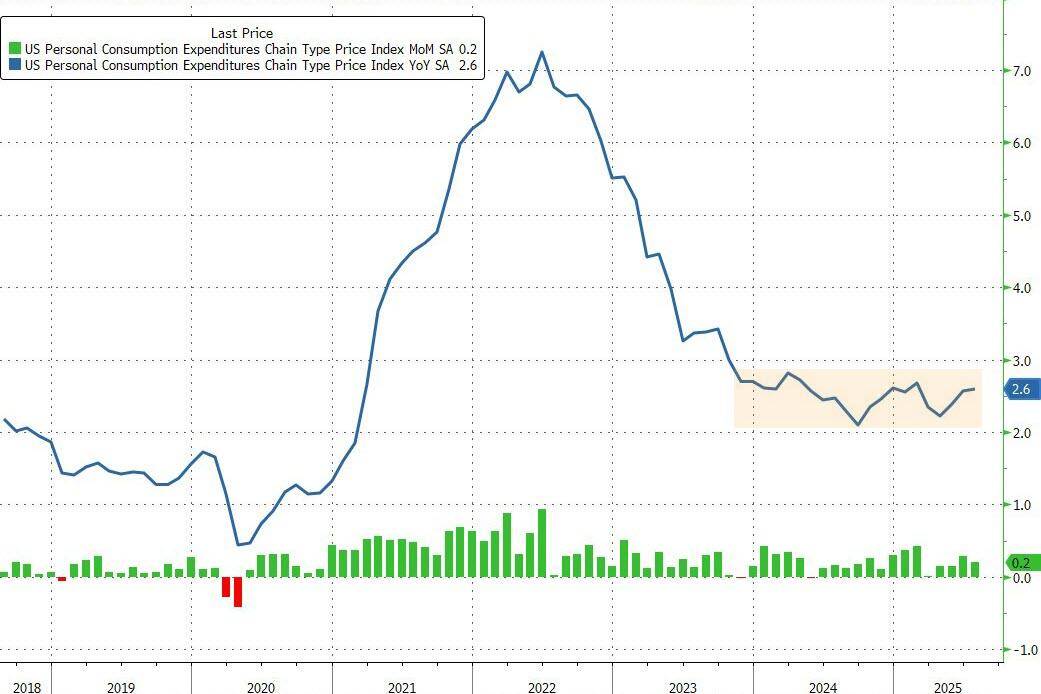
Core Insights - The core PCE price index in the U.S. rose to a year-on-year increase of 2.9% in July, indicating a slight uptick in inflationary pressures [1][2] - Consumer spending saw its largest increase in four months, accelerating to 0.5% in July, primarily driven by durable goods purchases [2][3] - The labor market remains weak, with average monthly job growth significantly lower than previous years, which may influence future monetary policy decisions [3][5] Inflation Trends - The PCE price index increased by 0.2% month-on-month in July, with a year-on-year growth of 2.6%, remaining stable compared to June [2] - Core PCE, excluding volatile food and energy prices, rose by 0.3% month-on-month, with a year-on-year increase of 2.9%, the highest since February [2] - Service costs rose by 0.3% month-on-month and 3.4% year-on-year, indicating persistent inflation in the service sector, which is less affected by tariffs [2][4] Economic Outlook - The upcoming Federal Reserve meeting in September will consider the July PCE data alongside the non-farm payroll and CPI reports [4] - Rising tariffs are expected to increase business costs, potentially leading to higher consumer prices, as indicated by recent warnings from retailers and automakers [4] - The probability of a 25 basis point rate cut in September is currently at 84%, reflecting a growing consensus within the Federal Reserve, despite concerns about inflation [5][6]
长春高新:8月28日召开董事会会议
Mei Ri Jing Ji Xin Wen· 2025-08-29 18:35
Company Overview - Changchun High New Technology Industry Group Co., Ltd. (SZ 000661) announced on August 30 that its 11th Board of Directors meeting was held on August 28, 2025, to discuss the proposal for issuing H-shares and listing on the Hong Kong Stock Exchange [1] Financial Performance - For the first half of 2025, the revenue composition of Changchun High New was as follows: Pharmaceutical industry accounted for 92.83%, Real estate accounted for 6.81%, and Service industry accounted for 0.36% [1]

钟新龙:“人工智能+”行动推动地方政府“差异化破局”
Zhong Guo Xin Wen Wang· 2025-08-29 16:23
Group 1 - The core viewpoint emphasizes the need for local governments to avoid chaotic competition in the "Artificial Intelligence +" era, focusing on unique application scenarios and soft strengths rather than hard metrics like computing power and data storage [1][2] - The "Opinions" document suggests a forward-looking and systematic approach, urging local governments to implement AI strategies tailored to their specific conditions and industries [1][2] - The shift from a "one-size-fits-all" resource allocation to a "precise drip irrigation" model is necessary, with different sectors such as industry, agriculture, and services requiring targeted AI integration [2] Group 2 - The document highlights the importance of developing AI application service providers and creating an AI application service chain, which will alter the traditional resource monopoly held by leading regions [2] - Future intelligent applications or agents are expected to become new traffic entry points, allowing smaller cities and underdeveloped areas to bypass reliance on platform economies [2] - Specific examples of regional strategies include leveraging advanced manufacturing in the Yangtze River Delta for "AI + Industry" and utilizing biodiversity in the southwest for "AI + Ecological Protection" [1][2]
关税冲击尚且可控!美国7月核心PCE物价指数同比2.9%,符合预期但创下四个月来最大增幅
Sou Hu Cai Jing· 2025-08-29 15:44
Group 1 - In July, U.S. consumer spending saw the largest increase in four months, indicating resilient demand despite persistent inflation [1] - The PCE price index for July increased by 2.6% year-on-year, aligning with expectations and previous values, while month-on-month it remained flat at 0.2%, down from 0.3% [1] - The core PCE price index rose by 2.9% year-on-year in July, matching expectations and marking the highest level since February, with a month-on-month increase of 0.3% [2] Group 2 - The super core PCE, which excludes housing and focuses on services, increased by 3.32% year-on-year, consistent with the level seen in July 2024 [3] - Following the data release, U.S. stock index futures and government bonds reduced their declines, while the dollar strengthened, as traders anticipated a potential interest rate cut by the Federal Reserve in mid-September [3] - Recent data indicates a rebound in service prices, raising concerns about inflation amid the impact of tariffs on the economy, although consumer spending remains robust [4]
法国西班牙CPI略低于预期 欧元区整体通胀靠拢2%目标
Zhi Tong Cai Jing· 2025-08-29 09:17
Group 1 - France's inflation rate decreased to 0.8% and Spain's to 2.7%, both slightly below expectations by 0.1 percentage points [1] - The European Central Bank (ECB) is satisfied with the overall situation in the Eurozone despite varying inflation pressures in member countries [1] - The ECB is expected to maintain interest rates at 2% for the second consecutive month, with investors no longer fully pricing in further rate cuts this year [1] Group 2 - Bloomberg economists predict that the Eurozone's overall inflation rate will rise from 2% in July to 2.1% in August, driven by base effects from energy prices [2] - France's economic growth is lagging behind peers due to political and fiscal uncertainties, while Spain is performing well as a leading economy in the Eurozone [2] - Preliminary data for August shows a slowdown in service sector inflation from 2.5% in July to 2.1%, with industrial prices down 0.3% and energy prices down 6.2% [2]