
非银金融

Search documents
【10日资金路线图】食品饮料板块净流入约110亿元居首 龙虎榜机构抢筹多股
Zheng Quan Shi Bao· 2025-11-10 11:57
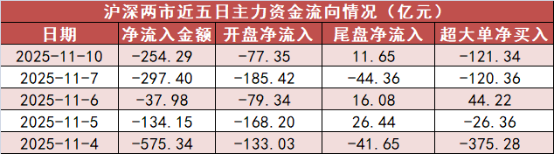
Market Overview - The A-share market showed mixed results on November 10, with the Shanghai Composite Index closing at 4018.6 points, up 0.53%, while the Shenzhen Component Index rose 0.18% to 13427.61 points. However, the ChiNext Index fell by 0.92% to 3178.83 points, and the North Star 50 Index decreased by 0.67% [1] - The total trading volume in the A-share market reached 21946.3 billion yuan, an increase of 1740.87 billion yuan compared to the previous trading day [1] Capital Flow - The main capital in the A-share market experienced a net outflow of 254.29 billion yuan, with an opening net outflow of 77.35 billion yuan and a closing net inflow of 11.65 billion yuan [2][3] - The CSI 300 index saw a net outflow of 87.96 billion yuan, while the ChiNext index had a net outflow of 147.56 billion yuan, and the Sci-Tech Innovation Board experienced a net outflow of 6.9 billion yuan [4][5] Sector Performance - Among the 13 sectors tracked, the food and beverage industry led with a net inflow of 109.94 billion yuan, reflecting a 3.49% increase [6][7] - Other sectors with significant net inflows included pharmaceuticals and biotechnology with 51.04 billion yuan, non-bank financials with 37.87 billion yuan, banks with 25.13 billion yuan, and agriculture, forestry, animal husbandry, and fishery with 24.72 billion yuan [7] - Conversely, the power equipment sector faced the largest net outflow of 211.06 billion yuan, followed by electronics with 154.94 billion yuan, and machinery with 76.27 billion yuan [7] Institutional Activity - Cambridge Technology recorded the highest net inflow of 7.58 billion yuan among individual stocks [8] - The top stocks with institutional net buying included Wanrun Technology and Tianji Shares, both showing a 10% increase [10][11] - Institutions showed interest in several stocks, with notable net buying in Prolo Pharmaceutical and Zhaoyan New Drug, indicating a positive outlook for these companies [13]

【10日资金路线图】食品饮料板块净流入约110亿元居首 龙虎榜机构抢筹多股
证券时报· 2025-11-10 11:48
Market Overview - The A-share market showed mixed performance with the Shanghai Composite Index closing at 4018.6 points, up 0.53%, while the Shenzhen Component Index rose 0.18% to 13427.61 points. The ChiNext Index fell by 0.92% to 3178.83 points, and the North Star 50 Index decreased by 0.67% [1] - Total trading volume in the A-share market reached 21946.3 billion yuan, an increase of 1740.87 billion yuan compared to the previous trading day [1] Capital Flow - The main capital in the A-share market experienced a net outflow of 254.29 billion yuan, with an opening net outflow of 77.35 billion yuan and a closing net inflow of 11.65 billion yuan [2][3] - The CSI 300 index saw a net outflow of 87.96 billion yuan, while the ChiNext and STAR Market experienced net outflows of 147.56 billion yuan and 6.9 billion yuan, respectively [4] Sector Performance - The food and beverage sector led with a net inflow of 109.94 billion yuan, showing a rise of 3.49%. Other sectors with significant inflows included biopharmaceuticals (51.04 billion yuan) and non-bank financials (37.87 billion yuan) [6][7] - Conversely, the power equipment sector faced the largest outflow of 211.06 billion yuan, followed by electronics with 154.94 billion yuan and machinery with 76.27 billion yuan [7] Stock Highlights - Cambridge Technology topped the list with a net inflow of 7.58 billion yuan [8] - Institutions actively participated in several stocks, with notable net purchases in Wanrun Technology (131.24 million yuan) and Tianji Technology (122.17 million yuan) [10][11] Analyst Ratings - Several companies received positive ratings from institutions, including Pro Pharmaceutical with a target price of 21.62 yuan, indicating a potential upside of 40.12% from its latest closing price [12]

行业轮动双周度跟踪:边际增持TMT-20251110
SINOLINK SECURITIES· 2025-11-10 07:55
Investment Rating - The report indicates a marginal increase in investment in the TMT (Technology, Media, and Telecommunications) sector, with specific recommendations for non-bank financials, communications, real estate, building materials, media, and banks [1]. Core Insights - The industry rotation model is driven by three main dimensions: fundamentals, price-volume, and sentiment, aiming to capture market microstructure and industry opportunities. The model has been backtested bi-weekly and expanded to include factors such as momentum, trends, capital flow, sentiment, market structure, and volatility [1]. - The sentiment score for the real estate sector has significantly improved, increasing by 0.98, while the media sector's price-volume factors have seen a notable increase of 3.24 [1]. Summary by Sections Industry Recommendations - The recommended ETFs include: - E Fund CSI 300 Non-Bank ETF - Guotai CSI All-Index Communication Equipment ETF - Southern CSI All-Index Real Estate ETF - Guotai CSI All-Index Building Materials ETF - GF CSI Media ETF - Huabao CSI Bank ETF [3]. Performance Metrics - The industry rotation strategy has increased by 0.25% over the past two weeks, with an excess return of 0.64% compared to an equal-weighted industry benchmark. Year-to-date, the strategy has risen by 34.89%, with a Sharpe ratio of 1.77 and a Calmar ratio of 2.88 [4][6].
阳光电源上周获融资资金买入超162亿元丨资金流向周报
2 1 Shi Ji Jing Ji Bao Dao· 2025-11-10 02:59
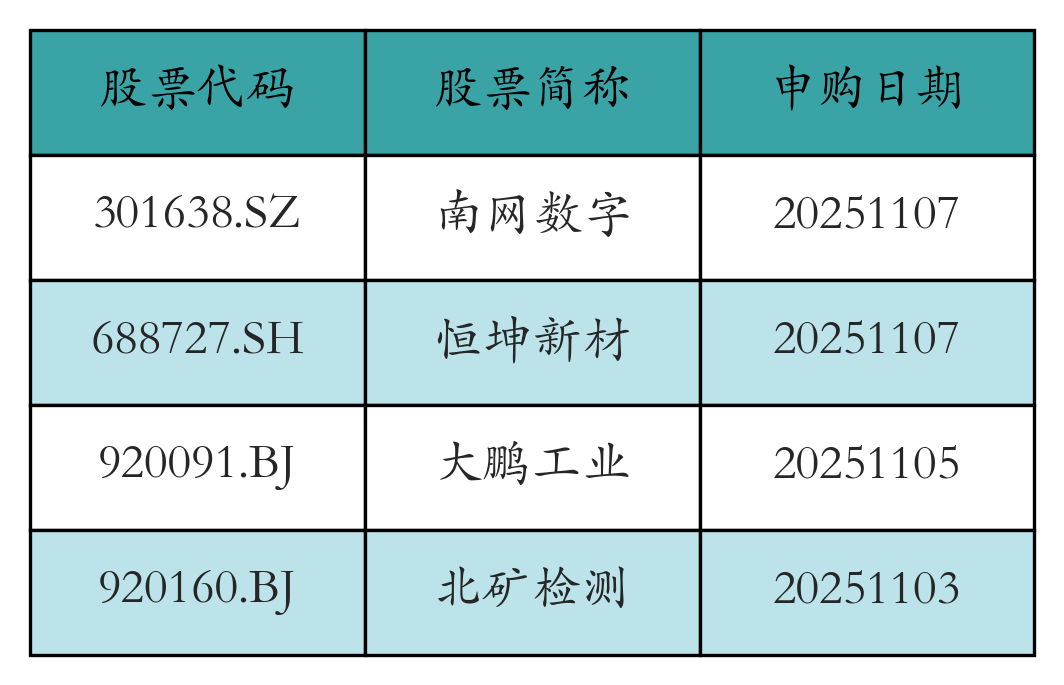
Market Overview - The Shanghai Composite Index rose by 1.08% last week, closing at 3997.56 points, with a peak of 4012.01 points [1] - The Shenzhen Component Index increased by 0.19%, ending at 13404.06 points, with a high of 13496.7 points [1] - The ChiNext Index saw a 0.65% rise, closing at 3208.21 points, reaching a maximum of 3240.34 points [1] - In contrast, major global indices experienced declines, with the Nasdaq Composite down by 3.04%, the Dow Jones Industrial Average down by 1.21%, and the S&P 500 down by 1.63% [1] - In the Asia-Pacific region, the Hang Seng Index increased by 1.29%, while the Nikkei 225 fell by 4.07% [1] New Stock Issuance - Four new stocks were issued last week, with details as follows: - Nanfang Digital (301638.SZ) on November 7, 2025 - Hengkun New Materials (688727.SH) on November 7, 2025 - Dapeng Industrial (920091.BJ) on November 5, 2025 - Beikuan Testing (920160.BJ) on November 3, 2025 [2] Margin Financing and Securities Lending - The total margin financing and securities lending balance in the Shanghai and Shenzhen markets reached 24857.39 billion, with a financing balance of 24675.74 billion and a securities lending balance of 181.65 billion [3] - This represents an increase of 72.69 billion compared to the previous week [3] - The Shanghai market's margin balance was 12691.71 billion, up by 74.28 billion, while the Shenzhen market's balance was 12165.68 billion, down by 1.59 billion [3] - A total of 3460 stocks had margin buying, with 178 stocks exceeding 1 billion in buying amount, led by Sunshine Power (162.82 billion), Zhongji Xuchuang (115.5 billion), and TBEA (100.09 billion) [3] Fund Issuance - A total of 21 new funds were issued last week, including various bond and mixed funds [5] - Notable funds include: - Lobo Mai CSI A500 Index Enhanced B - Huafu Fuze Six-Month Holding Period Bond A - Penghua Innovation Future Mixed (LOF) A [5] Share Buyback Announcements - There were 21 new share buyback announcements last week, with the highest execution amounts from: - COSCO Shipping Holdings (601919) - Lakala (300773) - Mars (300894) - Jiantou Energy (000600) - Zhongkong Technology (688777) [8] - The top three industries by buyback amount were transportation, non-bank financials, and household appliances [8]

11月7日非银金融、计算机、电子等行业融资净卖出额居前
Zheng Quan Shi Bao Wang· 2025-11-10 02:26
Core Insights - As of November 7, the latest market financing balance is 24,755.28 billion yuan, showing a decrease of 50.22 billion yuan compared to the previous trading day [1] - Among the 10 primary industries, the power equipment sector saw the largest increase in financing balance, rising by 4.031 billion yuan [1] - A total of 21 industries experienced a decrease in financing balance, with non-bank financials, computers, and electronics showing the most significant declines of 12.70 billion yuan, 12.11 billion yuan, and 11.09 billion yuan respectively [1][2] Industry Financing Balance Changes - The power equipment industry has a latest financing balance of 2,176.74 billion yuan, with an increase of 4.031 billion yuan, reflecting a growth rate of 1.89% [1] - The communication sector's financing balance increased by 0.246 billion yuan to 1,102.77 billion yuan, with a growth rate of 0.22% [1] - The basic chemical industry saw a slight increase of 0.201 billion yuan, bringing its financing balance to 978.68 billion yuan, with a growth rate of 0.21% [1] - The defense and military industry increased by 0.190 billion yuan to 791.43 billion yuan, with a growth rate of 0.24% [1] - The construction materials sector experienced a decrease of 1.98 billion yuan, resulting in a financing balance of 136.63 billion yuan, with a decline rate of 1.43% [1] - The coal industry saw a decrease of 1.43 billion yuan, bringing its financing balance to 146.12 billion yuan, with a decline rate of 0.97% [1] - The real estate sector's financing balance decreased by 3.42 billion yuan to 352.02 billion yuan, with a decline rate of 0.96% [2] - The electronic industry experienced a significant decrease of 11.09 billion yuan, resulting in a financing balance of 3,635.80 billion yuan, with a decline rate of 0.30% [2]
四季度调仓进行时 “专业买手”青睐两大方向
Shang Hai Zheng Quan Bao· 2025-11-09 15:26
Group 1 - Fund advisors are adopting a cautious investment approach in Q4, reducing allocations to active equity funds while increasing investments in index-enhanced products and sectors that hedge against volatility, such as non-ferrous metals and non-bank financials [1] - In October, the equity fund index fell by 2.21%, and the ordinary stock fund index decreased by 2.04%, indicating a challenging investment environment [1] - The overall allocation to the pharmaceutical and biological industry decreased, while the non-ferrous metals and non-bank financial sectors saw the highest increases in allocation by 0.52 and 0.39 percentage points, respectively [1] Group 2 - Non-bank financials are viewed as a sector that shares market beta, with recent market sentiment stabilizing, presenting potential trading opportunities [2] - After a rapid decline, gold has regained some interest from fund advisors, with specific funds increasing their positions in gold ETFs [2] - The new tax regulations on gold trading have introduced additional costs for physical gold delivery, impacting consumer prices, but have not significantly affected financial market transactions like gold ETFs [2]
中信建投:牛市有望持续,建议布局未来产业、紧抓关键资源与军工方向
Xin Lang Cai Jing· 2025-11-09 14:46
Core Viewpoint - The A-share market is expected to continue its bull market into 2026, with a forecast of a fluctuating upward trend but slower growth, leading investors to focus more on fundamental improvements and economic verification [1] Industry Insights - The technology sector may face structural and phase-based pullback risks, while resource products are likely to emerge as a new main direction for A-shares following the technology theme [1] - The ongoing comprehensive competition between China and the U.S. could significantly impact A-share investments, suggesting a focus on future industries and key resources, particularly in military industry sectors [1] Key Industry Focus - Key industries to watch include: - New energy - Non-ferrous metals - Basic chemicals - Oil and petrochemicals - Non-bank financials - Military industry - Machinery and equipment - Computers [1] Thematic Focus - Thematic areas of interest include: - New materials - Solid-state batteries - Commercial aerospace - Nuclear power - Cross-strait integration [1]

非银金融周报:A股前10月新开户增超10%,非车险新规指引落地-20251109
HUAXI Securities· 2025-11-09 14:33
Investment Rating - The industry rating is "Recommended" [5] Core Insights - The A-share market saw a significant increase in new accounts, with a total of 22.45 million new accounts opened in the first ten months of 2025, representing a year-on-year growth of 10.57% [3][13] - The implementation of new regulatory guidelines for non-auto insurance is expected to shift the industry focus from scale to value, promoting rational competition and enhancing profitability in the long term [7][15] Market and Sector Performance - The non-bank financial index decreased by 0.17%, underperforming the CSI 300 index by 0.99 percentage points, ranking 23rd among all primary industries [2][12] - The securities sector fell by 0.72%, while the insurance sector rose by 1.25% during the same period [2][12] - The average daily trading volume in the A-share market was 20.123 billion yuan, down 13.5% month-on-month and 21.1% year-on-year [18] New Account Openings - In October 2025, the Shanghai Stock Exchange recorded 2.3099 million new accounts, a sharp decline from 6.8468 million in October 2024, primarily due to the previous year's market surge [3][13] - Institutional accounts have been increasing, with 83,800 new institutional accounts opened in the first ten months of 2025, bringing the total to 1.2366 million [3][13] Insurance Regulatory Changes - The new guidelines for non-auto insurance, which include specific rules for premium payments and policy issuance, have been officially implemented, marking a significant regulatory shift [7][15] - The guidelines aim to enhance the operational efficiency of the non-auto insurance sector and are expected to lead to a more competitive and innovative market environment [7][15] Financial Performance - The securities industry reported a revenue of 419.561 billion yuan in the first three quarters of 2025, a year-on-year increase of 17.02%, with net profits rising by 62.48% to 169.291 billion yuan [14]





行业轮动双周度跟踪:边际增持TMT-20251109
SINOLINK SECURITIES· 2025-11-09 14:27
Report Summary 1. Report Industry Investment Rating - Not mentioned in the provided content 2. Core View of the Report - As of October 26, 2025, the model recommends non-bank finance, communication, real estate, building materials, media, and banking, with marginal increases in media and real estate investments [1] - The non-bank finance, communication, and real estate sectors are mainly driven by fundamentals, building materials and media are mainly influenced by sentiment, and banking is driven by both quantitative and fundamental factors [1] - The industry rotation model analyzes the market from three dimensions: fundamentals, volume-price, and sentiment, aiming to capture industry opportunities [1] 3. Summary by Relevant Catalogs Industry Rotation Model - The model backtests original factors on a bi-weekly basis and expands volume-price factors from dimensions such as momentum and trend, capital flow and sentiment, and market structure and volatility [1] - Six relatively effective factors are selected to construct the industry rotation strategy [1] Industry ETF Portfolio - The current industry ETF portfolio includes six ETFs: E Fund CSI 300 Non-Bank Finance ETF, Guotai CSI All-Index Communication Equipment ETF, Southern CSI All-Index Real Estate ETF, Guotai CSI All-Index Building Materials ETF, GF CSI Media ETF, and Huabao CSI Bank ETF [3] Performance of the Industry Rotation Strategy - In the past two weeks, the strategy rose 0.25%, with an excess return of 0.64% compared to the industry equal-weighted index [4][6] - Since the beginning of the year, the strategy has risen 34.89%, with a Sharpe ratio of 1.77 and a Calmar ratio of 2.88 in the past year [4] Strategy/Composite Factor Backtesting Results - Different factors have different IC means, IC standard deviations, ICIRs, frequencies of IC>0, and p-Values. For example, the成交均价因子 has an IC mean of 6.19%, an IC standard deviation of 27.11%, and an ICIR of 22.83% [10]
年底容易成为风格变化的高发期
Xinda Securities· 2025-11-09 12:55
Core Insights - Since October, value style has begun to outperform growth style, marking a significant shift compared to the dominance of growth represented by TMT in Q2-Q3 [2][10] - The cyclical rotation between growth and value styles typically occurs over a 2-3 year period, primarily driven by changes in profit trends [2][11] - The fourth quarter is prone to style changes, particularly in December, as investor allocation strategies shift based on economic and profit outlooks [2][16] Summary by Sections Strategy Viewpoint - The current growth style has been dominant since September 2024, lasting about one year, and is expected to continue due to the upward trend in AI and high-end manufacturing [3][11] - Q4 is historically a high-frequency period for style changes, especially in December, as investors focus on stability and valuation safety margins [3][16] - Historical examples of style shifts include the strong switch to blue-chip stocks in late 2014 and a more balanced style shift in late 2019 [3][17] Market Changes - The report indicates that the probability of value style outperforming in December significantly increases, with historical data supporting this trend [7][20] - The report highlights that in 2014, the non-bank financial sector saw a substantial rise, with the Shanghai Composite Index showing a rapid increase in excess returns [17][21] - In 2019, a valuation repair shift occurred, leading to a more balanced market style, with previously weak sectors rebounding [23][24] Industry and Sector Recommendations - The report suggests focusing on low-valuation sectors, particularly in finance, as they may benefit from the anticipated style shift [32][33] - Specific sectors recommended for investment include non-bank financials, electric equipment, steel, and chemicals, with an emphasis on their potential for recovery and growth [35][36] - The report notes that the financial sector's valuation remains attractive, with expectations of recovery driven by regulatory support and market conditions [35][36]