贵金属

Search documents
23:00,一份数据拯救了世界
Xin Lang Cai Jing· 2026-02-02 23:38
Core Insights - The market has shifted from a "worst-case scenario" to a phase of "waiting for validation" as U.S. stock markets experience a broad rally, with the Dow Jones index rising over 1% [2] - Economic data, particularly the ISM manufacturing index for January at 52.6, significantly exceeded market expectations of 48.5, indicating a shift from contraction to expansion and marking the highest level since 2022 [2] - This positive economic data alleviates three major market fears: concerns over a "hard landing," the stabilization of profit bottoms, and the Federal Reserve's ability to control inflation without rushing to intervene in the market [3] Market Reactions - The rise in U.S. stock markets has restored "missing confidence," which is crucial for mitigating the current global market downturn [2] - Gold and silver markets began to rebound after passive selling subsided, indicating a temporary recovery rather than a return of bullish sentiment [3] - The current market calm does not imply that issues have been resolved; rather, it suggests that problems are being postponed for later resolution [3] Future Outlook - The market is currently in a "repair phase," transitioning from panic to recovery, but caution is advised as misjudging the market's direction could be dangerous [3] - There is a call for deeper insights into global markets, suggesting that assumptions about January's direction continuing into February may be misleading [3]

复盘贵金属巨震!一场避险天堂的流动性压力测试
Di Yi Cai Jing Zi Xun· 2026-02-02 23:38
Core Viewpoint - The precious metals market experienced significant volatility following a panic sell-off, with silver showing over 8% price swings and other metals like platinum and palladium rebounding nearly 10% from early lows. Analysts are divided on the market outlook, with many believing the current downturn is temporary but suggesting that bottom-fishing may need to wait [1][2]. Market Performance - After a drop of over 5%, COMEX futures for February delivery recovered to $4,700, following an 11% plunge last Friday, marking the worst single-day performance since 1980. Gold futures hit a high of $5,626.80 per ounce but have since fallen 17% from that peak [2]. - UBS analysts predict gold prices will exceed $6,200 per ounce later this year, while JPMorgan forecasts a year-end price of $6,300 per ounce. Deutsche Bank maintains a $6,000 per ounce prediction based on sustained investor demand [2]. Market Dynamics - Short-term market volatility is expected to remain high, with the potential for further sell-offs due to ETF and options position liquidations triggering cascading futures market sell-offs. The risk of additional rounds of selling remains elevated, as crowded and one-sided trading positions have not been substantially reversed [3]. - Citigroup warns that gold valuations have reached extreme levels, with global gold expenditure as a percentage of GDP soaring to 0.7%, the highest in 55 years. A return to historical norms could pose a risk of significant price declines [3]. Influencing Factors - Future trends in the precious metals market will depend on the monetary policy path under the new Federal Reserve chair, the movements of the dollar and real interest rates, ETF fund flows, and central bank gold purchasing patterns [4]. - The recent sell-off resulted in an evaporation of $8 trillion in market value for gold and silver, highlighting the liquidity issues that arise when large amounts of capital attempt to exit the same type of "safe-haven" trades simultaneously [4]. Investment Behavior - The sell-off has revealed pressure on holdings in gold, while silver's performance has exposed liquidity pressures in the market. The focus should shift from "what to buy" to "what type of buyer you are" to avoid blind trading during market turmoil [5][6]. - Buyers sensitive to price, typically long-term holders, should consider transactions from a value and asset allocation perspective, while liquidity-sensitive holders, such as those using futures or options, are driven by volatility and risk management rules [6]. Market Insights - The recent precious metals crash serves as a stress test for the market, demonstrating that even traditionally safe assets can become volatile when everyone relies on them for hedging. The true "safe signal" for the market will be a decrease in volatility rather than a price rebound [6].
国泰海通:贵金属价格巨震 关注新任美联储主席带来的变化
Zhi Tong Cai Jing· 2026-02-02 22:40
Group 1: Precious Metals - Precious metal prices are under pressure due to trading congestion, the new Federal Reserve Chairman, and declines in US tech stocks [1][2] - The nomination of the new Federal Reserve Chairman is expected to significantly impact the dollar and US Treasury yields [2] - Central bank gold purchases and rising gold ETF holdings are projected to support gold prices through 2026 [1][2] - London silver leasing rates have decreased, while US silver inventories are declining rapidly [1][2] Group 2: Copper - The nomination of hawkish Kevin Walsh as the next Federal Reserve Chairman is leading to expectations of balance sheet reduction and a stronger dollar, putting downward pressure on copper prices [3] - The market is expected to continue digesting macroeconomic correction pressures, but supply disruptions and an anticipated widening global copper mine deficit may provide price support [3] Group 3: Aluminum - Macro sentiment has cooled, leading to downward pressure on aluminum prices due to tightening liquidity from falling US stocks and short-term policy tightening expectations [4] - The aluminum processing comprehensive operating rate has decreased by 1.5 percentage points to 59.4% compared to the previous week [4] - Seasonal inventory accumulation during the off-peak period is expected to further suppress aluminum prices [4] Group 4: Tin - Tin prices have significantly corrected due to a retreat in macro sentiment and liquidation by bullish funds [5] - The return to normalcy in Indonesian RKAB approvals and increased activity in exchanges, along with high ore prices, have alleviated supply concerns [5] - Tin prices are shifting from a "panic-driven" phase to a "supply-demand normalization" phase [5] Group 5: Energy Metals - Lithium carbonate inventories continued to decline, indicating strong demand despite seasonal production decreases [6] - Anticipated reductions in battery export tax rebates may lead to front-loaded battery demand, maintaining robust off-peak demand [6] - Cobalt prices remain high due to tight upstream raw material supply, while cobalt companies are extending into electric new downstream sectors to enhance competitive barriers [6] Group 6: Rare Earths - Prices of praseodymium and neodymium oxides are continuously rising due to tight supply-demand dynamics and pre-holiday stocking needs [7] - The investment value of rare earths as a strategic resource is viewed positively [7] Group 7: Minor Metals - Tungsten prices have surged due to policy regulation and replenishment, driven by crackdowns on illegal mining and strong pre-holiday stocking [8] - Supply constraints and high costs are expected to keep tungsten prices elevated despite potential volume reductions during the Spring Festival [8] - Uranium prices are anticipated to rise due to rigid supply and ongoing nuclear power development, leading to a persistent supply-demand gap [8]

金价大幅震荡凸显全球市场多重风险
2 1 Shi Ji Jing Ji Bao Dao· 2026-02-02 22:34
Core Viewpoint - The international gold and silver markets have experienced a rare and significant decline, influenced by multiple factors including changes in margin requirements and shifts in monetary policy expectations [1][2]. Group 1: Market Reactions - On February 2, Asian stock markets faced pressure, with domestic commodity futures markets showing declines, including a drop to the limit for silver and platinum [1]. - Gold recorded its largest single-day drop in nearly 40 years, primarily triggered by the Chicago Mercantile Exchange's announcement to raise margin requirements [1]. - The nomination of Waller as the next Federal Reserve Chair by President Trump led to a reassessment of monetary policy, causing a significant rebound in the dollar and prompting investors to sell off gold and silver [1]. Group 2: Investor Behavior - The recent volatility in global markets is partly due to crowded positions, where slight disturbances can trigger chain sell-offs [2]. - The rapid increase in gold prices since the New Year attracted significant investment, but the limited market size and high leverage created vulnerabilities that led to a sharp price correction [2]. - Profit-taking by investors, following a swift price rise, has been a significant factor in the current market adjustment [2]. Group 3: Gold as an Investment - Central banks have been diversifying their foreign exchange reserves, with gold becoming a crucial hedge against dollar risk and a key reserve asset [2]. - The narrative surrounding gold is shifting, as it is increasingly viewed as a risk asset rather than merely a safe haven, especially in the context of high valuations in U.S. equities and bonds [3]. - The accumulation of macro risks in the U.S. due to prolonged loose monetary and fiscal policies is pushing gold into a historic upward cycle, supported by central bank purchases and scarcity [3].
果然财经|A股三大指数集体重挫,沪指逼近4000点关口
Sou Hu Cai Jing· 2026-02-02 21:19
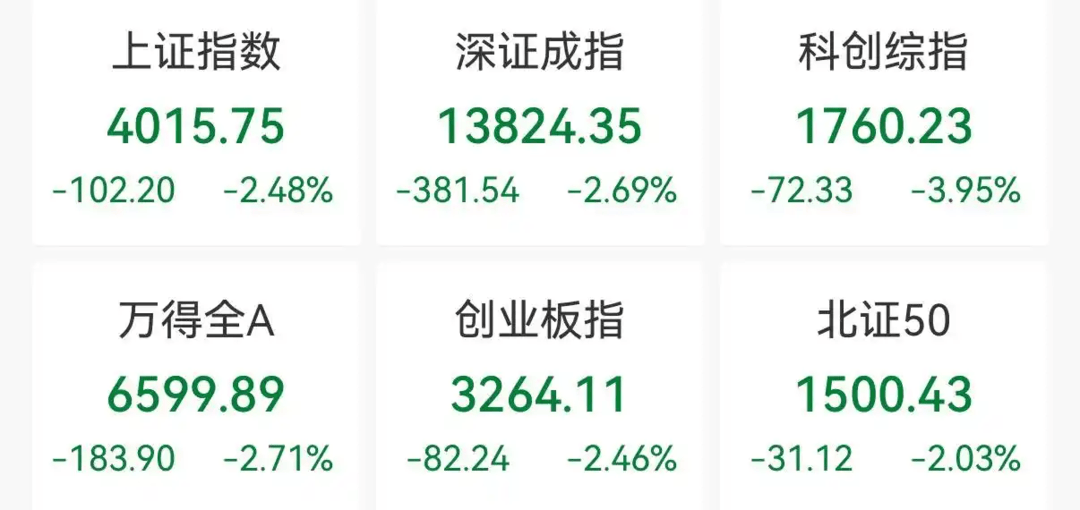
Market Overview - A-shares experienced a significant decline on February 2, 2026, with all major indices dropping over 2%, indicating a widespread bearish trend [2][3] - The Shanghai Composite Index closed at 4015.75 points, down 2.48%, while the Shenzhen Component and ChiNext Index fell by 2.69% and 2.46%, respectively [3] Individual Stock Performance - The market's profitability sharply decreased, with only 771 stocks rising against 4652 declining, and 123 stocks hitting the daily limit down [5] - The total trading volume in the Shanghai and Shenzhen markets was approximately 26.1 billion yuan, a decrease of 2.14 billion yuan from the previous trading day, marking a three-month low [5] Sector Analysis - The precious metals sector was heavily impacted, with significant declines following a sharp drop in international gold and silver prices, leading to a loss of over 300 billion yuan in market value for this sector [6] - In contrast, the electric power equipment sector saw a surge, with stocks like YN Power and Tongguang Cable hitting the daily limit up, driven by the demand for AI computing infrastructure [7] - The liquor sector also performed well, with stocks like Moutai and Huangtai Liquor showing resilience due to expectations of strong consumption during the upcoming Spring Festival [8] Unlocking of Restricted Shares - February 2026 is marked by a large-scale unlocking of restricted shares, with a total market value of approximately 2335.84 billion yuan facing release, contributing to liquidity pressure [9][12] - On February 2 alone, 15 companies had restricted shares unlocked, totaling about 600.11 billion yuan, with Xinda Securities leading at 448.79 billion yuan [10][11] Future Market Outlook - Short-term market fluctuations are expected to continue due to liquidity pressures and external market volatility, but the medium-term recovery trend remains intact [13] - The Shanghai Composite Index has broken below the 20-day moving average, indicating potential further declines, yet the valuation levels suggest limited downside risk [13]
黄金暴跌,市场总有轮回。
Sou Hu Cai Jing· 2026-02-02 20:40
Group 1 - The current market situation is characterized as a "repricing of risk assets" rather than a simple price correction, indicating a collective reassessment of long-ignored assumptions [3][5] - The macroeconomic environment has shifted, with signals from the Federal Reserve suggesting a potential slowdown in interest rate cuts, leading to a reevaluation of assets that thrived on low rates and high liquidity [4][5] - The tightening of liquidity and the strengthening of the dollar have forced long positions in various assets, including gold, to be liquidated, resulting in simultaneous declines in these safe-haven assets [6][7] Group 2 - Bitcoin and gold are both influenced by macroeconomic trends but differ significantly in their belief systems, funding structures, and correction mechanisms [20] - The recent decline in gold prices is attributed to its status as a central bank asset, which provides a buffer against severe drops, unlike Bitcoin, which is more volatile [21] - Gold is recognized as a universal hard currency with intrinsic value, and its price is expected to rise in the long term due to limited supply and increasing global demand, despite short-term fluctuations [23]
A股午盘:发现不对劲了!缩量约3000亿!接下来会迎来救赎吗
Sou Hu Cai Jing· 2026-02-02 20:10
Market Overview - The A-share market experienced a collective decline, with major indices falling over 1%, and the trading volume shrinking by approximately 300 billion yuan compared to the previous trading day, indicating a peak in market caution [1][12] - Nearly 3,200 stocks in the Shanghai and Shenzhen markets closed lower, with sectors such as precious metals, oil and gas, and semiconductor chips being heavily impacted [4][15] Sector Performance - Contrarily, heavyweight sectors like liquor and banking showed resilience, acting as stabilizers in the market [5][15] - The A50 futures index surged over 1% at the market open, with the insurance sector rising more than 3%, while thematic stocks like sodium batteries and lithium mines faced significant sell-offs [6][15] Fund Flow Dynamics - There was a notable outflow of over 200 billion yuan from main funds within the first hour of trading, primarily affecting technology and previously popular thematic stocks, while liquor and banking sectors saw inflows [6][12] - Recent data indicated a shift in fund allocation from passive index investments to active sector-specific investments, with a net outflow of 372 billion yuan from broad-based ETFs over the past week [12] Valuation and Market Sentiment - The market is experiencing a "high-low switch," with the proportion of trading volume in the CSI 300 reaching 41.2%, a new high for the month, indicating a strengthening of pricing power among core assets [12] - The market's overall volatility has increased, with the Shanghai Composite Index's price-to-earnings ratio at 13.87, below its three-year average, while the ChiNext Index stands at 42.36, at the 58th percentile of its three-year range [11][15] Seasonal Effects and Future Outlook - The seasonal effect ahead of the Spring Festival is becoming apparent, with rising risk aversion and potential pressure on indices [11] - Historical patterns suggest that after similar volume contractions, the market often requires time to find a bottom, indicating a possible upcoming adjustment phase [11][15]
多家银行密集公告,黄金白银价格暴跌!白银单日暴跌21%!杠杆踩踏预警,这波行情还能抄底吗?
Sou Hu Cai Jing· 2026-02-02 19:11
Core Viewpoint - The global precious metals market experienced unprecedented volatility in February, with significant price drops in both gold and silver, leading to a market value loss exceeding $3 trillion [1][2]. Group 1: Market Dynamics - On January 30, a rapid decline in gold and silver prices triggered automated selling mechanisms, exacerbating the downward pressure and creating a vicious cycle of selling [2][7]. - The London silver price fell from a high of $120 per ounce to a low of $71.17 per ounce, marking a drop of over 40% in just ten days, while gold prices fell from $5,300 to below $4,700, a nearly 20% decline [1][2]. - The domestic market mirrored these trends, with gold T+D prices dropping below 1,050 yuan per gram and silver T+D prices experiencing a one-day drop exceeding 21% [2]. Group 2: Institutional Responses - Major Chinese banks issued risk warnings and adjusted trading rules to mitigate risks, including raising margin requirements for gold and silver contracts [3]. - Despite the price drop, demand for physical gold surged, leading to sold-out investment products at several banks, indicating a shift towards long-term investment strategies [3][4]. Group 3: Market Sentiment and Future Outlook - The volatility was attributed to a combination of policy expectations, trading structures, and market sentiment, with the nomination of Kevin Warsh as the next Federal Reserve Chair being a significant catalyst for the market shift [4][5]. - The market is currently in a phase of emotional turmoil and policy expectation restructuring, with prices likely to remain volatile in the short term [9][10]. - Long-term fundamentals supporting gold and silver prices, such as central bank purchases and geopolitical uncertainties, remain intact, suggesting potential for recovery once market sentiment stabilizes [8][10].
全球市场遭遇“黑色星期一”
Xin Lang Cai Jing· 2026-02-02 18:02
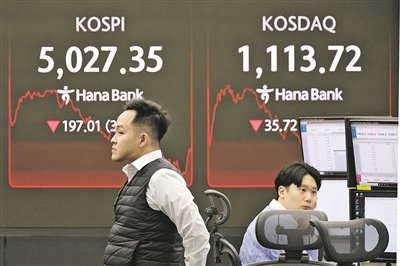
Market Overview - On February 2, the South Korean stock market experienced a significant drop, with the KOSPI index falling over 5%, triggering a trading halt for 5 minutes [2][4] - Global markets faced a "Black Monday" due to expectations of a hawkish shift in the Federal Reserve's monetary policy, technical adjustment pressures, and concerns over high valuations in technology stocks [2][4] Precious Metals Market - International precious metals prices saw drastic fluctuations, with gold futures dropping to $4423.2 per ounce, a decline of over 6%, and silver futures falling to $71.2 per ounce, down over 9% [2][3] - The London spot gold price hit a low of $4402.06 per ounce, marking a decline of over 10%, while silver prices fell to $71.312 per ounce, down over 16% [2] - Compared to the historical highs on January 29, silver prices dropped by 40% and gold prices by approximately 20% on February 2 [2] Oil Market - The oil market also faced significant declines, with light crude oil futures on the New York Mercantile Exchange falling to $61.43 per barrel and Brent crude futures dropping to $65.45 per barrel, both down over 5% from the previous day's close [3] Stock Market Reactions - Following a strong performance in January driven by AI hype, stock markets reversed course, with investors questioning the returns on substantial investments in the tech sector [4] - The Jakarta Composite Index in Indonesia also saw a significant drop, exceeding 5% in early trading on February 2 [4] - The Nikkei 225 index in Japan closed down by 1.25%, and the Tokyo Stock Exchange index fell by 0.85% [4] Investor Sentiment - Analysts noted that the volatility in the precious metals market has caused unease among traders, with increased margin requirements leading to forced liquidations and a domino effect across other assets [3] - The market is currently reassessing valuations amid uncertainty regarding potential monetary policy changes under Kevin Walsh, who has been nominated as the next Fed Chair [5]
为什么越乱,黄金美股反而一起跌?未来几年90%的人可能赚不到钱
Sou Hu Cai Jing· 2026-02-02 16:48
Core Viewpoint - The financial market experienced a rare event on January 30, 2026, with significant declines in gold (16%), silver (39%), U.S. stock indices, and Bitcoin, indicating a complete overhaul of global investment logic, where traditional safe-haven assets like gold fell alongside risk assets like stocks [1][3]. Group 1: Market Dynamics - The simultaneous sell-off of gold and U.S. stocks signals a contraction in dollar liquidity, indicating a cash shortage in global capital markets [3]. - The market's expectations for Federal Reserve interest rate cuts reversed dramatically at the end of 2025, with new Fed Chair Kevin Warsh advocating for a significant reduction in the Fed's balance sheet [3][4]. - The tightening of liquidity forces institutional investors to acquire cash at any cost, even if it means selling traditionally safe assets like gold [4]. Group 2: Federal Reserve Challenges - The U.S. federal debt has surpassed $38 trillion, creating a heavy interest burden, while inflation pressures compel the Fed to balance between curbing inflation and preventing economic recession [4][5]. - Internal disagreements within the Fed have surfaced, with differing opinions on the extent of interest rate cuts, reflecting confusion about the Fed's direction [5]. - The trend of de-dollarization reached a peak in 2025, with the dollar's share in global foreign exchange reserves falling below 60% for ten consecutive quarters, the lowest since 1995 [5]. Group 3: Gold and Silver Market Trends - The 2022 freezing of Russian overseas assets raised concerns about the safety of dollar assets, prompting central banks to accelerate gold purchases [7]. - In 2025, gold prices surged over 60%, with significant accumulation by major stablecoin issuers, indicating a lack of trust in traditional credit systems [7]. - The correlation between gold, U.S. stocks, and Bitcoin has reached unprecedented levels, with a 50% correlation coefficient over the past three years, driven by hedge funds' new trading strategies [7][8]. Group 4: Silver Market Vulnerabilities - Silver's market capitalization is approximately $5.2 trillion, only 15.6% of gold's, making it more susceptible to speculative manipulation and volatility [9]. - Industrial demand for silver, which constitutes 60% of total demand, faces risks from technological advancements that may reduce its necessity [9]. - Historical instances of silver market crashes highlight the potential for significant price drops under current market conditions, although current leverage levels are not at historical extremes [9]. Group 5: Investment Behavior and Market Sentiment - Ordinary investors are prone to extremes of either blind chasing of high prices or panic selling, often driven by anxiety rather than informed analysis [11]. - The 2025 market lessons indicate that leveraged traders are particularly vulnerable, as evidenced by the severe drop in silver prices [11]. - Traditional investment strategies have become unreliable, with a shift towards prioritizing safety over high returns in asset allocation [11][12]. Group 6: Global Monetary System Evolution - The global reserve asset composition is changing, with gold projected to account for 20% of reserves by 2024, surpassing the euro [12]. - The decline of the dollar's dominance will be a gradual process, with the international monetary system evolving towards a multi-currency framework [12]. - The current market downturn reflects the collapse of old investment logic and the reconstruction of new paradigms, emphasizing the importance of capital preservation over speculative gains [12].