
非银金融

Search documents
FICC日报:指数低开高走,板块内部表现分化-20251106
Hua Tai Qi Huo· 2025-11-06 05:39
Report Industry Investment Rating No relevant content provided. Core View The domestic market is relatively strong compared to the weak performance of the Asia-Pacific market on the day. Policy and capital support actions further confirm the long-term bullish pattern. However, in the short term, sector rotation continues and the internal differentiation is still prominent, and the market is still in the process of recovery. Bull market adjustments are often achieved through increased volatility, and it is expected that the market will continue the trend of shrinking volume, oscillating, and adjusting in the short term [3]. Summary by Related Catalogs Market Analysis - China has announced specific measures to implement the consensus of the China-US economic and trade consultations in Kuala Lumpur, including stopping the implementation of additional tariffs on some imported goods from the US, continuing to suspend 24% reciprocal tariffs for one year, and stopping export control measures on 15 US entities [1]. - A-share indices opened lower and closed higher. The Shanghai Composite Index rose 0.23% to 3969.25 points, and the ChiNext Index rose 1.03%. The power equipment, coal, and commercial retail sectors led the gains, while the computer, non-bank finance, and communication sectors led the losses. The trading volume of the Shanghai and Shenzhen stock markets was less than 1.9 trillion yuan [1]. - The US 10 - month ISM services PMI rose 2.4 points to 52.4, reaching an eight - month high. The three major US stock indices closed higher, with the Nasdaq rising 0.65% to 23499.8 points [1]. Futures Market - In the futures market, the basis of stock index futures declined. There was differentiation in trading volume and open interest. The trading volumes of IH, IC, and IM increased, and the open interest of stock index futures increased [2]. Strategy - The Asia - Pacific market was weak on the day, while the domestic market was relatively strong. It is expected that the market will continue the trend of shrinking volume, oscillating, and adjusting in the short term [3]. Macro - economic Charts - The report includes charts on the relationship between the US dollar index and A - share trends, US Treasury yields and A - share trends, RMB exchange rates and A - share trends, and US Treasury yields and A - share style trends [10][8]. Spot Market Tracking Charts - The daily performance of major domestic stock indices on November 5, 2025, shows that the Shanghai Composite Index rose 0.23%, the Shenzhen Component Index rose 1.95%, and the ChiNext Index rose 1.03% [13]. - Charts on the trading volume of the Shanghai and Shenzhen stock markets and margin trading balances are also included [14]. Futures Index Tracking Charts - The trading volume and open interest data of IF, IH, IC, and IM contracts are presented. For example, the open interest of IF was 116,616 (a decrease of 1,583), and the trading volume was 270,040 (an increase of 1,580) [18]. - The basis data of stock index futures for different contracts and different delivery months are provided. For example, the basis of the IF contract for the current month was - 16.46 (a decrease of 2.36) [42]. - The inter - delivery spread data of stock index futures are also given, such as the spread between the next - month and current - month contracts of IF was - 14.20 (an increase of 1.40) [49].
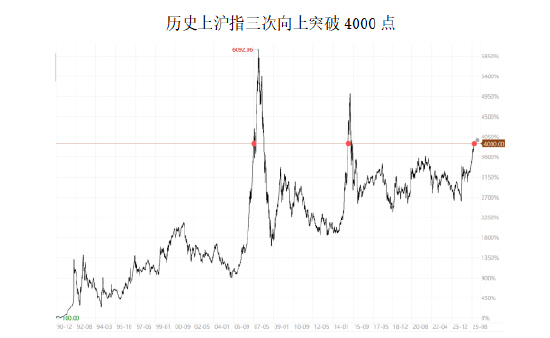
诺德基金:如何看待4000点后的震荡行情?
Xin Lang Ji Jin· 2025-11-06 02:39
Core Viewpoint - The current A-share market at the 4000-point level is fundamentally different from previous instances in 2007 and 2015, influenced by changes in market ecology, industry structure, and investment logic [1][4]. Market Changes - The new "National Nine Articles" has led to profound changes in market regulations, emphasizing a safe, transparent, and resilient capital market [6]. - A-share market has seen a significant increase in both the number of listed companies and total market capitalization, with the number of companies rising from 2,447 in 2015 to 5,444 in 2025, a growth of 122% [7][8]. - Total market capitalization expanded from 53 trillion yuan to 123 trillion yuan, marking a 132% increase [8][9]. - The industry structure has shifted, with technology and new energy sectors gaining prominence over traditional sectors like finance and real estate [9][10]. Trading and Investment Dynamics - A-share market trading volume has significantly increased, with daily trading volume reaching 2.29 trillion yuan, remaining above 1 trillion yuan for 128 consecutive trading days [16]. - The current margin financing level is significantly lower than the peak in 2015, indicating a healthier market environment [18]. - Institutional investors now hold 46% of the A-share market, up from 30.9% in 2014, reflecting a more mature investor structure [22][24]. Future Market Outlook - The macroeconomic environment is stabilizing, with China's economy projected to grow at an average rate of 4.7% to 5.0% during the 14th Five-Year Plan, providing a solid foundation for corporate earnings [27]. - Technological innovation, particularly in AI and new energy, is expected to drive market growth and create new leading companies [28][52]. - Policy support and ongoing capital market reforms are anticipated to boost investor confidence and market stability [32]. - The valuation of A-shares remains attractive compared to global markets, with the Shanghai Composite Index trading at a price-to-earnings ratio of approximately 17 times [38][39]. Investment Strategies - Investors are encouraged to identify undervalued sectors and capitalize on recovery opportunities, particularly in consumer, healthcare, and financial sectors [43]. - Focus on sectors benefiting from policy support and improving fundamentals, such as supply chain security and technological advancements [48][49][52]. - Maintain a balanced investment approach to mitigate risks associated with market volatility and potential short-term fluctuations [54][56].

每日市场观察-20251106
Caida Securities· 2025-11-06 02:33
Market Performance - A-shares showed resilience with a trading volume of 1.89 trillion, down approximately 500 billion from the previous trading day[1] - The Shanghai Composite Index rose by 0.23%, while the Shenzhen Component increased by 0.37% and the ChiNext Index gained 1.03%[4] - The October China Warehousing Index improved to 50.6%, up 1 percentage point from the previous month, indicating economic vitality[1] Sector Analysis - The power equipment sector, including energy storage and distribution, was the standout performer, driven by AI computing infrastructure concerns and energy shortages[2] - Main capital inflows were observed in power grid equipment, batteries, and photovoltaic equipment, while software development, semiconductors, and IT services saw capital outflows[4] Policy Developments - The State Council announced the suspension of additional tariffs on certain U.S. imports effective November 10, 2025, as part of trade negotiations[5][8] - China signed an economic partnership framework agreement with several Pacific island nations to enhance bilateral trade and investment cooperation[6][7] Fund Dynamics - The total trading volume of ETFs reached 497.25 billion, with stock ETFs accounting for 112.1 billion and bond ETFs for 246.06 billion[13][14] - Public fund reports indicate a concentration in technology growth sectors, with increased holdings in TMT while reducing positions in large finance and consumer sectors[15]
万和财富早班车-20251106
Vanho Securities· 2025-11-06 02:12
Macro Summary - The State Council Tariff Commission announced that starting from November 10, 2025, the 24% tariff on imports from the U.S. will be suspended, while the 10% additional tariff will remain in effect [4] - The Ministry of Commerce will host ten themed activities under the "Shared Big Market · Export to China" initiative to enrich the "Export to China" brand [4] - In October, the retail penetration rate of new energy vehicles in the passenger car market reached 58.7%, with a wholesale penetration rate of 55.2% [4] Industry Dynamics - The Hainan Free Trade Port will officially start its full island closure operation on December 18, 2025, with related stocks including Haixia Co., Ltd. (002320) and China Duty Free Group (601888) [6] - The production of robots in China is experiencing rapid growth, benefiting component manufacturers such as Furi Electronics (600203) and Top Group (601689) [6] - AI data centers are becoming significant electricity consumers, which is expected to greatly increase demand for energy storage, with related stocks including Sungrow Power Supply (300274) and EVE Energy (300014) [6] Company Focus - Xintong Electronics (001388) has successfully implemented its online monitoring devices for transmission lines in multiple ultra-high voltage transmission lines across the country [8] - Bowei Alloy (601137) has seen significant growth in its new materials business, particularly in the sales volume of VC uniform temperature board heat dissipation materials [8] - Salt Lake Co., Ltd. (000792) is constructing a new 40,000-ton lithium salt production facility, with a production plan of 3,000 tons of battery-grade lithium carbonate for the year [8] - Jiayuan Technology (688388) has signed a cooperation framework agreement with CATL, agreeing to deepen and broaden their existing collaboration [8] Market Review and Outlook - On November 5, the market showed resilience despite a significant drop at the open, with all three major indices closing in the green [10] - The total trading volume in the Shanghai and Shenzhen markets was 1.89 trillion, a decrease of 45.3 billion from the previous trading day [10] - The market sentiment is gradually recovering, with an increase in the number of stocks hitting the daily limit, indicating a rise in short-term trading interest [10] - The electrical equipment sector saw a collective surge, particularly in new energy-related stocks, while technology and non-bank financial sectors showed weakness [10][11] - The State Council's tariff adjustment is expected to stabilize external environment expectations, but market confidence remains fragile, with a lack of volume support hindering effective breakthroughs [11]
每日解盘:三大指数低开高走,电力设备板块大涨,成交额回落至1.8万亿-11月5日
Sou Hu Cai Jing· 2025-11-06 02:09
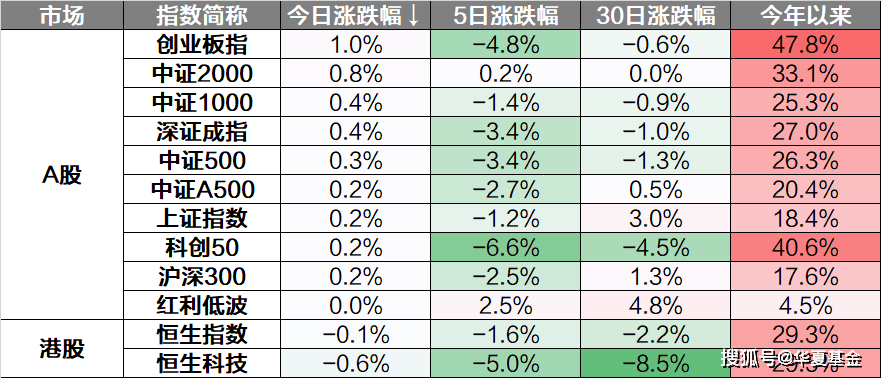
Market Overview - On November 5, 2025, major indices collectively rose, with the Shanghai Composite Index up 0.23% to 3969.25 points, the Shenzhen Component Index up 0.37% to 13223.56 points, and the ChiNext Index up 1.03% to 3166.23 points. The total trading volume in the two markets was 1.8721 trillion yuan, a decrease of approximately 43.3 billion yuan compared to the previous trading day [1]. Index Performance - The ChiNext Index increased by 1.0% year-to-date, showing a significant rise of 47.8% [2]. - The CSI 2000 Index rose by 0.8% year-to-date, with a 30-day increase of 33.1% [2]. - The CSI 1000 Index saw a 0.4% increase year-to-date, with a 30-day increase of 25.3% [2]. - The Shanghai Composite Index increased by 0.2% year-to-date, with a 30-day increase of 18.4% [2]. Sector Performance - The power equipment sector rose by 3.4%, coal by 1.4%, and retail by 1.2% [3][4]. - The computer, non-bank financials, and telecommunications sectors experienced declines [3]. Concept Themes - The Hainan Free Trade Zone saw a rise of 4.6%, flexible DC transmission by 4.1%, and ultra-high voltage by 3.4% [5]. - Conversely, concepts such as quantum technology and digital currency faced declines of 1.0% [5]. Hot Industry - Power Equipment - The power equipment industry increased by 3.4%. According to First Capital Securities, Nvidia's recent update on 800V DC architecture indicates that future data center power will primarily use 800V DC supply. It is estimated that by 2030, AI infrastructure spending could reach $3-4 trillion, which is more than five times the expected investment in 2025. This could lead to a significant increase in power demand, necessitating substantial investments in power sources and grids [6].
11月5日电子、通信、非银金融等行业融资净卖出额居前
Zheng Quan Shi Bao Wang· 2025-11-06 01:55
Core Insights - As of November 5, the latest market financing balance is 24,735.44 billion yuan, showing a slight decrease of 1.43 billion yuan from the previous trading day [1] Industry Summary - **Industries with Increased Financing Balance**: - The power equipment industry saw the largest increase, with a financing balance up by 27.39 billion yuan, totaling 2,111.34 billion yuan, reflecting a growth of 1.31% [1] - Other notable increases include: - Basic chemicals: up by 2.67 billion yuan to 971.28 billion yuan (0.28% increase) [1] - Steel: up by 2.52 billion yuan to 172.81 billion yuan (1.48% increase) [1] - Construction decoration: up by 2.46 billion yuan to 390.62 billion yuan (0.63% increase) [1] - **Industries with Decreased Financing Balance**: - The electronics industry experienced the largest decrease, down by 18.55 billion yuan to 3,602.21 billion yuan, a decline of 0.51% [2] - Other significant decreases include: - Communication: down by 9.28 billion yuan to 1,096.84 billion yuan (0.84% decrease) [2] - Non-bank financials: down by 5.81 billion yuan to 1,924.73 billion yuan (0.30% decrease) [2] - Light industry manufacturing: down by 1.38 billion yuan to 142.82 billion yuan (0.96% decrease) [1] - **Financing Balance Changes by Industry**: - The steel industry had the highest increase percentage-wise, with a financing balance of 172.81 billion yuan, reflecting a 1.48% growth [1] - Conversely, the light industry manufacturing, communication, and construction materials industries saw the largest percentage declines, with decreases of 0.96%, 0.84%, and 0.73% respectively [1][2]
ETF日报-A股三大股指小幅上涨,科创新能源ETF(588830)收涨5.18%,单日净申购达3500亿元(1105)
Sou Hu Cai Jing· 2025-11-06 01:27
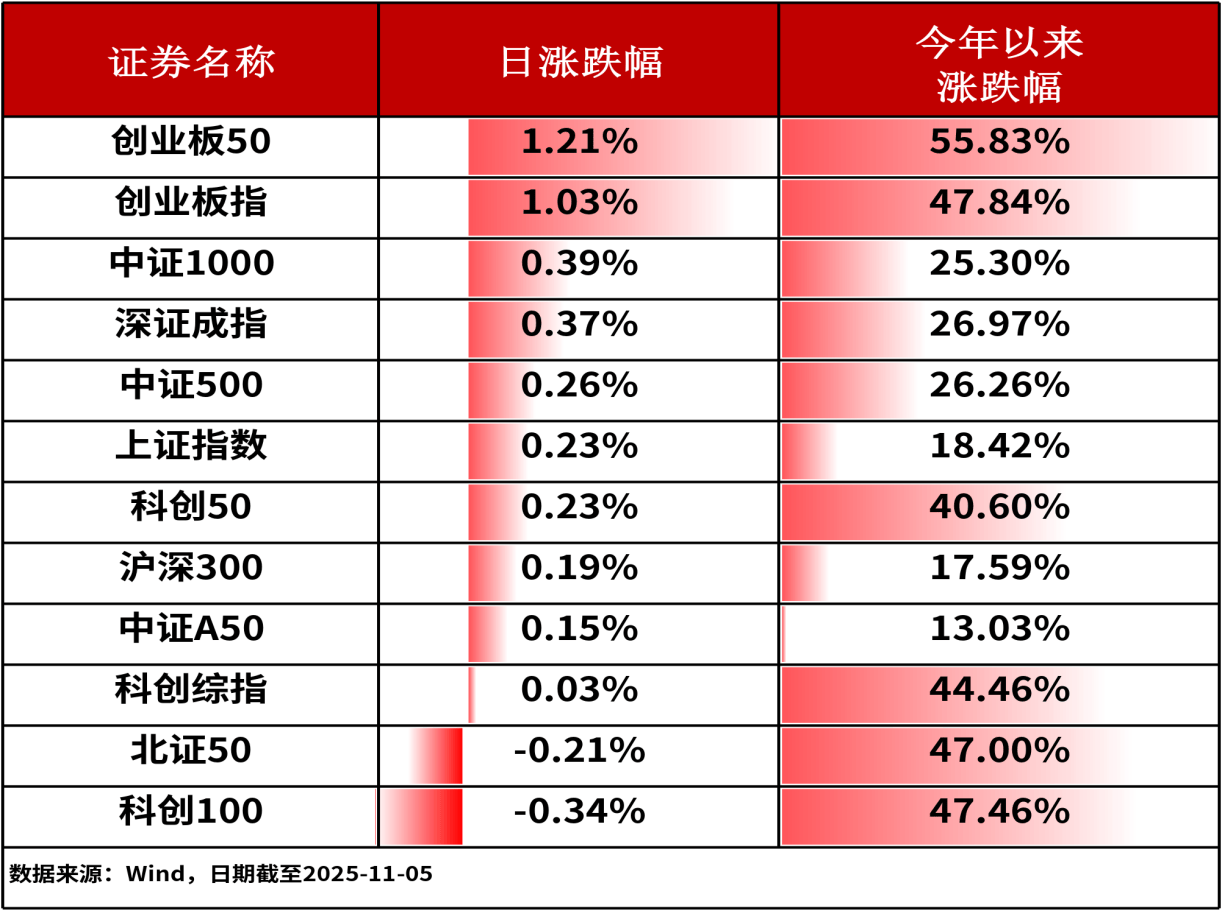
Market Overview - On November 5, A-shares saw a slight increase with the Shanghai Composite Index rising by 0.23%, the Shenzhen Component Index by 0.37%, and the ChiNext Index by 1.03%, with the ChiNext Index showing the most significant gain [1] - Over 3,380 stocks in the market experienced an increase, indicating high market activity [1] - The total trading volume in the Shanghai and Shenzhen markets was 1,872.3 billion RMB, slightly down from the previous trading day [1] Index Performance - The following indices showed daily and year-to-date performance: - ChiNext 50: +1.21% (YTD: +55.83%) - ChiNext Index: +1.03% (YTD: +47.84%) - CSI 1000: +0.39% (YTD: +25.30%) - Shenzhen Component Index: +0.37% (YTD: +26.97%) - Shanghai Composite Index: +0.23% (YTD: +18.42%) [2] Sector Performance - The leading sectors in terms of daily gains included: - Electrical Equipment: +3.40% - Coal: +1.39% - Retail: +1.22% - The sectors with the largest declines were: - Computer: -0.97% - Non-bank Financials: -0.49% - Telecommunications: -0.43% [5] Fund Flow - In terms of fund flow, the following ETFs saw significant net inflows: - Hong Kong Technology: +3.624 billion RMB - CSI A500: +1.878 billion RMB - Securities: +1.379 billion RMB - Conversely, the following sectors experienced net outflows: - CSI 300: -0.795 billion RMB - Food and Beverage: -0.283 billion RMB - Computer: -0.190 billion RMB [6][7] Macro Insights - The Central Financial Office emphasized the importance of enhancing the central bank system as part of the "14th Five-Year Plan" to promote the healthy and stable development of the capital market [8] - The focus is on comprehensive regulatory measures across all financial activities to strengthen oversight [8] Industry Developments - As of the end of September, China's new energy storage installations exceeded 100 million kilowatts, marking a growth of over 30 times compared to the end of the 13th Five-Year Plan, with a global market share exceeding 40% [9] - In the robotics sector, XPeng Motors aims to achieve mass production of humanoid robots by the end of 2026, collaborating with Baosteel for industrial applications [10] - In the semiconductor industry, Tesla's CEO announced plans for AI chip samples to be released in 2026, with mass production expected in 2027 [11]
【5日资金路线图】两市主力资金净流出超130亿元 电力设备等行业实现净流入
Zheng Quan Shi Bao Wang· 2025-11-05 23:56
11月5日,A股市场整体上涨。 截至收盘,上证指数收报3969.25点,上涨0.23%;深证成指收报13223.56点,上涨0.37%;创业板指收报3166.23点,上涨1.03%。两市合计成交 18723.41亿元,较上一交易日减少434.17亿元。 1. 两市主力资金净流出超130亿元 今日沪深两市主力资金开盘净流出168.2亿元,尾盘主力资金净流入26.44亿元,两市全天主力资金净流出134.15亿元。 | | | 沪深两市最近五个交易日主力资金流向情况(亿元) | | | | --- | --- | --- | --- | --- | | 日期 | | 净流入金额 开盘净流入 | 尾盘净流入 | 超大单净买入 | | 2025-11-5 | -134. 15 | -168. 20 | 26. 44 | -26. 36 | | 2025-11-4 | -575. 34 | -133.03 | -41.65 | -375. 28 | | 2025-11-3 | -221.45 | -150. 11 | 2.46 | -88. 75 | | 2025-10-31 | -437.44 | -120. 47 | ...

A股市场大势研判:A股全天低开高走,走出独立行情
Dongguan Securities· 2025-11-05 23:33
Market Overview - The A-share market opened lower but rebounded throughout the day, showing an independent trend with the Shanghai Composite Index closing at 3969.25, up 0.23% [2][4] - The Shenzhen Component Index and the ChiNext Index also saw gains of 0.37% and 1.03%, respectively, indicating a positive market sentiment [2][4] Sector Performance - The top-performing sectors included Power Equipment (3.40%), Coal (1.39%), and Retail (1.22%), while the weakest sectors were Computer (-0.97%) and Non-Bank Financials (-0.49%) [3][4] - Concept indices such as Hainan Free Trade Zone (4.61%) and Flexible DC Transmission (4.13%) performed well, whereas MLOps (-1.57%) and Huawei Euler (-1.16%) lagged behind [3][4] Future Outlook - The market is expected to continue its independent trend, with a focus on sectors like new energy and storage, which have shown strong performance recently [4][6] - The report suggests a balanced investment strategy, emphasizing defensive sectors like finance and coal, as well as low-positioned sectors like food and beverage, to navigate market volatility [6] - Long-term growth in technology sectors remains a focal point, despite short-term uncertainties regarding capital expenditures in the AI wave [6] Policy Impact - A significant policy change was noted, with the Chinese government suspending the 24% additional tariffs on U.S. imports starting November 10, 2025, while maintaining a 10% tariff [5] - This adjustment is expected to influence trade dynamics and market sentiment positively [5]
券商研判11月A股策略:风格切换概率加大 均衡配置为上策
Zheng Quan Shi Bao· 2025-11-05 18:35
Core Viewpoint - The A-share market has shown significant signs of style switching since November, with traditional value sectors like banks and utilities performing well, while previously strong sectors such as metals, new energy, and innovative pharmaceuticals have experienced increased volatility [1][2]. Group 1: Market Style Switching - Historical data indicates that when market valuations are high, style switching tends to occur at year-end, driven by policy, industry trends, and fund reallocation [2]. - Since 2005, there have been five instances of year-end style switching, with four of them shifting towards stable sectors like finance or consumption [2]. - In the current bull market, institutional behavior is likely to dominate style switching, with significant reallocations observed in the third quarter, particularly in the electronics, communication, and power equipment sectors [2][3]. Group 2: Institutional Behavior and Profit Taking - The fourth quarter often sees profit-taking pressures on leading sectors, as institutions shift focus from seeking excess returns to locking in profits [3]. - As of the third quarter of 2025, the electronics sector held a 25% share in active equity funds, with TMT (Technology, Media, and Telecommunications) exceeding 40%, marking historical highs [3]. - The potential for structural adjustments is heightened as institutions may face pressure to sell if others begin to realize profits [3]. Group 3: Long-term Outlook on Technology Sector - Despite short-term pressures, the long-term outlook for the technology sector remains positive, with continued value in growth stocks [6]. - The macroeconomic environment, particularly the onset of a U.S. interest rate cut cycle, is expected to enhance liquidity and support growth stock valuations [6]. Group 4: Balanced Investment Strategy - Multiple brokerages recommend a balanced investment strategy for November, favoring traditional value stocks [7]. - There is a noted improvement in capital returns for sectors like non-bank financials, steel, basic chemicals, and machinery, although these sectors have not attracted significant investor interest [8]. - Recommendations include focusing on upstream resources like copper, aluminum, and lithium, as well as capital goods and sectors benefiting from domestic demand recovery [8].