
半导体

Search documents
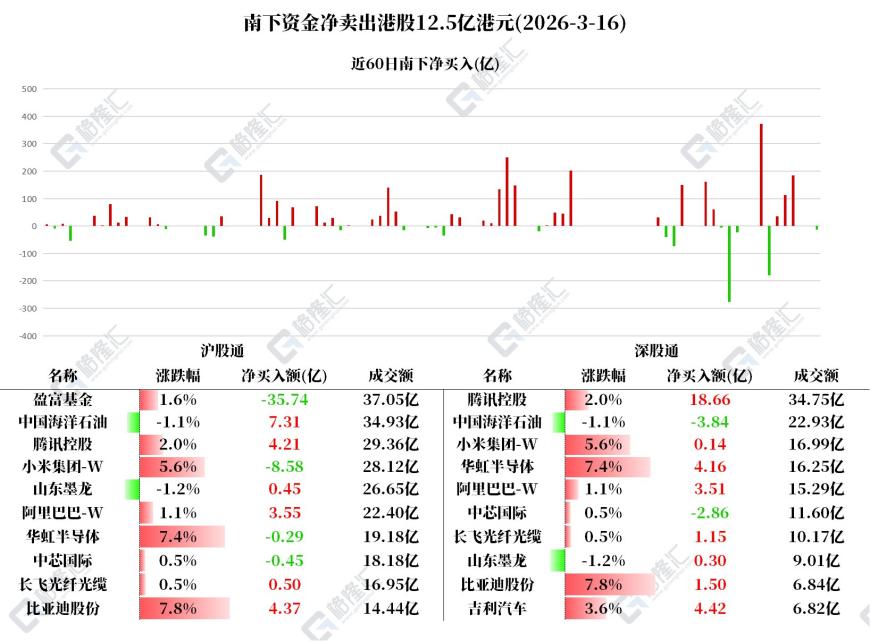
南下资金净买入腾讯、阿里和比亚迪
Ge Long Hui· 2026-03-16 10:34
Group 1 - Southbound funds recorded a net sell of HKD 1.25 billion in Hong Kong stocks on March 16, with notable net purchases in Tencent Holdings (HKD 2.287 billion), Alibaba-W (HKD 706 million), BYD Company (HKD 586 million), and Geely Automobile (HKD 442 million) [1] - The net sell was primarily driven by the iShares Asia 50 ETF, which saw a net sell of HKD 3.574 billion, and Xiaomi Group-W with HKD 844 million [1][3] - Southbound funds have consistently net bought China National Offshore Oil Corporation (CNOOC) for four consecutive days, totaling HKD 3.38424 billion [1] Group 2 - Tencent Holdings experienced a price increase of 2.0% with a net buy of HKD 4.21 billion, while Alibaba-W saw a 1.1% increase with a net buy of HKD 3.55 billion [3] - BYD Company had a significant price increase of 7.8% with a net buy of HKD 4.37 billion, and Geely Automobile increased by 3.6% with a net buy of HKD 4.42 billion [3] - The overall trading volume for the stocks mentioned indicates a mixed performance, with some stocks like Xiaomi Group-W and SMIC showing negative net buy figures [3]





电子行业周报:AMAT携手SK hynix、Micron合作开发新一代存储芯片
Shanghai Aijian Securities· 2026-03-16 10:24
Investment Rating - The electronic industry is rated as "Outperform" compared to the market [1]. Core Insights - The report highlights significant collaborations in the semiconductor sector, including AMAT's partnership with SK hynix and Micron to develop next-generation AI storage chips, with a total investment of up to $5 billion [21]. - The demand for AI computing power is driving the global storage industry towards AI-specific technologies, indicating a trend of collaborative innovation between equipment and manufacturing sectors [22]. - The report emphasizes the explosive growth of companies like Cambricon, which reported a revenue increase of 453.21% year-on-year, driven by the rising demand for AI computing power [25]. Market Performance Summary - The SW electronic industry index decreased by 1.23%, ranking 20th out of 31 sectors, while the CSI 300 index increased by 0.19% [2][3]. - The top-performing sub-sectors within the electronic industry included printed circuit boards (+2.95%), LEDs (+2.19%), and discrete devices (+1.84%), while passive components (-5.13%), semiconductor equipment (-4.86%), and integrated circuit packaging (-3.82%) lagged behind [8]. - Notable stock performances included Nanya Technology (+20.96%), Zhongying Technology (+19.87%), and Demingli (+18.05%), while stocks like Canxin Technology (-15.82%) and Igor (-15.01%) faced significant declines [11]. Global Industry Dynamics - AMAT's strategic partnership with SK hynix and Micron focuses on core technologies and process innovation for DRAM, HBM, and NAND AI storage chips [21]. - Samsung and NVIDIA are collaborating to accelerate the development of next-generation NAND Flash storage chips, significantly enhancing performance analysis speeds [22]. - The upcoming NVIDIA GTC 2026 conference will showcase advancements in AI infrastructure, including the Feynman architecture, which aims to reduce data center energy consumption [24]. - Broadcom has launched the first single-channel 400G optical DSP chip, designed for next-generation AI data centers, demonstrating advancements in bandwidth and energy efficiency [26].
电子行业周报:OpenClaw引发Agent热潮,推理Token需求拉动算力增长
Donghai Securities· 2026-03-16 10:24
Investment Rating - The report maintains a standard rating for the electronic sector, highlighting structural opportunities despite challenges in demand and pricing pressures [5]. Core Insights - The OpenClaw initiative is driving a surge in AI Agent applications, leading to increased demand for reasoning tokens and subsequently boosting the computing power across the AI industry chain. Major domestic CSPs have launched related Agent products [5]. - AI demand is projected to drive a 26.3% year-on-year growth in global wafer foundry output value in 2025, reaching a historical high of $169.5 billion. However, high storage prices may impact terminal demand and wafer fab capacity utilization in 2026 [5]. - The electronic sector underperformed the market this week, with the Shenwan Electronics Index declining by 1.23% compared to a 0.19% increase in the CSI 300 Index [5]. - Investment suggestions include focusing on companies benefiting from strong domestic and international AIOT demand, AI innovation-driven sectors, and upstream supply chain opportunities related to semiconductor equipment and materials [6]. Summary by Sections Industry Overview - The report emphasizes the transformative impact of OpenClaw on AI Agent applications, which are set to redefine human-computer interaction and necessitate upgrades in security systems [5]. - The global wafer foundry market is expected to see significant growth driven by AI server GPU and TPU demand, with TSMC maintaining a dominant market share [5]. Market Performance - The electronic sector's performance this week was below the market average, with various sub-sectors showing mixed results, particularly in semiconductors and consumer electronics [20][22]. Investment Recommendations - Suggested companies include those in the AIOT sector such as Lexin Technology and Hanguang Technology, as well as firms in the AI innovation space like Cambricon and Moore Threads [6].
策略点评:探底回升,震荡延续
Tebon Securities· 2026-03-16 10:23
Market Analysis - The A-share market showed a slight adjustment with a notable structural differentiation, closing at 4084.79 points, down 0.26%, while the Shenzhen Component rose by 0.19% to 14307.58 points, and the ChiNext Index increased by 1.41% to 3357.02 points, indicating a recovery trend after a dip [2][5] - The total trading volume in the A-share market reached 2.34 trillion, reflecting active market participation with 2843 stocks rising and 2489 falling, suggesting an improvement in market profitability [2][5] Sector Performance - The technology sector led the market with significant gains in sub-sectors such as memory chips and advanced packaging, with increases of 5.52%, 4.09%, and 4.08% respectively, driven by anticipated price hikes in the global semiconductor industry [5] - The shipping sector also performed well, rising by 3.59%, influenced by geopolitical changes in the Middle East affecting shipping routes and price expectations [5] - Conversely, traditional cyclical sectors like steel, non-ferrous metals, and coal saw declines, with drops of 3.08% to 1.06%, indicating profit-taking pressures in previously high-performing stocks [5] Short-term Market Outlook - The A-share market is expected to continue exhibiting structural characteristics, with a rotation between technology growth and traditional cyclical sectors being the main theme [7] - The upcoming disclosure of annual reports in late March will be crucial for stock performance, with companies showing better-than-expected earnings likely to attract market interest [7] Bond Market - The government bond futures market experienced a comprehensive decline, with the 30-year bond futures dropping by 0.43% to 110.63, reflecting cautious market sentiment [11] - Economic data from January to February showed fixed asset investment at 52,721 billion, up 1.8% year-on-year, and retail sales at 86,079 billion, up 2.8%, indicating a strengthening economic recovery that may exert pressure on the bond market [11] Commodity Market - The commodity index rose, with the Nanhua Commodity Index closing at 3160.68, up 0.11%, led by significant increases in petrochemical products such as asphalt, which surged by 10.63% [11] - Brent crude oil prices stabilized above $100 per barrel, influenced by geopolitical tensions, which also supported the rise in asphalt prices due to increased production costs [11][13] Trading Hotspots - Key sectors to watch include AI applications, commercial aerospace, nuclear fusion, quantum technology, brain-computer interfaces, and robotics, all of which are expected to benefit from technological advancements and policy support [14] - The brokerage sector is also highlighted due to high trading volumes in the A-share market, with potential changes in trading regulations being a point of interest [14]
最火芯片研究机构! SemiAnalysis创始人:算力瓶颈从CoWoS转移到EUV,存储吃掉30%资本开支
华尔街见闻· 2026-03-16 10:18
Core Insights - The core argument of the article is that the bottlenecks in AI computing power expansion are constantly shifting, with the semiconductor manufacturing segment becoming the primary constraint as other infrastructure components like data centers and power supply expand [2][5][6]. Group 1: Bottlenecks in AI Computing Power - The bottlenecks in the AI supply chain have changed almost every year, with previous limitations being CoWoS packaging, power supply, and data centers [4][5]. - As these issues are addressed, new bottlenecks emerge, indicating that the demand for AI is growing faster than the supply chain can expand [5][6]. - Currently, the core limitation is returning to semiconductor manufacturing, specifically in logic chip capacity, high-bandwidth memory (HBM), and wafer fabrication capabilities [6][8]. Group 2: Future Constraints - If AI computing power continues to grow rapidly, future bottlenecks may shift further downstream to semiconductor equipment capacity, particularly focusing on extreme ultraviolet (EUV) lithography machines produced by ASML [9][10]. - The current global production of EUV machines is about 70 units per year, with potential increases to 80 units, but even with aggressive expansion, it is unlikely to exceed 100 units by the end of the decade [11][12]. Group 3: Impact on Consumer Electronics - A significant shortage of memory chips is expected to be a core trading theme in the next couple of years, with predictions that about 30% of capital expenditures from tech giants will flow into memory chips by 2026 [17]. - The demand for high-bandwidth memory (HBM) will lead to a reduction in consumer electronics memory production, potentially increasing costs for devices like smartphones [18][19]. - The global smartphone shipment volume, originally projected at 1.4 billion units annually, may drop to 800 million this year and could halve to 500-600 million next year due to rising memory costs [20]. Group 4: Power Supply Considerations - The article argues that power supply will not be the ultimate constraint for AI computing, and alternative energy solutions can be implemented to support data centers [22][23]. - The concept of space-based data centers is dismissed as economically unfeasible due to high failure rates of chips and expensive communication costs [24].


顺义科创:能进能退,做一个“耐心”的产业培育者
FOFWEEKLY· 2026-03-16 10:00
Core Viewpoint - The article emphasizes the importance of being a long-term nurturer of industries rather than chasing short-term projects in a competitive market, advocating for a patient capital approach to foster sustainable growth in technology sectors [2][4]. Group 1: Industry Development and Investment Strategy - In 2025, China is accelerating its move towards the global technology frontier, with local hard-tech companies emerging in fields like AI, semiconductors, and biomedicine, supported by significant investments from state-owned enterprises [3]. - The investment strategy of Shunyi Technology Innovation Group focuses on being an "industry organizer" rather than merely a financial investor, aiming to create a complete ecosystem that integrates capital and services [7][11]. - Shunyi Technology Innovation Group has invested in 20 funds with a total scale exceeding 1000 billion yuan, contributing 2.5 billion yuan and supporting over 170 projects, showcasing its commitment to long-term industrial development [11]. Group 2: Unique Operational Model - Shunyi's operational model includes a clear division of responsibilities among its departments, ensuring a comprehensive support system for enterprises from incubation to industrialization [11]. - The "district-town linkage" model enhances Shunyi's reach in industry cultivation, with partnerships to establish town-level investment funds tailored to local industrial strengths [12]. - The focus on integrating government guidance with market mechanisms aims to create a closed-loop system of "fund + implementation + ecosystem," positioning Shunyi as a core capital engine for high-end manufacturing and technological innovation [12]. Group 3: Long-term Nurturing and Exit Strategy - The concept of "patient capital" is central to Shunyi's investment philosophy, emphasizing the need for a systematic nurturing process that respects industry rules and supports long-term growth [17]. - Shunyi's exit strategy is designed to be a natural outcome of the growth process, ensuring that exits align with the maturity of the invested enterprises [19]. - The nurturing system includes an online and offline integrated support framework, significantly reducing response times to enterprise needs and providing comprehensive assistance throughout different stages of development [18]. Group 4: Future Vision and Recommendations - The collaboration with Tsinghua alumni seed funds aims to create a high-precision radar for early detection of innovative projects, enhancing Shunyi's ability to identify and support potential industry leaders [16]. - The article advocates for a return to value creation in venture capital, encouraging more patient capital to support early-stage hard-tech projects that require long-term technological breakthroughs [23]. - The ultimate goal is to establish Shunyi as a preferred location for the industrialization of top-tier technological achievements, fostering a self-sustaining cycle of innovation and growth [16][24].

大反击 | 谈股论金
水皮More· 2026-03-16 09:37
Core Viewpoint - The article discusses the recent performance of the Hang Seng Technology Index and its impact on the A-share market, highlighting three core reasons for the index's strong performance and the subsequent market recovery [5][6][7]. Market Performance - The A-share market showed mixed results, with the Shanghai Composite Index down 0.26% at 4084.79 points, while the Shenzhen Component Index rose 0.19% to 14307.58 points, and the ChiNext Index increased by 1.41% to 3357.02 points. The total trading volume in the Shanghai and Shenzhen markets was 2.34 trillion, a decrease of 77.4 billion from the previous trading day [3][8]. Reasons for Hang Seng Technology Index Performance - The first reason for the strong performance of the Hang Seng Technology Index is the resolution of negative market sentiment, which had been driven by concerns over AI investment returns, intensified price wars among delivery platforms, and liquidity issues. The significant outflow of 27.7 billion from the Hong Kong Stock Connect on March 5 marked the end of this negative sentiment [6][7]. - The second reason is the endorsement from Michael Burry, known as Wall Street's "big short," who expressed optimism about the Hang Seng Technology Index, suggesting that the prior adjustments had been sufficient and that the fundamentals of related companies had not deteriorated [7]. - The third reason is the continuous inflow of foreign capital into A-shares and H-shares, amounting to approximately 22 billion USD this year, which is significantly higher than other emerging markets. The ongoing geopolitical tensions in the Middle East are likely to drive capital back to the Hong Kong market due to safety concerns [7]. Technical Analysis - The Shanghai Composite Index has completed a three-pin bottoming technical pattern, supporting the market's judgment of "water receding and stones emerging" [8].

午后爆发!603986涨停
证券时报· 2026-03-16 09:29
Core Viewpoint - The article highlights the performance of the A-share and Hong Kong stock markets, with a particular focus on the semiconductor and marine economy sectors, which are experiencing significant growth and investment opportunities [2][3][7][11]. A-share Market Performance - The Shanghai Composite Index closed down 0.26% at 4084.79 points, while the Shenzhen Component Index rose 0.19% and the ChiNext Index increased by 1.41% [2]. - A total of approximately 2.34 trillion yuan was traded across the Shanghai, Shenzhen, and North markets, a decrease of over 770 billion yuan from the previous day [2]. - Over 2800 stocks in the A-share market were in the green, with declines in sectors such as steel, coal, electricity, and non-ferrous metals [2]. Semiconductor Sector Surge - The semiconductor sector saw a strong afternoon rally, with notable increases in storage and MCU chips [5]. - Stocks like Baiwei Storage (688525) surged over 13%, reaching a historical high, while Huahong Semiconductor and Guokai Microelectronics rose over 10% [5][6]. - Reports indicate a potential new wave of price increases in the semiconductor industry, with companies like Texas Instruments and NXP announcing price hikes of up to 85% for certain products starting April 1 [7]. Marine Economy Sector Growth - The marine economy sector showed significant upward movement, with stocks like Deepwater Haina rising over 15% and hitting the daily limit [9][10]. - The Ministry of Natural Resources emphasized the importance of planning for marine economic development, encouraging social capital participation and the development of emerging marine industries [11]. - Analysts suggest that the marine economy, including offshore wind power and marine biomedicine, is becoming a crucial area for high-quality economic growth, with substantial market potential [11].






港股大型科技股集体回暖,小米涨超5%,半导体拉升,兆易创新涨超18%
21世纪经济报道· 2026-03-16 08:48
记者丨张嘉钰 编辑丨黎雨桐 3月16日,港股强势反攻,截至收盘,香港恒生指数收涨1.45%,恒生科技指数收涨2.69%。 大型科技股回暖,科网股集体上涨。小米集团涨超5%,美团涨超3%,腾讯涨超2%。 板块方面,芯片、医药股领涨,半导体板块走强,兆易创新涨超18%,澜起科技涨近8%,华 虹半导体涨超7%。长风药业涨超21%,石药集团、康方生物涨超5%。 此外,3月16日美股 盘前 ,大型科技股多数上涨,Meta、英伟达涨1%,特斯拉涨0.7%,微软 涨0.4%。 芯片存储板块普涨。美光科技涨3.7%,闪迪涨3.2%,西部数据涨2.5%,希捷科技涨 2.1%。 越声投研:热门题材公司线索延伸阅读 (声明:文章内容仅供参考,不构成投资建议。投资者据此操作,风险自担。) 出品丨21财经客户端 21世纪经济报道 冲上热搜!山姆三文鱼原来不能生吃,网友:天塌了 现货黄金刚刚再次跌破5000美元 A股超2700股上涨,半导体爆发,贵金属概念全线重挫,港股兆易创新飙涨16% SFC 21君荐读 ...

电子行业周报:AMAT携手SKhynix、Micron合作开发新一代存储芯片-20260316
Shanghai Aijian Securities· 2026-03-16 08:36
Investment Rating - The electronic industry is rated as "Outperform" compared to the market [1]. Core Insights - The report highlights a strategic collaboration between AMAT, SK hynix, and Micron to develop next-generation AI storage chips, with a total investment of up to $5 billion [21]. - The AI computing demand is driving the global storage industry towards AI-specific technologies, emphasizing collaborative innovation in equipment and manufacturing as a core trend [22]. - The report suggests focusing on investment opportunities within the domestic storage chip industry chain due to the ongoing technological advancements and market demand [25]. Market Performance Summary - The SW electronic industry index decreased by 1.23%, ranking 20th out of 31, while the CSI 300 index increased by 0.19% [2][3]. - The top-performing sectors within the SW electronic industry included printed circuit boards (+2.95%), LEDs (+2.19%), and discrete devices (+1.84%), while passive components (-5.13%), semiconductor equipment (-4.86%), and integrated circuit packaging (-3.82%) lagged [8]. - Notable stock performances included Nanya Technology (+20.96%), Zhongying Technology (+19.87%), and Demingli (+18.05%), while losses were seen in Canxin Technology (-15.82%) and Igor (-15.01%) [11]. Global Industry Dynamics - AMAT's partnership with SK hynix and Micron focuses on core technologies and process innovation for DRAM, HBM, and NAND chips [21]. - Samsung and NVIDIA are collaborating to accelerate the development of next-generation NAND Flash storage chips, significantly enhancing performance analysis speeds [22]. - NVIDIA's GTC 2026 conference will showcase advancements in AI infrastructure, including the Feynman architecture, which aims to reduce data center energy consumption [24]. - Cambricon reported a substantial revenue increase of 453.21% in 2025, driven by the rising demand for AI computing power [25]. - Broadcom launched the first single-channel 400G optical DSP chip, enhancing bandwidth and energy efficiency for AI data centers [26].


