
贵金属

Search documents
市场分析:电网酿酒行业领涨,A股宽幅震荡
Zhongyuan Securities· 2026-02-02 09:54
Investment Rating - The industry is rated as "stronger than the market," indicating an expected increase of over 10% in the industry index relative to the CSI 300 index over the next six months [16]. Core Insights - The A-share market experienced a low opening and wide fluctuations, with notable performance in the electric grid equipment, liquor, banking, and photovoltaic equipment sectors, while precious metals, fertilizers, mining, and non-ferrous metals lagged behind [2][3]. - The average price-to-earnings (P/E) ratios for the Shanghai Composite Index and the ChiNext Index are 16.90 times and 52.86 times, respectively, which are above the median levels of the past three years, suggesting a favorable environment for medium to long-term investments [3][15]. - The total trading volume on the two exchanges was 26,069 billion, which is above the median of the past three years, indicating robust market activity [3][15]. - The manufacturing PMI for January showed a slight decline, but the equipment manufacturing and high-tech manufacturing PMIs remain in the expansion zone, reflecting ongoing structural optimization in the industry [3][15]. - The report suggests a balanced investment strategy, focusing on AI and high-end manufacturing while also considering opportunities in certain consumer sectors [3][15]. Summary by Sections A-share Market Overview - On February 2, the A-share market opened low and experienced wide fluctuations, with the Shanghai Composite Index facing resistance around 4,103 points before retreating [7]. - The Shanghai Composite Index closed at 4,015.75 points, down 2.48%, while the Shenzhen Component Index closed at 13,824.35 points, down 2.69% [8]. - Over 80% of stocks declined, with only the electric grid equipment and liquor sectors showing slight increases [7]. Future Market Outlook and Investment Recommendations - The report anticipates that the Shanghai Composite Index will likely maintain a slight fluctuation, advising investors to closely monitor macroeconomic data, changes in overseas liquidity, and policy developments [3][15]. - Short-term investment opportunities are highlighted in the electric grid equipment, liquor, banking, and photovoltaic equipment sectors [3][15].
懒人财知道:2月2日交易复盘笔记 非理性恐慌下的机会
Xin Lang Cai Jing· 2026-02-02 09:47
Group 1 - The overall market sentiment is cautious due to high volatility, with a focus on avoiding risky trades and maintaining discipline in trading strategies [3][4][21] - The commodity market is experiencing a significant downturn, with a broad decline observed in various sectors, particularly in precious metals and energy [5][21][22] - The strongest sector identified is the chemical sector, specifically in caustic soda and PVC, while the weakest sectors include precious metals, non-ferrous metals, and crude oil [6][22] Group 2 - The core strategy involves going long on the strongest sectors and shorting the weakest ones, with a focus on maintaining a light position in weak commodities to avoid potential losses [7][24] - Specific strategies executed include automatic exit from PVC positions upon market decline and avoiding deep losses in precious metals and crude oil [9][10][25][26] - Risk management has been emphasized through systematic market analysis and strict stop-loss measures, successfully avoiding significant losses in weak sectors [11][27][28] Group 3 - Market drivers include geopolitical tensions and changes in U.S. monetary policy expectations, which have led to a bearish sentiment in the market [13][29] - The analysis framework used has effectively captured signals of market weakness, although there is a need for improved strategies for strong sectors to adapt to sudden market changes [14][30] - Continuous monitoring of U.S. Federal Reserve policies and global geopolitical developments is necessary for dynamic adjustment of trading strategies [15][31]


黑色星期一!罕见一幕,集体跌停!黄金、白银背后,谁在砸盘?
券商中国· 2026-02-02 09:32
Core Viewpoint - The article discusses the significant decline in the domestic commodity market, triggered by a sharp drop in international precious metals, leading to a rare market crash referred to as "Black Monday" [1][2]. Group 1: Market Performance - On February 2, the domestic futures market opened significantly lower, with panic spreading across various sectors, resulting in 13 commodities, including silver, platinum, palladium, copper, aluminum, and oil, hitting their daily limit down [2][4]. - The international precious metals market experienced extreme volatility, with gold prices dropping by as much as 12% in a single day, marking the largest daily decline in nearly 40 years, while silver saw a maximum drop of 36%, the largest since 1983 [3][4]. Group 2: Causes of the Decline - The recent crash is attributed to multiple factors, including excessive prior gains, concentrated leverage, and a fragile trading structure, which led to a rapid release of pressure when negative news emerged [2][5]. - Analysts noted that the extreme volatility in precious metals prices exceeded what could be explained by fundamental factors, indicating that emotional factors became the dominant force in the market [4][5]. Group 3: Market Dynamics - In January, precious metals saw significant price increases, with gold rising from approximately $4,300 to $5,600 per ounce (28% increase), and silver surging from around $70 to over $120 (nearly 70% increase) [5]. - The rapid rise in precious metals prices led to a spillover effect into base metals and related industries, with mining and resource stocks frequently hitting their upper limits in the capital market [5][6]. Group 4: Trading Mechanisms and Responses - The article highlights the role of high-leverage funds and derivative instruments in amplifying both upward and downward market movements, with a significant concentration of leveraged positions contributing to the market's fragility [5][6]. - Exchanges quickly implemented risk control measures in response to the extreme market conditions, including adjustments to margin levels and trading limits for various contracts [7]. Group 5: Market Outlook - Industry experts emphasize that the recent volatility serves as a warning for capital markets, suggesting that excessive narrative-driven speculation can lead to systemic risks [8]. - The article concludes that while the recent turmoil does not signify the end of long-term trends, the market must undergo a process of deleveraging and normalization in the short term [8][9].
21评论|金银价为何突然大跌?
2 1 Shi Ji Jing Ji Bao Dao· 2026-02-02 09:30
Core Viewpoint - The recent volatility in the international gold and silver markets is attributed to a combination of factors, including a sudden shift in U.S. Federal Reserve policy expectations, profit-taking, and structural weaknesses in the global precious metals market [2][3][4]. Group 1: Market Dynamics - On January 29, spot gold prices briefly exceeded $5,600, followed by a significant decline, dropping to $4,653 by February 2, while silver prices fell over 35% from a peak of $128 on January 30 [2]. - The shift to a hawkish stance by the Federal Reserve, influenced by President Trump's nomination of Kevin Walsh, led to a stronger dollar, which negatively impacted gold and silver prices [2][5]. - Technical indicators showed that both gold and silver were in overbought territory, prompting a rapid sell-off as investors took profits, resulting in gold dropping over $600 in a single day and silver nearly $40 [3][4]. Group 2: Structural Weaknesses - The influx of speculative and leveraged funds into the precious metals market created a fragile trading environment, where a price reversal triggered forced liquidations, exacerbating the decline [4][6]. - The current global financial system's reliance on the dollar and low interest rates has reached historical highs, making it sensitive to changes in U.S. monetary policy, which could lead to significant adjustments in emerging markets and high-debt countries [5][6]. - The potential for delivery defaults in the silver market raises concerns about the integrity of pricing mechanisms, which could have cascading effects on gold and credit markets [6][7]. Group 3: Financial System Implications - The recent turmoil in the precious metals market reflects broader vulnerabilities in the international financial system, highlighting the risks associated with low interest rates, high debt levels, and geopolitical uncertainties [6][7]. - Despite the volatility, the overall impact on the financial system appears manageable for now, with major stock indices showing only minor declines and investor sentiment remaining relatively stable [6][7]. - The situation serves as a stress test for the global market, revealing weaknesses and the potential for increased risk in the financial landscape [7].
贵金属行情持续,小金属盈利或提升
East Money Securities· 2026-02-02 09:26
Investment Rating - The report maintains an "Outperform" rating for the industry [2][12]. Core Insights - The report highlights the ongoing strength in precious metals and anticipates potential profit increases in minor metals [1]. - It emphasizes the financial attributes of copper and the impact of supply constraints on various metals, including aluminum and tungsten [4][5]. - The report notes the continued demand for gold driven by central bank purchases and the selling of U.S. government bonds by European institutions [4]. Summary by Sections Copper Sector - The report indicates a focus on the financial attributes of copper, with LME copper prices at $12,921 per ton and SHFE copper at ¥101,340 per ton, showing a week-on-week change of -0.6% and +0.6% respectively [4]. - It mentions a tightening supply of copper concentrate, with processing fees declining, which may accelerate the clearing of smelting profits [4]. Aluminum Sector - LME aluminum prices reached $3,175 per ton, while SHFE aluminum was at ¥24,290 per ton, reflecting a week-on-week increase of +0.9% and +1.5% respectively [4]. - The report notes a high operating rate of 98.3% for electrolytic aluminum and a slight increase in the operating rate of aluminum processing enterprises [4]. Precious Metals - SHFE gold prices were reported at ¥1,115.6 per gram and COMEX gold at $4,983.1 per ounce, with week-on-week increases of +8.1% and +8.3% respectively [4]. - The report highlights that the SPDR Gold ETF's net holdings increased to 1,086.5 tons, indicating stable demand from overseas investors [4]. Minor Metals - Tungsten prices rose to ¥535,000 per ton, with a week-on-week increase of +5.5% [4]. - The report also notes a tightening supply in the rare earth sector, with prices for praseodymium and dysprosium oxides showing slight declines [4]. Steel Sector - SHFE rebar and hot-rolled coil prices were reported at ¥3,142 and ¥3,305 per ton, with slight week-on-week decreases [5]. - The report mentions a significant explosion at a steel plant, which may lead to stricter safety regulations and supply constraints in the steel industry [5]. Investment Recommendations - The report suggests focusing on companies with rich copper resources, such as Zijin Mining and China Molybdenum, as well as those in the aluminum sector like China Aluminum and Nanshan Aluminum [8]. - It also recommends monitoring tungsten and rare earth companies, as well as steel firms with strong product structures [8].
【社区调查】贵金属预判集体跑偏?重大事件精准踩点!
Xin Lang Cai Jing· 2026-02-02 09:25
4636人次激情投票,36张百元礼品卡+7份财经日历全部送出,新浪财经1月社区调查圆满收官!本次聚 焦四大资产价格和三大国际事件,吸引大批专业投资者和资深交易员的深度参与。用户看涨情绪直接冲 顶,资产价格预判集体跑偏,对国际大事的判断却精准度拉满! 四大资产预判:集体跑偏!贵金属看涨情绪上头 贵金属方面,伦敦金(现货黄金)一度飙升至5596.33美元/盎司的历史新高,但随后急转直下,月底最 终收报5860.39美元/盎司。伦敦银(现货白银)在1月29日创历史高位121.49美元/盎司后,在30日收跌 26.83%,报84.43美元/盎司。市场分析提出,黄金和白银冲高回落,可归结为投资者的"获利了结"离 场。在黄金和白银创下历史新高后,前期布局的多头兑现收益,叠加凯文·沃什提名出任下任美联储主 席,预期推动美元反弹,带动金价回调。 由于贵金属前期走势持续强劲,用户的看涨情绪普遍高涨。近8成参与调研的用户笃定金价能冲破 5200 美元/盎司大关,仅有8%少数派保持谨慎,押注金价在4800-5000美元区间波动。 点击进入投票 白银方面,7成用户认为白银将收于110以上,仅7%用户给出保守预测,认为白银将收于90美 ...
沃什提名成金银价格暴跌导火索,恐波及更多市场
Di Yi Cai Jing Zi Xun· 2026-02-02 09:24
Core Viewpoint - The nomination of Kevin Warsh as the next Federal Reserve Chairman by Trump has led to a significant market reassessment of the dollar and dollar-denominated assets, resulting in a sharp decline in gold and silver prices, marking the largest single-day drop since the early 1980s, with a total market value loss of $7.4 trillion [2][5][6]. Group 1: Market Reactions - The market is forced to reevaluate the dollar as Warsh prepares to take over the Fed, with the dollar index rising by 0.8% after a previous decline of 2.1% in January [5]. - Analysts suggest that the nomination may lead to short-term panic in the U.S. stock market, but a clearer situation is expected shortly after Warsh's appointment [5]. - The nomination is seen as alleviating concerns about the politicization of the Fed, leading to a short-term increase in the dollar and a slight steepening of the yield curve [5][9]. Group 2: Impact on Precious Metals - The return of dollar trading has triggered a correction in the previously crowded precious metals market, particularly for gold and silver [6]. - Recent data indicates that gold purchases have been primarily driven by individual investors, with a significant increase in bullish positions and record levels of call options, creating a speculative bubble [9][11]. - The Chicago Mercantile Exchange has raised margin requirements for gold and silver futures, which may force high-leverage investors to exit the market, further reducing liquidity in precious metals [10]. Group 3: Broader Market Implications - The sell-off in gold and silver is expected to spill over into other markets, leading to a deleveraging effect that could force investors to sell other assets to cover losses in precious metals [11]. - Following the decline in precious metals, U.S. stock index futures and Bitcoin have also experienced downward pressure, indicating a broader market impact [11].

挖坑 | 谈股论金
水皮More· 2026-02-02 09:18
Market Overview - The A-share market experienced a significant decline, with the Shanghai Composite Index dropping by 2.48% to close at 4015.75 points, marking the largest single-day drop since April 7, 2025 [3] - The Shenzhen Component Index fell by 2.69% to 13824.35 points, while the ChiNext Index decreased by 2.46% to 3264.11 points [3] - Total trading volume in the Shanghai and Shenzhen markets was 260.69 billion, a decrease of 255.8 billion from the previous trading day [3] Individual Stock Performance - A total of 4465 stocks declined, while only 741 stocks rose, indicating a broad market sell-off [3] - The median decline across all stocks was 2.15%, reflecting a simultaneous drop in both volume and price [3] Sector Performance - Only two sectors, electric grid equipment and the liquor industry, saw gains, with the liquor sector's core stocks performing particularly well [4] - The banking sector attempted to stabilize the market but ultimately closed down by 0.26% [4] - The most significant declines were seen in cyclical stocks, particularly precious metals, with declines in mining, coal, non-ferrous metals, steel, and oil sectors, many of which experienced drops close to 5% [4] Commodity Market Impact - The commodity market experienced extreme volatility, with gold prices plummeting to $4559 per ounce, a drop of 3.83%, and oil prices falling by 4.88% [5] - Silver prices also fell to $73.15 per ounce, down by 6.81%, indicating a chain reaction affecting related A-share sectors [5] Economic Indicators - Recent PMI data released by the National Bureau of Statistics showed a comprehensive decline in economic activity, with manufacturing, non-manufacturing, and composite business indices all falling below the "50 boom-bust line," indicating a slowdown compared to the end of last year [5] - The real estate and construction materials sectors weakened significantly, influenced by a reported loss of 82 billion from Vanke, compounding the market's challenges [5] Future Market Outlook - The current market downturn is seen as a potential opportunity for the upcoming Spring Festival market rally, with expectations for the index to form a new range-bound trading pattern [6] - The core support logic is based on the prior cooling of large blue-chip stocks under "national team" regulation, which has mitigated some risks [6] - Blue-chip valuations are at historical lows, suggesting limited downside potential for the index, as evidenced by the stable performance of major liquor stocks and the four major banks [6]

贵金属板块2月2日跌10.18%,晓程科技领跌,主力资金净流出10.39亿元
Zheng Xing Xing Ye Ri Bao· 2026-02-02 09:07
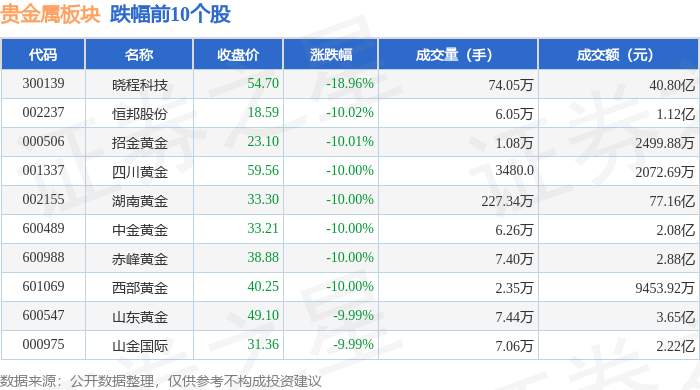
Market Overview - The precious metals sector experienced a significant decline of 10.18% compared to the previous trading day, with Xiaocheng Technology leading the drop [1] - The Shanghai Composite Index closed at 4015.75, down 2.48%, while the Shenzhen Component Index closed at 13824.35, down 2.69% [1] Individual Stock Performance - Xiaocheng Technology (300139) closed at 54.70, down 18.96% with a trading volume of 740,500 shares [1] - Hengbang Shares (002237) closed at 18.59, down 10.02% with a trading volume of 60,500 shares [1] - Zhao Jin Gold (000506) closed at 23.10, down 10.01% with a trading volume of 10,800 shares [1] - Sichuan Gold (001337) closed at 59.56, down 10.00% with a trading volume of 3,480 shares [1] - Hunan Gold (002155) closed at 33.30, down 10.00% with a trading volume of 2,273,400 shares [1] - Zhongjin Gold (600489) closed at 33.21, down 10.00% with a trading volume of 62,600 shares [1] - Chifeng Gold (6009888) closed at 38.88, down 10.00% with a trading volume of 74,000 shares [1] - Western Gold (eoloea) closed at 40.25, down 10.00% with a trading volume of 23,500 shares [1] - Shandong Gold (600547) closed at 49.10, down 9.99% with a trading volume of 74,400 shares [1] - Shanjin International (000975) closed at 31.36, down 9.99% with a trading volume of 70,600 shares [1] Capital Flow Analysis - The precious metals sector saw a net outflow of 1.039 billion yuan from institutional investors, while retail investors experienced a net inflow of 769 million yuan [1] - The following stocks had notable capital flows: - Shanjin International (000975) had a net inflow of 1.414 million yuan from retail investors, despite a net outflow of 10.571 million yuan from institutional investors [2] - Sichuan Gold (001337) saw a net outflow of 10.7625 million yuan from institutional investors, with a net inflow of 781.43 million yuan from retail investors [2] - Zhao Jin Gold (000506) had a net outflow of 16.9277 million yuan from institutional investors, while retail investors contributed a net inflow of 1.25826 million yuan [2] - Hengbang Shares (002237) experienced a net outflow of 22.7305 million yuan from institutional investors, with a net inflow of 1.82554 million yuan from retail investors [2] - Zhongjin Gold (600489) had a net outflow of 87.5449 million yuan from institutional investors, while retail investors contributed a net inflow of 5.4129 million yuan [2]


和讯投顾母保剑:黄金跌停,能抄底吗?
Sou Hu Cai Jing· 2026-02-02 09:02
Core Viewpoint - The recent decline in gold and silver prices is attributed to two main markets: the stock market and the Shanghai Futures Exchange, where both gold and silver futures have hit their limits down [1] Group 1: Market Conditions - The first condition for the decline in gold and silver prices is the easing of geopolitical risks, which has reduced the safe-haven demand for precious metals [1] - The second condition is the confirmation of Kevin Warsh as the new chair of the Federal Reserve, leading to significant market concerns regarding a shift in Fed policy, contributing to the global market downturn [1] - The third condition relates to the upcoming delivery dates for gold and silver, with gold on February 27 and silver in March, indicating that March historically represents a critical period for these metals [1] Group 2: Investment Outlook - Despite the current price drop, it is not yet advisable to buy gold and silver as a bottom-fishing strategy; a more suitable buying opportunity may arise after March [1] - The expectation is for gold and silver to experience volatility in February, but a rebound is not anticipated until later [1]