
有色

Search documents
三花智控低开近5%
第一财经· 2025-10-16 01:40
10月16日早盘,恒指跌0.08%,恒生科技指数跌0.14%。医药股普遍回调,科网股分化;有色行业 跟进期货涨势,中国白银集团涨超2%。三花智控低开近5%,澄清公司获得机器人大额订单为不实消 息。 ...

滚动更新丨A股三大股指集体低开,充电桩、智能电网等板块走强
Di Yi Cai Jing· 2025-10-16 01:40
Market Overview - The charging pile sector opened high, with companies like Jingquanhua and Aotexun hitting the daily limit up, while Heshun Electric rose over 10% [1] - The A-share market saw all three major indices open lower, with the Shanghai Composite Index down 0.29%, Shenzhen Component down 0.42%, and ChiNext down 0.58% [2][3] - The Hang Seng Index opened down 0.08%, with the Hang Seng Tech Index falling 0.14% [4] Sector Performance - The charging pile concept stocks showed strong performance, driven by the release of the "Three-Year Doubling Action Plan for Electric Vehicle Charging Facility Service Capacity (2025-2027)", which aims to establish 28 million charging facilities nationwide by the end of 2027 [1] - The pharmaceutical, military, and photovoltaic sectors also exhibited active trading [1][2] - Robotics concept stocks experienced a pullback, with Sanhua Intelligent Control opening down nearly 5% due to clarification of false news regarding large orders [4] Financial Data - The Shanghai Composite Index was at 3900.68, down 11.53 points or 0.29% [3] - The Shenzhen Component Index was at 13064.26, down 54.50 points or 0.42% [3] - The ChiNext Index was at 3008.37, down 17.49 points or 0.58% [3]

关税交易加速,聚焦国内政策主线,关注矿业ETF(561330)
Mei Ri Jing Ji Xin Wen· 2025-10-16 01:21
Group 1 - The core viewpoint is that the escalation of US-China tariff disputes has led to a risk-averse sentiment among investors, particularly impacting high-valuation technology sectors in the short term [1][2] - The current market is expected to remain volatile, with a focus on domestic policy directions and global manufacturing recovery opportunities, suggesting attention to specific ETFs like the Photovoltaic 50 ETF and Mining ETF [1][2] - The market has shown some preparedness for the tariff path, with investors not falling into extreme panic, indicating limited chances for a significant market crash but also constrained upward recovery potential due to existing valuation levels [1] Group 2 - A-share market is likely to exhibit more structural characteristics, with previously high-performing sectors now becoming vulnerable, suggesting a temporary avoidance of these areas [2] - Future opportunities may arise from domestic policies such as "anti-involution" and high-end manufacturing, as well as sectors related to domestic demand recovery [2] - Overall, the market is expected to consolidate under the shadow of tariffs, shifting the investment focus from external factors to internal policies and fundamentals, seeking structural opportunities amid volatility [2]
ETF日报:债市层面,在边际上看到一些好转,但目前好转尚未形成趋势,可关注十年国债ETF
Xin Lang Ji Jin· 2025-10-15 13:03
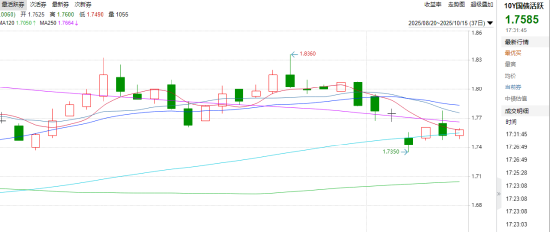
Market Performance - A-shares showed strong performance today, with the Shanghai Composite Index rising by 1.22% to 3912.21 points, the Shenzhen Component Index up by 1.73%, and the ChiNext Index increasing by 2.36% [1] - The total trading volume in the Shanghai and Shenzhen markets reached 2.09 trillion yuan, significantly lower than the previous day [1] - The technology sector, particularly photovoltaic, machinery, and communication stocks, led the gains, while defensive assets like gold also saw an increase [1] Investor Sentiment - Investor risk appetite was strong today, with over 4,300 stocks gaining [1] - Small-cap stocks outperformed large-cap stocks, and growth stocks were favored over value stocks [1] Trade Tensions and Market Outlook - The escalation of US-China trade tensions has led to a cautious sentiment among investors, particularly affecting high-valuation technology stocks [2][3] - Despite the trade tensions, the market has shown resilience, with investors having anticipated the complexities of US-China relations, limiting panic selling [2] - The trade conflict is viewed as a "lose-lose" situation, which may prevent further deterioration of the situation [2] Structural Opportunities - The A-share market is expected to exhibit more structural characteristics, with a recommendation to avoid previously high-flying sectors linked to overseas tech stocks [3] - Future opportunities may arise from domestic policies, particularly in high-end manufacturing and self-sufficient supply chains [3] Bond Market - The bond market remains neutral, with some signs of improvement, as the yield on 10-year government bonds has dipped below 1.75% [3] - Recent economic data has raised concerns about China's economic outlook, prompting a watchful stance on bond investments [3] Gold Market - Gold prices reached new highs, with COMEX gold trading above $4,200 per ounce [5] - The medium-term outlook for gold remains positive, driven by factors such as the weakening dollar credit system and ongoing geopolitical tensions [7][8] - Short-term geopolitical issues may lead to further spikes in gold prices, but the long-term fundamentals remain strong [8]
冠通期货早盘速递-20251015
Guan Tong Qi Huo· 2025-10-15 09:43
Group 1: Hot News - The National Development and Reform Commission issued the "Administrative Measures for Special Central Budgetary Investments in Energy Conservation and Carbon Reduction", supporting energy conservation and carbon reduction transformations in key industries such as electricity, steel, and non - ferrous metals [4] - The International Monetary Fund (IMF) raised the global economic growth forecast for 2025 to 3.2% from 3.0% in July, while keeping the 2026 forecast at 3.1%. Trump's trade war may significantly drag down global output [4] - Premier Li Qiang emphasized the need to implement counter - cyclical adjustments, expand domestic demand, and address disorderly and irrational competition in industries [4] - In September, the trading volume of China's futures market was 770,214,190 lots, a 3.03% year - on - year decrease, and the trading value was 71.495835 trillion yuan, a 33.16% year - on - year increase [4] - Analyst Adam Button speculated that the US September employment report might be poor based on Powell's hints [5] Group 2: Key Focus and Market Performance - Key commodities to focus on include silver, glass, crude oil, Shanghai copper, and Shanghai gold [6] - In the holiday overseas market, the precious metals sector had a capital increase ratio of 31.95%, the non - metallic building materials sector had a 2.81% increase, and other sectors also showed different performance [6] - The table shows the daily, monthly, and annual percentage changes of various major asset classes, including stocks, fixed - income, commodities, and others [8] Group 3: Main Commodity Trends - The report presents the trends of major commodities such as WTI crude oil, London spot gold, LME copper, etc., along with related ratios like the gold - oil ratio and copper - gold ratio [9]
零碳园区等节能降碳项目,将获中央专项资金支持!
中关村储能产业技术联盟· 2025-10-15 09:14
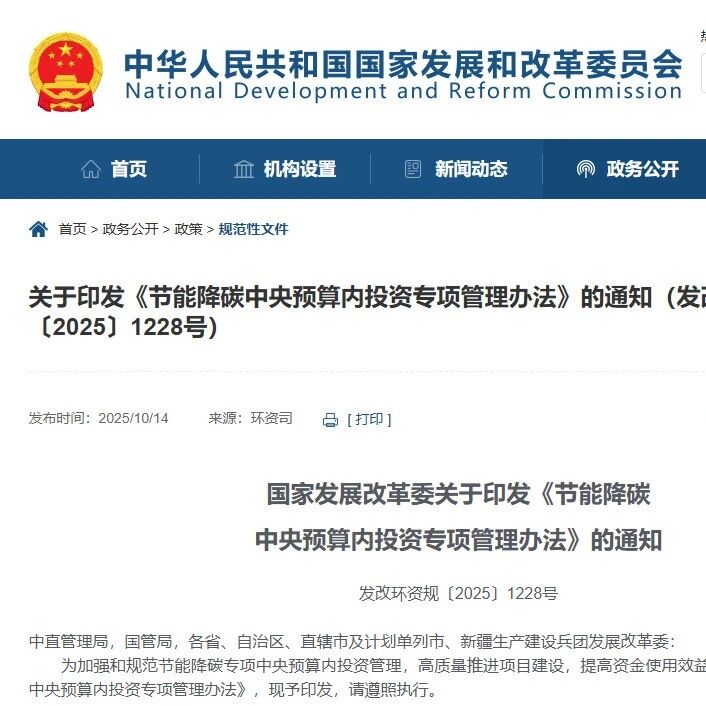
Core Viewpoint - The article discusses the issuance of the "Special Management Measures for Central Budget Investment in Energy Conservation and Carbon Reduction," aimed at supporting projects that align with the goals of carbon peak and carbon neutrality, promoting a comprehensive green transformation of economic and social development [2][4]. Summary by Sections Special Support Areas - The special support focuses on key industry energy conservation and carbon reduction projects, clean substitution of coal consumption, circular economy initiatives, low-carbon, zero-carbon, and negative-carbon demonstration projects, and foundational capacity building for carbon peak and carbon neutrality [2][3][11]. Investment Proportions - The support ratio for key industry energy conservation and carbon reduction projects, clean coal substitution projects, circular economy projects, and low-carbon demonstration projects is set at 20% of the approved total investment. For local government projects related to carbon peak and carbon neutrality, the support ratios vary by region: 60% for the East, 70% for the Central, and 80% for the West and Northeast regions. Central and national agency projects are generally fully funded [3][14]. Funding Mechanisms - The central budget investment funds will be allocated through direct investment, capital injection, and investment subsidies based on actual conditions [3][8]. Project Eligibility and Requirements - Projects must be new or under construction with complete preliminary procedures and cannot be used for completed projects. The focus is on projects that can effectively contribute to energy conservation and carbon reduction [8][12]. Application and Approval Process - Provincial development and reform departments are responsible for project application and must establish a dynamic reserve mechanism for projects. They will select eligible projects from the national major construction project database for annual investment plan submissions [16][21]. Performance Monitoring and Evaluation - The National Development and Reform Commission will strengthen performance target reviews and monitoring of investment plans, ensuring that projects are supervised throughout their lifecycle. Any issues identified during evaluations will be addressed promptly, and performance evaluation results will influence future investment allocations [35][36].
广发期货日评-20251015
Guang Fa Qi Huo· 2025-10-15 07:15
1. Report Industry Investment Ratings - No specific industry investment ratings are provided in the report. 2. Core Views - The market risk preference may be suppressed in the short - term due to Trump's statement on tariff hikes, causing A - shares to decline, but the stock index is expected to fall first and then rebound, with an upward long - term trend [3]. - The bond market warms up due to stock market adjustments and loose liquidity, and short - term treasury bond futures are expected to continue to fluctuate within a range [3]. - Gold has large market fluctuations before the APEC meeting in South Korea at the end of October, and silver maintains a strong trend [3]. - Steel products' hot - rolled coils have accumulated inventory, and attention should be paid to post - holiday demand recovery; the iron ore market has weakened [3]. - The price of crude oil is under pressure due to Sino - US trade tensions and a pessimistic IEA report; most chemical products have weak supply - demand expectations [3]. - Agricultural products such as soybeans, corn, and palm oil are affected by various factors and show different trends, with some under pressure and some in a weak pattern [3]. - Special commodities like soda ash and glass are in a situation of oversupply and weak operation; industrial silicon prices are weakly fluctuating [3]. - New energy products such as polysilicon and lithium carbonate have different trends, with polysilicon having a late - session rebound and lithium carbonate having a tight - balance fundamental situation [3]. 3. Summary by Related Catalogs Financial Index Futures - The stock index rises and then falls, with a style switch on the market. Due to the tariff conflict, the stock index is expected to fall first and then rebound in the short - term, and the long - term upward trend remains unchanged. Conservative investors can wait for the volatility to converge and then enter the market at low prices [3]. Treasury Bonds - The stock market adjustment and loose liquidity promote the bond market to warm up. Short - term treasury bond futures are expected to continue to fluctuate within a range. For example, T2512 may fluctuate between 107.4 - 108.3, and it is recommended to wait and see for over - adjustment opportunities [3]. Precious Metals - Gold has large fluctuations before the APEC meeting in South Korea at the end of October. One can choose to buy lightly above 910 yuan and set stop - loss and take - profit. Silver maintains a strong trend above 50 dollars [3]. Shipping Index (European Line) - From the perspective of macro - uncertainty factors, it is recommended to be cautious and wait and see [3]. Black Steel - Hot - rolled coils have accumulated a lot of inventory, and attention should be paid to post - holiday demand recovery. The profit of the coil - screw spread converges [3]. Iron Ore - Supply - side disturbances weaken, shipments decline, arrivals increase, and the iron ore market weakens. It is recommended to wait and see for the time being, with a reference range of 750 - 830 [3]. Coking Coal - After the holiday, coal prices in coal - producing areas are weak, downstream replenishment demand weakens, and there are concerns about reduced Mongolian coal supply. It is recommended to go long on JM2601 at low prices, with a reference range of 1080 - 1200 [3]. Coke - The first round of price increases was implemented before the holiday, and there is not much room for further increases. It is recommended to go long on J2601 at low prices, with a reference range of 1550 - 1700 [3]. Non - ferrous - Copper prices fluctuate, and it is recommended to take profit on long positions at high prices. Aluminum, zinc, nickel, stainless steel, etc. all have corresponding price reference ranges and operation suggestions [3]. - Tin can be bought when the macro - sentiment drops. Energy and Chemical Crude Oil - Sino - US trade tensions and a pessimistic IEA report suppress oil prices. It is recommended to maintain a short - selling strategy on the single side, with support levels for different benchmarks provided [3]. Chemical Products - Most chemical products such as urea, PX, PTA, etc. have weak supply - demand expectations, and corresponding operation suggestions such as short - selling on rebounds and month - spread reverse arbitrage are given [3]. Agricultural Products - Different agricultural products such as soybeans, corn, palm oil, sugar, cotton, eggs, apples, and dates are affected by various factors and show different trends and price ranges, with corresponding operation suggestions [3]. Special Commodities - Soda ash and glass are in a situation of oversupply and weak operation, and it is recommended to hold short positions. Rubber can be observed during the peak - production period, and industrial silicon prices fluctuate within a range [3]. New Energy - Polysilicon rebounds in the late session, and it is recommended to hold long positions. Lithium carbonate has a tight - balance fundamental situation, with a price - center reference range of 70,000 - 75,000 yuan [3].
有色上游价格回升,农业上游价格波动
Hua Tai Qi Huo· 2025-10-15 05:13
Report Summary 1. Industry Investment Rating No investment rating information is provided in the report. 2. Core View The report presents an overview of the mid - and upstream industries, including production and service sectors, and details the price and operation status of various industries at different levels. It also mentions relevant policies and responses to international trade issues [1][2][3]. 3. Summary by Directory 3.1 Mid - view Event Overview - **Production Industry**: The Shanghai Economic and Information Technology Commission released an action plan to promote the high - quality development of the intelligent terminal industry from 2026 - 2027, aiming to increase the scale of intelligent computing power terminals. The National Development and Reform Commission issued a management method to support energy - saving and carbon - reduction renovations in key industries and infrastructure [1]. - **Service Industry**: In response to the US 301 investigation restrictions on China's shipbuilding and other industries, the Chinese Ministry of Commerce stated that the US measures are unfair and discriminatory, and urged the US to correct its mistakes and resolve issues through dialogue [1]. 3.2 Industry Overview - **Upstream**: Copper, zinc, and aluminum prices in the non - ferrous metal industry have rebounded, while egg prices in the agricultural industry have dropped significantly [2]. - **Midstream**: The PX industry in the chemical sector has a high operating rate; power plant coal consumption in the energy sector has decreased; and the asphalt industry in the infrastructure sector has reached a three - year high in operating rate [2]. - **Downstream**: The sales of commercial housing in second - and third - tier cities in the real estate market have slightly increased [3]. 3.3 Key Industry Price Index Tracking - **Agriculture**: On October 14, the prices of eggs decreased by 19.12% year - on - year, while the prices of palm oil increased by 2.38% [37]. - **Non - ferrous Metals**: On October 9, the prices of copper increased by 7.20% year - on - year, and the prices of zinc increased by 1.45% [37]. - **Energy**: On October 14, the prices of WTI crude oil decreased by 6.24% year - on - year, and the prices of Brent crude oil decreased by 5.62% [37]. - **Real Estate**: On October 14, the building materials comprehensive index decreased by 0.94%, and the concrete price index decreased by 0.35% [37].
国泰海通:10月超配权益与黄金,标配债券
Ge Long Hui· 2025-10-15 03:57
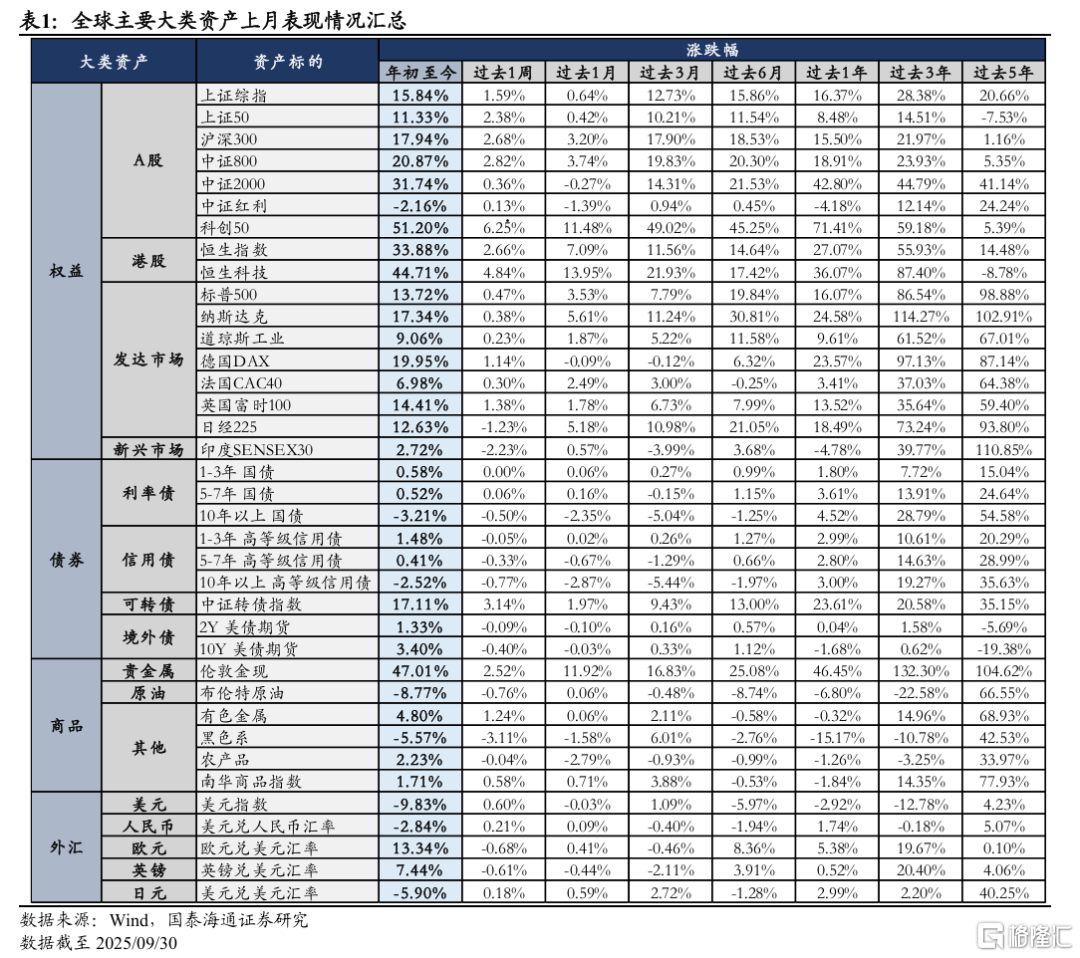
Core Viewpoint - The company has developed a "three-part" asset allocation framework consisting of Strategic Asset Allocation (SAA), Tactical Asset Allocation (TAA), and Major Event Review Adjustments to guide investment decisions. This framework aims to diversify macro risks, set long-term allocation benchmarks, and adjust based on short-term risk-return characteristics and significant events [1][10]. Group 1: Strategic Asset Allocation (SAA) - The SAA framework aims to mitigate macro risks by establishing a long-term allocation benchmark to ensure portfolio stability [1][10]. - The recommended asset allocation for October includes 41.25% in equities, 45% in bonds, and 13.75% in commodities, with specific allocations for A-shares, H-shares, and gold [1][2]. Group 2: Tactical Asset Allocation (TAA) - The TAA approach utilizes quantitative methods to identify assets with superior short-term risk-return characteristics, allowing for moderate adjustments to portfolio weights to enhance returns [1][10]. - The company remains optimistic about Chinese equities, suggesting an overweight position in A-shares and H-shares, while maintaining a neutral stance on bonds and a slightly optimistic view on commodities, particularly gold [2][3]. Group 3: Major Events Review - The company emphasizes the importance of subjective review of major events in conjunction with quantitative results to refine investment strategies, particularly in response to geopolitical uncertainties and market volatility [1][52]. - Recent events, such as the Chinese government's financial reforms and the U.S. Federal Reserve's interest rate adjustments, are expected to influence market dynamics positively, particularly for A-shares and gold [54]. Group 4: Performance Metrics - The performance of various asset classes has shown significant fluctuations, with notable increases in the Shanghai Composite Index and other Chinese indices over the past year, indicating a robust recovery in the equity market [6]. - The macro factor risk parity model has demonstrated effectiveness in enhancing returns while maintaining a balanced asset allocation, achieving an annualized return of 26.5% in 2025 with a Sharpe ratio of 2.59 [48][50].

研究所晨会观点精萃-20251015
Dong Hai Qi Huo· 2025-10-15 02:09
Report Industry Investment Ratings No specific industry investment ratings are provided in the given content. Core Views of the Report - Overseas, the game between China and the US persists, the Fed's balance - sheet reduction may near an end, the employment market has a downward risk, leading to a decline in the US dollar index and US Treasury yields, and a rise in global risk appetite. Domestically, economic growth accelerates, multiple industry stability - growth plans are introduced, but short - term Sino - US game and domestic risk - aversion sentiment exist. The market focuses on domestic incremental policies and Sino - US game, with weak short - term upward macro drivers [2]. - Different asset classes have different trends: stocks are in short - term high - level adjustment, bonds are in short - term oscillation, and different commodity sectors have different short - term trends such as oscillation or adjustment [2]. Summary by Relevant Catalogs Macro - finance - **Macro**: Overseas, the game between China and the US, Fed's balance - sheet reduction plan, and employment market situation affect the US dollar index and US Treasury yields. Domestically, economic growth accelerates, policies support multiple industries, and the market focuses on domestic policies and Sino - US game. Assets like stocks, bonds, and various commodities have different short - term trends [2]. - **Stock Index**: Affected by semiconductor, energy metal, and AI sectors, the domestic stock market falls. The economy grows, policies support, but short - term upward drivers are weak. Short - term cautious observation is recommended [3]. - **Precious Metals**: The precious metals market rises, with gold and silver prices increasing. Affected by trade uncertainty and Fed rate - cut expectations, they are in a short - term strong and long - term upward trend. Short - term, hold long positions or reduce at high prices; long - term, buy at low prices [3]. Black Metals - **Steel**: The domestic steel market is weak, with low - volume trading. Cost support weakens, and prices are expected to continue the weak trend in the short term [4]. - **Iron Ore**: The price of iron ore futures and spot falls. As steel mills' profits narrow, ore demand may decline. Supply shows a mixed trend, and a short - term bearish view is recommended [6]. - **Silicon Manganese/Silicon Iron**: The spot prices of silicon manganese and silicon iron are stable, and the futures prices fall. Supply and demand are in a certain state, and the futures prices are expected to oscillate in a range [7]. - **Soda Ash**: The soda ash contract is weak. Supply is in the capacity - expansion period, demand increases marginally in the peak season. In the long - term, a bearish view is recommended due to supply - side contradictions [8]. - **Glass**: The glass contract is weak. Supply increases, and the new policy provides support. Demand improves marginally in the peak season but slows down after the holiday. It is expected to run weakly in the short - term range [8]. Non - ferrous Metals and New Energy - **Copper**: Affected by trade concerns, copper prices fluctuate. The global copper output is expected to grow in 2026. The US economy and copper demand have uncertainties. Short - term, the domestic output is high, and demand faces challenges [9]. - **Aluminum**: Aluminum prices fall. Inventory increases, supply is rigid, demand weakens, and the price is difficult to rise significantly [10]. - **Tin**: The global tin supply is tight, and demand is weak. The price is expected to oscillate at a high level, with support and pressure coexisting [10]. - **Lithium Carbonate**: The lithium carbonate contract rises slightly. Trade conflicts and warehouse - receipt cancellation bring pressure, and the price is expected to oscillate in a range [11]. - **Industrial Silicon**: The industrial silicon contract falls. Production reaches a new high, and the price is expected to oscillate in a range, with attention to cost support [11]. - **Polysilicon**: The polysilicon contract rises. Warehouse - receipt cancellation and supply - demand imbalance bring pressure, and the price is expected to oscillate, with attention to spot price support [12]. Energy and Chemicals - **Crude Oil**: Oil prices are affected by trade signals, geopolitical factors, and port sanctions. Short - term, they oscillate; long - term, they are bearish [13][14]. - **Asphalt**: Asphalt is in a weak oscillation. The peak - season demand is near the end, inventory pressure increases, and it depends on crude - oil cost support [14]. - **PX**: PX oscillates weakly with the polyester sector. It has certain demand support but is likely to continue the weak trend [14]. - **PTA**: PTA prices are weak. Supply is high, demand is under pressure, and inventory increases [15]. - **Ethylene Glycol**: The inventory of ethylene glycol rises, demand is weak, and it is expected to accumulate inventory in October and run at a low price [15]. - **Short - fiber**: Short - fiber adjusts with the polyester sector. Terminal orders improve slightly, and it is expected to oscillate weakly [15]. - **Methanol**: Methanol prices oscillate weakly. Supply exceeds demand, inventory is high, and it is under pressure [16]. - **PP**: PP prices are weak. Supply and demand both increase, but new - capacity and trade - war factors bring pressure [16][17]. - **LLDPE**: LLDPE prices are expected to oscillate weakly. Supply pressure increases, demand recovers slowly, and it is affected by oil prices and trade [17]. - **Urea**: Urea prices rise slightly. Supply is strong, demand is weak, and it depends on export - policy implementation [18]. Agricultural Products - **US Soybeans**: US soybeans oscillate weakly due to demand uncertainty and lack of USDA reports [19]. - **Soybean Meal/Rapeseed Meal**: Domestic soybean meal contracts oscillate. In the long - term, the price may rise; in the short - term, inventory pressure exists, and it may oscillate at a low level [19]. - **Soybean Oil/Rapeseed Oil**: Soybean oil may accumulate inventory after the holiday and run weakly. Rapeseed oil inventory is being depleted and forms support [20]. - **Palm Oil**: Palm oil production increases in October, and exports also increase. The implementation of B50 in Indonesia has an impact on the market, and short - term demand growth is difficult [20][21]. - **Pigs**: Pig prices fall to a record low due to increased supply. With the expectation of consumption recovery in autumn and winter, prices may stabilize [21].