能源金属

Search documents
南方基金:铜铝齐飞,“涨声”迎新!有色为什么成为香饽饽?
Sou Hu Cai Jing· 2026-01-23 01:23
Core Viewpoint - The years 2024 and 2025 are expected to be "golden years" for gold, with COMEX gold prices projected to rise by 20.17% in 2024 and further increase by 55.51% in 2025. However, by 2026, the focus may shift towards non-ferrous metals as economic conditions change [1][2]. Group 1: Gold Market Analysis - The rise in gold prices during 2024-2025 is attributed to a combination of factors: a slowing global economy, high inflation leading to sustained high interest rates by the Federal Reserve, and increased gold purchases by central banks, with 95% of surveyed central banks planning to increase their gold reserves [2]. - The demand for gold as a safe-haven asset and inflation hedge has surged, especially with expectations of interest rate cuts and a weakening dollar, contributing to a bullish gold market [2]. Group 2: Shift to Non-Ferrous Metals - As the global economy begins to recover and liquidity enters the real economy, the market sentiment is shifting from "defensive" to "growth-oriented," indicating a potential focus on non-ferrous metals like copper, aluminum, lithium, and rare earths [3][4]. - The non-ferrous metals sector is seen as a representative of economic growth, with expectations of significant returns as the market transitions from traditional safe-haven assets [4]. Group 3: Metal Price Projections - Precious metals, particularly gold, have recently surpassed $4800 per ounce, driven by geopolitical risks and a restructuring of the international economic landscape, suggesting a continued strong performance [5]. - Industrial metals are expected to see a shift from surplus to shortage, particularly in copper, due to limited supply and increased demand from infrastructure projects and energy transitions [6]. - Energy metals like lithium and cobalt are projected to benefit from rising demand in battery storage and supply disruptions, with prices expected to remain elevated [6]. Group 4: Investment Strategies - For investors seeking stable opportunities aligned with economic recovery, focusing on industrial metals such as copper and aluminum is recommended, as their performance is closely tied to macroeconomic conditions [6]. - For those with a higher risk tolerance looking for long-term growth in the high-tech and renewable energy sectors, investments in energy metals like lithium and cobalt are suggested [7]. - Investors prioritizing risk defense and uncertainty management should consider funds focused on precious metals like gold, which offer a more straightforward safe-haven attribute [7].
能源金属板块1月22日跌0.2%,永兴材料领跌,主力资金净流出8.46亿元
Zheng Xing Xing Ye Ri Bao· 2026-01-22 08:48
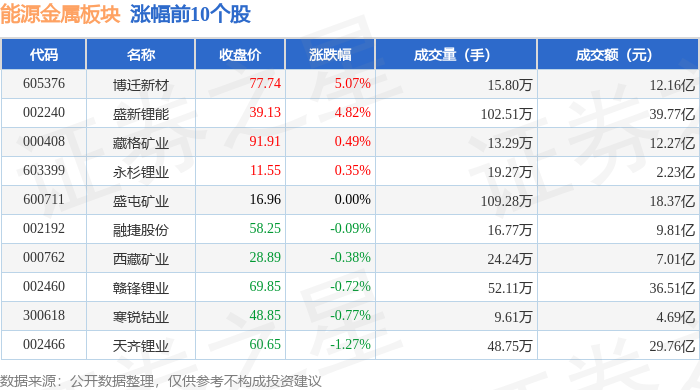
Market Overview - The energy metals sector experienced a decline of 0.2% on January 22, with Yongxing Materials leading the drop [1] - The Shanghai Composite Index closed at 4122.58, up 0.14%, while the Shenzhen Component Index closed at 14327.05, up 0.5% [1] Stock Performance - Notable gainers in the energy metals sector included: - Boqian New Materials (605376) with a closing price of 77.74, up 5.07% and a trading volume of 158,000 shares, totaling 1.216 billion yuan [1] - Shengxin Lithium Energy (002240) closed at 39.13, up 4.82% with a trading volume of 1.0251 million shares, totaling 3.977 billion yuan [1] - Conversely, Yongxing Materials (002756) closed at 52.50, down 2.38% with a trading volume of 191,600 shares, totaling 1.012 billion yuan [2] Capital Flow - The energy metals sector saw a net outflow of 846 million yuan from institutional investors, while retail investors contributed a net inflow of 738 million yuan [2] - The detailed capital flow for selected stocks showed: - Boqian New Materials had a net inflow of 124 million yuan from institutional investors, accounting for 10.22% of its trading volume [3] - Yongxing Materials experienced a significant net outflow of 101 million yuan from institutional investors, representing 9.99% of its trading volume [3]


和讯投顾华飞凡:能源金属的故事为何还能继续演绎
Sou Hu Cai Jing· 2026-01-22 02:59
Core Insights - The narrative of non-ferrous metals, particularly energy metals, will continue to evolve in 2026, driven by a complex interplay of supply-demand balance, liquidity easing, and resource value reassessment [1][4] - The simultaneous rise of copper and gold, traditionally viewed as inversely correlated, is attributed to three main factors: global liquidity easing, inflation-driven appreciation of physical assets, and the core drivers of each metal creating a resonance effect [1][2] Supply and Demand Dynamics - Copper prices are primarily driven by insufficient supply and strong demand from new sectors such as AI computing centers and grid modernization, while gold prices are supported by ongoing central bank purchases and concerns over the credibility of the US dollar [2] - The current supply-demand tightness is expected to persist until at least 2028, with new growth points in demand including energy storage, AI computing, global infrastructure projects, and increased military spending due to geopolitical tensions [2] Potential Investment Directions - Lithium, particularly lithium carbonate, is on the verge of a demand surge due to the expansion of energy storage applications, driven by new pricing policies [3] - Strategic minor metals such as rare earths, tungsten, molybdenum, cobalt, nickel, and tin are expected to see continued value reassessment, influenced by geopolitical factors and supply chain concentration [3] - Gold remains a key asset as a global ultimate currency, with a clear long-term upward trend due to the declining value of the US dollar and ongoing central bank purchases exceeding 1,000 tons annually [3]
又双叒新高!有色ETF华宝(159876)大涨3%续创新高!西部黄金等5股涨停!外围突传150吨黄金抢购大单!
Xin Lang Cai Jing· 2026-01-21 11:28
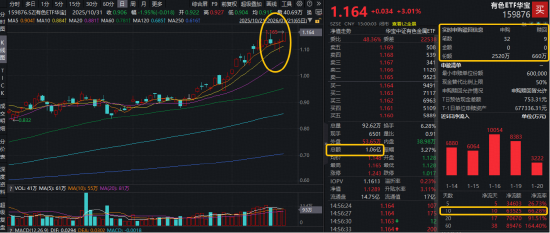
Core Viewpoint - The non-ferrous metal sector is leading the market, with the popular ETF, Huabao Non-Ferrous ETF (159876), surging by 3.01% to reach a new historical high, indicating strong investor interest and potential buying signals [1][10]. Fund Performance - Huabao Non-Ferrous ETF recorded a trading volume of 106 million yuan, an increase of 14% compared to the previous period, and saw a net subscription of 18.6 million units, accumulating a total of 635 million yuan over the past ten days [1][10]. Stock Performance - Over 60% of the constituent stocks rose by more than 2%, with notable stocks such as Baiyin Non-Ferrous, Guocheng Mining, Xibu Gold, Hunan Baiyin, and Shengxin Lithium Energy hitting the daily limit [3][12]. - Key stocks like Shandong Gold and Zijin Mining also showed significant gains, with Shandong Gold rising over 6% and Zijin Mining increasing by more than 2% [3][12]. Market Influences - A significant purchase order of 150 tons of gold by the Polish central bank was announced, which will increase Poland's gold reserves to 700 tons, positioning it among the top ten countries globally in terms of gold reserves [4][12]. - International gold prices have surged, with spot gold exceeding $4,800 per ounce, reaching a new historical high, while domestic gold jewelry prices have also surpassed 1,500 yuan per gram [4][12]. Economic and Policy Context - The analysis from Dongwu Futures indicates that precious metals are experiencing upward volatility due to rising geopolitical tensions and potential tariffs imposed by the U.S. on European countries, which are boosting safe-haven demand for precious metals [5][14]. - The Shanghai government has released a plan to enhance the competitiveness of non-ferrous metal commodities, aiming to improve resource allocation and global pricing influence [5][14]. - Analysts from China Galaxy Securities suggest that escalating global geopolitical conflicts may reshape the global metal supply chain, potentially driving up the demand and value of key strategic metals such as copper, tungsten, molybdenum, cobalt, and rare earth materials [5][14]. ETF Coverage - Huabao Non-Ferrous ETF and its linked funds comprehensively track indices covering copper, aluminum, gold, rare earths, and lithium, allowing for better exposure to various market cycles, including precious metals (safe-haven), strategic metals (growth), and industrial metals (recovery) [6][15].

“鬼压床” | 谈股论金
水皮More· 2026-01-21 10:11
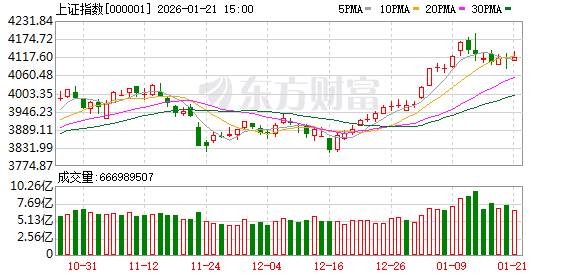
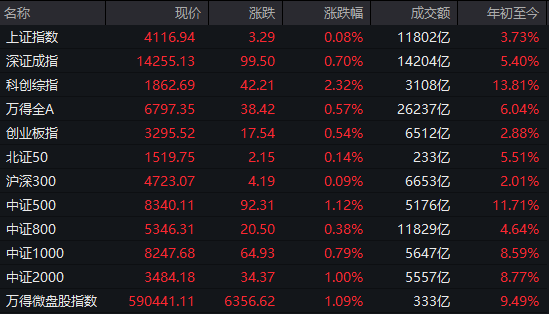
Market Overview - A-shares major indices collectively rose today, with the Shanghai Composite Index up 0.08% closing at 4116.94 points, Shenzhen Component Index up 0.70% at 14255.13 points, ChiNext Index up 0.54% at 3295.52 points, and the STAR 50 Index up 3.53% at 1535.39 points [2] - The trading volume in the Shanghai and Shenzhen markets was 26,240 billion, a decrease of 1,804 billion compared to the previous day [2] ETF Market Dynamics - The broad-based ETFs continue to exert downward pressure, particularly the SSE 50 ETF (510050), which saw a record trading volume of 16.9 billion and negative premium, indicating strong regulatory control [5] - The CSI 1000 ETF (512100) also reached a historical trading volume of 18.2 billion, showing the ongoing regulatory pressure from state-backed funds [5] - Despite the negative premium in SSE 50 ETF, the CSI 300 ETF showed no premium, while the CSI 500 ETF had a positive premium rate of 0.21 and the CSI 1000 ETF had a positive premium rate of 0.15, indicating a tug-of-war between bulls and bears in the market [5] Sector Performance - The AI hardware sector showed significant rebounds, with stocks like Haiguang Information rising nearly 18%, driving up shares of companies like Cambrian, Industrial Fulian, and SMIC [6] - Precious metals performed strongly, with international gold prices surpassing 4,700 USD per ounce, while energy and non-ferrous metals also saw gains [7] - The coal sector, however, lagged behind, contrasting with the performance of the non-ferrous sector, indicating a divergence in sector performance [7] Capital Flow Insights - Main capital flows showed a net inflow of 6.3 billion in the Shanghai market, which is relatively rare, while the Shenzhen market experienced a net outflow of 670 million, possibly indicating a shift in main capital allocation [8]

市场分析:有色半导体领涨,A股小幅上行
Zhongyuan Securities· 2026-01-21 09:02
Market Overview - On January 21, the A-share market opened lower but experienced a slight upward trend, with the Shanghai Composite Index facing resistance around 4135 points[2] - The Shanghai Composite Index closed at 4116.94 points, up 0.08%, while the Shenzhen Component Index rose by 0.70% to 14255.13 points[7] - Total trading volume for both markets was 26,240 billion yuan, slightly lower than the previous trading day[3] Sector Performance - Strong performers included precious metals, energy metals, semiconductors, and electronic components, while coal, liquor, retail, and power equipment sectors lagged[3] - Over 60% of stocks in the two markets saw gains, with significant inflows into semiconductors, computer equipment, and non-ferrous metals[7] Valuation Metrics - The average price-to-earnings (P/E) ratios for the Shanghai Composite and ChiNext indices are 16.87 times and 52.56 times, respectively, above the median levels of the past three years[3] - The current trading volume is above the median of the past three years, indicating a healthy market activity level[3] Future Outlook - The central bank's recent actions, including interest rate cuts, suggest there is still room for further easing to support economic transformation and boost market confidence[3] - Short-term adjustments are expected to be limited, with a focus on performance and industry trends for future market momentum[3] Investment Recommendations - Investors are advised to closely monitor macroeconomic data, changes in overseas liquidity, and policy developments[3] - Short-term investment opportunities are recommended in sectors such as semiconductors, electronic components, energy metals, and non-ferrous metals[3]
发生了什么?沪指午后一度翻绿 这只ETF成交额超169亿元 创10年以来天量
Mei Ri Jing Ji Xin Wen· 2026-01-21 07:50
Market Overview - The market experienced fluctuations with the Shanghai Composite Index closing up 0.08%, the Shenzhen Component Index up 0.7%, and the ChiNext Index up 0.54% [2] - Over 3,000 stocks in the market rose, with a total trading volume of 2.6 trillion yuan, a decrease of 177.1 billion yuan from the previous trading day [2] - The A-share market has shown a retreat since last Wednesday, with large funds redeeming from broad-based ETFs, leading to a pause in significant upward movement while maintaining levels above 4,100 points for the Shanghai Composite Index [2] Sector Performance - Active sectors included precious metals, semiconductor industry chain, lithium mining, and oil and gas, while the consumer sector, particularly liquor, saw declines [2] - Precious metals have shown significant growth, with a rise of over 23% in the last five trading days, indicating a new leading sector [11] ETF Trading Activity - The trading volume of major ETFs has fluctuated, with the total trading volume for four large-scale CSI 300 ETFs recorded at 435 billion yuan, 674 billion yuan, 390 billion yuan, 363 billion yuan, and 693 billion yuan over recent days [5] - The trading volume of the SSE 50 ETF exceeded 16.9 billion yuan, marking the highest volume since July 2015 [7] Investment Trends - Investors are advised to focus on performance-driven sectors as the earnings season approaches, shifting from previous popular themes to those with solid fundamentals [13][18] - The semiconductor sector is experiencing growth due to rising demand for storage chips and AI server procurement, with significant price increases noted in DDR5 memory chips [19] Future Outlook - Analysts suggest that the market may continue to favor technology and non-ferrous metal sectors, especially with the upcoming Chinese New Year in mid-February, which may limit rapid shifts in market focus [18] - The potential for gold prices to reach 5,000 USD per ounce in the first half of the year is highlighted, driven by concerns over the independence of the Federal Reserve [13]
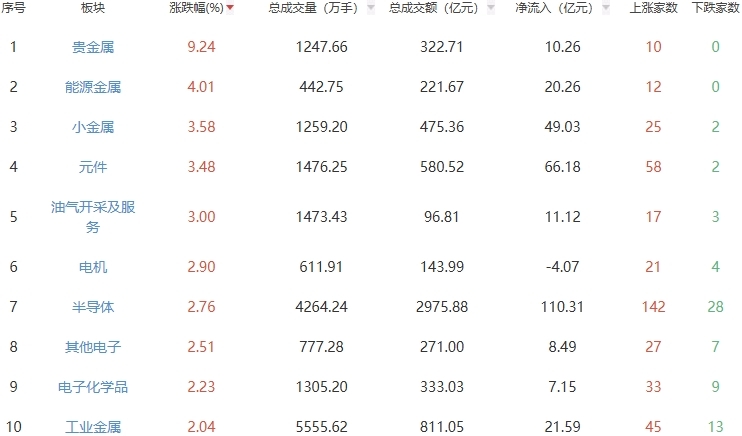
收评:三大指数低开高走创指涨0.54% 贵金属板块走强
Zhong Guo Jing Ji Wang· 2026-01-21 07:37
Market Overview - The A-share market opened lower but closed higher, with the Shanghai Composite Index at 4116.94 points, an increase of 0.08%, and a total trading volume of 11,801.85 billion yuan [1] - The Shenzhen Component Index closed at 14,255.13 points, up by 0.70%, with a trading volume of 14,204.14 billion yuan [1] - The ChiNext Index ended at 3,295.52 points, rising by 0.54%, with a trading volume of 6,512.35 billion yuan [1] Sector Performance Top Gaining Sectors - Higher Education sector led with a gain of 9.24%, total trading volume of 1,247.66 million hands, and a net inflow of 10.26 billion yuan [2] - Energy Metals sector increased by 4.01%, with a trading volume of 442.75 million hands and a net inflow of 20.26 billion yuan [2] - Small Metals sector rose by 3.58%, with a trading volume of 1,259.20 million hands and a net inflow of 49.03 billion yuan [2] Top Losing Sectors - The Beverage Manufacturing sector decreased by 2.12%, with a trading volume of 170.27 million hands and a net outflow of 51.90 billion yuan [2] - The Electric Grid Equipment sector fell by 1.59%, with a trading volume of 6,678.51 million hands and a net outflow of 77.14 billion yuan [2] - The Coal Mining and Processing sector declined by 1.42%, with a trading volume of 1,141.48 million hands and a net outflow of 14.56 billion yuan [2]
A股三大指数集体收涨:贵金属板块爆发,半导体大涨
Guan Cha Zhe Wang· 2026-01-21 07:36
Market Overview - Major A-share indices collectively rose, with the Shanghai Composite Index increasing by 0.08%, Shenzhen Component Index by 0.70%, ChiNext Index by 0.54%, and the STAR Market 50 Index by 3.53% [1] - The total trading volume in Shanghai and Shenzhen exceeded 2.6 trillion yuan, a decrease of nearly 200 billion yuan compared to the previous day [1] Index Performance - Shanghai Composite Index: 4116.94, up 3.29 points (0.08%), with a trading volume of 1.18 trillion yuan and a year-to-date increase of 3.73% [2] - Shenzhen Component Index: 14255.13, up 99.50 points (0.70%), with a trading volume of 1.42 trillion yuan and a year-to-date increase of 5.40% [2] - ChiNext Index: 3295.52, up 17.54 points (0.54%), with a trading volume of 651.2 billion yuan and a year-to-date increase of 2.88% [2] - STAR Market 50 Index: 1862.69, up 42.21 points (2.32%), with a trading volume of 310.8 billion yuan and a year-to-date increase of 13.81% [2] Sector Performance - The majority of industry sectors saw gains, with precious metals, energy metals, mining, electrical machinery, semiconductors, small metals, and electronic components leading the increases [2] - The coal, liquor, retail, and electric grid equipment sectors experienced the largest declines [2] Stock Performance - Nearly 3000 stocks rose, with close to 90 stocks hitting the daily limit up [3] - The precious metals sector surged, with stocks like Hunan Silver, Zhaojin Gold, Sichuan Gold, and Western Gold hitting the daily limit up [3] - The semiconductor sector also saw significant gains, with stocks such as Longxin Technology, Dagan Co., Huatech, Yingfang Micro, and Tongfu Microelectronics hitting the daily limit up [3] Capital Flow - In terms of industry capital flow, semiconductor, computer equipment, and non-ferrous metals sectors ranked high in net inflows, with semiconductors seeing a net inflow of 12.07 billion yuan [6] - Conversely, the electric grid equipment, liquor, and photovoltaic equipment sectors experienced significant net outflows, with electric grid equipment seeing a net outflow of 6.095 billion yuan [6]
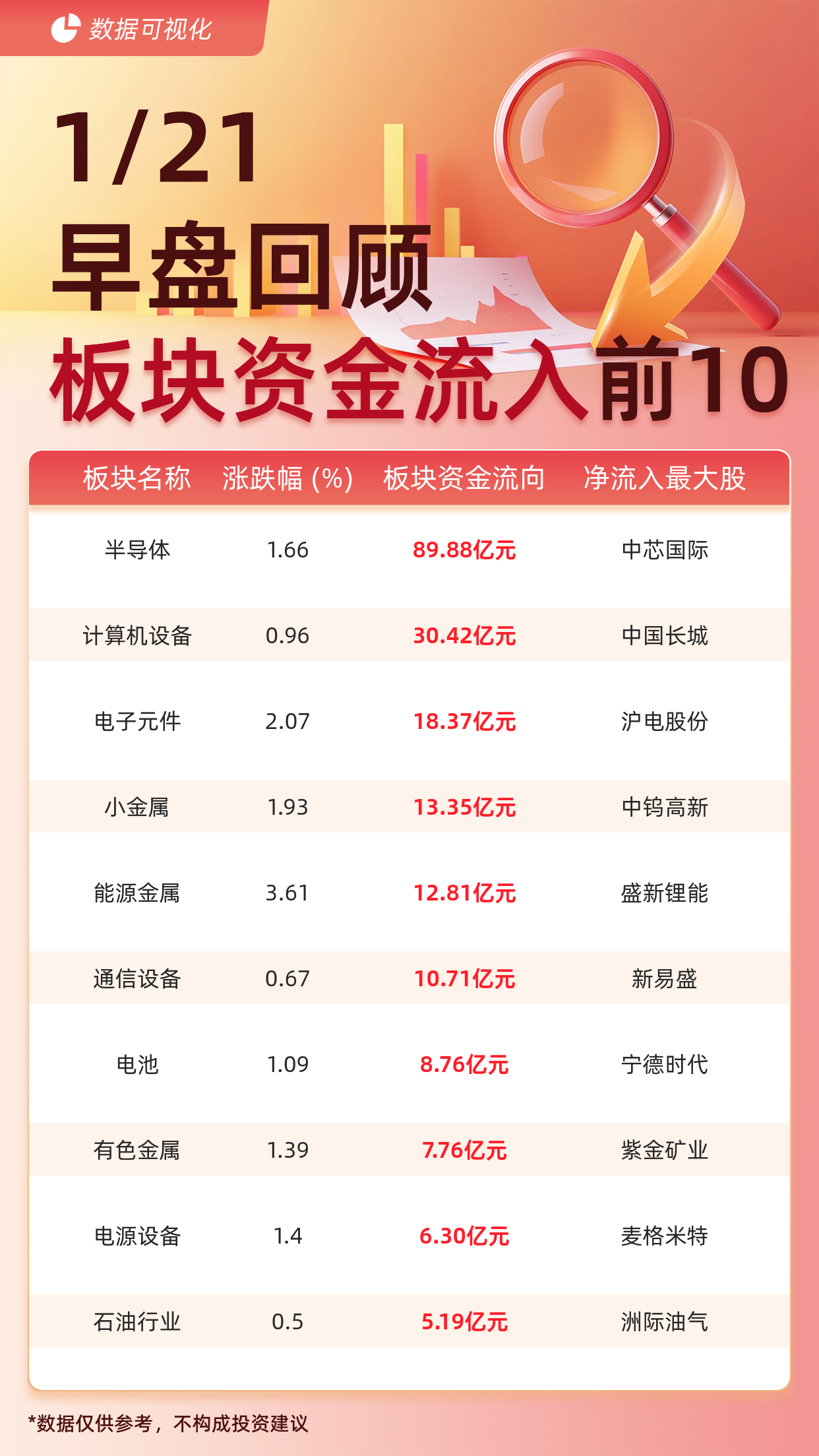
主力板块资金流入前10:半导体流入89.88亿元、计算机设备流入30.42亿元
Jin Rong Jie· 2026-01-21 04:04
Core Insights - The main market saw a net inflow of 77.65 billion yuan as of January 21, with significant investments in various sectors [1] Sector Summaries - **Semiconductors**: Experienced a net inflow of 89.88 billion yuan with a price increase of 1.66%, led by companies like SMIC [2] - **Computer Equipment**: Saw a net inflow of 30.42 billion yuan and a price increase of 0.96%, with China Great Wall Technology as a notable performer [2] - **Electronic Components**: Recorded a net inflow of 18.37 billion yuan and a price increase of 2.07%, highlighted by Huadian Technology [2] - **Minor Metals**: Achieved a net inflow of 13.35 billion yuan with a price increase of 1.93%, driven by Zhongtung High-tech [2] - **Energy Metals**: Noted a significant net inflow of 12.81 billion yuan and a price increase of 3.61%, with Shengxin Lithium Energy leading the sector [2] - **Communication Equipment**: Had a net inflow of 10.71 billion yuan and a price increase of 0.67%, with Xinyi Technology as a key player [2] - **Batteries**: Experienced a net inflow of 8.76 billion yuan and a price increase of 1.09%, with CATL being a major contributor [3] - **Non-ferrous Metals**: Recorded a net inflow of 7.76 billion yuan and a price increase of 1.39%, with ZD Technology as a notable company [3] - **Power Equipment**: Saw a net inflow of 6.30 billion yuan and a price increase of 1.4%, with Magpower as a significant player [3] - **Oil Industry**: Experienced a net inflow of 5.19 billion yuan and a price increase of 0.5%, with Intercontinental Oil and Gas leading the sector [3]