
非金属矿物制品

Search documents
北交所首批半年度业绩预告出炉 九家业绩预增
Xin Hua Wang· 2025-08-12 06:19
Core Insights - The majority of companies listed on the Beijing Stock Exchange (BSE) are experiencing significant profit growth, with 9 out of 10 companies forecasting increased earnings for the first half of the year [1][2] - Key drivers for this growth include product innovation, cost control, and strong market demand, particularly in emerging industries [2][3] Group 1: Company Performance - Kairun Intelligent Control expects a net profit increase of 7006.45% to 8783.06%, with profits projected between 12 million to 15 million yuan, attributed to production optimization and market demand from carbon neutrality policies [1] - Huifeng Diamond forecasts a net profit of 38 million to 42 million yuan, representing a year-on-year growth of 50.12% to 65.92%, driven by strong demand in various emerging sectors [1][3] - Chenguang Cable anticipates a net profit of 25 million to 28 million yuan, reflecting a growth of 95.96% to 119.48%, due to improved production management and cost control [2] - Better Energy expects a net profit of 850 million to 1 billion yuan, with a growth of 16.37% to 36.91%, supported by strong global demand for lithium-ion batteries [2] Group 2: Industry Trends - The performance of newly listed companies on the BSE is notably strong, with many classified as specialized and innovative enterprises [2] - The overall trend indicates that product innovation and effective cost management are crucial for the profitability of BSE-listed companies [2][3] - Bond Shares projects a net profit of approximately 34 million yuan, a 61.53% increase, due to customer retention and automation investments [3]
四川7月CPI环比上涨0.4%
Sou Hu Cai Jing· 2025-08-11 23:16
Group 1: Consumer Price Index (CPI) Analysis - In July, Sichuan's Consumer Price Index (CPI) experienced a month-on-month increase of 0.4%, reversing from a previous month of stability [1] - Year-on-year, the CPI decreased by 0.4%, with the decline rate widening by 0.1 percentage points compared to the previous month [1] - The rise in CPI was driven by increased prices in tourism, transportation, accommodation, and refined oil [1] - Specific price changes included a 3.9% decrease in fresh vegetable prices, a 1.7% decrease in fresh fruit prices, and a 0.5% increase in pork prices [1] - The slight increase in pork prices is attributed to industry measures aimed at reducing production capacity and improving supply-demand balance [1] - During the peak travel season, air ticket prices rose by 20.1%, travel agency fees increased by 13.9%, hotel accommodation prices went up by 5.0%, and transportation rental fees rose by 4.8% [1] Group 2: Producer Price Index (PPI) Analysis - In July, the Producer Price Index (PPI) continued its downward trend, with a year-on-year decrease of 3.5%, and the decline rate expanded by 0.2 percentage points from the previous month [2] - Month-on-month, the PPI fell by 1.2%, with the decline rate narrowing by 0.1 percentage points compared to the previous month [2] - Contributing factors to the PPI decline included seasonal decreases in water and electricity prices, as well as an increase in the scale of market-oriented electricity transactions [2] - The prices in the black metal smelting and rolling processing industry continued to decline, along with ongoing decreases in the non-metallic mineral products industry [2]
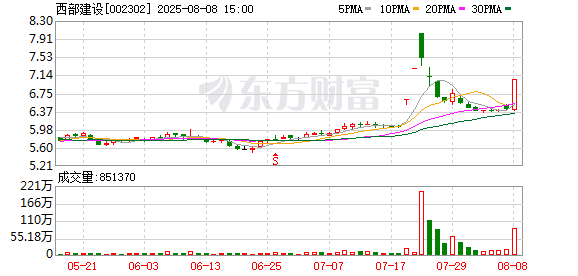
西部建设:公司及合并报表范围内的各级子公司尚未到期的对外担保总额为4.8亿元
Mei Ri Jing Ji Xin Wen· 2025-08-08 09:54
Group 1 - The company, Xibu Construction, announced that as of the announcement date, the total amount of external guarantees not yet due for the company and its subsidiaries is 480 million yuan, all of which are guarantees for subsidiaries within the consolidated financial statements, accounting for 5.06% of the company's audited net assets attributable to the parent company for the fiscal year 2024 [2] - For the fiscal year 2024, the revenue composition of Xibu Construction is as follows: non-metallic mineral products account for 99.08%, service revenue accounts for 0.77%, export coatings account for 0.12%, and other industries account for 0.04% [2]


联检科技:拟收购深圳中认通测检验技术有限公司60%股权
Mei Ri Jing Ji Xin Wen· 2025-08-06 15:51
Group 1 - Company announced the acquisition of 60% stake in Shenzhen Zhongrentong Testing Technology Co., Ltd. for 21 million yuan, making it a subsidiary [1] - After the acquisition, Zhongrentong Testing will be included in the company's consolidated financial statements [1] - As of the report, the company's market capitalization is 3 billion yuan [1] Group 2 - For the year 2024, the company's revenue composition is as follows: 82.46% from professional technical services, 15.82% from non-metallic mineral products, and 1.71% from software and information technology services [1]
“反内卷”驱动量价再平衡,关注价格修复的可持续性
China Post Securities· 2025-08-04 03:09
Group 1: Economic Indicators - The manufacturing PMI for July is at 49.3%, a decrease of 0.4 percentage points from the previous month, indicating a marginal decline in manufacturing sentiment[9] - The new orders index for manufacturing PMI is at 49.4%, down 0.8 percentage points, indicating a return to contraction territory[12] - The production index for manufacturing PMI is at 50.5%, a decrease of 0.5 percentage points, but still within the expansion range[15] Group 2: Supply and Demand Dynamics - Both supply and demand have weakened, with the supply-demand gap widening in July[9] - The new export orders index is at 47.1%, down 0.6 percentage points, reflecting a decline in external demand[12] - The marginal consumption propensity of residents is at 65.52%, a decrease of 0.08 percentage points year-on-year, indicating cautious consumer spending[13] Group 3: Policy Impact and Market Outlook - The "anti-involution" policy is expected to marginally improve PPI growth, supporting corporate profit expectations[2] - The BCI profit forecast index for July is at 44.26, an increase of 0.48 points, indicating improved profit expectations[18] - If inflation recovery is sustainable in Q3, the capital market may stabilize and trend positively in August[26] Group 4: Risks and Challenges - Risks include potential escalation of global trade tensions and geopolitical conflicts[27] - The impact of extreme weather on construction and service sectors has been significant, leading to a slowdown in expansion momentum[21][22]
国泰海通|宏观:PMI淡季回落,价格上涨——2025年7月PMI数据点评
国泰海通证券研究· 2025-08-01 09:44
Core Viewpoint - The manufacturing PMI declined in July, influenced by seasonal factors and the implementation of "anti-involution" policies aimed at capacity management in key industries, which has led to an increase in raw material prices. Additionally, weak real estate demand has negatively impacted domestic demand [1]. Manufacturing Sector - In July 2025, the manufacturing PMI was 49.3%, a decrease of 0.4 percentage points from the previous month. The construction business activity index was 50.6%, down 2.2 percentage points, while the services business activity index was 50.0%, a slight decline of 0.1 percentage points [2]. - The marginal decline in manufacturing PMI aligns with seasonal trends, with some regions experiencing supply and demand disruptions due to extreme weather conditions. There is a notable divergence in PMI performance between large and small enterprises [2]. - Production has entered a low season, with demand showing a greater-than-seasonal slowdown. Certain sectors, such as railway, shipping, aerospace, and computer communication, continue to see new orders in the expansion zone, likely due to ongoing equipment upgrade policies. Conversely, sectors like chemical raw materials and non-metallic mineral products remain below the critical point due to insufficient end-demand amid real estate pressures [2]. Services Sector - The service sector remains stable, supported by seasonal factors. The tourism-related industries have seen increased activity due to summer holiday effects, with transportation, postal, and entertainment sectors maintaining high business activity indices. However, real estate and residential services are in contraction zones, indicating weaker performance [3]. - The construction industry has experienced a greater-than-seasonal decline in activity, primarily due to weak real estate demand and a slowdown in fiscal spending on infrastructure projects. Future improvements in construction activity are anticipated, supported by major projects like the Yarlung Tsangpo River hydropower project, with a total investment of approximately 1.2 trillion yuan [3]. Policy and Investment Outlook - The central political bureau meeting in July emphasized the need for sustained macro policy efforts and timely enhancements. The focus should be on three main lines: first, the "anti-involution" policies are expected to adjust supply-side dynamics in certain industries, potentially boosting price levels; second, 69 billion yuan in special long-term bonds for consumer upgrades will be allocated in July, with remaining funds to be disbursed in October, supporting consumption; third, urban renewal projects are likely to enhance investment, particularly in municipal infrastructure and the renovation of old urban areas [4].

兼评国家生育补贴和7月PMI数据:PMI供需均放缓,“反内卷”提振价格
KAIYUAN SECURITIES· 2025-08-01 02:42
Group 1: National Fertility Subsidy - The national fertility subsidy covers a wider range, with a total subsidy of 10,800 CNY per newborn over three years, compared to a median of 6,600 CNY and an average of 8,700 CNY for local subsidies[3][16] - The first-year budget for the national fertility subsidy is approximately 100 billion CNY, expected to promote the birth of about 330,000 newborns[4][16] - The short-term leverage effect of the subsidy is estimated at 0.9 times, potentially increasing to about 1.4 times in the medium to long term, with a GDP increase of 926 billion CNY in 2025[4][19] Group 2: Manufacturing Sector - The manufacturing PMI for July is reported at 49.3%, down 0.4 percentage points from the previous month, indicating a decline in manufacturing activity[5][13] - The production PMI decreased by 0.5 percentage points to 50.5%, while new orders, new export orders, and imports fell to 49.4%, 47.1%, and 44.7% respectively[5][22] - The "anti-involution" trend is expected to boost commodity prices, with July PPI projected to improve slightly to -3.0% year-on-year[5][29] Group 3: Non-Manufacturing Sector - The construction PMI fell by 2.2 percentage points to 50.6%, indicating a potential continuation of the slowdown in infrastructure investment[6][35] - The service sector remains relatively stable, with a service PMI of 50.0%, down 0.1 percentage points, and new orders declining to 46.3%[6][42] - Infrastructure investment may be affected by high base effects in Q3 and Q4, requiring policy measures to mitigate the impact[6][35] Group 4: Risks and Economic Outlook - Risks include unexpected policy changes and a potential recession in the U.S. economy[7][45] - The overall economic impact of the fertility subsidy includes direct boosts to consumer spending and indirect effects on child-rearing and housing demand[4][18]
2025年7月PMI数据点评:PMI淡季回落,价格上涨
Haitong Securities International· 2025-07-31 14:31
Group 1: Manufacturing PMI Insights - In July 2025, the manufacturing PMI decreased to 49.3%, down 0.4 percentage points from the previous month[6] - The production index for July was 50.5%, reflecting a seasonal decline of 0.5 percentage points[13] - The new orders index fell to 49.4%, a decrease of 0.8 percentage points, indicating a stronger-than-seasonal decline in demand[13] Group 2: Sector Performance - The construction business activity index was 50.6%, down 2.2 percentage points, influenced by weak real estate demand and slowing fiscal spending on infrastructure projects[27] - The services business activity index remained stable at 50.0%, with tourism-related sectors performing well during the summer[25] - In key industries, the equipment manufacturing PMI was 50.3%, while the consumer goods industry PMI dropped to 49.5%, down 0.9 percentage points[12] Group 3: Raw Material Prices and Inventory - The main raw material purchase price index rose to 51.5%, an increase of 3.1 percentage points, marking the first rise above the critical point since March 2025[19] - The procurement index fell to 49.5%, down 0.7 percentage points, indicating reduced purchasing activity due to insufficient domestic demand[21] - The raw material inventory index decreased to 47.7%, down 0.3 percentage points, suggesting continued reduction in inventory levels[21] Group 4: Policy and Economic Outlook - The central political bureau emphasized the need for sustained macroeconomic policy efforts, including timely fiscal measures[29] - A total of 69 billion yuan was allocated in July for consumer support initiatives, with additional funds expected in October[29] - Urban renewal projects are anticipated to boost investment, particularly in municipal infrastructure and renovation of old neighborhoods[29]
宏观点评:7月PMI超季节性回落的背后-20250731
GOLDEN SUN SECURITIES· 2025-07-31 11:33
Group 1: PMI Trends - July manufacturing PMI decreased to 49.3%, down 0.4 percentage points from the previous value, indicating a contraction for the fourth consecutive month[2] - Non-manufacturing PMI fell to 50.1%, a decline of 0.4 percentage points, with service and construction sectors dropping by 0.1 and 2.2 percentage points respectively[2] - Composite PMI output index decreased by 0.5 percentage points to 50.2%, suggesting a slowdown in overall economic expansion[2] Group 2: Supply and Demand Signals - July PMI production index was 50.5%, down 0.5 percentage points, indicating continued expansion but with weakening demand[3] - New orders index fell by 0.8 percentage points to 49.4%, entering contraction territory, with new export orders down by 0.6 percentage points[3] - New export orders index dropped to 47.1%, remaining in contraction, while import orders held steady at 47.8%[3] Group 3: Price and Employment Insights - Price indices rebounded, with raw material and factory price indices rising by 3.1 and 2.1 percentage points respectively, indicating a narrowing decline in PPI[4] - Employment pressure eased slightly, with manufacturing, service, and construction employment indices increasing by 0.1, 0.0, and 1.0 percentage points respectively[4] - Service sector PMI fell to 50.0%, while construction PMI dropped 2.2 percentage points to 50.6%, the second-lowest this year[6] Group 4: Economic Outlook - The July Politburo meeting indicated a focus on policy implementation, with potential new policies expected but not strong stimulus measures[6] - Economic pressures are anticipated to increase in the second half of the year, particularly in August and September, due to prior "export rush" effects and short-term contraction[6] - Continued monitoring of US-China trade negotiations is advised, as potential developments may impact market conditions[6]
国家统计局发布重磅数据!
Zheng Quan Ri Bao Wang· 2025-07-31 03:27
Group 1: Manufacturing Sector - The manufacturing Purchasing Managers' Index (PMI) decreased to 49.3% in July, down 0.4 percentage points from the previous month, indicating a decline in manufacturing activity [1][2] - The production index remained in expansion at 50.5%, while the new orders index fell to 49.4%, reflecting a slowdown in market demand [2] - Large enterprises maintained expansion with a PMI of 50.3%, while medium-sized enterprises improved to 49.5%, and small enterprises decreased to 46.4% [3] Group 2: Non-Manufacturing Sector - The non-manufacturing business activity index was 50.1%, down 0.4 percentage points from last month, but still above the critical point [4] - The service sector's business activity index was stable at 50.0%, with strong performance in transportation and tourism-related industries [4] - The construction sector's business activity index fell to 50.6%, influenced by adverse weather conditions [4] Group 3: Price Indices - The price indices for major raw materials increased, with the purchasing price index at 51.5% and the factory price index at 48.3%, indicating an overall improvement in market prices [2] Group 4: Market Expectations - The production and business activity expectations index rose to 52.6%, showing increased confidence among manufacturing enterprises regarding market development [3] - The business activity expectations index for the service sector increased to 56.6%, indicating optimism among service industry enterprises [4]