TMT

Search documents
暖春凉夏-2026年A股年度策略
2025-12-29 01:04
Summary of Key Points from the Conference Call Industry or Company Involved - The conference call discusses the overall market outlook for the A-share market in 2026, focusing on various sectors including technology, consumption, and cyclical stocks. Core Insights and Arguments 1. **Market Outlook for 2026**: The first quarter of 2026 is expected to be the peak for the year, with a cautious view on the overall market despite some optimistic expectations. The market may exhibit a pattern of high followed by low performance [1][5] 2. **Earnings Forecast**: Corporate earnings growth is projected to be between 5% and 10%, slightly below market consensus. If EPS growth falls within this range, the index may only rise by about 10%, with a peak around 4,200 to 4,300 points [1][8] 3. **Valuation Assessment**: The current market is nearing traditional peak valuation levels, making significant increases in valuation challenging. The stock-bond valuation ratio indicates that the market is not in a bubble but is close to a top position [1][7] 4. **Chip Structure Analysis**: There is extreme differentiation in active equity holdings, with the electronics sector accounting for nearly 25% and TMT sectors nearly 40%. Historical data suggests that when an industry approaches a 20% holding, it is likely to peak [1][11] 5. **Opportunities in Consumer Sector**: The consumer sector is currently undervalued and may experience a reversal due to low expectations. This sector could outperform next year [1][14] 6. **Cyclical Stocks Investment Logic**: Cyclical stocks may present opportunities, but not based on PPI inflation logic. Attention should be paid to companies with high operating leverage in sectors like steel, non-ferrous metals, express delivery, and home appliances [1][15][16] Other Important but Possibly Overlooked Content 1. **Spring Market Dynamics**: The spring market is expected to start around mid to late January, with historical data indicating that January typically has the weakest market performance [4] 2. **Debt Asset Expectations**: The market currently holds a bearish view on debt assets, a trend that may continue into next year [3] 3. **TMT Sector Outlook**: The TMT sector is not expected to experience significant bubble formation, although it is currently crowded in terms of holdings. Valuation disparities within the sector are at historically high levels [12][13] 4. **Export Chain Prospects**: The export chain is expected to have a good outlook in the first half of the year, but caution is advised for the second half due to potential global economic changes [2][17][21] 5. **Investment Style Expectations**: A more balanced investment style is anticipated for next year, with quality assets expected to perform better as earnings continue to recover [23] 6. **Focus on Specific Industries**: Attention should be given to the chemical chain, black chain (steel), and real estate chain (glass, cement) as they are expected to perform well. Additionally, sectors like lithium batteries and machinery are also worth monitoring [24] This summary encapsulates the key insights and projections discussed in the conference call, providing a comprehensive overview of the anticipated market dynamics for 2026.
【策略】多重支撑护航,春季行情行稳致远——策略周专题(2025年12月第4期)(张宇生/郭磊)
光大证券研究· 2025-12-28 23:04
Core Viewpoint - The A-share market has shown strong performance recently, with major indices experiencing significant gains, particularly in small-cap growth stocks, while certain sectors have underperformed [4][6]. Market Performance - Major A-share indices, including the CSI 500 and ChiNext, have seen substantial increases, while the Shanghai Composite Index and CSI 300 have had smaller gains [4]. - The current valuation levels of indices like the Sci-Tech 50 and Wind All A are relatively high, with PE (TTM) percentiles above 85% since 2010 [4]. - The small-cap growth style has outperformed, with sectors such as non-ferrous metals and defense industries leading the gains, while beauty care and social services have lagged [4]. Important Events - The People's Bank of China has introduced a one-time credit repair policy, which will not display overdue information in personal credit reports for eligible individuals [5]. - The housing and urban-rural development meeting has set priorities for real estate development in 2026, with Beijing optimizing its real estate policies [5]. - The EU has extended economic sanctions against Russia for an additional six months, and Japan has finalized its budget for the 2026 fiscal year, reaching a historical high [5]. Market Outlook - The A-share market is expected to continue its upward trend, supported by favorable policies and increased capital inflows [6][7]. - Historical trends indicate a "spring rally" in the A-share market, with expectations for sustained economic growth and policy support to bolster market confidence [7]. - Focus on growth and consumer sectors is recommended, with particular attention to TMT and advanced manufacturing during the spring rally, as well as the commercial aerospace sector [7].


年末关口的强劲反弹能否延续?丨每周研选
Sou Hu Cai Jing· 2025-12-28 16:13
Core Viewpoint - The A-share market is experiencing a strong year-end rebound, with the Shanghai Composite Index achieving an eight-day consecutive rise, and trading volume in the Shanghai and Shenzhen markets returning to 2 trillion yuan, indicating a potential "spring rally" in the near future [4][6]. Group 1: Market Trends - The A-share market is showing signs of a "small rally" as it approaches the year-end, with significant trading volume and a notable rise in sectors such as non-ferrous metals, lithium mining, and commercial aerospace [8]. - The recent upward movement in the index is primarily driven by cyclical sectors, particularly non-ferrous metals, reflecting a recovery in market risk appetite [9]. - The current market environment is characterized by a "bottom consolidation" phase, preparing for a potential rally before the Spring Festival, rather than a full-blown upward trend [9]. Group 2: Capital Flow and Investment Strategies - Institutional buying power is expected to strengthen, driven by favorable policy expectations and a stable economic backdrop, with a notable increase in inflows into stock ETFs [10]. - The weak dollar and the appreciation of the RMB are enhancing the attractiveness of Chinese assets, leading to increased foreign investment [10]. - There is a strong willingness among various funds to enter the market, particularly as the new year approaches, indicating a potential continuation of the "spring rally" [11]. Group 3: Sector Focus and Investment Opportunities - High-growth sectors such as optical modules, PCB, and short-term supply-constrained areas like optical chips and high-speed copper cables are recommended for investment [12]. - The "price increase" narrative is acting as a catalyst for the current rally, with significant inflows into broad-based ETFs and a focus on sectors like chemicals and new energy materials [13]. - The consumption sector is also highlighted as a potential area for investment, given its relative underperformance this year and the supportive policy environment [16].
十大机构看后市:以震荡市思维应对跨年行情,多重支撑护航,春季行情行稳致远
Xin Lang Cai Jing· 2025-12-28 09:30
Group 1 - The three major indices in the stock market have risen, with the Shanghai Composite Index increasing by 1.88%, the Shenzhen Component Index by 3.53%, and the ChiNext Index by 3.90, indicating a positive market trend [1][16] - Citic Securities suggests that the market requires more diverse sources of economic growth to sustain upward momentum, emphasizing the need for structural opportunities in a fluctuating market [2][17] - Everbright Securities highlights the potential for a "spring rally" driven by policy support and increased capital inflows, suggesting that historical patterns indicate a seasonal market uptrend [3][18] Group 2 - The focus on growth and consumption sectors is recommended, with particular attention to the commercial aerospace concept as a potential investment opportunity [4][19] - Zhongtai Securities notes that the market has room for upward movement before the Spring Festival, with a favorable risk appetite and a focus on low-cost positioning [5][20] - Zheshang Securities identifies three driving factors for the market's shift towards a bullish sentiment, including strong performance from the CSI A500 ETF and the ongoing popularity of commercial aerospace [6][21] Group 3 - The overall valuation of A-shares has expanded, with the non-ferrous metals sector leading the gains, driven by global liquidity and tight supply conditions [10][26] - The current PB (LF) for the non-ferrous metals sector is at the 84.4% historical percentile, indicating that valuations have not reached extreme levels [10][26] - Long-term strategies under the current trend include focusing on technology and defensive sectors, particularly in light of the ongoing appreciation of the RMB [11][27] Group 4 - The market is expected to stabilize around the 4000-point mark on the Shanghai Composite Index, with a focus on macroeconomic data and policy changes [12][28] - The upcoming Spring Festival is anticipated to bring about a continuation of the spring rally, with a focus on technology and cyclical sectors [13][29] - The outlook for January includes expectations of further policy support and a potential increase in liquidity, which may enhance market conditions [14][30]
全面复盘:史上5轮PPI回升的股债表现【国盛宏观熊园团队】
Xin Lang Cai Jing· 2025-12-26 14:58
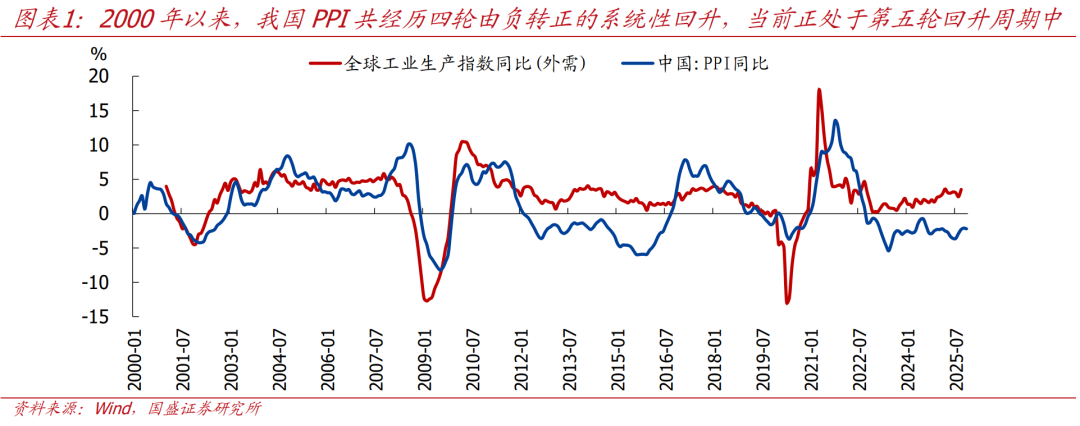
Core Viewpoint - The article discusses the recovery trend of China's Producer Price Index (PPI) since July 2025, predicting a narrowing year-on-year decline in PPI for 2026, with the next six months likely being the fastest recovery period. Historical analysis of past PPI recovery phases is used to identify potential investment opportunities in the stock and bond markets for 2026 [2][3]. Group 1: Historical PPI Recovery Phases - Since 2000, there have been five rounds of PPI recovery in China, with the current phase being the fifth. The PPI has transitioned from negative to positive during these periods, with significant economic events influencing these changes [15][22]. - The first round (2002-2004) saw PPI rise from -4.2% to 8.4%, driven by global economic recovery and domestic urbanization [4][16]. - The second round (2009-2010) experienced a rise from -8.2% to 7.1%, supported by the global financial crisis response and domestic stimulus measures [5][17]. - The third round (2015-2017) saw PPI increase from -5.9% to 7.8%, influenced by supply-side reforms and monetary policies [6][19]. - The fourth round (2020-2021) had PPI rise from -3.7% to 13.5%, primarily due to supply-side factors and global commodity price increases [7][20]. - The current phase (2025-present) has seen PPI recover from -3.6% to -2.2%, with expectations for further recovery in 2026 [8][21]. Group 2: Stock Market Performance During PPI Recovery - Historical analysis indicates that during the first phase of PPI recovery, A-shares typically show an upward trend, with small-cap growth stocks outperforming [3][6]. - In the second phase, as PPI rises from its bottom to positive territory, the stock market experiences a more balanced performance across growth, consumption, and cyclical sectors, with notable performances in electronics, communication, and consumer goods [3][8]. - The third phase, when PPI turns positive, often leads to high-level market fluctuations, with value stocks gaining an advantage over growth stocks [3][7]. Group 3: Bond Market Dynamics - The bond market's response to PPI recovery is influenced by various factors, including growth expectations and liquidity conditions, rather than solely by inflation [10][11]. - Historical data shows that during PPI recovery phases, the 10-year government bond yield may face upward pressure, but this is not always synchronized with PPI movements [10][11]. - A stable liquidity environment and lack of sustained demand improvement can prevent significant upward trends in bond yields, even during periods of PPI recovery [11][12]. Group 4: Outlook for 2026 - The PPI is expected to narrow its year-on-year decline in 2026, with the next six months likely being the fastest recovery period, driven by policies aimed at stabilizing coal and steel prices, as well as rising demand for lithium and copper [12][13]. - The stock market is anticipated to have upward potential, with growth, consumption, and cyclical sectors all presenting investment opportunities, particularly in undervalued sectors such as food and beverage, home appliances, and non-ferrous metals [12][13]. - The bond market is expected to remain in a state of fluctuation, with a continued focus on monetary easing, although significant adjustments in bond yields are not anticipated [13].
2026年权益市场展望:结构性机遇凸显,多主线值得关注
Zheng Quan Shi Bao Wang· 2025-12-26 04:42
Core Viewpoint - The market is increasingly focused on investment opportunities for 2026 as the A-share market approaches the end of 2025, with sectors like metals, TMT, and power equipment performing well, while dividend stocks and real estate are under pressure [1] Group 1: Global Economic Environment - The global macroeconomic landscape is expected to show positive changes in 2026, with the U.S. likely to adopt more accommodative fiscal and monetary policies, potentially increasing the federal deficit by approximately $3.4 trillion over the next decade [4] - The anticipated fiscal expansion in the U.S. may require a low-interest-rate environment, which could improve global liquidity and stabilize the external environment for the A-share market [4] Group 2: Domestic Economic Policies - The Central Economic Work Conference at the end of 2025 has set a policy direction of "seeking progress while maintaining stability," indicating a focus on quality and efficiency improvements [5] - Industrial enterprises are at the bottom of the inventory cycle, with a narrowing decline in PPI suggesting an approaching recovery phase for corporate profits, as evidenced by a 3.2% year-on-year growth in net profit for all A-shares in Q3 2025 [5] Group 3: Investment Opportunities for 2026 - The A-share market is expected to remain structurally driven, with five key areas for investors to focus on: 1. AI Super Cycle: Continued growth in domestic and international computing power chains, with a focus on new technology iterations and the gaming industry [9] 2. High-end Manufacturing Overseas: Attention on sectors like energy storage and lithium batteries, as well as heavy-duty vehicles and engineering machinery that offer growth potential [11] 3. Strategic Resource Revaluation: Long-term focus on precious and industrial metals, with particular attention to energy and lithium carbonate showing signs of stabilization [11] 4. Frontier Technology Breakthroughs: Ongoing interest in industries such as robotics, solid-state batteries, and quantum computing [11] 5. New Consumption and Innovative Pharmaceuticals: Focus on sectors with solid fundamentals in consumer and technology spending, as well as innovative medical devices [11] Group 4: Market Liquidity - The degree of asset allocation migration towards equity markets is still in its early stages, with significant room for growth as indicators remain at historical lows [10] - Institutional investors, including insurance funds and bank wealth management products, are expected to become important sources of marginal capital in 2026, further enhancing market liquidity [10]
广发证券刘晨明:科技、出海、反转三重奏 重塑2026年A股格局
Mei Ri Jing Ji Xin Wen· 2025-12-25 17:40
Group 1 - The core viewpoint is that the market is still in the first half of a bull market, and investment should focus on three dimensions: the technology industry wave, global competitive output, and the reversal of cyclical dilemmas [1][5] - The A-share market is undergoing profound changes, breaking historical patterns in profit assessment and valuation, with non-financial ROE stabilizing for three consecutive quarters despite traditional economic sectors not showing significant improvement [2][3] - The electronic industry's institutional holdings have reached historical highs, challenging the old belief that a 20% holding indicates a peak, while TMT sector transaction volumes have also set new records during the AI boom [2][3] Group 2 - The future market's core engine relies on substantial improvements in corporate profits, driven by strong external demand and the globalization of Chinese manufacturing capabilities [4][5] - The AI revolution is another key driver, with no signs of bubble formation, and 2026 is expected to be a pivotal year for hardware products in the AI sector [4][6] - The industry configuration for 2026 should focus on technology chains, external demand chains, and opportunities arising from cyclical reversals, with a particular emphasis on sectors like electric equipment and new energy [5][6][7] Group 3 - The innovative drug sector is transitioning from a long R&D phase to an internationalization phase, with Chinese pharmaceutical companies becoming key players in global licensing transactions [7] - Future industries such as humanoid robots, hydrogen energy, and synthetic biology are expected to commercialize sooner due to their relative maturity, leading to improved profit growth expectations across key segments [7] - The industry configuration map for 2026 is clear, emphasizing technology growth as an offensive strategy and cyclical reversals as a stabilizing shield, while enhancing China's global competitive strength [7]

光大证券晨会速递-20251225
EBSCN· 2025-12-25 00:16
Group 1: Macro Insights - Concerns about potential gold sell-off due to January 2024 Bloomberg Commodity Index rebalancing are limited, as historical instances did not significantly impact the market [2] - The US GDP growth rate rebounded in Q3 2025, driven by reduced "import rush" effects and increased net exports, with personal consumption contributing 2.4 percentage points to GDP growth [3] - By Q4 2025, US GDP growth may face pressure due to government shutdown impacts, but a significant rebound is expected in Q1 2026, reducing the likelihood of interest rate cuts by the Federal Reserve [3] Group 2: Industry Research - The Hong Kong TMT sector is expected to experience a "Davis Double Play" in 2026, driven by valuation recovery, profit growth, and a return to core themes, with technology stocks as the main driver [5] - High-end manufacturing exports improved in November 2025 due to the fading high base effect and strong seasonal restocking demand, with recommendations to focus on companies like QuanFeng Holdings and Anhui Heli [6] - The lithium battery materials sector is anticipated to rebound, with high prices for hexafluorophosphate (6F) and a favorable supply-demand relationship, suggesting investment in companies like CATL and Yiwei Lithium Energy [8] Group 3: Company Research - The report on Bomei Ke (603727.SH) indicates a downward revision of profit forecasts for 2025-2026, with expected net profits of 0.49 billion (down 81%) and 1.59 billion (down 59%) respectively, while maintaining an "Accumulate" rating due to ongoing high demand in the overseas oil service market [9]
Red Violet: Still A Compelling Story Going Into 2026 (NASDAQ:RDVT)
Seeking Alpha· 2025-12-24 20:06
Core Insights - The article emphasizes the importance of identifying underfollowed, promising stocks in sectors such as consumer retail, restaurants, and TMT (Technology, Media, and Telecommunications) companies. It advocates for a long-term investment perspective focused on companies with a competitive advantage that can adapt to industry changes [1]. Group 1: Investment Strategy - The company aims to identify businesses with a broad moat or deep-rooted competitive advantage that will persist over the years [1]. - In fast-changing industries, the focus is on whether companies possess the fundamental strength to adapt without losing their competitive edge [1]. - Quarterly developments are evaluated in the context of a company's long-term strategy, with recommendations for buy/sell positions based on significant deviations from this strategy [1].


兴证策略张启尧团队:历史上的牛市躁动行情有何规律?
Xin Lang Cai Jing· 2025-12-23 11:05
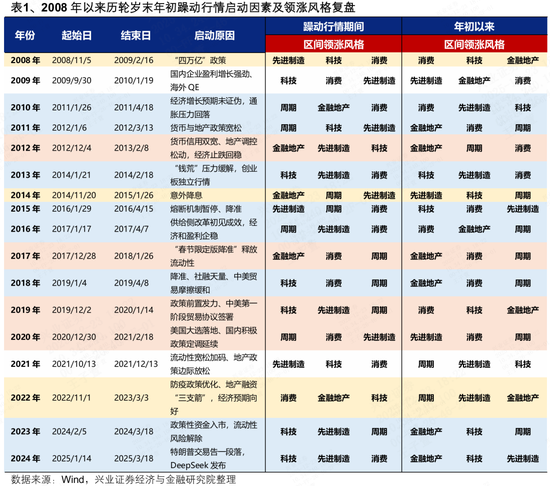
Core Viewpoint - The article analyzes the historical patterns of stock market rally initiations since 2008, categorizing them based on their starting times and catalysts, highlighting the significance of macroeconomic policies and market conditions in triggering these rallies [1][3]. Group 1: Historical Rally Patterns - The article identifies three main categories of rally initiation times: 1. January-February starts, which are the most common for historical rallies [1][3]. 2. November starts, which require a clear shift in macroeconomic policy [1][3]. 3. December starts, which occur after strong market performance but face disturbances that, once resolved, lead to a rally [1][3]. Group 2: Key Factors for Rally Initiation - The analysis of the rallies in 2017, 2019, and 2020 reveals that they often began despite lacking strong macroeconomic policy shifts, indicating that market sentiment can drive early rallies [15][20]. - Important factors contributing to the initiation of these rallies include: 1. Positive policy signals from year-end meetings that bolster market sentiment [15][20]. 2. Improvement in economic fundamentals and corporate earnings, with no significant disturbances in economic data or earnings forecasts [15][20]. 3. Loose monetary policy and ample liquidity supporting market growth [15][20]. Group 3: Signals for Rally Initiation - The article outlines three main types of events that can signal the start of a rally: 1. Resolution of prior uncertainties that have suppressed the market [19]. 2. Implementation of easing policies such as rate cuts that can ignite market enthusiasm [19]. 3. Key economic data that confirms improving fundamentals, enhancing investor participation [19]. Group 4: Industry Performance During Rallies - The analysis indicates that during the rallies of 2017, 2019, and 2020, the leading sectors did not experience significant shifts, maintaining a correlation with the performance trends established earlier in the year [20]. - The leading sectors during these rallies included: 1. In 2017, low-valuation value stocks and blue-chip companies dominated the market [20]. 2. In 2019, the TMT sector continued to thrive, with the rise of the new energy industry [20]. 3. In 2020, the focus remained on high-end manufacturing and consumption, with some resource sectors benefiting from favorable monetary policies [20].