
债券

Search documents
华鑫证券研究所所长谭倩:科创债市场发行主体预计将加速扩容
Xin Hua Cai Jing· 2025-11-26 04:59
Core Insights - The "Technology Board" in the bond market has made significant progress in its first six months, with over 530 billion yuan raised for 276 companies, including 230 tech firms and 46 equity investment institutions [1][2]. Group 1: Impact of Technology Bonds - Technology bonds address the financing challenges faced by tech enterprises, serving as a crucial bridge between finance and technology, enhancing industrial competitiveness and economic growth potential [1]. - The issuance of technology bonds has surpassed 10% of the total debt financing tools in the interbank market, marking a 5 percentage point increase since their introduction [1]. - The Yangtze River Delta, Pearl River Delta, and Beijing-Tianjin-Hebei regions account for over 60% of the issuance volume [1]. Group 2: Financing Benefits - Technology bonds provide a significant medium- to long-term funding channel for tech companies, facilitating a diversified financing system that includes equity, debt, and loans [2]. - They help reduce financing costs for tech firms, improving the efficiency and precision of financial support for the real economy, with technology bond yields consistently lower than those of ordinary credit bonds since May [2]. - The issuance of technology bonds diversifies investment options in a low-interest-rate environment, shifting investor focus from traditional sectors to high-growth tech innovation areas [2]. Group 3: Participation and Future Outlook - The participation of private enterprises in the technology bond market has notably increased, with over 50 private companies issuing 107.4 billion yuan, representing 20% of the total issuance [3]. - The market for technology bonds is expected to expand further, supported by policies aimed at enhancing risk-sharing mechanisms and diversifying product types and investor profiles [3].
内地禁用的债券操作在香港卷土重来,8%变16%
阿尔法工场研究院· 2025-11-26 02:55
Core Viewpoint - Hong Kong banks are assisting investors in obtaining bond returns significantly exceeding official interest rates, with these activities occurring discreetly [2]. Group 1: Local Government Financing Platforms (LGFVs) - Cash-strapped local governments in China are in a dilemma, needing to roll over substantial debts while facing high investor demands for interest rates [3][4]. - Some LGFVs are paying undisclosed additional amounts to investors when issuing bonds, a practice that has shifted to Hong Kong after being regulated against in mainland China [5]. - In Q2 of this year, dozens of LGFVs issued $3.3 billion in bonds in Hong Kong, with actual returns potentially reaching double the coupon rates, indicating severe liquidity pressures on these platforms [5][10]. - The International Monetary Fund (IMF) estimates that the debt of these financing platforms could reach 60 trillion yuan (approximately $8.4 trillion) by 2023 [9]. Group 2: Bond Issuance and Hidden Returns - Various methods exist to transform 8% interest rate bonds into high-yield products, with issuers paying investors through "consulting fees" or undisclosed discounts [7][12]. - Investment banks receive additional commissions from bond buyers and charge higher underwriting fees, deviating from standard bond issuance processes [13]. - For example, the Luoyang High-tech Innovation Group in Henan issued bonds with a promised total return of around 16%, despite its financial struggles [14][19]. Group 3: Market Impact and Trading Behavior - The hidden returns have led to volatility in the Hong Kong bond market, with some investors selling bonds shortly after issuance, causing yields to spike [21][25]. - In Q2, over 80 bonds from LGFVs in Hong Kong saw yields rise by at least 2 percentage points within three months of listing [27]. - The total amount of bonds issued by LGFVs in Hong Kong and Macau is projected to reach $52.7 billion in 2024, a year-on-year increase of over 70% [27]. Group 4: Regulatory Concerns - The Securities and Futures Commission (SFC) of Hong Kong has indicated it will take regulatory action against licensed entities that do not meet expected standards [9]. - The practices of LGFVs raise concerns about the integrity of the bond market and could potentially harm the reputation of Chinese enterprises seeking offshore financing [21][28].


大类资产早报-20251126
Yong An Qi Huo· 2025-11-26 00:59
Group 1: Global Asset Market Performance - The latest yields of 10 - year government bonds in major economies are as follows: US 3.997, UK 4.493, France 3.406, Germany 2.671, Italy 3.399, Spain 3.161, Switzerland 0.131, Greece 3.273, Japan 1.799, Brazil 6.146, China 1.818, South Korea (not available), Australia 4.428, New Zealand 4.145 [3] - The latest yields of 2 - year government bonds in major economies are: US 3.460, UK 3.755, Germany 2.013, Japan 0.964, Italy 2.184, China (1Y yield) 1.404, South Korea (not available), Australia 3.673 [3] - The latest exchange rates of the US dollar against major emerging - economy currencies are: Brazil 5.386, Russia (not available), South Africa zar 17.220, Korean won 1468.300, Thai baht 32.310, Malaysian ringgit 4.135 [3] - The latest exchange rates of the RMB are: on - shore 7.085, off - shore 7.082, mid - price 7.083, 12 - month NDF 6.945 [3] - The latest values of major economies' stock indices are: S&P 500 6765.880, Dow Jones Industrial Average 47112.450, Nasdaq 23025.590, Mexican index 63214.560, UK index 9609.530, French CAC 8025.800, German DAX 23464.630, Spanish index 16140.900, Russian index (not available), Nikkei 48659.520, Hang Seng Index 25894.550, Shanghai Composite Index 3870.023, Taiwan index 26912.170, South Korean index 3857.780, Indian index 8521.885, Thai index 1268.780, Malaysian index 1611.740, Australian index 8824.235, emerging - economy index 1353.840 [3] - The latest values of credit - bond indices are: US investment - grade 3548.370, euro - zone investment - grade 266.193, emerging - economy investment - grade 290.250, US high - yield 2886.590, euro - zone high - yield 407.810, emerging - economy high - yield 1797.248 [3] Group 2: Stock Index Futures Trading Data - For A - shares, the closing price is 3870.02 with a 0.87% increase; for CSI 300, the closing price is 4490.40 with a 0.95% increase; for SSE 50, the closing price is 2968.20 with a 0.60% increase; for ChiNext, the closing price is 2980.93 with a 1.77% increase; for CSI 500, the closing price is 6954.60 with a 1.25% increase [4] - The PE (TTM) values are: CSI 300 13.92, SSE 50 11.89, CSI 500 31.69, S&P 500 26.78, German DAX 18.20, with环比changes of 0.11, 0.07, 0.34, 0.14, 0.18 respectively [4] - The risk premiums (1/PE - 10 - year interest rate) are: S&P 500 - 0.26, German DAX 2.82, with环比changes of 0.01 and - 0.04 respectively [4] - The latest capital flows are: A - shares 118.55, main board 41.57, small - and - medium - sized enterprise board (not available), ChiNext 82.95, CSI 300 22.47, and the 5 - day average values are - 534.34, - 438.23, (not available), - 68.11, - 58.99 respectively [4] Group 3: Other Trading Data - The latest trading volume amounts are: Shanghai and Shenzhen stock markets 18121.47, CSI 300 4115.24, SSE 50 980.32, small - and - medium - sized enterprise board 3723.91, ChiNext 5224.55, with环比changes of 843.73, - 142.83, - 122.39, 249.84, 462.39 respectively [5] - The basis and basis spreads of stock index futures are: IF basis - 17.40 (- 0.39%), IH basis - 9.00 (- 0.30%), IC basis - 54.60 (- 0.79%) [5] - The closing prices and price changes of treasury bond futures are: T2303 108.37 (- 0.13%), TF2303 105.80 (- 0.09%), T2306 108.22 (- 0.11%), TF2306 105.98 (- 0.01%) [5] - The capital interest rates are: R001 1.3843%, R007 1.5238%, SHIBOR - 3M 1.5800%, with daily changes of - 18.00 BP, - 4.00 BP, 0.00 BP respectively [5]
美国财长贝森特:特朗普很有可能在12月25日之前宣布美联储主席人选。债券市场迎来自2020年以来最好的一年。政府关门使美国G
Sou Hu Cai Jing· 2025-11-25 13:25
美国财长贝森特:特朗普很有可能在12月25日之前宣布美联储主席人选。债券市场迎来自2020年以来最 好的一年。政府关门使美国GDP减少了1.5%,至少损失了110亿美元。美联储理事们似乎倾向于降息。 ...
走在债市曲线之前系列报告(九):债券指数体系与应用解析(上)
Changjiang Securities· 2025-11-25 11:20
Group 1: Report Overview - The report is a deep - dive into the bond index system, covering classification, construction, calculation, and evaluation [5][17] - It aims to provide a comprehensive reference for understanding the bond index's compilation basis and internal logic [5] Group 2: Index Classification - Mainstream bond indices are compiled by institutions like ChinaBond, China Securities Index, Shanghai Clearing House, etc [19] - Indices can be classified by bond type (interest - rate bonds, credit bonds, convertible bonds, and composite bonds) and return treatment (wealth index, full - price index, net - price index) [19][24] - Different institutions have unique index family classifications [27] Group 3: Index Construction - Sample bond selection follows criteria such as bond type, credit rating, and remaining maturity, with some indices setting limits on the number of constituent bonds [37] - Market - value weighting is the mainstream method, and some indices set weight caps [42] - Index sample bonds are adjusted regularly (daily, monthly, quarterly) and temporarily, with some indices having an alternative bond mechanism [50][54] Group 4: Index Calculation - There are two main calculation methods: the daily - calculation method and the Paasche - weighting method [61] - The daily - calculation method is used by ChinaBond, Shenzhen, and other institutions, while the Paasche - weighting method is used by China Securities Index and others [61] Group 5: Index Evaluation - Evaluation dimensions include representativeness, transparency, investability, and stability [72] - A comparison between the ChinaBond New Composite Index and the China Securities Composite Bond Index shows differences in constituent bond composition, rating weights, and duration contributions [79][83][88]
平安固收:2025年11月托管月报:年末债市需求仍有支撑-20251125
Ping An Securities· 2025-11-25 08:52
1. Report Industry Investment Rating No information provided in the content. 2. Core Viewpoints of the Report - In October 2025, the year - on - year growth rate of bond custody balance was 14.0%, 0.1 percentage points lower than that in September. The newly - added custody scale was 1.5 trillion yuan, basically the same as the same period last year. The main contributor to the year - on - year increase was inter - bank certificates of deposit, while interest - rate bonds had a negative contribution. Credit bonds also increased significantly year - on - year [3][4]. - In terms of institutions, the bond - allocation power of allocation - type institutions declined, while non - legal person products significantly increased their bond allocation. Banks, insurance and other institutions decreased their bond allocation, especially banks, while non - legal person products and securities firms increased their bond allocation [3]. - Looking ahead, it is expected that the supply of government bonds from November to December will remain at a high level, but the year - on - year growth is expected to decline. The demand in the bond market at the end of the year still has support [3]. 3. Summary by Relevant Catalogs 3.1 Overall Bond Custody in October - The year - on - year growth rate of bond custody balance was 14.0%, 0.1 percentage points lower than that in September. The newly - added custody scale was 1.5 trillion yuan, basically the same as the same period last year [3][4]. 3.2 By Bond Type - Inter - bank certificates of deposit were the main contributor to the year - on - year increase in October, followed by credit bonds. Interest - rate bonds (treasury bonds + local government bonds + policy - based financial bonds) significantly decreased year - on - year, followed by financial bonds [3][9]. - The supply scale of government bonds and policy - based financial bonds decreased in October. The supply of government bonds continued to decline, with treasury bonds decreasing by about 150 billion yuan and local government bonds decreasing by about 410 billion yuan year - on - year. Policy - based financial bonds were at a low level, and financial bond financing also continued at a low level [19]. - Credit bonds increased by nearly 190 billion yuan year - on - year in October, further expanding significantly. This was due to the repair of the corporate balance sheet, the decline in corporate financing costs, and the new policy on science - innovation bonds [20]. - Inter - bank certificates of deposit financing expanded significantly in October. The central bank restarted bond - buying operations, and banks may have increased the supply of inter - bank certificates of deposit to meet credit demand [23]. 3.3 By Institution - **Banks**: Affected by the supply, after considering the net investment of 400 billion yuan in the central bank's outright reverse repurchase, banks' bond investment decreased by 680.4 billion yuan year - on - year in October. They mainly reduced their allocation of treasury bonds, policy - based financial bonds, financial bonds and credit bonds, and slightly increased their allocation of inter - bank certificates of deposit [30][33]. - **Insurance**: Insurance slightly reduced its bond allocation year - on - year in October but continued to increase its allocation of local government bonds. The proportion of its increased government bond scale to the newly - added government bond custody was about 17.5%, significantly higher than the 9.6% in the past 12 months [36]. - **Non - legal person products**: They increased their bond holding by 1.03 trillion yuan in October, with a year - on - year increase of 978.2 billion yuan. They mainly increased their allocation of inter - bank certificates of deposit, followed by credit bonds [37]. - **Foreign capital**: Foreign capital continued to reduce its bond holding in October, mainly increasing its holding of treasury bonds and reducing its holding of inter - bank certificates of deposit. The cost - performance of carry trade income was still insufficient [48]. - **Securities firms**: Securities firms increased their bond holding by 156.1 billion yuan in October, with a year - on - year increase of 131 billion yuan, mainly increasing their holding of treasury bonds and local government bonds [48]. 3.4 Outlook - **Supply**: It is expected that the supply of government bonds from November to December will remain at a high level, with a monthly supply scale exceeding 1 trillion yuan, but the year - on - year growth is expected to decline due to the high base in the same period last year [50]. - **Demand**: - **Banks**: It is expected that from November to December, banks will follow the supply, with a relatively large bond - allocation scale but a year - on - year decrease. The allocation scale is expected to be between 1 and 1.5 trillion yuan [54]. - **Insurance**: Insurance institutions may have a certain willingness to scramble for bond allocation at the end of the year. If the government bond supply from November to December is 2.3 trillion yuan, the insurance allocation scale may exceed 40 billion yuan [58]. - **Asset management accounts**: It is expected that from November to December, asset management accounts will maintain a certain intensity of bond allocation, but it may be lower than that in October when they undertook a large number of inter - bank certificates of deposit [63].
上交所:厦门翔业集团有限公司债券11月26日上市,代码244196
Sou Hu Cai Jing· 2025-11-25 02:06
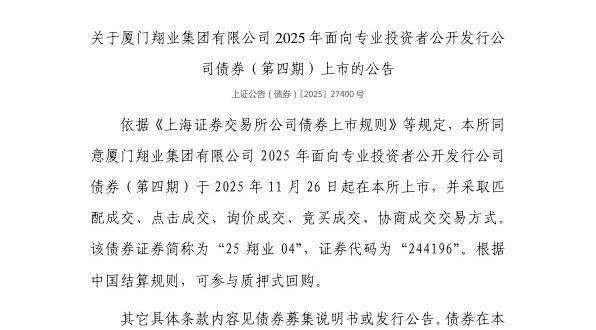
11月25日,上交所发布关于厦门翔业集团有限公司2025年面向专业投资者公开发行公司债券(第四期) 上市的公告。 来源:市场资讯 依据《上海证券交易所公司债券上市规则》等规定,上交所同意厦门翔业集团有限公司2025年面向专业 投资者公开发行公司债券(第四期)于2025年11月26日起在上交所上市,并采取匹配成交、点击成交、 询价成交、竞买成交、协商成交交易方式。该债券证券简称为"25翔业04",证券代码为"244196"。根据 中国结算规则,可参与质押式回购。 ...
农银汇理基金经理助理刘慧婷:转债创出新高,接下来怎么看?
Sou Hu Cai Jing· 2025-11-25 01:33
Core Viewpoint - The recent fluctuations in the equity market, influenced by geopolitical conflicts, tempered expectations for a December Fed rate cut, and profit-taking by institutions, have led to a high-level oscillation in major stock indices. This has resulted in a strong performance of convertible bonds, with indices showing significant increases since November [1]. Group 1: Convertible Bonds Performance - The convertible bond indices, including the China Securities Convertible Bond Index, Shanghai Convertible Bond Index, and Shenzhen Convertible Bond Index, have risen by 1.39%, 1.15%, and 1.64% respectively since November, indicating a robust market sentiment [1]. - The convertible bond market has reached a yearly high, with the Shenzhen Convertible Bond Index surpassing its August peak [1]. Group 2: Characteristics of Convertible Bonds - Convertible bonds are defined as bonds that can be converted into stocks at a predetermined price within a specified period, distinguishing them from regular credit bonds due to their conversion rights [2]. - Key features of convertible bonds include regular principal and interest payments, the ability to convert into stocks, price sensitivity to the underlying stock, and additional clauses such as redemption and put options that complicate their pricing [2]. Group 3: Market Outlook - The core logic supporting the current equity market bull run remains intact, driven by a low-interest-rate environment and domestic policy support, suggesting a sustained bullish trend in the domestic equity market [2]. - The pure bond market is experiencing limited disturbances due to the central bank's supportive monetary policy and a resumption of government bond trading, which keeps yields from rising significantly [3]. - The supply-demand dynamics in the convertible bond market are expected to remain tight, with limited issuance and strong demand driven by the anticipated performance of convertible bonds compared to pure bonds [3].
近期债券市场回顾:债券市场相对较乐观
Sou Hu Cai Jing· 2025-11-25 01:20
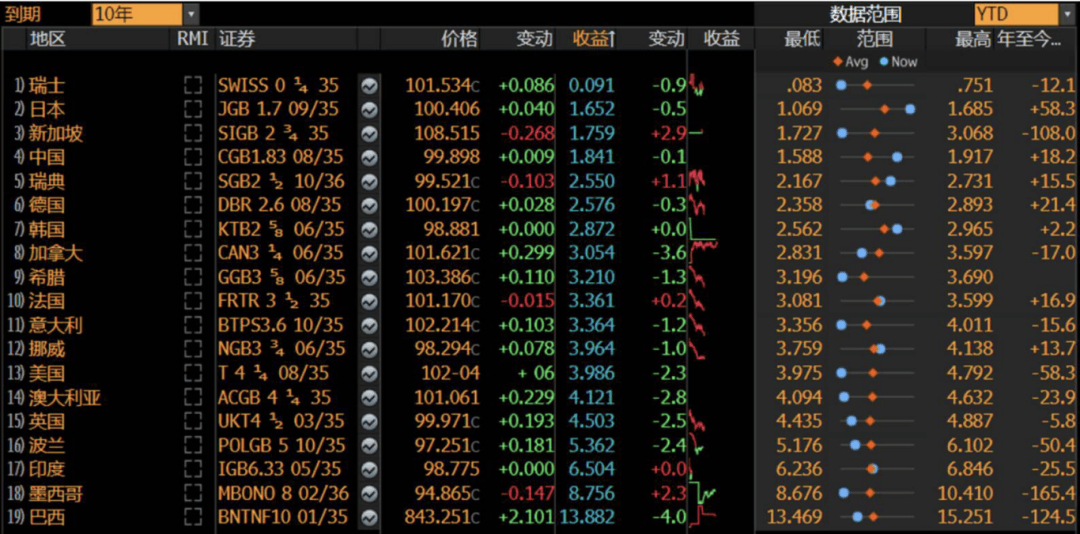
Core Viewpoint - The bond market has shown a downward trend in yields since the end of September, despite an overall adjustment since the beginning of the year, with the ten-year government bond yield currently around 1.8% [1][2]. Group 1: Bond Market Performance - The active ten-year government bond has switched to 250016, which has a higher yield due to VAT, currently at approximately 1.8%, compared to the previous bond 250011, which remains below 1.75% [1]. - The downward trend in bond yields is supported by positive factors, including the central bank's resumption of government bond trading operations, which alleviates market supply and demand pressure [1]. - The economic environment in October is facing challenges, with a longer holiday period and a marginal decline in the effects of previous policy stimuli, leading to a downward trend in economic performance compared to Q3 [1]. Group 2: Credit Bonds and Global Comparison - Credit bonds have shown a similar trend to government bonds, but credit spreads remain in a downward oscillation [2]. - As of October, China's ten-year government bond yield is approximately 1.84%, which is still low compared to global standards, with only Switzerland, Japan, and Singapore having lower yields [2]. - Most Western developed countries have higher government bond yields than China, with U.S. Treasury yields around 4%, indicating a significant China-U.S. yield spread [2]. Group 3: Future Outlook - The bond market is currently in a favorable narrow oscillation pattern, with expectations for policy easing in early next year, suggesting potential trading opportunities [4]. - The ten-year government bond ETF (511260) is highlighted as a preferred tool for medium to long-term allocation and trading, offering stable duration, transparent holdings, and low fees [4].
固收 股债双弱,怎么做?
2025-11-25 01:19
Summary of Conference Call Notes Industry Overview - The current market environment is characterized by a simultaneous decline in both equity and bond markets, primarily driven by changes in liquidity expectations rather than liquidity itself [1][3]. Key Points and Arguments - **Liquidity Expectations**: The central bank's report suggests a potential decrease in credit growth and a reduction in interbank leverage, leading to lowered expectations for overall monetary policy. Structural tools are becoming the main method for liquidity provision, impacting market sentiment [1][3]. - **Real Estate Policy Rumors**: Speculation regarding enhanced real estate policies, particularly interest subsidy policies, has reinforced market perceptions of cross-cycle policies, causing fluctuations in trading sentiment and resulting in weak performance in both stock and bond markets [1][4]. - **30-Year Treasury Bond Competition**: The competition for active 30-year treasury bonds reflects trading sentiment but is fundamentally seen as a gimmick. Not all bonds can maintain active status, and traders should capitalize on market sentiment to extract value [1][5]. - **T2 and T6 Bond Liquidity**: T2 bonds currently exhibit poor liquidity, while T6 bonds are relatively active. The spread between T2 and T6 is approximately 5 basis points (BP), below the theoretical value of 7 BP, primarily due to declining liquidity expectations for T2 [1][7]. - **Investment Strategy**: Investors are advised to adopt a long-term perspective on spread changes and consider switching bond holdings. Focus should be on short-term products and 3-7 year government bonds, which have shown good relative value recently [1][8]. Additional Important Insights - **Market Dynamics**: The weak correlation between stock and bond markets suggests independent factors affecting each market. The prevailing view is that liquidity expectations have shifted, impacting market performance [3][4]. - **Future Opportunities**: In the coming months, attention should be directed towards short-term products and mid-term government bonds. The opening of numerous carbon credit bonds in December and the first quarter of the following year will provide strategic opportunities [2][9]. - **Relative Value Observations**: Investment strategies should be based on the relative value changes among different bond types over various maturities, allowing for a more structured approach to investment [2][9].