塑料

Search documents
聚烯烃:趋势震荡偏弱
Guo Tai Jun An Qi Huo· 2025-07-06 13:17
1. Report Industry Investment Rating - The investment rating for polyolefins is trending weakly with oscillations [1][5][7] 2. Core Views of the Report - For polypropylene, the external environment is volatile, new production capacity offsets supply - side efforts, and the overall supply is in excess. Although there is optimism about improved trade - war situations, the high - level should be treated with caution. The key to future seasonal reversal may be the recovery of Sino - US seasonal demand driven by the Fed's interest - rate cuts [6] - For polyethylene, the easing of the conflict between Iran and Israel has led to a retracement of the premium caused by import risks. The demand is weak, but the rapid decline in social sample warehouse inventory provides short - term support. The supply pressure will gradually increase in Q3 2025, and attention should be paid to the spread changes between different types of polyethylene [8] 3. Summary by Relevant Catalogs 3.1 Overview - Polypropylene is trending weakly with oscillations. The external environment brings uncertainty, new production capacity offsets supply - side efforts, and export growth is limited [5][6] - Linear low - density polyethylene (LLDPE) is also showing a weakly oscillating trend. The macro environment affects the price premium, and supply - demand imbalance exists [7][8] - Core data shows that the spot price of both polypropylene and polyethylene has decreased compared to the previous period and the same period last year. The basis and monthly spread of both have weakened. The polypropylene's average capacity utilization has decreased, while polyethylene's has increased. The polyolefin inventory has increased slightly compared to the previous period but decreased compared to the same period last year [9] 3.2 Polypropylene Supply and Demand - **Price and Spread**: The non - standard price spread is not conducive to price rebound [17] - **Supply - Side**: New domestic production capacity is being put into operation, and more manufacturers are producing copolymer products with higher profits. The short - term overall start - up rate has declined, and there are still many overhauls in July, but new production capacity offsets the support from overhauls. The potential new production capacity in 2025 is 785.5 million tons, with a capacity increase of 15.4% [20][22][26] - **Inventory**: The production inventory has decreased, while the trader inventory has increased. The total commercial inventory has decreased slightly, mainly due to more upstream overhauls and lower downstream purchasing enthusiasm [27][31] - **Cost and Profit**: The cost has decreased due to the decline in crude oil prices. The profit of oil - based manufacturers has declined, while the profit of PDH - based production has increased [32][37] - **Downstream**: The BOPP start - up rate remains flat, with fewer orders and more finished - product inventory. The profit is at a low level due to over - capacity. The tape master - roll start - up rate, orders, and the start - up rate and orders of plastic - weaving and non - woven fabric industries have all declined. The CPP start - up rate and orders have slightly decreased [39][42][47] 3.3 Polyethylene Supply and Demand - **Spread**: The short - term L - LL spread is declining, which is negative for polyethylene. The HD - LL spread has expanded in 2025, but may oscillate later [62][65] - **Supply - Side**: The start - up rate has decreased, but the output has increased. The expected overhaul loss in July will be less than that in June. The potential new production capacity in 2025 is 613 million tons, with a capacity increase of 17.17% [66][69][70] - **Inventory**: The production - enterprise inventory has decreased, while the social inventory has increased [72] - **Cost and Profit**: The cost has decreased due to the decline in crude oil prices, and the profit of oil - based production devices has declined [76][82] - **Downstream**: The start - up rate and orders of the agricultural film industry have decreased. The start - up rate and orders of the packaging film industry have increased. The start - up rates of the pipe and hollow industries are lower than the same period last year [84][85][86]
【图】2025年5月贵州省初级形态的塑料产量统计分析
Chan Ye Diao Yan Wang· 2025-07-06 06:58
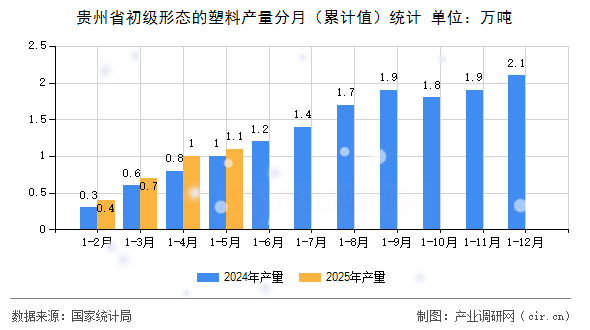
Core Insights - The production of primary plastic shapes in Guizhou Province reached 11,000 tons in the first five months of 2025, marking a 9.6% increase compared to the same period in 2024, although the growth rate has slowed by 7.8 percentage points from 2024 [1] - In May 2025, the production for that month alone was 200 tons, reflecting an 11.1% increase year-on-year, but the growth rate has also decreased by 1.5 percentage points compared to 2024 [2] Summary by Category Production Data - Total primary plastic production in Guizhou for January to May 2025 was 11,000 tons, which is 0.0% of the national total of 5,809,800 tons [1] - In May 2025, the production was 200 tons, accounting for 0.0% of the national total of 1,190,000 tons [2] Growth Rates - The growth rate for the first five months of 2025 was 9.6%, which is lower than the national growth rate by 0.5 percentage points [1] - The May 2025 growth rate of 11.1% was higher than the national rate by 0.9 percentage points [2] Historical Context - The definition of primary plastic shapes has evolved, with the term previously known as plastic resins and copolymers until 2004 [6] - The threshold for large-scale industrial enterprises in China was raised from an annual main business income of 5 million yuan to 20 million yuan starting in 2011 [6]

每周股票复盘:海正生材(688203)股东减持与股份回购进展
Sou Hu Cai Jing· 2025-07-06 00:25
Summary of Key Points Core Viewpoint - The company Zhejiang Haizheng Biomaterials Co., Ltd. is experiencing stock fluctuations, with a recent decline in share price and ongoing shareholder activities including share buybacks and planned reductions in holdings by major shareholders [1][2]. Group 1: Stock Performance - As of July 4, 2025, the stock price of Haizheng Biomaterials closed at 12.06 yuan, down 4.96% from the previous week [1]. - The stock reached a high of 12.86 yuan and a low of 11.85 yuan during the week [1]. - The current market capitalization is 2.444 billion yuan, ranking 62nd in the plastics sector and 4703rd in the A-share market [1]. Group 2: Shareholder Activities - Sinopec Capital, a major shareholder, holds 13,659,494 shares (6.74% of total shares) and plans to reduce its holdings by up to 3,525,600 shares (1.74% of total shares) through block trading within three months from the announcement date [1][3]. - In the past 12 months, Sinopec Capital has already reduced its holdings by 2,026,780 shares (1% of total shares) at prices ranging from 10.17 to 12.02 yuan per share [1]. Group 3: Share Buyback Progress - The company has initiated a share buyback program with a budget of 20 million to 30 million yuan, aimed at employee stock ownership plans or equity incentives [2]. - As of June 30, 2025, the company has repurchased 1,482,364 shares, representing 0.731% of total shares, with a total expenditure of approximately 14.29 million yuan [2].

【图】2025年1-4月湖北省初级形态的塑料产量统计分析
Chan Ye Diao Yan Wang· 2025-07-05 09:15
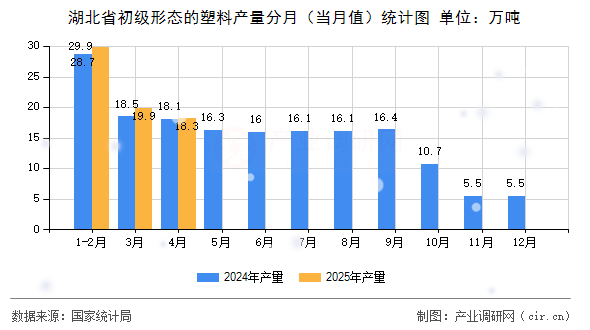
Group 1 - The core viewpoint of the article highlights the production statistics of primary plastic forms in Hubei Province for the first four months of 2025, indicating a growth trend in production [1] - In April 2025, the primary plastic production reached 183,000 tons, showing a year-on-year increase of 1.3%, with a growth rate 2.8 percentage points higher than the same period last year [1] - The total primary plastic production from January to April 2025 was 696,000 tons, reflecting a year-on-year growth of 5.6%, with a growth rate 14.8 percentage points higher than the previous year [1] Group 2 - The growth rate of Hubei's primary plastic production in April 2025 was 10.7 percentage points lower than the national average, which was 1,168,600 tons for the same period [1] - The cumulative production from January to April 2025 accounted for 1.5% of the national total of 4,601,200 tons for large-scale industrial enterprises [1] - The article notes that the definition of primary plastic has evolved, previously referred to as plastic resins and copolymers before 2004 [3]
期货模式打破塑料外贸定价困境
Zhong Guo Zheng Quan Bao· 2025-07-04 20:26
Group 1 - The core viewpoint of the articles highlights the increasing importance of futures pricing in China's petrochemical industry, particularly in the plastic sector, as companies seek to enhance their global competitiveness amid complex international trade conditions [1][2][3]. Group 2 - In 2024, China's petrochemical industry is projected to generate revenue of 16 trillion yuan, with the plastic sector contributing approximately 2.3 trillion yuan, showcasing strong export performance [2]. - The reliance on spot pricing for plastic products has revealed shortcomings, as many companies currently base their pricing on spot price indices or negotiate on a case-by-case basis, leading to potential issues with data transparency and timeliness [2][3]. - The adoption of futures pricing is seen as a way for Chinese companies to gain greater influence in international trade, with futures prices being perceived as more fair and transparent compared to traditional pricing methods [3][4]. Group 3 - The Dalian Commodity Exchange has implemented over 20 optimization measures since 2021 to promote futures pricing in the chemical sector, resulting in over 90% of spot trades for certain chemicals using futures contracts as pricing references [4][5]. - The introduction of new futures products, such as pure benzene futures and options, is expected to enhance risk management tools for the chemical industry and support high-quality development [5][6]. Group 4 - Companies are increasingly adopting basis trading models, which allow them to leverage futures prices for better pricing outcomes, as demonstrated by successful case studies where companies achieved significant profit margins over traditional pricing methods [5][6]. - The growing acceptance of China's futures market by foreign clients indicates a promising future for futures pricing in enhancing the smoothness of PVC export trade [6].
《能源化工》日报-20250704
Guang Fa Qi Huo· 2025-07-04 06:51
1. Report Industry Investment Ratings No relevant content provided. 2. Core Views of the Report PVC and Caustic Soda - The policy signal of supply - side optimization brings positive long - term expectations for the supply - demand contradiction of PVC, but the short - term supply - demand contradiction remains prominent. The export volume may decline in the third quarter, and the anti - dumping tax decision in mid - July will affect future exports. The PVC inventory is lower than the same period in 23 - 24, and the pressure is limited. The short - term disk is strong, but the upward space should be viewed with caution [6]. - For caustic soda, the supply - side optimization expectation boosts market sentiment, and the price rebounds. The supply - demand contradiction is limited, but high profits stimulate high production. The downstream non - aluminum market is in the off - season, and the alumina purchase price adjustment has limited support for the caustic soda price. After the stimulus news, there is low - price speculative demand. It is recommended to wait and see [6]. Methanol The port's inventory accumulation, Iranian device restart, and MTO device shutdown increase the port's inventory pressure and weaken the basis. The inland market is weak due to high production and the off - season of demand, but the increase in maintenance plans in July eases the supply pressure. Overall, the upward and downward space of methanol is limited, and interval operation is recommended [10]. LLDPE and PP PP and PE are in a state of supply contraction, with increasing PP maintenance losses and low PE import expectations, driving inventory reduction. The weighted valuation has been repaired, and the July balance sheet shows a de - stocking expectation, but there is still overall pressure. In the short - term, attention can be paid to the support brought by de - stocking. For PP, it is recommended to short when the price rebounds to the 7200 - 7300 range [13]. Urea The urea disk is mainly driven by macro - policies. The anti - involution policy stimulates the commodity market, and the export collection and device maintenance support the price. However, weak industrial demand and unclear export quotas limit the upward space. It is necessary to track policy details, agricultural demand progress, and device maintenance dynamics. The disk needs export and downstream demand support to continue to rise [19]. Crude Oil Oil prices are oscillating weakly due to concerns about trade negotiations and OPEC+ supply decisions. The increase in US crude oil inventory further exacerbates supply pressure. The future trend depends on the OPEC+ meeting and trade negotiation results. It is recommended to wait and see, with resistance levels for WTI at [66, 67], Brent at [68, 69], and SC at [510, 520] [77]. Styrene The pure benzene market rebounds weakly, supported by crude oil and affected by the possible resumption of US ethane exports to China. High imports and production suppress the pure benzene price. The styrene market in East China is stable, with a strong basis before the end - of - month paper delivery. High - price transactions are limited. In the medium - term, high profits may lead to over - supply, and attention can be paid to short - selling opportunities [73]. Polyester Industry Chain - PX: The supply - demand is tight in the short - term, but with the PXN repair, some device maintenance may be postponed. The PX drive is limited, and it is expected to oscillate at a high level in the short - term, with the PX09 oscillating in the 6600 - 6900 range [81]. - PTA: The supply - demand is expected to weaken in July, and the basis has weakened. The absolute price is under pressure but supported by raw materials. It is recommended to short at the upper limit of the 4600 - 4900 range and conduct a rolling reverse spread for TA9 - 1 [81]. - Ethylene Glycol: The supply is increasing, and the supply - demand is turning to be loose. The short - term price is expected to oscillate. It is recommended to conduct a reverse spread for EG9 - 1 at high prices [81]. - Short - fiber: The supply - demand is weak. The absolute price is supported by raw materials, and the processing fee has been repaired to a limited extent. PF should be operated similarly to PTA, and the processing fee can be expanded at a low level [81]. - Bottle - chip: The supply - demand is expected to improve. The processing fee is bottoming out, and the absolute price follows the cost. It is recommended to operate PR similarly to PTA, conduct a positive spread for PR8 - 9 at low prices, and expand the processing fee at the lower limit of the 350 - 600 yuan/ton range [81]. 3. Summaries According to Relevant Catalogs PVC and Caustic Soda - **Price Changes**: The price of East China calcium - carbide - based PVC increased by 0.4% on July 3 compared to July 2, while the price of East China ethylene - based PVC remained unchanged. The export profit of PVC increased by 147.2% from June 19 to June 26. The FOB price of caustic soda in East China decreased by 2.4% from June 19 to June 26, but the export profit increased by 61.3% [2][3]. - **Supply**: The caustic soda industry's operating rate increased by 1.2% from June 20 to June 27, and the PVC total operating rate increased by 0.1%. The profit of externally purchased calcium - carbide - based PVC increased by 2.2%, while the northwest integrated profit decreased by 20.5% [4]. - **Demand**: The operating rate of the alumina industry increased by 0.5% from June 20 to June 27, while the operating rates of the viscose staple fiber and printing and dyeing industries decreased [5]. The operating rates of PVC downstream products such as pipes and profiles decreased, and the pre - sales volume decreased by 2.9% [6]. - **Inventory**: The inventory of liquid caustic soda in East China factories and Shandong decreased, while the PVC upstream factory inventory decreased by 1.6%, and the total social inventory increased by 1.9% [6]. Methanol - **Price and Spread**: The closing prices of MA2601 and MA2509 increased on July 3 compared to July 2, with increases of 0.66% and 0.42% respectively. The MA91 spread decreased by 20.00%, and the Taicang basis decreased by 32.79% [10]. - **Inventory**: The methanol enterprise inventory, port inventory, and social inventory all increased, with increases of 3.14%, 0.47%, and 1.37% respectively [10]. - **Operating Rate**: The upstream domestic enterprise operating rate decreased by 3.19%, the downstream external - purchase MTO device operating rate increased by 1.28%, and the formaldehyde operating rate decreased by 1.95% [10]. LLDPE and PP - **Price and Spread**: The closing prices of L2601 remained unchanged, L2509 decreased by 0.05%, PP2601 increased by 0.18%, and PP2509 increased by 0.03% on July 3 compared to July 2. The L2509 - 2601 spread decreased by 15.38%, and the PP2509 - 2601 spread decreased by 25.00% [13]. - **Inventory**: The PE enterprise inventory decreased by 2.19%, the social inventory increased by 9.12%, the PP enterprise inventory decreased by 2.55%, and the PP trader inventory increased by 10.81% [13]. - **Operating Rate**: The PE device operating rate increased by 3.95%, the downstream weighted operating rate decreased by 0.24%, the PP device operating rate decreased by 0.4%, and the PP powder operating rate decreased by 1.3% [13]. Urea - **Price and Spread**: The futures prices of different contracts showed different changes on July 3 compared to July 2. The 01 - 05 contract spread decreased by 16.67%, the 05 - 09 contract spread increased by 17.24%, and the 09 - 01 contract spread decreased by 7.32% [15][16]. - **Inventory**: The domestic urea factory inventory decreased by 7.06%, and the port inventory increased by 14.70% on a weekly basis [19]. - **Production**: The domestic urea daily production remained unchanged, and the weekly production remained unchanged. The device maintenance loss increased by 12.53% on a weekly basis [19]. Crude Oil - **Price and Spread**: On July 4, Brent crude oil decreased by 0.45%, WTI increased by 0.19%, and SC increased by 0.66%. The Brent - WTI spread decreased by 7.22%, and the EFS decreased by 1.46% [77]. - **Product Price and Spread**: The prices of NYM RBOB and ICE Gasoil changed slightly, and the spreads of different contracts also showed different changes [77]. - **Crack Spread**: The crack spreads of various refined oils decreased to different degrees on July 4 compared to July 3 [77]. Styrene - **Upstream Price**: On July 3, Brent crude oil decreased by 0.4%, CFR Japan naphtha increased by 0.9%, and the prices of CFR Northeast Asia ethylene and CFR Korea pure benzene increased slightly [71]. - **Spot and Futures Price**: The East China spot price of styrene decreased by 0.1%, EB2508 increased by 0.5%, and EB2509 increased by 0.4%. The basis decreased by 14.4%, and the monthly spread increased by 6.2% [71]. - **Overseas Price and Import Profit**: The CFR China price of styrene increased by 0.7%, and the import profit decreased by 96.3% [72]. - **Operating Rate and Profit**: The domestic pure benzene comprehensive operating rate decreased by 2.9%, the styrene operating rate increased by 1.4%, and the profits of different products showed different changes [73]. - **Inventory**: The inventories of pure benzene, styrene, PS, EPS, and ABS all increased to different degrees [73]. Polyester Industry Chain - **Upstream Price**: On July 3, Brent crude oil decreased by 0.4%, CFR Japan naphtha increased by 0.9%, and the prices of CFR Northeast Asia ethylene and CFR China PX changed slightly [81]. - **Product Price and Cash Flow**: The prices of various polyester products such as POY, FDY, and DTY decreased to different degrees, and the cash flows also changed [81]. - **Operating Rate**: The operating rates of Asian PX, Chinese PX, PTA, MEG, and polyester products all decreased to different degrees [81]. - **Inventory and Arrival Expectation**: The MEG port inventory decreased by 12.4%, and the arrival expectation increased by 141.9% [81].
大越期货PVC期货早报-20250703
Da Yue Qi Huo· 2025-07-03 03:34
交易咨询业务资格:证监许可【2012】1091号 PVC期货早报 2025年7月3日 大越期货投资咨询部 金泽彬 从业资格证号:F3048432 投资咨询证:Z0015557 联系方式:0575-85226759 1 重要提示:本报告非期货交易咨询业务项下服务,其中的观点和信息仅作参考之用,不构成对任何人的投资建议 。 我司不会因为关注、收到或阅读本报告内容而视相关人员为客户;市场有风险,投资需谨慎。 目 录 1 每日观点 2 基本面/持仓数据 供给端来看,据隆众统计,2025年5月PVC产量为201.9692万吨,环比增加3.31%;本周样本企业 产能利用率为78.09%,环比减少0.01个百分点;电石法企业产量34.5695万吨,环比增加0.68%, 乙烯法企业产量11.349万吨,环比减少4.54%;本周供给压力有所减少;下周预计检修有所减 少,预计排产少量增加。 需求端来看,下游整体开工率为42.78%,环比减少1.53个百分点,低于历史平均水平;下游型材 开工率为35%,环比减少1.25个百分点,低于历史平均水平;下游管材开工率为38.56%,环比减 少1.57个百分点,低于历史平均水平;下游薄膜开 ...
综合晨报-20250703
Guo Tou Qi Huo· 2025-07-03 02:16
Group 1: Energy - Brent 09 contract rose 2.78%. Geopolitical risks in the Middle East around the Iran nuclear issue have heated up again, and the trade war risk has weakened. The theme of loose supply and demand in the crude oil market continues, and the supply - demand guidance is still negative [1] - Night - time oil prices rose 3% due to positive news of US - Vietnam tariffs. High - sulfur fuel oil (FU) is in a weak oscillation, while low - sulfur fuel oil (LU) is boosted in the short term [21] - Night - time oil prices rose 3%, and asphalt is expected to follow the upward trend. Supply and demand are expected to increase, and the de - stocking trend is expected to continue [22] - The 7 - month CP of liquefied petroleum gas was significantly lowered, and the market is in a weak oscillation [23] Group 2: Metals - Overnight, the international copper price led the rise at a high level. The market is trading the probability of a July interest rate cut. Short - term Shanghai copper's upward trend tests 81,000, and long - term high - level short - allocation is recommended [3] - Overnight, Shanghai aluminum oscillated at a high level. The social inventory of aluminum ingots increased slightly, and there is a risk of a phased correction [4] - Cast aluminum alloy follows the fluctuation of Shanghai aluminum. If the spread between the far - month contracts on the disk expands, consider a long - ADC12 and short - AL strategy [5] - The spot price of alumina is around 3,100 yuan, and the upward space is limited [6] - Overnight, the precious metals oscillated strongly. The market's expectation of an interest rate cut has increased, and attention is focused on the non - farm payrolls data [2] - Zinc has strong support at 22,000 yuan/ton in the short term, and a short - allocation strategy is recommended in the medium and long term [7] - Shanghai lead is consolidating above 17,000. The supply - demand contradiction is not prominent, and attention is paid to whether it can stand firm at 17,000 [8] - Shanghai nickel is oscillating at a high level in the rebound. Technically, it is at the end of the rebound, waiting for a short - selling opportunity [9] - Tin prices oscillated overnight. It is advisable to short - allocate the far - month contracts [10] Group 3: Building Materials and Chemicals - Multi - silicon futures' main contract rose to the daily limit. The short - term upward space depends on the implementation of supply - side regulation policies [12] - Industrial silicon futures prices rose strongly. Due to the interweaving of long and short themes, the market is expected to oscillate [13] - Night - time steel prices oscillated. Supply and demand in the steel market are both increasing, and the short - term is expected to remain strong [14] - Iron ore prices rose overnight. Supply is expected to decline, and the short - term trend is expected to follow the finished products and oscillate strongly [15] - Coke prices rose. There is an expectation of a price increase, and the price is expected to oscillate strongly [16] - Coking coal prices rose. Policy may reduce production, and the price is expected to oscillate strongly [17] - Manganese silicon prices rose. The inventory has decreased, but the upward pressure above 6,750 is large [18] - Silicon iron prices rose. Demand is okay, and the price is expected to oscillate strongly [19] - Polyvinyl chloride (PVC) is following the cost fluctuations in the short term and may oscillate at a low level in the long term. Caustic soda is strong in the short term but under pressure in the long term [28] - PX and PTA prices are in a weak oscillation. The supply - demand pattern may gradually become looser [29] - Ethylene glycol is continuing a small - scale rebound and is expected to oscillate at the bottom [30] Group 4: Agricultural Products - The USDA reports on soybeans are neutral. Domestic soybean meal is in a weak oscillation [35] - Soybean oil and palm oil prices rose. A long - allocation strategy on dips is recommended in the long term [36] - Canadian rapeseed prices rose. Domestic rapeseed products are expected to oscillate in the short term [37] - The price of domestic soybeans rebounded from a low level. Weather and policies need to be focused on in the short term [38] - Corn futures are in an oscillating trend. The supply rhythm affects the market [39] - Hog futures rose significantly. The rebound space is limited in the medium term, and policy support is expected in the long term [40] - Egg futures fell. Short - selling on rallies is recommended [41] - U.S. cotton prices rose. Domestic cotton inventory is expected to be tight, and buying on dips is recommended [42] - U.S. sugar is in a downward trend, and domestic sugar is expected to oscillate [43] - Apple futures are oscillating, and a short - selling strategy is recommended [44] - Wood futures are oscillating. Supply has some positive factors, but the price is still weak [45] - Pulp futures rose slightly. The inventory is still high year - on - year, and it is expected to oscillate at a low level [46] Group 5: Others - The freight rate of the container shipping index (European line) is expected to be stable in July. The progress of the Gaza negotiations may affect the far - month contracts [20] - Urea market supply and demand have improved marginally, and the short - term market is in a strong oscillation [24] - Methanol futures are expected to fluctuate narrowly in the short term [25] - Styrene prices are in a weak trend. Supply and demand support is insufficient [26] - Polypropylene and polyethylene are in a weak fundamental situation [27] - Glass futures rose significantly, but it is recommended to wait and see due to high inventory and weak demand [32] - Natural rubber supply is increasing, and inventories are rising. A rebound from an oversold position is possible [33] - Soda ash is strong in the short term, but the upward space is limited due to expected demand reduction [34] Group 6: Financial Markets - A - share market is in a weak oscillation. In the style configuration, technology and growth should be increased on the basis of dividend assets [47] - Treasury bond futures closed up across the board. Be aware of the risk of increased volatility in the short term [48]
《能源化工》日报-20250703
Guang Fa Qi Huo· 2025-07-03 02:08
1. Report Industry Investment Ratings No relevant information provided. 2. Core Views of the Reports Crude Oil - Overnight oil prices rose, driven by geopolitical events and trade progress, but fundamental factors restricted the increase. Iran's suspension of cooperation with the UN nuclear agency raised concerns about supply disruptions, and the US - Vietnam trade agreement boosted some demand expectations. However, OPEC+ planned production increases were digested, Saudi exports increased, US crude inventories unexpectedly rose, and gasoline demand was weak. The oil price broke through the previous trading range but lacked strong drivers, with a low probability of short - term unilateral trends. It is recommended to wait and see, with resistance levels for WTI at [67, 68], Brent at [69, 70], and SC at [510, 520]. Options can capture opportunities from increased volatility [2]. Polyester Industry Chain - **PX**: Supply - demand is tight in the short term due to maintenance expectations, high downstream loads, and new PTA production plans. However, as PXN recovers, some maintenance may be postponed, and weak terminal demand may limit the rebound space. It is expected to fluctuate at a high level, with PX09 oscillating between 6600 - 6900 [6]. - **PTA**: In July, the maintenance of PTA devices is average, and new devices are stable. With expected downstream production cuts and weak terminal demand, supply - demand is turning loose. Although the low price is supported by raw materials, the absolute price is under pressure. TA is expected to oscillate between 4600 - 4900, with a short - position allocation at the upper edge of the range and a rolling reverse spread for TA9 - 1 [6]. - **Ethylene Glycol**: Supply is increasing at home and abroad, and the supply - demand is gradually turning loose, with a possible inventory build - up from August to September. Domestic coal - based MEG plants are restarting, and overseas plants are also recovering. The price is expected to fluctuate, with the seller of option EG2509 - C - 4450 exiting and a reverse spread for EG9 - 1 at high prices [6]. - **Short Fibre**: The supply - demand is weak. Although short - term prices are supported by raw materials due to expected production cuts and limited inventory pressure, weak downstream demand restricts the repair space of processing fees. PF is similar to PTA in unilateral trading, and the processing fees can be expanded at low levels [6]. - **Bottle Chips**: In July, due to the peak consumption season and production cuts by some plants, the supply - demand is expected to improve, and the processing fees are bottoming out. The absolute price follows the cost. PR is similar to PTA in unilateral trading, with a positive spread for PR8 - 9 at low prices and attention to expanding processing fees at the lower edge of the 350 - 600 yuan/ton range [6]. Urea The increase in urea futures prices is mainly driven by improved demand expectations, including seasonal agricultural demand, marginal improvement in industrial demand, and positive market sentiment from export tenders. Although supply - side device maintenance provides some support, overall supply growth restricts the upside. The supply - demand may further improve, and the short - term price may have upward potential depending on the tender results [15]. PVC and Caustic Soda - **Caustic Soda**: The supply - side optimization expectation boosts market sentiment. Fundamentally, the supply - demand contradiction is limited, but high profits lead to high production, and non - aluminum downstream is in the off - season. The price may rebound at a low level under strong macro sentiment, but the momentum depends on spot market follow - up [38]. - **PVC**: The supply - side optimization policy is beneficial in the long - term, but short - term supply - demand contradictions are still prominent. The real - estate demand is dragging, and overseas factors may affect exports. PVC has a fundamental basis for a rebound, but the near - term upside is limited, and the long - term effect depends on policy implementation [38]. Methanol Port inventory build - up, Iranian plant restarts, and MTO device shutdowns increase the pressure on port prices, and the port basis weakens rapidly. The inland market is affected by high production and weak demand in the off - season, but more maintenance plans in July will relieve some supply pressure. Overall, the price has limited upside and downside, and interval operations are recommended [41]. Styrene The pure benzene market first declined and then rebounded at a low level. The styrene market in East China was stable, with a strong basis price as the paper - cargo delivery approached. In the medium term, tariffs and subsidies may not drive terminal demand further. High styrene profits stimulate production, and supply - demand pressure may lead to valuation repair, which may rely on a decline in styrene prices. Attention should be paid to short - selling opportunities for styrene due to raw material resonance [51]. Polyolefins Cost - end valuation has recovered, but monomer prices are firm, squeezing the profit of the monomer - purchasing process. The supply of PP and PE is shrinking, with increasing PP maintenance losses and low PE import expectations, leading to continuous inventory reduction. Although the July balance sheet shows a de - stocking expectation, there is still overall pressure. In the short - term, support from de - stocking can be noted, and for PP, short positions can be considered when the price rebounds to the 7200 - 7300 range [55]. 3. Summary by Relevant Catalogs Crude Oil - **Prices and Spreads**: On July 3, Brent rose 2.00 to 69.11 dollars/barrel, WTI fell 0.19 to 67.26 dollars/barrel, and SC rose 10.50 to 509.00 yuan/barrel. Most spreads changed, with Brent - WTI increasing by 0.19 to 1.85 dollars/barrel [2]. - **Refined Oil**: NYM RBOB and NYM ULSD declined slightly, while ICE Gasoil rose 15.25 to 741.50 dollars/ton. The cracking spreads of some refined oils changed, with the US gasoline cracking spread falling 0.08 to 21.63 dollars/barrel [2]. Polyester Industry Chain - **Downstream Polyester Products**: On July 2, POY150/48, FDY150/96, and other prices mostly declined, while short - fiber and bottle - chip futures prices changed slightly [6]. - **PX - related**: CFR China PX declined, and PX - related spreads also changed, such as PX - crude oil and PX - naphtha [6]. - **PTA - related**: PTA prices and spreads changed, with the spot price falling and the basis weakening. The processing fees also decreased [6]. - **MEG - related**: MEG prices, inventory, and开工率 changed. The inventory decreased, and the开工 rate of some plants changed [6]. Urea - **Futures and Spot**: On July 2, futures prices rose, and spot prices in some regions changed slightly. The basis and spreads also had corresponding changes [10][11][14]. - **Supply and Demand**: Domestic urea daily production decreased, and the plant start - up rate decreased. The inventory in some areas decreased, and the number of enterprise orders decreased [15]. PVC and Caustic Soda - **Spot and Futures**: On July 2, the prices of caustic soda and PVC spot and futures changed. For example, the price of SH2509 rose 33.0 to 2391.0 yuan/ton [33]. - **Supply and Demand**: The opening rates of caustic soda and PVC plants changed, and the inventory of some products changed. The downstream opening rates of caustic soda and PVC also had corresponding changes [36][37][38]. Methanol - **Prices and Spreads**: On July 2, MA2509 and MA2601 prices rose, and the basis and regional spreads changed. For example, the太仓 basis fell 95 to 61 [41]. - **Inventory and开工率**: Methanol inventory increased slightly, and the开工率 of upstream and downstream plants changed. The upstream enterprise start - up rate increased, while the downstream MTO device start - up rate decreased [41]. Styrene - **Upstream**: On July 2, the prices of Brent crude, CFR Japan naphtha, and other upstream raw materials changed. The pure benzene - naphtha and ethylene - naphtha spreads also changed [49]. - **Spot and Futures**: The styrene spot and futures prices declined, and the basis and month - spreads decreased [49]. - **Industry Chain**: The开工率 and profit of the styrene industry chain changed. For example, the styrene start - up rate increased, and the integrated profit increased significantly [51]. Polyolefins - **Futures and Spot**: On July 2, L2601, L2509, PP2601, and PP2509 prices rose, and the basis and month - spreads changed. The spot prices of some products also changed [55]. - **Supply and Demand**: The开工率 of PE and PP plants changed, and the inventory decreased. The downstream weighted开工率 of PE and PP also changed [55].
上纬新材:上市以来零增持、零回购!研发强度排名行业倒数
Zheng Quan Shi Bao Wang· 2025-07-03 00:29
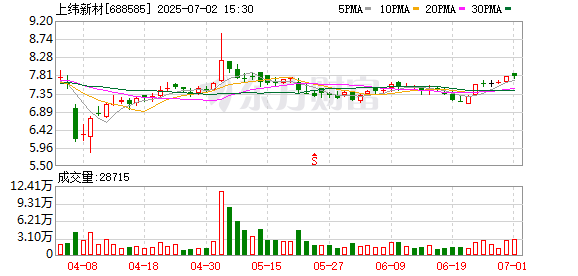
Core Viewpoint - The company is undergoing a significant matter that may lead to a change in control, resulting in a temporary suspension of its stock trading for up to two trading days starting July 2, 2025 [2] Group 1: Business Overview - The company specializes in environmentally friendly high-performance corrosion-resistant materials, materials for wind turbine blades, new composite materials, and circular economy materials, primarily applied in energy conservation and environmental protection, as well as new energy sectors [2] - Products are widely used in pollution prevention projects across various industries, including electronics, new energy, semiconductors, rail transportation safety materials, electricity, petrochemicals, metallurgy, and construction [2] Group 2: Stock Performance - The company's stock price surged over 5.5 times on its debut on the Sci-Tech Innovation Board in September 2020, reaching a peak of 20.49 yuan per share, but has since seen a significant decline, with a current price of 7.78 yuan per share, representing a 61.48% drop from its historical high [3] - The stock has experienced low trading volume, with an average turnover rate of 0.59% year-to-date, ranking last in the plastics industry [3] Group 3: R&D Investment - The company’s investment in technological innovation is not prominent, with R&D expenditure of 30 million yuan in 2024, showing a slight decline over three consecutive years [6] - The R&D intensity, measured as the ratio of R&D expenditure to revenue, stands at 2.03% in 2024, placing the company in the bottom fifth of the plastics industry, indicating insufficient investment in technological innovation [6] Group 4: Shareholder Returns - The company has shown a lack of emphasis on shareholder returns, with a cash dividend rate of 19.56% since its listing, ranking ninth from the bottom in the plastics industry [7] - There have been no announcements for share buybacks or increases in holdings by major shareholders, contrasting with 12 announcements for share reductions, primarily by the major shareholder, Jin Feng Investment Holdings [7]