
存储芯片

Search documents
内存条炒成“黑金条”,手机和笔记本电脑很可能都要涨价了
3 6 Ke· 2025-11-17 12:12
Group 1 - The global market is expected to face uncertainty in 2026, particularly due to a strong upward cycle in memory prices, leading to increased costs for end products and potential price hikes in the consumer market [1][2] - TrendForce has revised down its production shipment forecasts for global smartphones and laptops for 2026, from a growth of 0.1% and 1.7% to declines of 2% and 2.4% respectively [1] - If the imbalance in memory supply and demand worsens, or if end product price increases exceed expectations, further downward revisions to production forecasts may occur [1] Group 2 - The price increase of smartphone memory in 2025 is primarily driven by DRAM, with contract prices rising over 75% compared to the previous year, leading to an increase in BOM costs by 8%-10% [1] - The overall BOM cost for devices is expected to rise by an additional 5%-7% next year, which may lead brands to adjust their product mix and increase end product prices to maintain operations [1][2] - Smaller smartphone brands may face challenges in resource acquisition, potentially leading to a market reshuffle favoring larger players [2] Group 3 - The laptop market is also under pressure, with DRAM and NAND Flash accounting for approximately 10%-18% of the BOM cost, which is expected to rise above 20% due to ongoing price increases [2] - If brands pass on costs, laptop prices may increase by 5%-15% in 2026, impacting demand and potentially leading to delayed upgrades or a shift to the second-hand market [2] - The high demand for storage products is closely linked to the global AI data center construction phase, with major internet companies increasing their investment in computing power [3] Group 4 - Major memory chip manufacturers are shifting production focus to high-end products, exacerbating supply shortages in the mid-to-low-end market [3] - The rising storage costs have already impacted consumer electronics, as seen in Xiaomi's pricing strategy for its Redmi K90 smartphone [3]
存储芯片疯狂涨价,PC与服务器厂商受伤!大摩:每涨10%,OEM毛利率就下降45-150个基点
美股IPO· 2025-11-17 09:54
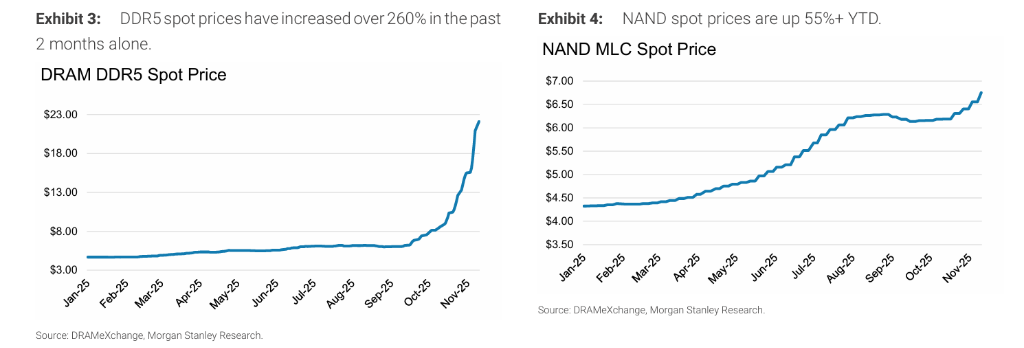
Core Viewpoint - The storage chip market is experiencing an unprecedented "super cycle" driven by AI demand and supply shortages, significantly impacting the profit outlook for PC and server manufacturers [1][3][4]. Group 1: Price Surge and Impact - Morgan Stanley warns that storage chip prices are skyrocketing due to AI demand and supply constraints, with DRAM spot prices soaring over 260% in just two months [1][5]. - The report indicates that the cost of storage chips (NAND and DRAM) constitutes 10%-70% of the BOM for high-end products, leading to a potential decline in hardware OEM gross margins by 45 to 150 basis points for every 10% increase in storage chip prices [3][6]. - The current price surge is unprecedented, with NAND flash prices rising over 50% since the beginning of the year [5][6]. Group 2: Drivers of Price Increase - The price surge is primarily driven by accelerated procurement from large cloud service providers for AI infrastructure, a spike in demand for high-bandwidth memory (HBM) for AI accelerators, and insufficient investment in NAND capacity over the past few years [6][10]. - Morgan Stanley predicts that contract prices for both NAND and DRAM could see double-digit percentage increases each quarter until 2026, far exceeding the previous cycle from 2016-2018 [6][10]. Group 3: Historical Context and Comparison - The previous storage super cycle from 2016 to 2018 serves as a reference point, where OEM margins and stock valuations began to decline 6 to 12 months after prices started to rise [8][10]. - Key differences in the current cycle include a more rapid price increase and a weaker demand environment for non-AI hardware compared to the previous cycle [10][11]. Group 4: Company Ratings and Vulnerabilities - Morgan Stanley has downgraded ratings for several major hardware companies, citing dual pressures on profits and valuations [12][13][14]. - Dell Technologies was downgraded from "Overweight" to "Underweight," with a target price cut from $144 to $110, due to significant impacts from rising storage costs [13]. - HP's rating was lowered from "Market Perform" to "Underweight," with a target price adjustment from $26 to $24, as profit margin pressures overshadow market recovery [14]. - Lenovo's rating was adjusted from "Overweight" to "Market Perform," as over 60% of its PC business targets the enterprise market, which is better positioned to pass on cost increases [17]. Group 5: Market Segmentation and Resilience - Different hardware manufacturers face varying levels of risk, with PC and server manufacturers more exposed due to their reliance on DRAM [18][20]. - Companies like Apple and Pure Storage are viewed as more resilient due to strong supply chain negotiation power and better pricing capabilities [20]. - Memory chip manufacturers such as Micron Technology, SK Hynix, and Samsung Electronics are expected to be direct beneficiaries of this super cycle [20].



存储芯片疯狂涨价,PC与服务器厂商受伤!大摩:每涨10%,OEM毛利率就下降45-150个基点
Hua Er Jie Jian Wen· 2025-11-17 09:01
Core Insights - A significant "super cycle" in storage chips is impacting the profit outlook for PC and server manufacturers, with Morgan Stanley warning of severe profit margin erosion due to skyrocketing storage chip prices [1][2][3] Price Surge and Market Dynamics - The current price surge in storage chips is driven by increased demand from AI infrastructure, a shift towards high bandwidth memory (HBM), and insufficient investment in NAND flash memory [2][7] - DRAM spot prices have surged over 260% in the past two months, while NAND flash prices have increased by over 50% since the beginning of the year [3][7] Historical Context and Comparison - The previous storage super cycle from 2016 to 2018 serves as a reference point, where OEM profit margins and stock valuations faced pressure after a similar price increase [9][11] - Key differences in the current cycle include a more rapid price increase and a weaker demand environment for non-AI hardware compared to the previous cycle [11][13] Impact on Hardware Manufacturers - Morgan Stanley has downgraded ratings for several global hardware giants, predicting dual pressure on profits and valuations [14] - PC and server manufacturers, particularly those heavily reliant on DRAM, are identified as the most vulnerable, with Dell, HP, Asus, and Acer being the most affected [15][17] Company-Specific Ratings Changes - Dell Technologies: Downgraded from "Overweight" to "Underweight," target price reduced from $144 to $110 due to severe impact from rising storage costs [17] - HP Inc.: Downgraded from "Market Perform" to "Underweight," target price lowered from $26 to $24 as profit margin pressures offset market recovery [17] - Asus: Downgraded from "Market Perform" to "Underweight," target price cut from NT$625 to NT$500 due to reliance on price-sensitive consumer markets [17] - Lenovo Group: Downgraded from "Overweight" to "Market Perform," with over 60% of its PC business targeting the enterprise market, which is better positioned to absorb cost increases [17]
涨价成掘金信号!公募选股看好“确定性+弹性”
证券时报· 2025-11-17 08:42
Core Viewpoint - The concept of price increases based on supply and demand has become a key logic for fund managers to outperform the market and identify potential high-growth stocks [1][2]. Group 1: Price Increase as a Signal for Investment - Price increases are viewed by fund managers as a sign of corporate expansion and competitive strength, often leading to excess returns [2]. - The price of Moutai liquor has risen from 499 RMB to approximately 1169 RMB from January 2011 to November 2023, significantly benefiting funds heavily invested in it [2]. - Companies like Bilibili, Meitu, and Tencent Music have also seen positive investment cycles due to membership price increases, with Meitu's net profit reaching 467 million RMB in the first half of the year, a 71.3% year-on-year increase [2]. Group 2: Risks of Price Decrease - The decline in prices can indicate either an industry recession or a competitive "elimination round," posing risks for non-leading companies [3]. - A notable example is the significant losses incurred by funds that invested heavily in Nayuki Tea during a price decline cycle, leading to its market value dropping to less than 2 billion HKD [3]. Group 3: Fund Flows and Market Trends - In a climate of rising risk aversion, companies with price increase expectations have become attractive investment targets [4]. - Recent data shows that the top-performing funds are concentrated in resource and new energy themes, with some funds achieving returns of up to 31% in a month due to price increases in related commodities [4]. Group 4: Sensitivity to Price Increase Logic - There has been a significant influx of funds into chemical ETFs, reflecting investor sensitivity to price increase logic, despite some ETFs experiencing net value losses earlier in the year [5]. - The asset size of the Jianxin Chemical ETF grew from 604 million RMB to 1.099 billion RMB from June to September 2023, indicating strong investor interest [5]. Group 5: Long-term Investment Strategies - Fund managers are focusing on sectors with price increase potential, such as non-ferrous metals, which are expected to see upward price trends due to supply constraints [6]. - The technology sector is also benefiting from price increases, with major memory suppliers planning to raise prices by up to 30% to meet the growing demand driven by AI [6]. Group 6: Caution in Competitive Industries - Some fund managers advocate for caution in industries experiencing price competition, such as the AI large model sector, where price reductions have been announced [7].

存储芯片板块冲高回落 迈为股份、诚邦股份跌超6%
Xin Lang Cai Jing· 2025-11-17 05:15
Group 1 - The storage chip sector experienced a sharp rise followed by a decline, with Maiwei Co., Ltd. and Chengbang Co., Ltd. both dropping over 6% [1] - Shannon Semiconductor fell more than 4%, while Jiangbolong, Haoshanghao, and Huahaikongke also saw declines [1]




市场冰火两重天!军工狂欢VS指数低迷,投资者如何应变?
Sou Hu Cai Jing· 2025-11-17 04:47
Group 1 - The global situation is changing significantly, with the prediction of a Federal Reserve rate cut in December dropping below 50%, indicating a bearish market outlook and potential impacts on financial markets [1] - The A-share market has shown signs of institutional reduction in positions, suggesting caution as funds may react to negative news this week [1] - The military industry is entering an upward cycle, with Q3 performance showing a narrowing year-on-year decline, and Q4 expected to see positive growth driven by "14th Five-Year Plan" orders and military trade catalysts [1] Group 2 - The military sector continues to perform strongly, with stocks like Aerospace Development and Changcheng Military Industry seeing significant gains, indicating a trend of improving quarterly results [3] - Retail concepts have surged, with notable increases in stocks like Dazhongfang and Dongbai Group, supported by a 2.9% year-on-year growth in social retail sales in October, totaling 46,291 billion yuan [3] - The storage chip sector has regained strength, with companies like Baiwei Storage and Puran Shares seeing over 10% increases, driven by Samsung's price hikes of 30% to 60% for server chips [3]


A股开盘速递 | 指数走势分化 军工板块逆势走强 多股直线涨停
智通财经网· 2025-11-17 01:57
Core Viewpoint - The market is experiencing fluctuations with mixed performance across major indices, highlighting sector-specific movements and investor sentiment shifts. Group 1: Market Performance - As of November 17, major indices showed weak fluctuations, with the Shanghai Composite Index down by 0.4%, while the Shenzhen Component and ChiNext Index saw slight increases of 0.16% and 0.18% respectively [1] - The military equipment sector saw significant gains, with companies like Great Wall Military Industry hitting the daily limit, and others such as Jianglong Shipbuilding and Northern Long Dragon also rising sharply [1][3] - The lithium battery sector rebounded strongly, with Shengxin Lithium Energy reaching the daily limit, and other companies like Rongjie Co., Tianqi Lithium, and Ganfeng Lithium following suit [1][4] Group 2: Sector Highlights - The aquaculture sector was active, with Guolian Aquatic Products hitting a 20% limit up, and other companies like Dahu Co. and Zhongshui Fishery also reaching their limits [1] - The storage chip sector showed an upward trend, with Baiwei Storage rising over 10%, alongside companies like Purun Co. and Shenkong Co. [1] Group 3: Individual Stock Focus - Contemporary Amperex Technology Co. (CATL) experienced a decline of over 4% as a major shareholder, Huang Shilin, plans to transfer 45.6324 million shares, representing 1% of the company's total share capital [1] Group 4: Institutional Insights - Huashan Securities noted that the market is entering a high-level fluctuation phase, with increased rotation among sectors, particularly in the AI industry, which may present better investment opportunities [2][6] - Citic Securities highlighted a decline in the A-share sentiment index, while emphasizing interest in sectors such as electric power, basic chemicals, and defense military [5][7] - The market is expected to continue showing rotation between technology and cyclical sectors, with a focus on industries like non-ferrous metals, coal, building materials, batteries, inverters, and storage devices [8]




手机厂商叫苦不迭!
是说芯语· 2025-11-17 00:44
Core Viewpoint - A sudden surge in storage chip prices is impacting the consumer electronics sector, particularly affecting major domestic smartphone manufacturers like Xiaomi, OPPO, and vivo, who are facing inventory shortages and rising costs due to nearly 50% price increases from major suppliers [1][2]. Group 1: Price Surge and Inventory Challenges - The price increase in storage chips is a result of a combination of industry cycles and supply-demand dynamics, following a prolonged downtrend where prices fell over 60% from 2023 to mid-2024 [1]. - Major smartphone manufacturers have adopted a conservative procurement strategy due to previous price declines, leading to an average inventory cycle of 1.5 to 2 months, with some DRAM inventories dropping to less than three weeks [2][4]. - The 50% price increase translates to an additional cost of 100 to 200 yuan per mid-range smartphone, significantly impacting profit margins already under pressure [2]. Group 2: Manufacturer Responses and Supply Chain Adjustments - Manufacturers are responding cautiously, with many opting to delay large-scale procurement and instead reallocating internal inventory and optimizing product configurations [4]. - Some manufacturers are negotiating with upstream suppliers for better pricing or installment agreements, while others with sufficient inventory are making small-scale purchases to mitigate future price increases [4]. - The price surge is prompting manufacturers to reassess their supply chain strategies, accelerating partnerships with domestic storage chip companies to reduce reliance on foreign suppliers [5]. Group 3: Broader Industry Implications - The price increase is affecting the entire supply chain, compressing margins for storage module manufacturers and leading to difficulties in order fulfillment for smaller firms [5]. - If smartphone manufacturers cannot absorb the increased costs, there may be price hikes for mid-range smartphones in the next 1 to 2 quarters, potentially affecting consumer purchasing behavior [5]. - Future price trends will depend on supply-demand dynamics, with predictions suggesting that prices may remain high through late 2024 to early 2025 due to ongoing production cuts by major suppliers [5].

内存条变身「电子茅台」,谁买单?
36氪· 2025-11-17 00:10
Core Viewpoint - The article discusses the significant price increase in memory products, particularly DRAM and SSDs, driven by a "super cycle" in the memory supply chain, influenced by the rise of AI and structural changes in global production capacity [5][17]. Group 1: Price Trends - The price of 16GB DDR4 memory has surged from around 200 RMB to over 400 RMB within a year, with some models increasing by more than 300% [10]. - High-end DDR5 memory prices have also doubled, with some models reaching nearly 2000 RMB, reflecting a 100% increase compared to two months prior [12]. - The average price of 1TB PCIe4.0 SSDs has risen over 60% since the beginning of the year, with some popular models seeing price hikes of 80% or more [14]. Group 2: Supply and Demand Dynamics - The demand for DRAM has surged due to the AI industry's growth, with AI servers requiring eight times more DRAM than standard servers [18]. - Major memory manufacturers like Samsung and SK Hynix are shifting production towards high-end chips, reducing the supply of DDR4, which is expected to remain tight until mid-2026 [21][23]. - The recovery of the consumer electronics market and the growth in smart vehicle technology are further exacerbating the supply-demand imbalance [24]. Group 3: Market Speculation - Speculative behavior in the memory market has amplified price volatility, with some dealers hoarding memory products in anticipation of price increases [25][27]. - The article warns that while there may be opportunities for profit, the risks associated with speculation in the memory market are significant, likening it to past gold market experiences [30][33]. Group 4: Future Outlook - The transition from DDR4 to DDR5 and HBM is irreversible, suggesting that prices will continue to rise as demand outstrips supply [29]. - Domestic memory manufacturers are expected to increase their market share significantly by 2025, indicating a potential shift in the competitive landscape [35].
年末避险情绪抬升 公募选股遵循涨价硬逻辑
Zheng Quan Shi Bao· 2025-11-16 17:58
Core Viewpoint - The concept of price increases based on supply and demand has become a key logic for fund managers to identify potential high-performing stocks, especially during year-end risk aversion periods [1][4]. Group 1: Price Increase as a Stock Selection Logic - Price increases are viewed as a strong indicator of corporate expansion and competitiveness, often leading to excess returns for investors [2][3]. - The price of Moutai liquor has risen from 499 yuan to approximately 1169 yuan from January 2011 to November 2023, significantly benefiting funds heavily invested in it [2]. - Internet companies like Bilibili, Meitu, and Tencent Music have also seen positive investment cycles due to membership price increases, with Meitu's net profit in the first half of this year reaching 467 million yuan, a year-on-year increase of 71.3% [2]. Group 2: Impact of Price Decrease on Investment Decisions - The decline in prices within certain industries can signal dangerous trends for non-leading companies, as it may indicate either a recession or a competitive "elimination round" [3]. - Funds that heavily invested in Nayuki Tea faced significant losses as the industry entered a price-cutting phase, leading to its removal from major fund holdings [3]. Group 3: Fund Flows and Market Trends - The expectation of price increases has attracted significant capital into specific sectors, particularly during times of heightened risk aversion [4][5]. - Recent data shows that funds focused on resource themes and new energy have performed well, with some achieving returns of up to 31% in the past month, closely linked to price increase news in related industries [4]. - The rapid growth of chemical ETFs, despite previous underperformance, indicates strong investor sensitivity to price increase logic [5][6]. Group 4: Long-term Investment Strategies - Fund managers emphasize the importance of price increase logic in their investment strategies, particularly in sectors like non-ferrous metals, where supply constraints are expected to drive prices higher [7]. - In the technology sector, rising prices for memory chips, driven by increased demand from AI applications, are expected to support strong performance in tech growth stocks [7].