有色金属

Search documents
哪些板块会成为马年的资产配置“黑马”? | 策马点金
Qi Huo Ri Bao· 2026-02-23 00:04
Group 1 - The core viewpoint is that the domestic market has entered a re-inflation trading phase since 2024, driven by macroeconomic policies and changes in the Federal Reserve's monetary policy, leading to a re-evaluation of asset values in the Greater China region [3] - The market is expected to see a strong performance in the stock market, particularly in the technology sector, while the commodity market is experiencing a strong performance in the metals sector [3] - Two clear directions for the market in the upcoming year include the continued positive environment for domestic assets due to the appreciation of the RMB and a likely rebalancing process in the market as financial assets see significant price increases [3] Group 2 - The energy sector is identified as a potential "dark horse" for asset allocation in the upcoming year, with the possibility of a market shift driven by geopolitical developments [5] - The agricultural products sector is also highlighted, as its low valuation and correlation with the energy sector may provide opportunities for growth, especially in light of potential geopolitical tensions affecting food prices [6] - The black metal sector may see a breakthrough if domestic economic policies shift towards expanding domestic demand, potentially revitalizing the real estate and construction industries [6] Group 3 - Recommendations for high-net-worth traders include diversifying their asset allocation to manage risk while capitalizing on market trends, while ordinary traders are advised to avoid high-risk positions and focus on assets with a safety margin [7]
智通港股通资金流向统计(T+2)|2月23日
智通财经网· 2026-02-22 23:33
Core Insights - Tencent Holdings (00700), Xiaomi Group-W (01810), and Meituan-W (03690) ranked as the top three in net inflow of southbound funds, with net inflows of 1.457 billion, 1.029 billion, and 1.022 billion respectively [1] - WuXi Biologics (02269), Zijin Mining (02899), and Southern Hengtong Technology (03033) experienced the highest net outflows, with net outflows of -493 million, -457 million, and -363 million respectively [1] - In terms of net inflow ratio, Southern East Selection (03441), Yuan Da Pharmaceutical (00512), and Anhui Wanshan Expressway (00995) led the market with ratios of 1937.29%, 149.39%, and 144.79% respectively [1] Net Inflow Rankings - Tencent Holdings (00700) had a net inflow of 1.457 billion, representing an increase of 11.22% with a closing price of 548.000 [2] - Xiaomi Group-W (01810) saw a net inflow of 1.029 billion, with a net inflow ratio of 12.46% and a closing price of 37.100 [2] - Meituan-W (03690) recorded a net inflow of 1.022 billion, with a significant net inflow ratio of 30.48% and a closing price of 88.850 [2] Net Outflow Rankings - WuXi Biologics (02269) faced a net outflow of -493 million, with a net outflow ratio of -34.59% and a closing price of 41.400 [2] - Zijin Mining (02899) had a net outflow of -457 million, reflecting a -13.09% change with a closing price of 43.520 [2] - Southern Hengtong Technology (03033) experienced a net outflow of -363 million, with a net outflow ratio of -8.41% and a closing price of 5.380 [2] Net Inflow Ratio Rankings - Southern East Selection (03441) led with a net inflow ratio of 1937.29%, achieving a net inflow of 188 million and a closing price of 11.650 [3] - Yuan Da Pharmaceutical (00512) followed with a net inflow ratio of 149.39%, with a net inflow of 30.408 million and a closing price of 7.780 [3] - Anhui Wanshan Expressway (00995) had a net inflow ratio of 144.79%, with a net inflow of 12.383 million and a closing price of 13.580 [3]




A股市场点评资源类板块表现突出
Zhongshan Securities· 2026-02-22 06:35
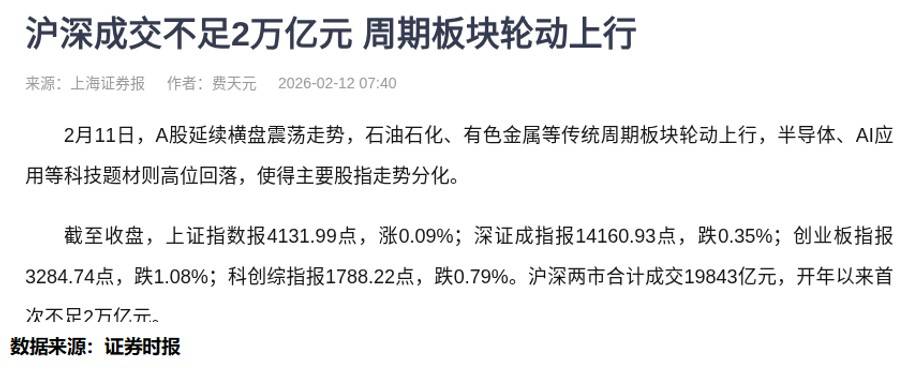
Market Performance - On February 11, the Shanghai Composite Index increased by 0.09%, while the Shenzhen Component Index decreased by 0.35%[3] - The resource sector showed strong performance, with the top-performing industries including construction materials (+3.29%) and non-ferrous metals (+2.39%) while the communication sector fell by 2.17%[3] Economic Indicators - The Consumer Price Index (CPI) rose by 0.2% month-on-month and year-on-year, with the core CPI (excluding food and energy) increasing by 0.8%[6] - The Producer Price Index (PPI) increased by 0.4% month-on-month but decreased by 1.4% year-on-year, indicating a weak overall price level[6] Government Initiatives - The Chinese government announced a budget of 20.5 billion yuan for consumer incentives during the Spring Festival, including vouchers and subsidies[5] - An additional 625 billion yuan in national subsidies has been allocated to support local consumer spending during the holiday period[5] Market Outlook - The market is expected to continue a volatile consolidation pattern, with trading activity likely to decrease as the Spring Festival approaches[7] - Systemic risks in the market are considered limited due to government policies aimed at maintaining stability and positive consumer expectations[9]
2020-2026年1月下旬锌锭(0#)市场价格变动统计分析
Chan Ye Xin Xi Wang· 2026-02-22 03:55
Core Insights - The report by Zhiyan Consulting forecasts the market development status and competitive landscape of the non-ferrous metals industry in China from 2026 to 2032 [1] Price Trends - The market price of zinc ingot (0) in late January 2026 is projected to be 24,728.6 yuan per ton, reflecting a year-on-year increase of 3.32% and a month-on-month increase of 0.64% [1] - Over the past five years, the highest price for zinc ingot (0) was recorded in late January 2022, reaching 24,920 yuan per ton [1]


板块轮动加速,但节前缩量背后有什么名堂?
Sou Hu Cai Jing· 2026-02-22 00:30
Market Overview - The A-share market is currently experiencing a sideways fluctuation, with traditional cyclical sectors like oil and non-ferrous metals showing upward movement, while technology sectors such as semiconductors and AI applications are retreating from high levels [1] - The trading volume in the Shanghai and Shenzhen markets has narrowed to below 2 trillion yuan [1] - The chemical sector is active due to changes in the supply-demand dynamics of specific products, with some stocks reaching high prices for four consecutive trading days [1] - The commercial aerospace concept has shown localized movements due to breakthroughs in key industry experiments [1] Investment Trends - Multiple institutions have observed a high probability of market style switching around the Spring Festival, with value and large-cap styles expected to dominate before the holiday, while growth and small-cap styles may perform better afterward [1] - Key focus areas include the AI industry chain, companies going overseas, and resource price increases [1] Behavioral Analysis - In a high-volatility environment, many market participants rely solely on price trends, often falling into a cycle of chasing gains and cutting losses [1] - Quantitative big data provides a new and more reliable perspective for observing core market behaviors, moving beyond subjective experience [1] Institutional Participation - Data shows that institutional funds remain actively engaged even during price adjustments, indicating core support for market continuity [5] - The behavior of institutional funds can validate the internal continuity of market trends, eliminating judgment interference caused by price fluctuations [8] Market Dynamics - During periods of price increases, some stocks experience significant adjustments, leading to misjudgments about the end of trends, which can cause participants to exit prematurely [3][11] - Weak rebounds in certain technology stocks lack institutional support, indicating low continuity in these price movements [11][14] Data-Driven Investment Insights - The use of quantitative big data allows for capturing the behavior characteristics of funds, providing a more objective and quantifiable observation dimension [14] - This approach helps participants avoid the pitfalls of traditional price-based judgments and fosters a data-centric investment recognition system [14]
河南连续两年举办高规格餐叙,释放什么信号
He Nan Ri Bao· 2026-02-21 22:43
Core Viewpoint - The article highlights the significance of the annual "破五" gathering in Henan, where provincial leaders engage with private enterprise representatives, signaling strong governmental support for the private sector and the commitment to high-quality economic development in the province [2][4]. Group 1: Event Overview - On February 21, the provincial leaders hosted a high-profile dinner with 17 representatives from prominent private enterprises in Henan, emphasizing the importance of this traditional event [2][3]. - The participating companies include major players such as Muyuan Foods, Luoyang Molybdenum, and Mijia Ice City, showcasing a diverse range of industries from agriculture to technology [3]. Group 2: Government Support and Policies - The provincial government has implemented a series of measures to promote high-quality development of the private economy, including the release of the "Henan Province Action Plan for Promoting High-Quality Development of the Private Economy" [5]. - The establishment of a leadership group co-chaired by the provincial governor and secretary aims to ensure the effective implementation of these policies [5][6]. Group 3: Economic Contributions - The private sector in Henan contributes over 55% of the province's GDP, approximately 65% of tax revenue, and 70% of total imports and exports, highlighting its critical role in the local economy [6]. - In 2025, Henan's GDP is projected to exceed 6.66 trillion yuan, with a year-on-year growth rate of 5.6%, indicating robust economic performance compared to other major provinces [6]. Group 4: Future Outlook - The gathering is expected to bolster the confidence of private entrepreneurs in Henan, providing them with the motivation to innovate and expand their market presence [6].
连续两年,省委书记、省长在正月初五“请客”
Xin Lang Cai Jing· 2026-02-21 16:12
Core Viewpoint - The article highlights the ongoing efforts of the Henan provincial government to strengthen relationships with private enterprises and promote the development of the private economy through various initiatives and policies [1][2][8]. Group 1: Government Engagement with Private Enterprises - The Henan provincial government hosted a dinner for private entrepreneurs, marking the second consecutive year of this initiative [1]. - A total of 17 private entrepreneurs attended the dinner, with two new participants compared to the previous year [2]. - Key representatives included Qin Yinglin from Muyuan Foods, the world's largest pig farming company, and Zhang Hongfu from Mixue Ice City, a leading player in the new consumption sector [2]. Group 2: Economic Performance and Growth - In 2025, Henan's GDP is projected to reach 6.66 trillion yuan, with a growth rate of 5.6%, ranking third nationally and first among central provinces [7]. - Private investment in Henan increased by 7.3% from January to October last year, surpassing the national average by 11.8 percentage points [7]. - The province has 11.605 million business entities, with over 95% being private enterprises [7]. Group 3: Policy Initiatives and Support - The Henan government has established a leadership group to promote high-quality development of the private economy, involving multiple government departments [3][4]. - A series of supportive policies have been implemented, including measures to optimize government services and promote fair competition [5]. - The new revised "Henan Province Optimizing Business Environment Regulations" will take effect on March 1, providing legal support for the private economy [5]. Group 4: Future Outlook and Encouragement - The provincial leaders emphasized the importance of a favorable business environment and ongoing policy support to encourage private enterprises to thrive [8]. - There is a call for private entrepreneurs to maintain confidence in development and take on significant responsibilities in driving economic growth [8].
美国1750亿美元关税退税,对A股的影响(附50股)
Sou Hu Cai Jing· 2026-02-21 11:41
Group 1 - The core point of the article is that the recent US Supreme Court ruling on the $175 billion tariff refund has significant implications for both China and the A-share market, despite the refund being an internal US matter [2][6][28] - The $175 billion in tariffs was primarily collected from imports, including a 10% tariff on Chinese goods, and is now being refunded to US importers [8][10] - The refund will indirectly benefit Chinese companies as US importers, who have been financially strained by tariffs, will use the refunded money to pay off debts to Chinese suppliers and resume orders [12][14][28] Group 2 - The immediate impact on the A-share market is expected to be positive, with a potential "opening red" for A-shares as market sentiment improves following the ruling [40][46] - The ruling is seen as a signal that the previous high tariffs on Chinese goods may not be a permanent state, which could lead to a more favorable environment for Chinese exports [20][48] - Structural opportunities in the A-share market are identified, focusing on five main lines: export-oriented sectors, domestic substitution, strategic resources, domestic consumption, and new energy [51][62][88] Group 3 - Export-oriented sectors, particularly those with high exposure to the US market, are expected to benefit directly from the tariff refunds, with companies like Midea Group and Haier expected to see improved performance [52][72][73] - Domestic substitution and self-sufficiency in sectors like semiconductors and military equipment are highlighted as long-term strategic focuses, with companies like SMIC and AVIC Shenyang Aircraft being key players [53][78][86] - Strategic resources such as rare earths and gold are also expected to see price support due to ongoing global supply chain disruptions, benefiting companies like Northern Rare Earth and Shandong Gold [56][87]





黄金涨完有色涨,2026年这波行情能持续多久?答案可能出乎你意料
Sou Hu Cai Jing· 2026-02-21 09:57
Core Viewpoint - The article emphasizes that the investment opportunities in the non-ferrous metals sector will continue into 2026, driven by inflation, resource scarcity, and expected interest rate cuts by the Federal Reserve. Group 1: Inflation and Resource Demand - The article highlights that inflation has surged due to unprecedented monetary expansion by central banks, leading to a significant increase in the prices of commodities, particularly non-ferrous metals like copper and silver [2][3]. - The demand for industrial metals is expected to remain robust due to the growth in AI infrastructure and renewable energy investments, with companies like Google and Amazon planning to invest heavily in AI-related capital expenditures [3][4]. Group 2: Federal Reserve's Interest Rate Policy - The article discusses the anticipated interest rate cuts by the Federal Reserve, with market expectations suggesting a reduction of 50 basis points in 2026, which would likely weaken the dollar and boost commodity prices [4][5]. - The dynamics between former President Trump and Fed Chair Powell are noted, indicating a potential shift in monetary policy that could favor lower interest rates [4]. Group 3: Market Trends and Investment Strategies - The article suggests that while the copper market may experience short-term fluctuations due to increased inventory levels, the long-term demand remains strong, and investors should look for entry points during price corrections [6][8]. - The small metals market, particularly tungsten and antimony, is highlighted as having significant growth potential due to supply constraints and strategic importance, with prices already showing substantial increases [7][8]. Group 4: Investment Approaches - The article recommends using ETFs as a way to mitigate risks associated with individual stock selection in the non-ferrous metals sector, allowing investors to benefit from overall market trends without the need for extensive research [9][10]. - It emphasizes the importance of maintaining a disciplined investment strategy, focusing on long-term trends rather than short-term market fluctuations [11][12].
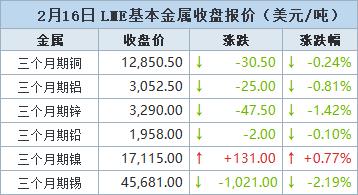
期铜在清淡市况中收跌,焦点转向库存增加【2月16日LME收盘】
Wen Hua Cai Jing· 2026-02-21 02:08
Core Viewpoint - LME copper prices weakened due to a strong dollar, increased inventories, and weak demand outlook during the holiday trading period [1][3]. Group 1: Market Conditions - On February 16, LME three-month copper fell by $30.5, or 0.24%, closing at $12,850.5 per ton [1][2]. - The market experienced low trading volumes due to the Chinese New Year holiday and a public holiday in the U.S. [3]. - Market liquidity was reported to be uneven, with many participants waiting for clearer signals regarding U.S. interest rates and potential demand from China post-holiday [3]. Group 2: Inventory Focus - LME copper inventories increased by 7,975 tons, or 3.91%, reaching 211,850 tons, marking an increase of over 50% since January 9 [3]. - The ample inventory led to a situation where the LME spot month copper contract was at a discount to the three-month copper contract, with the discount reaching approximately $111.50 per ton, a one-year high [3]. Group 3: Other Base Metals - LME three-month aluminum decreased by $25, or 0.81%, closing at $3,052.5 per ton [2][4]. - LME three-month zinc fell by $47.5, or 1.42%, closing at $3,290.0 per ton [4]. - LME three-month lead dropped by $2, or 0.1%, closing at $1,958.0 per ton [4]. - LME three-month nickel rose by $131, or 0.77%, closing at $17,115.0 per ton [4]. - LME three-month tin decreased by $1,021, or 2.19%, closing at $45,681.0 per ton [4].