
食品饮料

Search documents
香飘飘:2025年度净利润预计为1.02亿到1.25亿元
Bei Jing Shang Bao· 2026-01-30 11:31
Core Viewpoint - Xiangpiaopiao announced an expected decline in net profit and revenue for the year 2025, primarily due to a decrease in sales of traditional brewing products [1] Financial Performance - The company anticipates a net profit attributable to shareholders of between 102 million to 125 million yuan for 2025, representing a year-on-year decrease of approximately 50.59% to 59.68% [1] - Expected operating revenue for the same period is around 2.927 billion yuan, which is about a 10.95% decrease compared to the previous year [1] Sales Dynamics - The decline in performance is attributed to a drop in sales of traditional brewing products, which typically see peak sales around the Chinese New Year [1] - The sales window for these products is affected by the timing of the Chinese New Year, with 2025 seeing an earlier celebration and 2026 a later one, leading to a shortened sales period in both the first and fourth quarters of 2025 [1]

好想你发布2025年度业绩预告:预计实现归母净利润超7.5亿
Quan Jing Wang· 2026-01-30 10:41
Core Viewpoint - The company "好想你" (002582) forecasts a net profit of 750 million to 950 million yuan for the fiscal year 2025, driven by strategic operational initiatives and cost control measures [1] Group 1: Financial Performance - The projected net profit for 2025 is between 750 million and 950 million yuan [1] - The company has implemented cost control measures, including precise procurement of raw materials and refined production management, leading to a steady increase in gross margin [1] Group 2: Product Innovation and Development - Since 2025, the company has increased investment in product innovation and technology research, launching several new products that meet diverse consumer demands for health foods [2] - Key technologies such as "black processing of red dates" and "medicinal and food dual-purpose freeze-dried instant powder" have passed scientific achievement evaluations, reinforcing the company's R&D capabilities [2] Group 3: Sales and Channel Expansion - The company is enhancing its sales channels by upgrading offline stores and traditional supermarkets while actively expanding into emerging channels [2] - Strategic partnerships with high-potential supermarkets and a focus on mainstream e-commerce platforms have improved channel efficiency and product reach [2] Group 4: Brand Development - The company emphasizes cultural content and heritage craftsmanship to strengthen its brand image as "the expert in red dates" [2] - The brand's core message revolves around "Eastern date gifts, Central Plains sentiments," enhancing its cultural depth and consumer connection [2] Group 5: Market Outlook - The company anticipates continued strong sales during the 2026 consumption peak, with core products like black dates and pitted dates leading the market [3] - Future strategies will focus on functional innovation and scenario-based extensions of products, leveraging modern food technology to meet specific health needs [3]

好想你:2025年预盈7.5亿元~9.5亿元 同比扭亏为盈
Mei Ri Jing Ji Xin Wen· 2026-01-30 10:40
每经AI快讯,好想你(002582)1月30日发布业绩预告,预计2025年归母净利7.5亿元~9.5亿元,同比扭 亏为盈,上年同期亏损7195.77万元。报告期内,公司通过红枣原料精准采购、生产精细化管理等措 施,控制生产成本,毛利率提升。报告期内,公司非经常性损益大幅增加主要系参股公司鸣鸣很忙公允 价值变动所致。 ...
好想你:预计2025年净利润7.5亿元-9.5亿元,同比扭亏为盈
Di Yi Cai Jing· 2026-01-30 10:38
(本文来自第一财经) 好想你公告,预计2025年度归属于上市公司股东的净利润为7.5亿元-9.5亿元,上年同期亏损7195.77万 元。报告期内,公司优化产品清单管理,聚焦核心品类,持续创新升级,提升产品品质,拓展销售渠 道,优化收入结构。通过红枣原料精准采购、生产精细化管理等措施,控制生产成本,毛利率提升。报 告期内,公司非经常性损益大幅增加主要系参股公司湖南鸣鸣很忙商业连锁股份有限公司公允价值变动 所致。 ...
好想你:2025年全年预计净利润7.50亿元—9.50亿元
2 1 Shi Ji Jing Ji Bao Dao· 2026-01-30 10:26
南财智讯1月30日电,好想你发布年度业绩预告,预计2025年全年归属于上市公司股东的净利润为 75,000万元—95,000万元;预计2025年全年归属于上市公司股东的扣除非经常性损益的净利润为亏损 5,000万元—8,000万元。报告期内,公司围绕"四个坚持"不动摇,深入实施"十大经营发展战略",优化 产品清单管理,聚焦核心品类,持续创新升级,提升产品品质,拓展销售渠道,优化收入结构。通过红 枣原料精准采购、生产精细化管理等措施,控制生产成本,毛利率提升。报告期内,公司非经常性损益 大幅增加主要系参股公司湖南鸣鸣很忙商业连锁股份有限公司(以下简称"鸣鸣很忙")公允价值变动所 致。 ...
走访上市公司 推动上市公司高质量发展系列(三十三)
证监会发布· 2026-01-30 10:16
Core Viewpoint - The article emphasizes the efforts of Hebei Securities Regulatory Bureau in enhancing the quality and efficiency of listed companies through comprehensive and targeted visits, aiming for high-quality development in the capital market [2]. Group 1: Regulatory and Service Integration - Hebei Securities Regulatory Bureau has prioritized the visitations to listed companies, establishing a comprehensive visiting mechanism that covers all listed companies in the region, ensuring effective understanding of their operational status and addressing their issues [4][9]. - A collaborative mechanism has been formed with various departments and financial institutions to enhance the support for listed companies, creating a multi-faceted service ecosystem involving regulators, government, exchanges, financial institutions, and media [6][10]. Group 2: Problem-Solving and Empowerment - The bureau focuses on addressing the urgent and challenging issues faced by companies, conducting targeted visits to key industries such as electronics and biomedicine, and facilitating solutions to enhance strategic emerging industries [8][12]. - In 2025, 64 listed companies in the region implemented cash dividends totaling 24.652 billion, a 14.70% increase year-on-year, indicating a rising level of shareholder returns [9]. Group 3: Innovative Approaches and Efficiency - The bureau has introduced an integrated approach combining visits and inspections to enhance efficiency, allowing for immediate guidance on minor compliance issues and reducing disruptions to normal business operations [11]. - Training programs have been conducted to improve governance and operational standards among listed companies, with nearly 3,000 participants from 993 companies involved [11]. Group 4: Future Outlook - The bureau plans to continue its regular visitation mechanism, focusing on tracking the progress of issues raised by companies and enhancing collaboration with local governments to ensure effective resolution of various demands [12][28].


氪星晚报|苹果收购人工智能初创公司;诺和诺德中国区总裁将离职;SpaceX发布空间态势感知系统Stargaze
3 6 Ke· 2026-01-30 09:57
Group 1: Company Performance Forecasts - Datang Power is expected to achieve a net profit attributable to shareholders of approximately 6.8 billion to 7.8 billion RMB in 2025, representing a year-on-year increase of about 51% to 73% [1] - Qiaqia Food anticipates a net profit of 300 million to 320 million RMB in 2025, reflecting a year-on-year decline of 62.33% to 64.68% due to rising raw material procurement costs [2] - New Hope forecasts a net loss of 15 billion to 18 billion RMB in 2025, a shift from a profit of 474 million RMB in the previous year, primarily due to a significant drop in pig prices [3] - Great Wall Motors expects a net profit of 9.912 billion RMB in 2025, a year-on-year decrease of 21.71%, despite a 10.19% increase in total revenue to 222.79 billion RMB [4] Group 2: Strategic Developments - Starbucks plans to add over 2,000 net new stores globally by the 2028 fiscal year, including approximately 400 new stores in the U.S., with a target of at least 5% revenue growth [4] - Kimi reports that its overseas revenue has surpassed domestic revenue, with a fourfold increase in global paid users following the release of its new model K2.5 [6] - Deckers Brands announced a revenue of 1.96 billion USD for the third quarter of the 2026 fiscal year, a 7% increase year-on-year, with HOKA brand sales growing by 18.5% [7] Group 3: Mergers and Acquisitions - Apple has acquired an AI startup, Q.ai, which specializes in "silent" communication technology, enhancing its capabilities in non-verbal communication interpretation [10] Group 4: Market Insights - Morgan Stanley predicts that gold prices could rise to between 8,000 and 8,500 USD in the coming years, driven by retail investors seeking gold as a hedge against stock market declines [13]
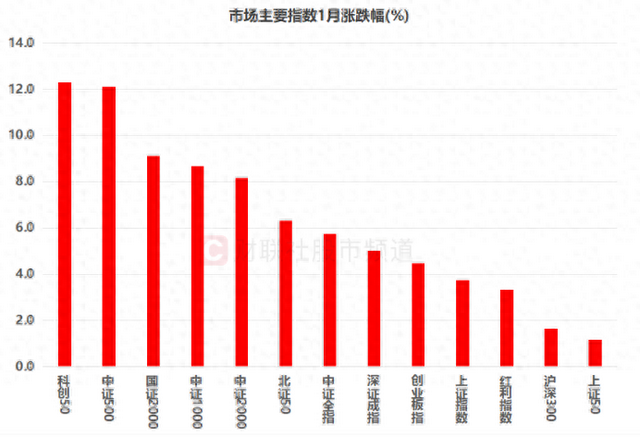
开年首月A股盘点:个股平均上涨7.8%,科创、中盘成关键点,红利资产跑输市场
Xin Lang Cai Jing· 2026-01-30 09:28
Market Overview - The A-share market closed with an overall increase in January 2026, with major indices recording gains, particularly the Sci-Tech Innovation 50 Index leading the market [1] - Excluding new stocks, the average increase for individual stocks was nearly 7.8%, with a median increase of approximately 4.9% [1] Index Performance - There was a notable divergence in performance between large-cap and small-cap stocks, with small-cap indices like the Guozheng 2000 and CSI 2000 rising by 9.13% and 8.16% respectively, while large-cap indices such as the SSE 50 and CSI 300 had gains of less than 2% [3] - Among the 12 stocks with a market capitalization exceeding 1 trillion yuan, three-quarters experienced declines, with a median drop of 4.6% [3] Individual Stock Performance - Major banks such as Industrial and Commercial Bank of China, Agricultural Bank of China, and China Construction Bank saw declines of 8.58%, 12.50%, and 6.03% respectively [4] - Conversely, China Life Insurance recorded a gain of 9.27%, while Kweichow Moutai increased by 1.73% [4] Market Capitalization Analysis - In the small-cap segment, 78.7% of stocks with a market capitalization below 5 billion yuan increased, with an average gain of 7.8% and a median gain of nearly 5.8% [5] - Mid-cap stocks, particularly those with market capitalizations between 50 billion and 100 billion yuan, performed actively with an average increase of nearly 9% [5] ETF Trends - The performance of dividend-related ETFs showed divergence, with the low-volatility dividend ETF from Huatai-PB increasing by 8.00%, while the dividend ETF from Wanji recorded a decrease of 14.88% [7] Historical Trends - Historically, the Shanghai Composite Index has shown an 80% increase rate in February over the past decade, with an average gain of 2.1% [8] - In the past ten years, 30 out of 31 sectors in the Shenwan first-level classification recorded gains in February, with the banking sector slightly declining by about 0.3% [10]
中银量化多策略行业轮动周报–20260129-20260130
Bank of China Securities· 2026-01-30 09:03
Core Insights - The report highlights the current industry allocation of the Bank of China’s multi-strategy system, with the highest weights in basic chemicals (22.3%), telecommunications (14.0%), and building materials (11.0) [1] - The average weekly return for the CITIC primary industries was 0.4%, with a one-month average return of 6.3% [3][10] - The report indicates that the composite strategy achieved a cumulative return of 1.0% this week, outperforming the CITIC primary industry equal-weight benchmark by 0.5% [3] Industry Performance Review - The top three performing industries this week were non-ferrous metals (15.6%), petroleum and petrochemicals (7.3%), and food and beverage (4.5%) [3][10] - The bottom three performing industries were defense and military (-3.7%), automotive (-3.5%), and home appliances (-2.5%) [10] - The report provides detailed weekly and monthly performance data for each industry, indicating a mixed performance across sectors [11] Valuation Risk Warning - The report employs a valuation warning system based on the PB ratio over the past six years, identifying industries with high valuation risks [12] - Industries currently flagged for high valuation include retail, computers, non-ferrous metals, defense and military, petroleum and petrochemicals, electronics, media, machinery, steel, and composite industries, all exceeding the 95th percentile of historical PB valuations [12][13] Single Strategy Rankings and Recent Performance - The report outlines the top three industries based on the S1 high prosperity industry rotation strategy: telecommunications, basic chemicals, and coal [15] - The S2 implied sentiment momentum strategy ranks the top three industries as basic chemicals, building materials, and telecommunications [19] - The S3 macro style rotation strategy identifies the top six industries as banking, petroleum and petrochemicals, coal, home appliances, non-ferrous metals, and construction [23] Strategy Composite - The report details the composite strategy's adjustments, indicating a significant increase in positions within the TMT sector while reducing exposure to consumer and financial sectors [3] - The report emphasizes the importance of monitoring macroeconomic indicators and their correlation with industry performance to optimize investment strategies [21][22]
食品饮料行业双周报(2026、01、16-2026、01、29):市场波动短期增加,关注春节需求表现-20260130
Dongguan Securities· 2026-01-30 08:47
Investment Rating - The report maintains an "Overweight" rating for the food and beverage industry, expecting the industry index to outperform the market index by over 10% in the next six months [48]. Core Insights - The SW food and beverage industry index rose by 2.31% from January 16 to January 29, outperforming the CSI 300 index by approximately 2.26 percentage points [10][11]. - Approximately 61% of stocks in the industry recorded positive returns during the same period, with notable gainers including Guyue Longshan (+17.73%) and Zhongxin Niya (+16.55%) [14]. - The industry valuation is currently at a PE (TTM) of approximately 20.94 times, which is below the five-year average of 31 times [17]. Summary by Sections Market Review - The SW food and beverage industry outperformed the CSI 300 index, with a rise of 2.31% from January 16 to January 29, ranking tenth among the Shenwan first-level industries [10]. - Most sub-sectors outperformed the CSI 300 index, with the other liquor sector seeing the highest increase of 6.85% [11]. - About 61% of stocks in the industry achieved positive returns, with significant increases from stocks like Guyue Longshan and Zhongxin Niya [14]. Industry Data Tracking Liquor Sector - The price of Feitian Moutai increased to 1580 RMB per bottle, up 60 RMB from January 15, while the price of Guojiao 1573 rose to 850 RMB per bottle [20]. Seasoning Sector - The price of soybeans was 4188.20 RMB per ton, down 2.35% month-on-month, while the price of white sugar decreased to 5320.00 RMB per ton [23]. Beer Sector - The average price of barley was 2210.00 RMB per ton, up 5.00 RMB from January 15, and aluminum ingot prices rose to 24810.00 RMB per ton, an increase of 590.00 RMB [28]. Dairy Sector - The average price of fresh milk was 3.04 RMB per kilogram, a slight increase from the previous period [34]. Meat Products Sector - The average wholesale price of pork was 18.60 RMB per kilogram, up 0.60 RMB from January 15 [36]. Industry News - The retail sales of tobacco and alcohol grew by 2.7% in 2025, totaling 642.5 billion RMB [38]. - The beer import volume decreased by 9.2% in 2025, while exports increased by 14.4% [39]. - The average wholesale price index for national liquor decreased by 0.47% in mid-January [40]. - The revenue of the liquor, beverage, and refined tea manufacturing industry fell by 4.4% in 2025 [41]. Weekly Industry Outlook - Market volatility is expected to increase in the short term, with a focus on the performance of demand during the Spring Festival [45]. - The report suggests monitoring high-end liquor stocks like Guizhou Moutai and Shanxi Fenjiu, as well as other sectors benefiting from demographic policies [45][46].
