
农产品加工等

Search documents
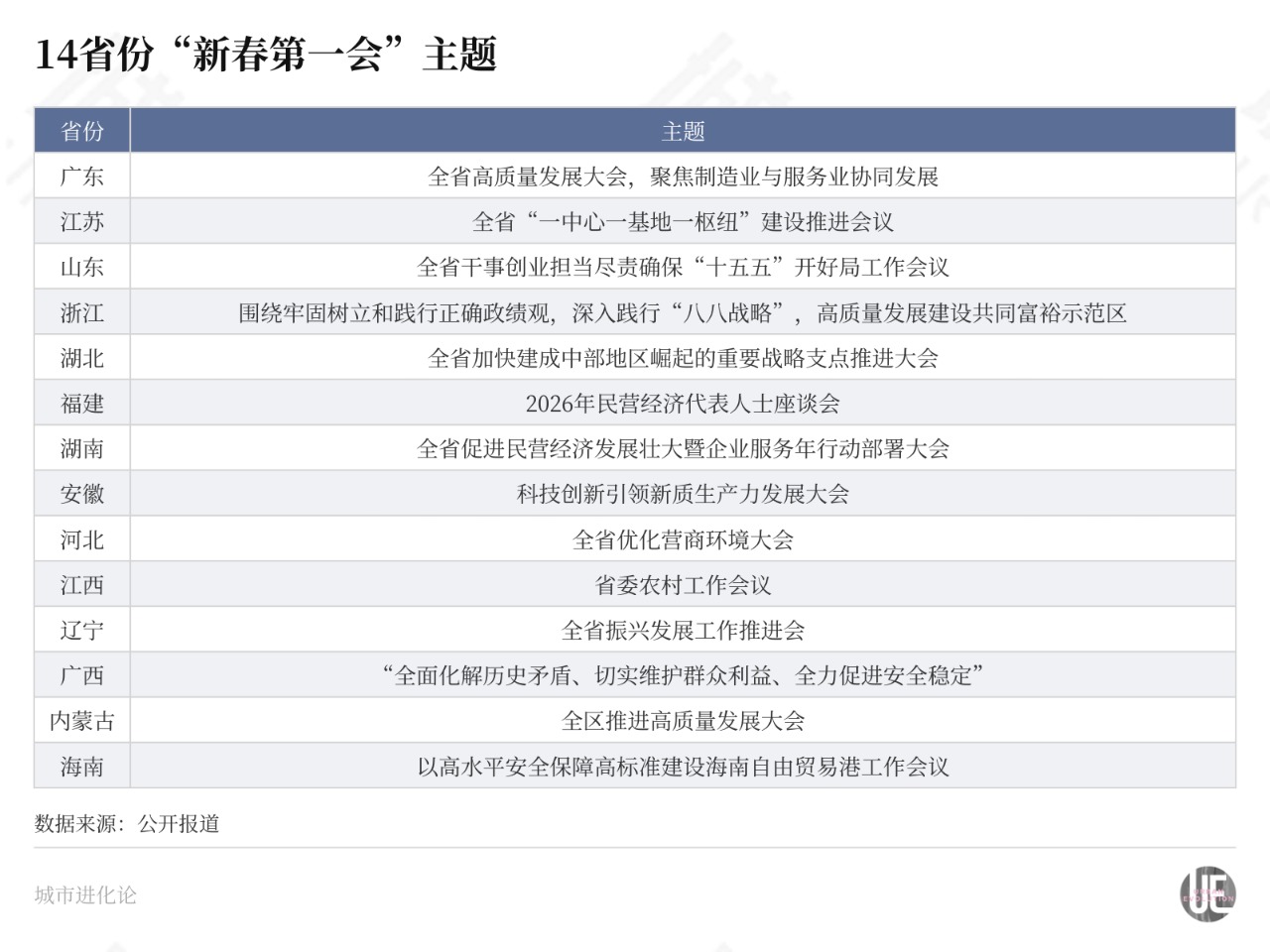
14省份“新春第一会” 传递出哪些信号?
Mei Ri Jing Ji Xin Wen· 2026-02-24 14:32
Core Insights - The "New Spring First Meeting" held across various provinces serves as a significant indicator for observing development trends and setting strategic directions for the year, particularly at the start of the "14th Five-Year Plan" [1] Group 1: Industry Upgrades - Guangdong's focus on the synergy between manufacturing and service industries highlights the importance of a modern industrial system as a foundation for China's modernization, with a GDP of 14.58 trillion yuan, maintaining the top economic position for 37 consecutive years [3][4] - The need for Guangdong to ascend the "smile curve" of industry, emphasizing advanced R&D and precise brand marketing, is crucial for overcoming current challenges in high-quality development [4][5] - Other provinces like Anhui and Hubei are also prioritizing technological innovation and new industries, with Anhui targeting quantum technology and biomanufacturing as future growth points [6][7] Group 2: Strategic Implementation - Hubei's strategic focus on becoming a key support point for central region development emphasizes specific goals such as increasing the number of large enterprises and enhancing infrastructure [7][8] - Liaoning's emphasis on project-driven growth aims to address investment declines and stimulate economic activity through effective project management and collaboration across industries [9] Group 3: Private Economy - The importance of a favorable business environment is underscored as a core competitive advantage for regional high-quality development, particularly in older industrial bases [10] - Provinces like Hebei and Hunan are actively working to improve their business environments, with Hebei aiming for a significant increase in private sector contributions to GDP by 2025 [12][13] - Fujian's initiatives to enhance the business environment have led to substantial growth in private enterprises, contributing significantly to innovation and economic activity [14]

“十五五”首个中央一号文件发布
证券时报· 2026-02-03 10:52
Core Viewpoint - The article emphasizes the importance of agricultural and rural modernization as a foundation for China's overall modernization, highlighting the need for comprehensive rural revitalization and the implementation of effective agricultural policies to ensure food security and improve farmers' livelihoods [1][3]. Group 1: Agricultural Production Capacity and Quality - The goal is to stabilize grain production at around 1.4 trillion jin, implementing actions to enhance grain capacity and optimize agricultural production structures [4]. - The focus is on improving the quality and efficiency of the "vegetable basket" industry, ensuring a balanced supply of meat and dairy products, and enhancing food safety measures [5]. - There is a commitment to protecting arable land and improving its quality, with strict management of land use and a focus on sustainable agricultural practices [6]. Group 2: Agricultural Innovation and Disaster Prevention - The article calls for strengthening agricultural technology innovation, promoting the application of advanced technologies such as AI and IoT in agriculture [7]. - It emphasizes the need for a robust agricultural disaster prevention and mitigation system, including improved monitoring and response capabilities to extreme weather events [8]. Group 3: Continuous Support for Rural Development - A framework for ongoing support to prevent poverty and ensure water safety is outlined, with a focus on maintaining financial stability in rural areas [9]. - The article discusses enhancing monitoring and assistance mechanisms to identify and support vulnerable populations effectively [10]. Group 4: Promoting Farmers' Income Stability - Policies will be implemented to protect farmers' interests, including price supports and insurance mechanisms for key crops [11]. - The development of county-level industries and the integration of agriculture with tourism and e-commerce are highlighted as strategies to boost rural economies [12]. Group 5: Infrastructure and Public Services - The article stresses the need for improved rural infrastructure, including water supply, electricity, and transportation systems, to enhance living conditions in rural areas [16]. - It also emphasizes the importance of providing basic public services, such as education and healthcare, to support rural communities [17]. Group 6: Ecological and Cultural Development - There is a focus on ecological protection and restoration in rural areas, promoting sustainable agricultural practices and waste management [18]. - The article advocates for the promotion of cultural values and community engagement to foster a positive rural social environment [19][20]. Group 7: Leadership and Governance - The article underscores the necessity of strong leadership in rural development, with a focus on enhancing the capabilities of local governance structures [25][26]. - It calls for innovative approaches to rural financing and resource management to support sustainable agricultural practices [22][23].

日度策略参考-20260116
Guo Mao Qi Huo· 2026-01-16 06:01
1. Report Industry Investment Ratings - No clear overall industry investment ratings are provided in the report. However, specific ratings for some individual industries are as follows: - Industrial silicon is rated "bearish" [1] -沪胶 is rated "bullish" [1] 2. Core Views of the Report - The stock index is expected to continue rising after a period of shock adjustment. The bond market is favored by the asset shortage and weak economy, but short - term interest rate risks are prompted by the central bank. The prices of various commodities show different trends due to factors such as macro - policies, supply - demand relationships, and geopolitical situations [1] 3. Summary by Related Catalogs Macro - financial - **Stock index**: After the policy of lowering the margin trading leverage, the market speculative sentiment declined. The central bank's measures of lowering interest rates and increasing loan quotas are expected to further loosen the capital side. The stock index is expected to continue rising after shock adjustment [1] - **Treasury bonds**: The asset shortage and weak economy are beneficial for bond futures, but the central bank's short - term interest rate risk prompt and the Japanese central bank's interest rate decision need attention [1] Non - ferrous metals - **Copper**: The downstream demand is relatively pressured. With the cooling of market sentiment, copper prices have fallen from high levels and are currently in a volatile trend [1] - **Aluminum**: Due to limited industrial drivers and weakening macro - sentiment, aluminum prices have fallen from high levels and are expected to fluctuate [1] - **Alumina**: The alumina production capacity has a large release space, and the industrial side exerts downward pressure on prices. However, the current price is close to the cost line, so it is expected to fluctuate [1] - **Zinc**: The cost center of zinc fundamentals is stabilizing, but there is inventory pressure. Although zinc prices have made up for losses due to good macro - sentiment recently, the upside space is cautiously viewed [1] - **Nickel**: The 2026 RKAB target of Indonesian nickel mines is about 260 million wet tons, but the supply shortage pattern is difficult to change. Nickel prices are expected to be strongly volatile in the short term, and attention should be paid to Indonesian policies, macro - sentiment, and futures positions [1] - **Stainless steel**: The price has risen sharply due to the supply shortage of nickel ore. The price of raw material nickel - iron has been rising, the social inventory of stainless steel has slightly decreased, and steel mills' production in January has increased. The stainless steel futures are expected to be strongly volatile [1] - **Tin**: Due to good macro - sentiment and continuous supply disturbances, tin prices have continued to rise. The exchange's margin - increasing action on the 15th has had a short - term impact on tin prices [1] Precious metals and new energy - **Precious metals**: With the easing of geopolitical tensions and Trump's decision to postpone the tariff on key minerals, the upward momentum of precious metal prices has slowed down. Gold and silver prices are expected to fluctuate widely at high levels in the short term. Platinum and palladium prices are expected to fluctuate widely in the short term. In the long term, due to the supply - demand gap of platinum and the relatively loose supply of palladium, platinum can be allocated at a low price or a [long - platinum, short - palladium] arbitrage strategy can be adopted [1] - **Lithium carbonate**: It is in the traditional peak season of new energy vehicles, with strong demand for energy storage and increased supply from restarts. It is expected to be strongly volatile, but the spot market is weak, and the upward momentum is insufficient [1] Black metals - **Rebar and hot - rolled coil**: High output and high inventory suppress the price increase space. The transmission from futures price increases to the spot market is not smooth. Unilateral long positions should be closed and observed, and cash - and - carry arbitrage positions can be participated in [1] - **Iron ore**: There is obvious upward pressure, and it is not recommended to chase long positions at the current position [1] - **Coking coal and coke**: If the "capacity - reduction" expectation continues to ferment and there is pre - holiday stockpiling in the spot market, coking coal may still have room to rise. However, since the "capacity - reduction" expectation mainly comes from online rumors, the actual upward space is difficult to judge, and the volatility increases after a sharp rise [1] - **Glass and soda ash**: The short - term market sentiment has warmed up, and supply and demand are supportive. However, in the medium term, supply and demand will continue to be in surplus, and prices will be under pressure. Soda ash mainly follows the trend of glass, and its supply - demand situation is more relaxed in the medium term, so the price is under pressure [1] Agricultural products - **Palm oil**: The rumor that Indonesia will not implement B50 has put pressure on the market. It is expected to enter a shock - consolidation phase in the short term, waiting for positive driving factors such as Indian stockpiling and inventory reduction in the producing areas [1] - **Soybean oil**: It has a strong fundamental situation, and it is recommended to allocate more in the oil market. Consider a long - soybean - oil, short - palm - oil spread strategy [1] - **Rapeseed oil**: The expectation of improved Sino - Canadian trade and the Australian commercial crushing are expected to improve the tight domestic supply situation. Coupled with the global rapeseed harvest in the new season, the fundamentals of rapeseed oil are relatively weak in the oil market [1] - **Cotton**: There is support from the new - crop purchase price, and the downstream has rigid replenishment demand. However, there is currently no clear driving factor. Future attention should be paid to the central government's No.1 Document in the first quarter of next year, planting intentions, weather during the planting period, and the peak - season demand in March and April [1] - **Sugar**: The global sugar market has a surplus, and the domestic new - crop supply has increased. There is a strong consensus on short positions. If the futures price continues to fall, there will be strong cost support below, but there is a lack of continuous fundamental drivers in the short term [1] - **Corn**: The grain - selling progress has slowed down but is still faster than the same period last year. The port inventory is low, and there is a certain pre - holiday replenishment demand from the middle and lower reaches. The spot price is still firm in the short term, and the futures price is expected to fluctuate at a high level [1] - **Soybeans**: The USDA report is bearish. The expected harvest pressure in South America is gradually reflected in the Brazilian CNF premium. The domestic futures market is expected to be weakly volatile. In the first quarter, the concentrated ownership of imported soybeans may lead to structural problems, which may support the pre - holiday spot price, but the domestic auction policy is uncertain [1] Energy and chemicals - **Crude oil**: OPEC+ has suspended production increases until the end of 2026, the uncertainty of the Russia - Ukraine peace agreement, and US sanctions on Venezuelan oil exports have an impact on the market [1] - **Fuel oil**: It follows the trend of crude oil in the short term. The probability of the "14th Five - Year Plan" rush - work demand is falsified, and the supply of Venezuelan crude oil is not short [1] - **Asphalt**: The raw material cost provides strong support, the futures - spot price difference has rebounded significantly, and the mid - stream inventory has increased significantly [1] - **BR rubber**: The futures position has declined, the new warehouse receipts have increased, and the short - term upward momentum has slowed down. The spot price has led the recovery of the basis, and attention should be paid to the upward momentum above 12,000. The processing profit of butadiene rubber has narrowed, and the overseas cracking device capacity has been cleared, which is beneficial for the long - term domestic butadiene export [1] - **PTA**: The PX market has experienced a sharp rise, which is not due to fundamental changes. The PX fundamentals are supported, and the market is expected to be tight in 2026. Domestic PTA maintains high - level operation, and the high gasoline spread supports aromatics [1] - **Ethylene glycol**: Two MEG plants in Taiwan, China, with a total capacity of 720,000 tons/year, plan to shut down next month. Ethylene glycol has rebounded rapidly due to supply - side news. The current polyester downstream operating rate is maintained above 90%, and the demand performance slightly exceeds expectations [1] - **Styrene**: The Asian styrene market is generally stable. Suppliers are reluctant to lower prices due to continuous losses, while buyers insist on pressing prices due to weak downstream polymer demand and profit compression. Although the downstream demand is weak, the domestic market has a strong bullish sentiment due to export support. The market is in a weak - equilibrium state, and the short - term upward momentum depends on the overseas market [1] - **Hydrogen**: The upward space is limited due to weak domestic demand, but there is support from anti - involution and the cost side [1] - **PE**: The supply pressure is relatively large due to high operating load and less maintenance. The downstream improvement is less than expected, and the price has returned to a reasonable range. Geopolitical conflicts may lead to a rise in crude oil prices [1] - **PVC**: There is less global production in 2026, and the future expectation is optimistic. The cancellation of export tax rebates may lead to a rush - export phenomenon. The implementation of differential electricity prices in the northwest region may force the elimination of PVC production capacity [1] - **LPG**: The January CP has risen unexpectedly, providing strong support for the import cost. The escalation of the Middle East geopolitical conflict has increased the short - term risk premium. The EIA weekly C3 inventory accumulation trend has slowed down and is expected to turn into inventory reduction, and the domestic port inventory has also decreased. Domestic PDH maintains high - level operation but is deeply in deficit [1] Others - **Container shipping**: It is expected to reach the peak in mid - January. Airlines are still cautious about trial resumption of flights. The pre - holiday replenishment demand still exists [1] - **Paper pulp**: Affected by the decline of the commodity macro - market, paper pulp has fallen but has not broken through the shock range. The short - term commodity sentiment fluctuates greatly, and it is recommended to observe cautiously [1] - **Log**: The spot price of logs has shown signs of bottom - rebounding recently, and the further decline space of the futures price is limited. However, the January overseas offer has still declined slightly, and the log futures and spot markets lack upward driving factors, and it is expected to fluctuate in the range of 760 - 790 yuan/m³ [1] - **Live pigs**: The spot price has gradually stabilized recently. Supported by demand and with the unsold slaughter weight, the production capacity still needs to be further released [1]
海仲集团供应链金融的未来发展展望
Sou Hu Cai Jing· 2025-12-24 15:28
Core Viewpoint - Haizhong Group's supply chain finance business plays a positive role in promoting industrial collaborative development by optimizing the flow of funds within the supply chain, enhancing overall efficiency and effectiveness, and fostering cooperation among enterprises in the industrial chain [1][2]. Group 1: Impact on SMEs - Supply chain finance addresses the financing difficulties faced by small and medium-sized enterprises (SMEs), facilitating their development and enabling them to secure funding for production expansion, new product development, and market expansion [1]. - SMEs, often the main force of innovation in high-tech industries, can increase R&D investment and enhance product competitiveness through support from supply chain finance [1]. Group 2: Information Sharing and Collaboration - Supply chain finance promotes information sharing and collaboration among enterprises, leading to more transparent transaction information and smoother logistics, information flow, and capital flow [2]. - In agricultural supply chains, farmers can adjust planting based on market demand, while processing enterprises can secure stable raw material supplies through advance contracts, improving overall supply chain efficiency and product quality [2]. Group 3: Strategic Investments - Haizhong Group strengthens control over core supply chain segments through industrial investments, focusing on strategic areas such as new energy and high-end manufacturing [2]. - The group employs a model of "investment to promote production, and production to promote trade," facilitating industrial upgrades and transformations, exemplified by investments in battery manufacturing and charging infrastructure in the electric vehicle sector [2]. Group 4: Future Development Outlook - The supply chain finance business faces new opportunities and challenges due to the ongoing integration and transformation of global supply chains [3]. - Technological advancements such as artificial intelligence, big data, and blockchain are expected to enhance the efficiency and security of supply chain finance, allowing for more personalized financial services [3]. Group 5: Challenges and Responses - As the supply chain finance business expands, risk management becomes increasingly complex, necessitating improvements in risk assessment mechanisms and management systems [4]. - Haizhong Group plans to enhance technological innovation and talent development to address these challenges, investing in R&D and building a skilled workforce knowledgeable in both finance and supply chain management [4].

安徽、河南两地联合印发《皖豫省际毗邻地区合作发展实施方案》:LP跨区域合作,完善共同招商机制
FOFWEEKLY· 2025-12-01 10:01
Core Viewpoint - The article discusses the implementation plan for cooperative development between Anhui and Henan provinces, focusing on enhancing collaborative investment mechanisms and promoting industrial transfer from eastern regions through market-oriented approaches [1]. Group 1: Industrial Development - The plan aims to create specialized industrial clusters, particularly in the new energy vehicle sector and advanced materials, including new energy industries such as wind, solar, and hydrogen energy [5]. - It emphasizes the development of a green food industry cluster through collaboration in agricultural product processing, focusing on high-quality grains, fruits, and vegetables [5]. Group 2: Infrastructure Connectivity - The initiative includes the construction of key highways and railways to improve transportation networks between the two provinces, such as the Nanjing to Xinyang highway and high-speed rail projects [5]. - It also plans to enhance waterway transport by upgrading existing channels and establishing cross-province navigation mechanisms [5]. Group 3: Urban-Rural Integration - The plan promotes urbanization efforts in potential areas, encouraging the development of small and medium-sized cities and enhancing rural public services [5]. - It aims to strengthen agricultural supply chains and support the production of specialty agricultural products, including traditional Chinese medicinal herbs [5]. Group 4: Ecological and Environmental Protection - The article outlines strategies for ecological restoration in the Huai River basin, focusing on joint pollution control and the establishment of ecological corridors [6]. - It also addresses air quality improvement through collaborative management of emissions from industries and vehicles [6]. Group 5: Regional Cooperation Mechanisms - The plan proposes the establishment of a free flow mechanism for resources and data sharing to facilitate market integration and enhance investment opportunities [7]. - It encourages the creation of cross-border e-commerce zones and the development of international trade bases for agricultural products [7].

研究所晨会观点精萃-20250903
Dong Hai Qi Huo· 2025-09-03 01:27
Report Industry Investment Rating No relevant content provided. Core View of the Report - Overseas, concerns about government fiscal conditions have intensified, leading to multi - year high yields on UK and French government bonds, a decline in the pound and euro, and a rebound in the US dollar. The global risk appetite has cooled. In China, the official manufacturing PMI in August improved slightly to 49.4 but remained below the boom - bust line for the fifth consecutive month. The Ministry of Commerce will introduce policies to expand service consumption in September. The extension of the 90 - day tariff truce between China and the US and the increased expectation of US monetary easing have reduced short - term external risks and increased domestic risk appetite. The market is focused on domestic incremental stimulus policies and easing expectations, with a marginal increase in short - term macro - upward drivers. [2] - For different assets: the stock index is expected to be slightly stronger in the short term, and short - term cautious long positions are recommended; government bonds are expected to oscillate at a high level in the short term, and cautious observation is advised; the black commodity sector is expected to be slightly weaker in the short term, and cautious observation is recommended; the non - ferrous sector is expected to be slightly stronger in the short term, and short - term cautious long positions are recommended; the energy and chemical sector is expected to rebound in the short term, and cautious observation is recommended; precious metals are expected to oscillate strongly at a high level in the short term, and cautious long positions are recommended. [2] Summary by Related Catalogs Macro Finance - **Macro**: Overseas, concerns about government finances have led to high bond yields in the UK and France, a decline in the pound and euro, and a rise in the US dollar. A US federal appellate court's ruling on tariffs and the assessment of Trump's tariff policy have cooled global risk appetite. In China, the August official manufacturing PMI improved slightly but was below the boom - bust line. The Ministry of Commerce will introduce policies to expand service consumption. The extension of the tariff truce and US easing expectations have increased domestic risk appetite. The market focuses on domestic policies and easing expectations, with short - term macro - upward drivers strengthening. [2] - **Stock Index**: Affected by sectors such as communications, electronics, and consumer electronics, the domestic stock market declined slightly. The August official manufacturing PMI improved slightly but was below the boom - bust line. Policy support and reduced external risks have increased domestic risk appetite. The market focuses on domestic policies and easing expectations. Short - term cautious observation is recommended. [3] - **Government Bonds**: Government bonds are expected to oscillate at a high level in the short term, and cautious observation is advised. [2] Black Metals - **Steel**: The domestic steel futures and spot markets continued to be weak on Tuesday, with a slight increase in trading volume. Real - world demand continued to weaken, but there may be a seasonal improvement in September - October. Supply remained high, with the average daily crude steel output of key enterprises in August at 2.115 million tons, a 2% month - on - month increase, and a 4% increase in steel inventories. Although supply may decline temporarily due to production restrictions, steel mills are likely to resume production next week. Coke price increases were blocked and instead decreased. The steel market is likely to remain weak in the short term. [4] - **Iron Ore**: On Tuesday, the spot price of iron ore rebounded slightly, and the futures price oscillated. Due to production restrictions, steel mills' demand decreased, and they mainly replenished inventory on a just - in - time basis. Last week, the pig iron output was over 2.4 million tons but decreased significantly. The global iron ore shipment volume increased by 2.41 million tons to 35.56 million tons this week, and the arrival volume increased by 1.827 million tons. The supply of mainstream Australian powder was stable, but traders were reluctant to sell at low prices. The port inventory decreased slightly by 120,000 tons. Iron ore prices are expected to oscillate in the short term. [6] - **Silicon Manganese/Silicon Iron**: On Tuesday, the spot prices of silicon iron and silicon manganese were flat. The price of 6517 silicon manganese in the northern market was 5,650 - 5,700 yuan/ton, and in the southern market was 5,680 - 5,730 yuan/ton. Manganese ore prices were weak. Inner Mongolia's production was stable, with new high - silicon production this month and planned new capacity in October. Ningxia's production was stable, and some southern factories were in losses. The price of 72 - grade silicon iron in the main production areas was 5,150 - 5,300 yuan/ton, and 75 - grade was 5,750 - 5,950 yuan/ton. Although silicon iron profits were compressed, electricity costs provided support, and producers were reluctant to cut production. The market is expected to oscillate in the short term. [7] - **Soda Ash**: On Tuesday, the main soda ash contract oscillated. Last week, the weekly production of soda ash decreased. With new capacity coming online, supply pressure remained, and the oversupply situation persisted, with new installations planned for the fourth quarter. Demand was stable week - on - week, but overall support from downstream demand was weak. Profits decreased week - on - week, and the industry was in a loss. Soda ash is expected to oscillate in the short term due to high supply, high inventory, and weak demand. [8] - **Glass**: On Tuesday, the main glass contract oscillated. Last week, glass production was stable, with an increase in the start - up rate and the number of production lines. Terminal real estate demand remained weak, but downstream deep - processing orders increased in mid - August, and overall demand was stable. Profits increased slightly. Glass is expected to oscillate in the short term due to stable supply and limited demand growth. [8] Non - ferrous Metals and New Energy - **Copper**: On Tuesday, concerns about the UK economy and rising global bond yields led to a rise in the UK's long - term borrowing costs and a fall in the pound against the US dollar. With the decline of factors such as export rush, over - installation in the photovoltaic industry, and the diminishing marginal effect of the trade - in policy, domestic copper demand will weaken. However, the expected Fed rate cut in September may boost copper prices temporarily. [9] - **Aluminum**: On Tuesday, the closing price of aluminum rose slightly but fell slightly at the end of the session, with a decrease in open interest of 7,398 lots. Aluminum inventory increased to 623,000 tons, exceeding the previous expectation of 600,000 tons. LME aluminum inventory decreased by 1,450 tons, reaching a neutral level. In the medium term, the upside potential of aluminum prices is limited, but in the short term, there is still a peak - season expectation, and there is no strong downward driver, so it is expected to oscillate. The recent rise in gold prices may have a limited positive impact on copper and aluminum prices. [10] - **Aluminum Alloy**: Currently, the supply of scrap aluminum is tight, and the production cost of recycled aluminum plants is rising. It is still the off - season for demand, and manufacturing orders are growing slowly. Considering cost support, the price is expected to oscillate strongly in the short term, but the upside is limited due to weak demand. [10] - **Tin**: The combined start - up rate of Yunnan and Jiangxi decreased by 0.21% to 59.43%. Some smelters in Yunnan were under maintenance, and the supply of tin ore was tight in reality but expected to ease. The import of African tin ore decreased in July due to transportation and power issues. Terminal demand was weak, and the inventory decreased by 117 tons to 9,161 tons last week. As prices rose, downstream procurement slowed down. Tin prices are expected to oscillate in the short term, supported by smelter maintenance and peak - season expectations but restricted by high - tariff risks,复产 expectations, and weak demand. [11] - **Lithium Carbonate**: On Tuesday, the main lithium carbonate contract 2511 fell 4.3% to a settlement price of 74,180 yuan/ton, with an increase in open interest of 19,567 lots to a total of 761,400 lots. The price of battery - grade lithium carbonate was 75,250 yuan/ton, a 1,750 - yuan decrease. The price of Australian lithium spodumene was 860 US dollars/ton, a 20 - dollar decrease. The production profit of purchasing lithium spodumene was 50 yuan/ton. Lithium carbonate inventory is gradually decreasing, and it is expected to oscillate widely, with a short - term bearish and long - term bullish outlook. [11] - **Industrial Silicon**: On Tuesday, the main industrial silicon contract 2511 rose 1.13% to a settlement price of 8,515 yuan/ton, with a decrease in open interest of 12,531 lots to 491,200 lots. The price of oxygen - blown 553 industrial silicon in East China was 9,100 yuan/ton, a 50 - yuan increase. The futures price was at a discount of 630 yuan/ton. The price difference between 421 and 553 in East China was 300 yuan/ton. With polysilicon prices oscillating at a high level, industrial silicon is expected to oscillate in the short term. [12] - **Polysilicon**: On Tuesday, the main polysilicon contract 2511 rose 3.97% to a settlement price of 51,985 yuan/ton, with a decrease in open interest of 8,457 lots to 318,000 lots. The price of N - type polysilicon was 50,500 yuan/ton, a 1,000 - yuan increase. The price of P - type cauliflower - shaped polysilicon was 30,500 yuan/ton, unchanged. The price of N - type silicon wafers was 1.25 yuan/piece, a 0.01 - yuan increase. The price of single - crystal Topcon battery cells (M10) was 0.292 yuan/watt, unchanged. The price of N - type modules (centralized): 182mm was 0.66 yuan/watt, unchanged. The number of polysilicon warehouse receipts was 6,870, a decrease of 10 lots. Rumors of a "industry restructuring plan" by GCL Technology have increased market expectations of capacity integration. Polysilicon prices are expected to oscillate at a high level in the short term, facing a game between strong expectations and weak reality. [13] Energy and Chemicals - **Crude Oil**: Technical buying and supply disruptions drove the rebound of crude oil prices, with the largest increase since the end of July. Ukraine's attacks on Russian refineries have affected crude oil supply, and the US will study sanctions on Russia this week. The Cushing inventory is still low. However, attention should be paid to the OPEC+ production decision this Sunday. [14][15] - **Asphalt**: As crude oil prices rise, the asphalt futures price also increases, driven by cost factors in the short term. Currently, asphalt is still weak, with a slightly decreasing basis. The social inventory has not decreased significantly, and the factory inventory has decreased slightly. Profits have recovered slightly, and the start - up rate has increased significantly. In the future, crude oil prices may be affected by OPEC+ production increases, and the follow - up increase of asphalt prices needs to be monitored. [15] - **PX**: Although crude oil prices are rising, the increase in downstream petrochemical products is limited. The low start - up rate of PTA has kept the PX price weak, supported only by maintenance plans. The PX supply is still tight, with the PXN spread decreasing slightly to 251 US dollars and the PX foreign price rebounding to 848 US dollars. It is expected to oscillate in the short term, waiting for changes in PTA installations. [15] - **PTA**: Recently, the start - up rate of PTA has dropped to a seasonal low due to environmental protection requirements and low processing fees. The high basis has weakened, and the processing fee has recovered, indicating a high possibility of supply recovery. The demand growth has slowed down, with a downstream start - up rate of only 89.8%. PTA is expected to oscillate narrowly in the short term, and attention should be paid to the recovery risks of crude oil and downstream demand. [16] - **Ethylene Glycol**: Due to problems with overseas installations, the import forecast has been low recently, leading to a significant decrease in port inventory to 440,000 tons. The load of syngas - based production units is already high, and there is limited room for further increase. The impact of the petrochemical industry's capacity adjustment on ethylene glycol is relatively limited. It is recommended to go long at low prices in the short term, but attention should be paid to the recovery of downstream start - up rates and crude oil cost fluctuations. [16] - **Short - Fiber**: The price of short - fiber rose with the sector but then declined slightly. The overall strength of the polyester sector is still insufficient. Terminal orders have increased seasonally, and the start - up rate of short - fiber has rebounded slightly, with a limited increase in inventory. Further inventory reduction depends on the continuous recovery of terminal orders. In the medium term, short - fiber is expected to follow the polyester sector and may be shorted on rallies. [16] - **Methanol**: The restart of inland installations and concentrated arrivals have increased supply pressure. As the port price falls, the reflux window has opened, providing some support to the spot market. MTO installations are planned to restart, and the traditional downstream peak season is approaching, indicating a marginal improvement in the fundamentals. However, the oversupply situation remains, and high inventory continues to suppress prices. Methanol prices are expected to oscillate weakly in the short term. [17] - **PP**: The start - up rate of PP installations has increased, and new capacity has been put into operation, resulting in a record - high weekly supply. The downstream start - up rate has increased slightly, but demand growth is weak. Although there is policy support, the downside is limited. The 01 contract is expected to oscillate weakly. [17] - **LLDPE**: Currently, maintenance has relieved some supply pressure, and downstream demand is gradually increasing, with a decrease in inventory. The supply - demand contradiction is not prominent. However, as maintenance ends and supply recovers, pressure will increase, and attention should be paid to the synchronous growth of demand. The price is expected to oscillate. [17] Agricultural Products - **US Soybeans**: Overnight, the November soybean contract on the CBOT closed at 1,040.00, a decrease of 14.50 or 1.38% (settlement price: 1,041.00). As of August 31, 2025, the good - to - excellent rate of US soybeans was 65%, lower than the market expectation of 68%. The pod - setting rate was 94%, and the leaf - falling rate was 11%. The weekly export inspection volume of US soybeans as of August 28, 2025, was 472,914 tons, higher than the market expectation. Since the beginning of this crop year, the cumulative export inspection volume has reached 49.763188 million tons, higher than the same period last year. [19] - **Soybean Meal/Rapeseed Meal**: The CBOT soybean futures price is likely to be under pressure in the short term. In China, the increase in imported soybean sales and the high procurement and start - up rate of oilseeds in the third quarter have increased the inventory pressure. The basis is difficult to repair in the short term. The rapeseed meal market is also weak, and attention should be paid to the trade policy between China and Canada. [20] - **Oils**: Overnight, the CBOT soybean oil futures price rose by 1% due to the decline in soybean oil inventory. The BMD palm oil futures price may open higher, supported by strong palm oil exports from Malaysia and a weakening ringgit. According to high - frequency data, Malaysia's palm oil exports increased by 15.37% (AmSpec) and 30.53% (SGS) in August 2025 compared with the same period last year. Ukraine has imposed a 10% export tax on soybeans and rapeseeds until January 1, 2030, and the tax rate will decrease by 1% annually until it reaches 5%. [20] - **Corn**: New - season corn has started to be harvested in Liaoning, and farmers are reluctant to sell at low prices. The futures market has rebounded recently, which is beneficial to market sentiment. This year, there is no pressure from a large - scale arrival of corn at ports, and the inventory at ports and downstream enterprises is low. The estimated cost of new - season corn in North China is 1,960 - 2,020 yuan/ton, and in Heilongjiang, it is at least 2,100 yuan/ton. Referring to the policy - supported wheat market, it is expected that during the new - season corn harvest period, farmers will be reluctant to sell when the price in North China is below 2,220 yuan/ton and in the northern ports is below 2,130 yuan/ton, and traders will be more willing to store corn. It is estimated that the opening price of the main C2511 contract may be slightly higher than last year, and if there are no unexpected weather risks during the harvest, the main operating range of the opening - price market may be 2,150 - 2,250 yuan/ton. [21] - **Pigs**: In September, the supply and demand of pigs will both increase. In August, large - scale farms increased pre
湖北:“十四五”高新企业增长近两倍,技术合同成交额全国第3
2 1 Shi Ji Jing Ji Bao Dao· 2025-08-22 01:34
Core Insights - Hubei Province has made significant progress in technological innovation during the "14th Five-Year Plan" period, with a 6.98 percentage point increase in the regional comprehensive technology innovation level index compared to 2020, ranking first in Central China and among the top in the nation [1] Group 1: Technological Innovation Achievements - Hubei has strengthened the construction of innovation platforms, achieving a breakthrough with the establishment of the Hanjiang Laboratory and the approval of national laboratories [1] - The number of major national scientific and technological infrastructure in Hubei has reached 8, with 45 national key laboratories, ranking 4th in the country [1] - The province has seen a surge in new research and development institutions, totaling 545, placing it among the top in the nation [1][2] Group 2: Major Innovation Outcomes - Key breakthroughs in basic research include the discovery of key genes for increasing corn and rice yields and the creation of new world records in pulsed magnetic fields [2] - In strategic fields, Hubei has made significant advancements in three-dimensional flash memory chip technology and centimeter-level satellite navigation precision [2] - The province has achieved multiple world records in optical transmission with self-developed "hollow core fibers" and has broken international monopolies in key equipment such as high-power lasers [2] Group 3: Industrial Upgrading and Economic Growth - Hubei's high-tech enterprises have nearly doubled from 10,404 at the end of the "13th Five-Year Plan" to nearly 30,000, while technology-based small and medium-sized enterprises have increased over fivefold [3] - The total transaction amount of technology contracts has risen from 168.7 billion to 550 billion, ranking 3rd in the nation, with a consistent annual increase of over 100 billion [3] - The core industry value added of the digital economy has grown by 139%, from 240.2 billion to 574.3 billion [3] Group 4: Future Development Plans - Hubei is advancing traditional industry upgrades, emerging industry growth, and future industry cultivation simultaneously, with a focus on establishing a "51020" advanced manufacturing industry cluster [4] - The province aims for its five pillar industries to achieve a breakthrough of over one trillion yuan by the end of the "14th Five-Year Plan" [4] - Hubei is preparing for new requirements and opportunities in the "15th Five-Year Plan" period, aiming to become a nationally influential technology innovation hub [4]
中国出口市场韧性十足
Qi Huo Ri Bao Wang· 2025-08-21 01:28
Core Viewpoint - The article highlights China's resilience in export trade despite the pressure from the U.S. tariffs, showcasing a diversified export structure and strong adaptability in various markets [1][7]. Export Market Structure - China's export market has become increasingly diversified, reducing reliance on the U.S. market, which previously accounted for over 20% of total exports [1]. - In the first seven months of 2025, China's total exports reached $2.13 trillion, with imports totaling $1.45 trillion, resulting in a trade surplus [1]. - The top ten export destinations for China in 2025 included ASEAN, EU, U.S., Hong Kong, Latin America, Africa, Japan, South Korea, India, and Russia, collectively accounting for over 80% of total exports [2]. Changes in Export Destination - Compared to 2000, Asia's share of China's exports increased by approximately 3 percentage points, while North America's share decreased by about 9 percentage points [2]. - In the first seven months of 2025, exports to the U.S. decreased by $35.5 billion, but exports to ASEAN surged by $45.2 billion, indicating a shift in trade dynamics [2][3]. Export Growth Rates - Africa led the growth in export amounts with a 24.5% increase, followed by ASEAN at 13.5% and India at 13.4% [3]. - The U.S. experienced a decline in exports of -12.6%, highlighting the contrasting performance of different regions [3]. Product Structure of Exports - The export product structure is characterized by a balance between traditional manufacturing and high-tech products, with mechanical and electrical products making up 60% of total exports [4]. - Traditional manufacturing goods, including clothing and household items, still hold significant export value, contributing to 9% and 8% of total exports, respectively [6]. Supply Chain Advantages - China's manufacturing sector benefits from a robust supply chain, characterized by extensive raw material supply, efficient logistics, and a stable social environment, making it a dominant player in global manufacturing [5]. - The transition towards "smart manufacturing" is expected to enhance the competitiveness of traditional manufacturing sectors, keeping a significant portion of production within China [6]. Conclusion - Despite the challenges posed by U.S. tariffs, China's well-established manufacturing infrastructure and diversified export strategies position it to maintain strong export performance, which remains a crucial driver of economic growth [7].