分体式飞行汽车‘陆地航母’

Search documents
2026年,人形机器人、飞行汽车与Robotaxi的“量产分水岭”
Hua Xia Shi Bao· 2026-02-25 15:31
Core Insights - Xiaopeng Motors has outlined its strategic plan for 2026, emphasizing a shift from "capable" to "mass production" with a focus on "physical AI" [2][3] - The company aims to launch three super-extended range models in Q1 and introduce at least four new vehicles to overseas markets throughout the year, while also increasing its global workforce by 8,000 [2][4] Strategic Goals - The year 2026 is defined as a pivotal year for Xiaopeng, with a clear timeline for scaling up production based on accumulated technological reserves [2][3] - Xiaopeng plans to achieve mass production and delivery of its split-type flying car and the next-generation IRON humanoid robot within the year, with the latter targeting commercial applications in shopping malls and stores [3][5] Market Expansion - Xiaopeng's overseas sales target for 2026 is set at 90,000 units, doubling last year's figure, with a focus on key markets such as Israel, Germany, Norway, Thailand, and France [3][4] - The company aims for overseas sales to contribute over 70% of its profits by 2030, with a long-term goal of reaching 1 million units sold internationally [3][4] Workforce Development - To support its ambitious goals, Xiaopeng plans to hire 8,000 new employees, with 5,000 positions reserved for campus recruitment, highlighting the importance of talent acquisition in achieving its strategic objectives [4][5] - The company emphasizes a cultural shift towards AI literacy among all employees, integrating technology and decision-making processes [4][5] Industry Context - The competitive landscape for "physical AI" is intensifying, with other players like Yushu Technology and Volant Aerotech also making strides in humanoid robots and flying cars, respectively [5][6] - The timeline for commercializing eVTOL and Robotaxi services is critical, with 2026-2027 seen as a decisive period for these technologies [6][7]


车企马年开工信:反内卷、AI、海外成关键词
Jing Ji Guan Cha Wang· 2026-02-25 11:09
Group 1: Industry Overview - The automotive industry is facing dual pressures of "involution" and "elimination," leading companies to adopt both common and unique strategic focuses [3][7]. Group 2: Geely Automotive - Geely Automotive emphasizes a strategy of "anti-involution," focusing on long-term goals in technology, quality, brand, service, and corporate ethics [4]. - The company plans to accelerate AI technology, with the G-ASD H7 solution to be integrated into multiple models by 2026, and aims to enhance the interactive capabilities of its AI assistant, Eva [4]. - Geely will launch a new generation of methanol hybrid vehicles in 2026, with a cost of approximately 0.2 yuan per kilometer, and aims to increase its refueling network coverage to 60% [4]. - The brand is also focusing on high-end products, with the Zeekr 8X set to debut, featuring a unique 900V high-voltage power system [5]. - Geely is transitioning from "international trade" to "product-oriented" strategies, aiming for localized product development to create global benchmark products [6]. Group 3: Changan Automobile - Changan's president emphasizes the need to confront the gap with top-tier companies and outlines six strategies to address market competition and internal efficiency [7][8]. - The company aims to enhance its AI capabilities and expand its overseas market presence, recognizing a limited window of opportunity for growth [8]. Group 4: XPeng Motors - XPeng Motors is positioning itself as a leader in the all-automated driving era, with plans to mass-produce robots, flying cars, and Robotaxis by 2026 [9]. - The company has ambitious overseas sales targets, aiming to double its international sales by 2026 and sell 1 million units by 2030 [9]. - XPeng plans to hire an additional 8,000 employees globally by 2026 to support its growth and enhance its supply chain capabilities [9]. Group 5: SAIC-GM-Wuling - SAIC-GM-Wuling's approach focuses on product innovation and manufacturing efficiency, aiming to meet changing consumer demands through a digital platform [10]. - The company plans to implement a "manufacturing island + digital island + intelligent island" system to enhance production capabilities and efficiency [11]. - The CEO highlights the challenges of the current automotive landscape, including rising raw material costs and the need for rapid product iteration [11].

小鹏新年亮剑,指向物理AI
Hua Er Jie Jian Wen· 2026-02-25 03:17
Group 1 - The core theme of Xiaopeng Motors' strategy for 2026 is "steady progress and breaking through," emphasizing the need to maintain scale and quality in the mainstream automotive market while advancing in physical AI technology [1] - Xiaopeng achieved a delivery volume of 429,400 vehicles in 2025, marking a year-on-year growth of 126% and becoming the first among new electric vehicle manufacturers to reach one million vehicles produced [1] - The company aims to transition from creating popular models to developing a broader product matrix to capture various market segments [6] Group 2 - Xiaopeng's CEO, He Xiaopeng, believes that the tipping point for autonomous driving has arrived, referring to it as the "DeepSeek moment," characterized by significant technological advancements and cost reductions [2] - The second-generation VLA (Vision-Language-Action) model, which is seen as a step towards L4 fully autonomous driving, is set to be officially launched this quarter [2] - The merger of the autonomous driving center and the intelligent cockpit center into a unified AI center indicates a strategic shift towards integrated decision-making and user interaction [2] Group 3 - The partnership with Volkswagen, which began in 2023, signifies a shift for Xiaopeng from a technology inputter to a technology exporter, enhancing its global competitiveness in autonomous driving [3] - Xiaopeng plans to become the first company to mass-produce robots, flying cars, and Robotaxis in the same year by 2026, marking a significant milestone in physical AI [4] - The company is set to pilot its ride-hailing model this year, aiming to establish a foundational cycle of technology, customers, and business [4] Group 4 - Xiaopeng's ambitious product strategy for 2026 includes launching over ten new models, with a focus on a dual-energy strategy to move beyond solely electric vehicles [6] - The company achieved over 45,000 overseas deliveries in 2025, a 96% year-on-year increase, and aims to double its overseas sales in 2026 [7] - The strategy for global expansion includes launching six global models and increasing overseas outlets to 680, with a focus on key markets such as Israel, Germany, and Norway [8] Group 5 - Xiaopeng plans to increase its global workforce by 8,000 in 2026, with a focus on nurturing talent from within to ensure cultural integration and operational consistency [10] - The company faces financial challenges due to ongoing price wars in the automotive industry and high R&D investments in AI and robotics [10] - The sales target for 2026 is set between 550,000 and 600,000 vehicles, representing a growth of approximately 40% from 2025 [10] Group 6 - The transition from survival to growth for Xiaopeng is marked by the need to capitalize on the "DeepSeek moment" in autonomous driving and successfully commercialize its advanced AI technologies [11] - The ability to navigate the challenges of engineering, supply chain, cost control, and regulatory approval will be crucial for Xiaopeng's success in the coming years [5][11]
何小鹏发内部信:2026年期望小鹏海外销量“翻番”
Xin Lang Cai Jing· 2026-02-25 02:11
Core Viewpoint - Xiaopeng Motors aims to become the first global company to mass-produce robots, flying cars, and Robotaxis in the same year, marking a significant transition from "capable" to "mass production" in 2026 [1][8] Group 1: Strategic Goals and Milestones - The year 2026 is identified as a watershed moment for Xiaopeng, focusing on the mass production of advanced AI technologies [1][7] - Robotaxi pilot operations will commence this year, with expectations for significant revenue and market value growth by 2027-2028 [1][8] - The new generation of IRON robots is set to begin mass production by the end of 2026, aiming to be the first high-level humanoid robot produced at scale [1][8] Group 2: Product Development and Market Expansion - Xiaopeng plans to launch multiple new models in 2026, including three super-range products in the first quarter, to capture core market segments [7][9] - The company aims to double its overseas sales by 2026, with a target of selling 1 million units abroad by 2030, contributing over 70% of profits [1][9] - The flying car, referred to as "land aircraft," has completed trial production and will achieve mass production and delivery within the year [1][8] Group 3: Workforce and Organizational Development - Xiaopeng plans to increase its global workforce by 8,000 employees in 2026, with 5,000 positions aimed at campus talent [1][10] - The company emphasizes internal talent development and aims to enhance its organizational capabilities to support global operations [10][11] Group 4: Technological Advancements - The second-generation VLA model has received recognition from Volkswagen, marking a significant validation of Xiaopeng's AI technology [6] - The integration of the autonomous driving center and smart cockpit center into a "General Intelligence Center" is expected to enhance the development of AI capabilities [4][5]
何小鹏开年信:今年将是产品大年,冲刺高阶人形机器人量产
Xin Lang Cai Jing· 2026-02-24 11:16
Core Insights - Xiaopeng Motors is poised for mass production of several key products in 2026, marking a significant transition from technology exploration to large-scale manufacturing [2][3] Group 1: 2025 Achievements - In 2025, Xiaopeng Motors achieved a milestone by being the first new electric vehicle manufacturer to produce one million vehicles, with total deliveries reaching 429,400 units, a year-on-year increase of 126% [2] - The company deepened its strategic partnership with Volkswagen, integrating the Turing AI chip into its vehicles and launching multiple new products under the "dual-energy" strategy [2] Group 2: 2026 Strategic Focus - 2026 is defined as an unprecedented product year for Xiaopeng Motors, with plans to launch three super-range products in the first quarter and introduce at least four new vehicles to overseas markets [4] - The P7+ model has completed trial production in Austria and is set for delivery across 25 countries in Europe, expanding the business to over 60 countries and regions globally [4] Group 3: AI and Robotics Initiatives - The company plans to start mass production of the next-generation IRON humanoid robot by the end of 2026, aiming to be the first to achieve large-scale production of advanced humanoid robots [4] - Xiaopeng aims to achieve simultaneous mass production of three cutting-edge AI businesses: robots, flying cars, and Robotaxi in 2026, with Robotaxi trials commencing within the year [4] Group 4: Global Expansion Plans - Xiaopeng Motors targets to double its overseas sales in 2026, with a long-term goal of reaching one million units by 2030, contributing over 70% of profits [5] - The market strategy focuses on five key benchmark markets: Israel, Germany, Norway, Thailand, and France, with plans to double the number of channel outlets to 680 [5] Group 5: Workforce and Operational Enhancements - To support its strategic initiatives, Xiaopeng plans to hire an additional 8,000 employees in 2026, including 5,000 through campus recruitment [5] - The company will implement AI Agent across all business processes to enhance quality systems and global supply chain capabilities, ensuring steady progress in its physical AI and globalization strategies [5]
何小鹏内部信要率先量产,什么是“高阶”人形机器人?
Guan Cha Zhe Wang· 2026-02-24 10:25
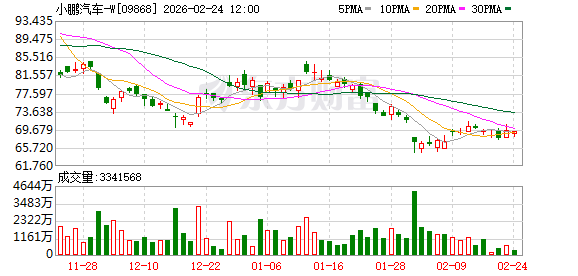
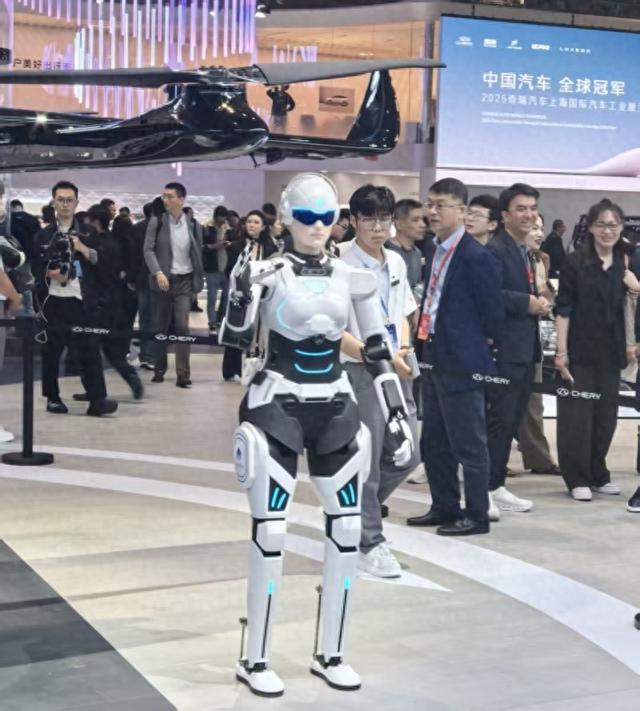
Core Viewpoint - Xiaopeng Motors aims to become the first company globally to mass-produce advanced humanoid robots by the end of the year, with a focus on integrating automotive-grade reliability and AI capabilities [1][12][14]. Group 1: Robot Development and Market Position - The new generation of IRON robots will initially be deployed in guiding and shopping scenarios, with an SDK available for global developers [1][12]. - Xiaopeng's IRON robot features a second-generation VLA model and three Turing AI chips, enabling integrated high-level intelligent capabilities such as conversation and walking [2][10]. - The company’s stock performance has shown a significant increase, reaching a market capitalization of HKD 212 billion, driven largely by the anticipated success of the IRON robot [3][5]. Group 2: Competitive Landscape and Challenges - Xiaopeng's approach to robotics emphasizes a combination of automotive-grade standards and integrated intelligence, distinguishing it from competitors like Yushun and Zhiyuan, which focus on different aspects of robotics [2][15]. - The company faces challenges in commercializing its robots, as competitors have already established a presence in the performance and rental markets [6][9]. - The IRON robot's primary applications will be in Xiaopeng's own production and retail environments, which may limit its scalability compared to competitors targeting broader B2B markets [9][10]. Group 3: Strategic Vision and Future Goals - Xiaopeng Motors is transitioning from being an automotive manufacturer to a technology company focused on advanced AI applications, including robots and flying cars [10][12]. - The company aims to leverage its technological advancements to capture significant market opportunities in autonomous driving and AI by 2026 [12][13]. - Xiaopeng's ambition is to redefine mass production standards in the robotics industry, shifting the focus from quantity to quality and reliability [14][15].
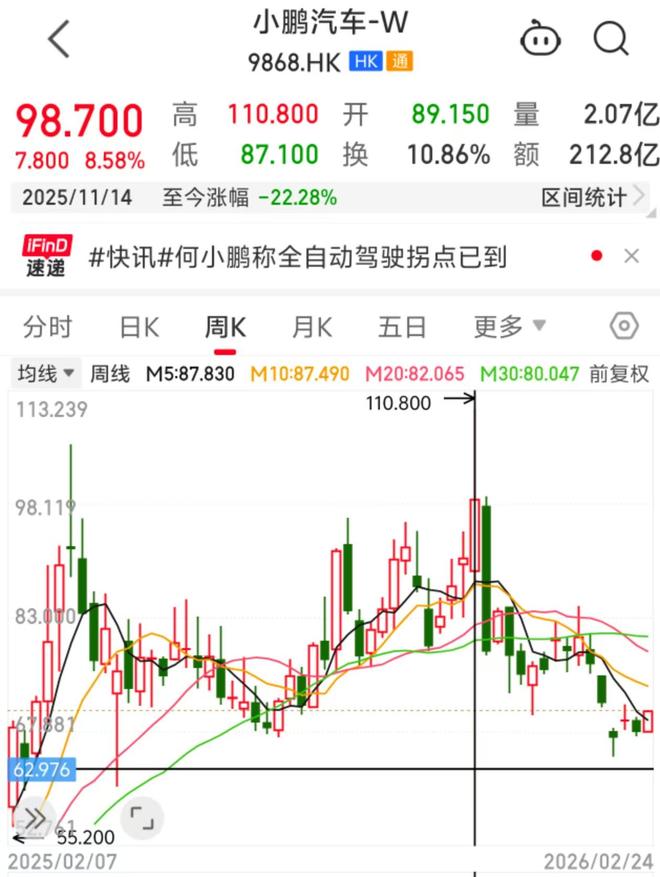
何小鹏开工信:2026年海外销量要翻番,全球员工总数将再增8000人
Xin Lang Cai Jing· 2026-02-24 06:20
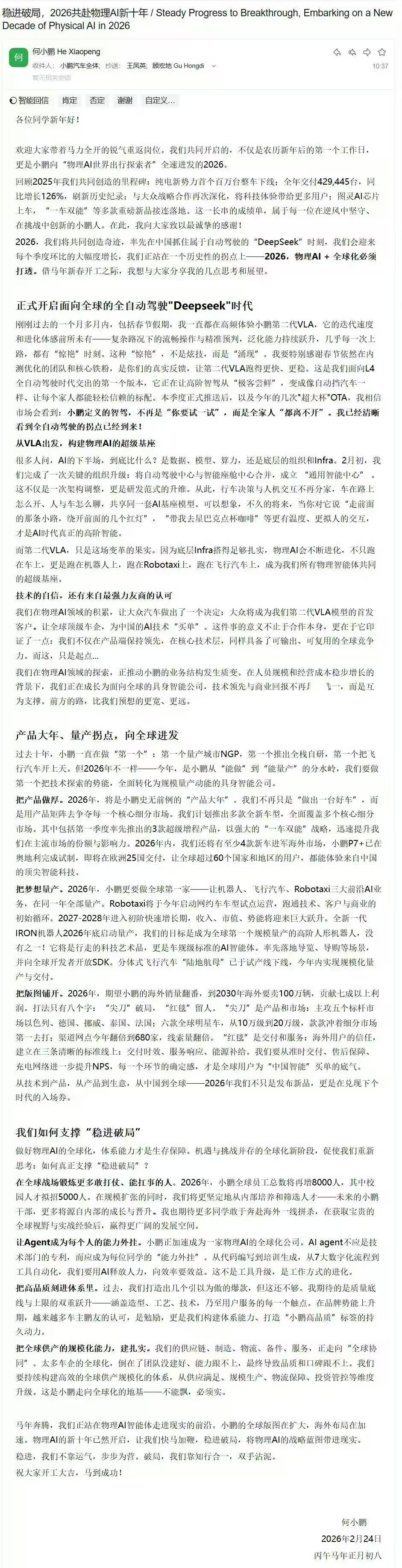
Core Insights - The CEO of XPeng Motors, He Xiaopeng, emphasized the theme "Steady Progress and Breaking Through, Together Entering the New Decade of Physical AI in 2026" in a letter to employees, highlighting the company's achievements in 2025 and setting ambitious goals for 2026 [1][14][17] 2025 Achievements - XPeng delivered 429,445 vehicles in 2025, marking a 126% year-on-year increase and setting a historical record [1][14][17] - The strategic partnership with Volkswagen was deepened, enhancing technology experiences for more users [1][14][17] - The Turing AI chip was integrated into vehicles, and several new products were launched, including the "dual-energy" vehicle [1][14][17] 2026 Goals - The company aims to seize the "DeepSeek" moment for autonomous driving in China, with the second-generation VLA set to be launched in the current quarter, and Volkswagen as the first customer for this model [1][14][15] - XPeng plans to introduce multiple new models to cover various core market segments [2][15][21] - The company targets mass production of three frontier AI businesses—robots, flying cars, and Robotaxi—within the same year [2][15][22] - The Robotaxi service will begin pilot operations this year, while the new generation IRON robot is expected to start mass production by the end of 2026 [2][15][22] Global Expansion - XPeng aims to double its overseas sales by 2026 and sell 1 million units overseas by 2030, contributing over 70% of profits [2][15][23] - The company plans to expand its global employee base by 8,000, with 5,000 positions targeted for campus talent [2][15][10] Product Strategy - 2026 is designated as a "Product Year," with plans to launch at least four new models in overseas markets, including the XPeng P7+ [2][15][21] - The company intends to leverage a product matrix to capture every core market segment, focusing on both product and market strategies [2][15][21] Technological Advancements - The second-generation VLA is positioned as a significant step towards L4 autonomous driving, with improvements in operational fluidity and predictive capabilities [4][18][20] - XPeng has merged its autonomous driving and intelligent cockpit centers to form a "General Intelligence Center," enhancing the integration of driving decisions and human-vehicle interaction [4][18][19] Quality and Efficiency - The company is committed to enhancing quality across all aspects, including design, craftsmanship, technology, and user service [10][24] - XPeng aims to build a robust global supply chain and production capability to support its international expansion [10][24]
何小鹏内部信:要实现全球首个高阶人形机器人量产
Xin Lang Cai Jing· 2026-02-24 05:51
Core Viewpoint - The CEO of XPeng Motors, He Xiaopeng, emphasizes the company's strategic focus on "steady progress and breaking through" in the new decade of physical AI, aiming to achieve mass production of advanced humanoid robots and other AI technologies by 2026 [1][2][3] Group 1: Physical AI and Product Development - XPeng aims to become the first company globally to mass-produce advanced humanoid robots, with the new generation IRON robot set to start production by the end of 2026 [4][12] - The company plans to launch multiple new models in 2026, including three super-extended range products in the first quarter, to capture various core market segments [31][43] - The second-generation VLA model will be launched with Volkswagen as the first customer, marking a significant step towards full autonomous driving [27][41] Group 2: Sales and Global Expansion - In 2025, XPeng achieved a record sales volume of 429,445 units, a 126% year-on-year increase, and aims to double its overseas sales in 2026, targeting 100,000 units by 2030 [7][32][45] - The company plans to introduce at least four new models to international markets in 2026, focusing on key markets such as Israel, Germany, Norway, Thailand, and France [8][45] - XPeng's overseas delivery volume exceeded 45,000 units in 2025, representing a 96% increase, positioning it as a leader among Chinese electric vehicle manufacturers in international markets [7][32] Group 3: Talent Strategy - XPeng plans to increase its global workforce by 8,000 in 2026, with a focus on recruiting 5,000 campus talents and emphasizing internal talent development [11][36] - The company aims to integrate AI capabilities across all employees, making AI a core competency rather than just a technical department's responsibility [11][36] Group 4: Quality and Operational Excellence - XPeng is committed to enhancing product quality across all aspects, including design, craftsmanship, technology, and user service, to establish a strong brand reputation [47] - The company emphasizes the importance of building a robust global supply chain and operational capabilities to support its international expansion and maintain product quality [35][47]
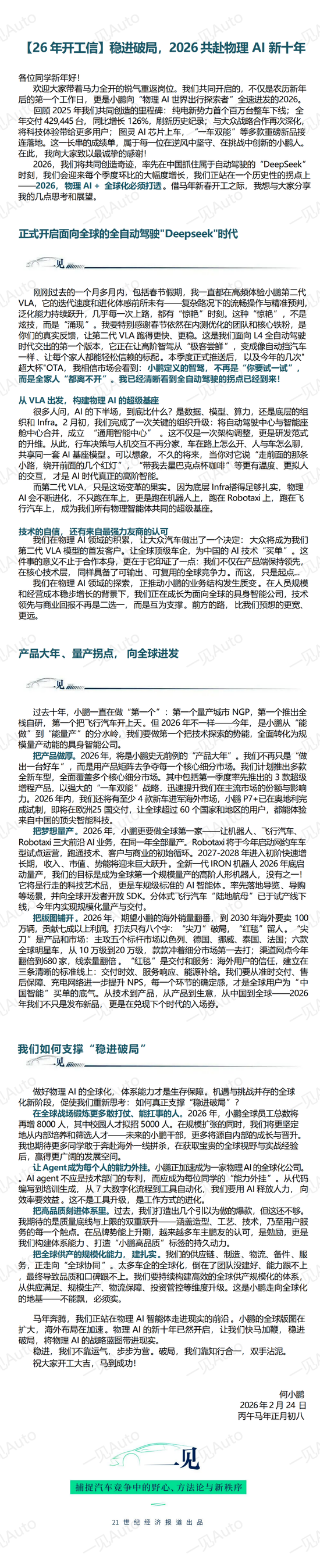
小鹏新年开工信:物理 AI+全球化,今年必须打透
2 1 Shi Ji Jing Ji Bao Dao· 2026-02-24 04:36
Core Insights - The core message of the communication from the CEO of XPeng Motors emphasizes a strategic focus on "steady progress and breaking through" in the context of the upcoming decade of physical AI, with a clear roadmap for 2026 [1][12]. Sales Performance - In 2025, XPeng achieved a record sales figure of 429,400 units, surpassing its annual sales target by 13% [1]. - The company aims to double its overseas sales in 2026, with a target of selling 1 million units abroad by 2030, contributing over 70% of its profits [8][20]. Product Development - XPeng plans to launch three new super-extended range products in the first quarter of 2026 as part of its "one car, dual energy" strategy [7]. - The second-generation VLA model, viewed as a significant step towards L4 fully autonomous driving, will be launched with Volkswagen as its first customer [2][17]. - The company aims to be the first to mass-produce robots, flying cars, and Robotaxis in the same year, with the Robotaxi service set to begin pilot operations in 2026 [4][19]. Global Expansion - XPeng's overseas strategy includes launching at least four new models in international markets, targeting key regions such as Israel, Germany, Norway, Thailand, and France [8][20]. - The company plans to double its channel network to 680 locations and increase lead generation [9][20]. Talent Strategy - XPeng intends to hire 8,000 new employees in 2026, with 5,000 of those being campus recruits, while emphasizing internal talent development [12][21]. - The company aims to integrate AI capabilities across all employees, making it a core competency rather than limited to the tech department [12][21]. AI and Technology Integration - The establishment of a "General Intelligence Center" merges the autonomous driving and smart cockpit divisions, enhancing the integration of driving decisions and human-machine interaction [2][15]. - XPeng is focused on creating a robust infrastructure for physical AI, which will evolve beyond vehicles to include robots and other intelligent systems [16][18].
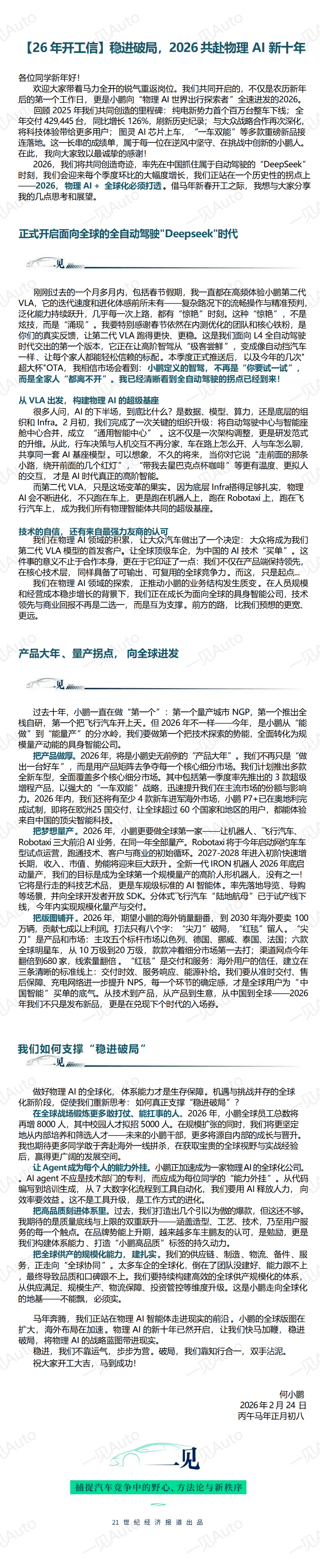
21独家|小鹏新年开工信:物理 AI+全球化,今年必须打透
2 1 Shi Ji Jing Ji Bao Dao· 2026-02-24 04:04
Core Insights - The core message of the letter from CEO He Xiaopeng emphasizes a strategic focus on "steady progress and breaking through" as the company aims for a transformative decade in physical AI by 2026 [2][12]. Sales Performance - In 2025, the company achieved a record sales volume of 429,400 units, surpassing its annual sales target by 13% [2]. - The company aims to double its overseas sales in 2026, building on a 96% year-on-year increase in 2025, where it delivered over 45,000 units internationally [8]. Product Development - The company plans to launch three new super-range products in the first quarter of 2026 as part of its "one car, dual energy" strategy [7]. - The second-generation VLA model, viewed as a significant step towards L4 autonomous driving, will have Volkswagen as its first customer [3]. AI and Technology - The company is set to mass-produce three advanced AI business lines, including Robotaxi, flying cars, and high-level humanoid robots, all in the same year [5][6]. - The integration of the autonomous driving center and smart cockpit center into a "General Intelligence Center" aims to enhance user interaction and decision-making [4]. Global Expansion - The company plans to introduce at least four new models to international markets in 2026, targeting key markets such as Israel, Germany, Norway, Thailand, and France [9]. - The company aims to establish 680 sales outlets globally, doubling its previous count, to enhance market penetration [10]. Talent Strategy - The company intends to recruit 5,000 campus talents and increase its total workforce by 8,000 in 2026, emphasizing internal talent development [12][13]. - The focus will be on cultivating a workforce capable of adapting to global challenges and leveraging AI as a core competency across all levels of the organization [13].