办公软件

Search documents
突发!澳洲第一厂狂裁 1600 人,研发成重灾区,CTO 月底走人
程序员的那些事· 2026-03-14 15:58
Group 1 - Atlassian has laid off 1,600 employees, which is 10% of its workforce, focusing on optimizing its research and development team, particularly affecting nearly 1,000 engineers [1][3] - The layoffs are part of a strategic shift towards AI, with the company committing to invest the savings from these layoffs into developing its own AI capabilities and enhancing its sales system for large clients, relying on internal cash flow rather than external financing [3] - The company has implemented a global approach to layoffs, affecting major regions including North America, Australia, and India, indicating a uniform strategy across its operations [3] Group 2 - The compensation package for laid-off employees includes a minimum of 16 weeks' salary and a complete benefits transition period, with the company setting aside approximately $170 million for severance costs [3] - Following the announcement, the stock price of Atlassian saw a slight increase, suggesting that investors are supportive of the company's "streamlining + AI" strategy [4] - The CEO acknowledged that this was a difficult but necessary decision, emphasizing that without restructuring, the company risks being left behind in the AI era [3]



9日投资提示:族兴新材北交所新股申购
集思录· 2026-03-08 13:48
Group 1 - The core viewpoint of the article highlights the ongoing conflict between Anshi Netherlands and Anshi China, where the former has disabled the office accounts of the latter's employees, impacting production processes [1] - The Chinese Ministry of Commerce emphasizes that such actions by Anshi Netherlands create new obstacles in the negotiation process between the two companies, which are currently seeking to resolve internal disputes [1] - The Chinese side maintains a responsible attitude towards the global semiconductor supply chain and holds Anshi Netherlands accountable for any potential crisis that may arise from their actions [1] Group 2 - The article also mentions that Jisilu has stopped providing fund valuation data, indicating a shift in their service offerings [1] - Several companies, including Wen Tai Technology and Anshi Netherlands, are involved in strategic cooperation agreements, which may influence their operational dynamics [1] - A list of convertible bonds is provided, detailing their current prices, redemption prices, last trading dates, and other relevant financial metrics, which could be of interest to investors [1][4][6]

光大证券晨会速递-20260212
EBSCN· 2026-02-12 01:51
Macro Insights - The CPI year-on-year growth rate has significantly decreased due to seasonal factors and the drop in fresh vegetable prices, but the upward trend remains intact. The transmission of raw material price increases to downstream durable consumer goods continues, and the central government's policy on pig production capacity may accelerate the reduction of pig production, leading to a moderate improvement in pork prices in the second half of the year [1] - The PPI month-on-month growth rate has accelerated, with price increases spreading further, influenced by external factors and domestic policies aimed at reducing competition. It is expected that the PPI year-on-year growth may turn positive in the second quarter [1] Industry Research - In the steel and aluminum sector, the potential for increased dividend payouts is supported by three factors: the inclusion of market capitalization management in assessments, high dividend yield as a core strategy for insurance capital allocation, and a gradual decline in capital expenditures in the steel and aluminum industries. Companies with high undistributed profits, ample cash reserves, and low debt ratios are likely to have strong dividend potential. Key recommendations include Hualing Steel, Baosteel, and Jiuli Special Materials, with a suggestion to pay attention to China Aluminum [3] Company Research - Jiantao Laminated Board (1888.HK) is a leading global manufacturer of copper-clad laminates with a vertically integrated supply chain. The forecasted net profit attributable to shareholders for 2025-2027 is expected to be HKD 2.17 billion, HKD 3.95 billion, and HKD 4.84 billion, representing year-on-year growth of 64%, 82%, and 22% respectively. The company excels in cost control and supply chain stability, enhancing profit elasticity during rising copper price cycles, and its deep upstream material layout and AI electronic fabric are expected to open new growth avenues. The company is considered to have a certain level of scarcity and valuation upside, thus receiving a "buy" rating [4]
【光大研究每日速递】20260212
光大证券研究· 2026-02-11 23:07
Group 1 - The article discusses the potential for increased dividend rates in the steel and aluminum sectors, supported by favorable conditions such as market value management, high dividend stocks being a core strategy for insurance capital allocation, and a gradual decline in capital expenditures within the industry [5] - Companies with high undistributed profits, ample cash reserves, and low debt ratios are identified as having strong dividend potential as they prepare for 2026 [5] Group 2 - Newhan New Materials (301076.SZ) plans to raise no more than 1 billion yuan to establish itself as a leader in the PEEK full industry chain, with funds allocated for projects including the production of high-performance resins and composite materials [5] - Kingsoft (3888.HK) is currently in a period of adjustment for its gaming business, but the stable growth of its office business, driven by AI and innovation, provides strong support for its valuation, especially given its substantial cash reserves and significant equity discount [5]


美银证券:中资软件首选股金蝶国际及金山办公(688111.SH)
Zhi Tong Cai Jing· 2026-01-09 06:58
Core Viewpoint - Bank of America Securities predicts that the average stock price of covered Chinese software companies will rise by 16% by 2025, underperforming the MSCI China Index's increase of 23% [1] Group 1: Industry Outlook - The firm holds a cautiously optimistic view on software demand for 2026, driven by accelerated AI monetization and trends in software import substitution, despite weak demand across various verticals [1] - Overall, the firm forecasts a 12% year-on-year revenue growth for the Chinese software and IT services industry in 2026, down from a 13% growth forecast for 2025 [1] Group 2: Revenue Projections - After a downward revision of approximately 2% for revenue forecasts in 2025-2026, the expected average revenue growth for covered software companies is projected to accelerate to 14% year-on-year in 2026, compared to 7% in 2025 [1] Group 3: Sector-Specific Insights - The firm maintains a selective positive outlook on companies in the Enterprise Resource Planning (ERP), photo editing software, and office software sectors, as these segments show higher growth visibility under the SaaS model and AI-driven initiatives [1] - Conversely, a cautious stance is held towards cybersecurity and real estate software due to weak demand [1] Group 4: Preferred Stocks - Preferred stocks include Kingdee International (00268), Meitu Inc. (01357), and Kingsoft Office (688111.SH), all rated as "Buy" [1]

美银证券:中资软件首选股金蝶国际、美图公司及金山办公
Zhi Tong Cai Jing· 2026-01-09 06:39
Group 1 - The core viewpoint of the report is that the average stock price of covered Chinese software companies is expected to rise by 16% by 2025, underperforming the MSCI China Index by 23% [1] - The outlook for software demand in 2026 is cautiously optimistic, driven by accelerated AI monetization and trends in software import substitution, despite weak demand across various verticals [1] - The forecast for the Chinese software and IT services industry anticipates a 12% year-on-year revenue growth in 2026, down from a projected 13% growth in 2025 [1] Group 2 - After a downward revision of approximately 2% for the revenue forecast for 2025-2026, the average revenue growth for covered software companies is expected to accelerate to 14% year-on-year in 2026, compared to 7% in 2025 [1] - The company holds a selectively positive view on companies in the enterprise resource planning (ERP), photo editing software, and office software sectors, as these segments show higher growth visibility under the SaaS model and AI-driven initiatives [1] - Caution is maintained regarding cybersecurity and real estate software due to weak demand, with preferred stocks including Kingdee International (00268), Meitu Inc. (01357), and Kingsoft Office (688111.SH), all rated as "Buy" [1]
美银证券:中资软件首选股金蝶国际(00268)、美图公司(01357)及金山办公(688111.SH)
智通财经网· 2026-01-09 06:37
Group 1 - The core viewpoint of the report is that the average stock price of covered Chinese software companies is expected to rise by 16% by 2025, underperforming the MSCI China Index's increase of 23% [1] - The outlook for software demand in 2026 is cautiously optimistic, driven by accelerated AI monetization and trends in software import substitution, despite weak demand across various verticals [1] - The overall revenue growth forecast for the Chinese software and IT services industry is projected at 12% year-on-year for 2026, down from a previous estimate of 13% for 2025 [1] Group 2 - After a downward revision of approximately 2% for the revenue forecasts for 2025-2026, the average revenue growth for covered software companies is expected to accelerate to 14% year-on-year in 2026, compared to 7% in 2025 [1] - The report expresses selective positive views on companies in the Enterprise Resource Planning (ERP), photo editing software, and office software sectors, as these segments show higher growth visibility under the SaaS model and AI-driven trends [1] - Caution is maintained regarding cybersecurity and real estate software sectors due to weak demand [1] Group 3 - Preferred stocks identified include Kingdee International (00268), Meitu Inc. (01357), and Kingsoft Office (688111.SH), all rated as "Buy" [1]
广州:加快研发具有自主知识产权的操作系统、数据库、中间件、办公软件等通用基础软件
Zheng Quan Shi Bao Wang· 2026-01-08 09:23
Core Viewpoint - Guangzhou Municipal Government has issued a plan to accelerate the construction of a strong advanced manufacturing city from 2024 to 2035, focusing on developing independent software systems and enhancing product compatibility [1] Group 1: Software Development - The plan emphasizes the development of general foundational software with independent intellectual property rights, including operating systems, databases, middleware, and office software [1] - It aims to promote the establishment of new industrial software standards and achieve several landmark results in software development [1] Group 2: Industrial Software Focus - The initiative will focus on industrial general tools software such as CAD/CAM/CAE, EDA technology research and application, and common supporting technologies for industrial software [1] - There will be a push for the comprehensive application of independent innovation in industrial operating systems, middleware, industrial apps, and new database management systems [1] Group 3: Cloud Computing and Emerging Technologies - The plan includes the development of a next-generation cloud computing software system, enhancing cloud security and intelligent cloud service capabilities [1] - It supports innovations in high-performance data collection, high-capacity storage, massive information processing, artificial intelligence algorithms, toolsets, and blockchain technologies [1] - There is an emphasis on accelerating the development of new platforms related to machine learning, virtual reality, and the metaverse [1]
如何锻造中国“链主”企业全球竞争力
Guo Ji Jin Rong Bao· 2025-12-22 01:44
Core Viewpoint - The article emphasizes the need for the government to play a guiding role in enhancing the leadership of "chain master" enterprises, improving the resilience and safety of industrial supply chains, and promoting industrial upgrades through collaboration with universities and research institutions [1][6]. Group 1: Current Issues in China's Industrial Chain - China's industrial chain, while complete, faces significant issues of being "large but not strong" and "broad but not deep," with high dependence on foreign core technologies and key components [2]. - The self-sufficiency rate of critical technologies is low, and many strategic industries still rely on imports for essential materials and equipment, weakening the control of "chain master" enterprises over the supply chain [2]. - The collaboration depth among upstream and downstream enterprises is insufficient, with "chain master" enterprises often unable to receive high-end support from small and medium-sized enterprises (SMEs) due to their low value-added roles [2]. - The relationship between "chain leader" (government) and "chain master" (enterprise) is not fully clarified, leading to inefficiencies in policy execution and a lack of effective communication between the government and enterprises [2]. Group 2: Financial Support Challenges - Financial support for "chain master" enterprises and SMEs is currently inadequate, with a heavy reliance on bank loans and low utilization of direct financing methods, resulting in high financing costs [3]. - SMEs face persistent financing difficulties due to a lack of collateral and low credit ratings, limiting their ability to innovate and expand [3]. - The development of supply chain finance is lagging, failing to effectively connect "chain master" enterprises with SMEs, which reduces the efficiency of capital flow within the industrial chain [3]. Group 3: International Experience and Recommendations - The U.S. government supports "invisible champion" enterprises through funding initiatives like the Small Business Innovation Research (SBIR) program, encouraging technological breakthroughs in niche areas [4]. - "Chain master" enterprises in the U.S. integrate SMEs into their ecosystems, enhancing their control over critical supply chain segments [4]. - Recommendations for strengthening China's "chain master" enterprises include establishing collaboration platforms between enterprises and research institutions, creating a cross-regional coordination mechanism, and promoting supply chain finance services [6][7]. - Encouraging "chain master" enterprises to globally allocate resources can lower costs and enhance efficiency, supported by government policies such as tax incentives and financial subsidies for overseas investments [7].

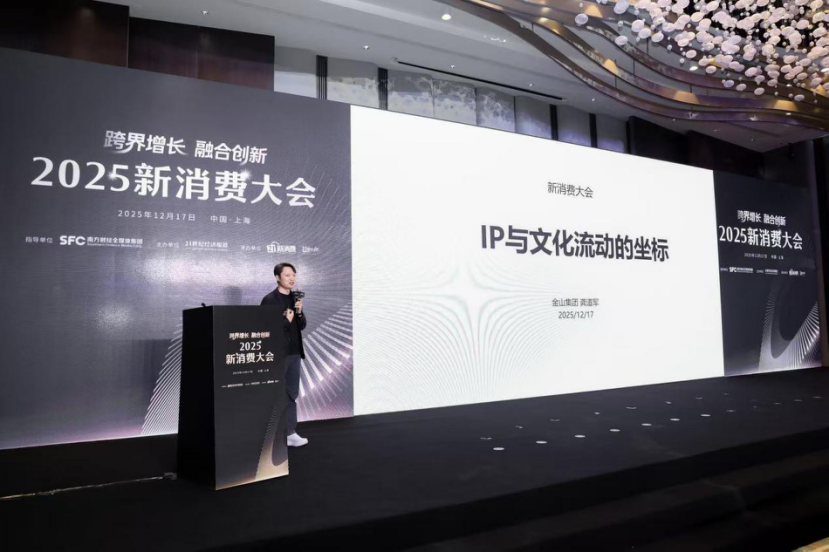
金山软件龚道军:解码IP消费的核心逻辑
2 1 Shi Ji Jing Ji Bao Dao· 2025-12-19 00:38
Core Insights - The "New Consumption Conference" organized by 21st Century Business Herald is a significant event in the consumer industry, taking place on December 17 in Shanghai [1] Group 1: IP and Cultural Flow - Gong Daojun, Vice President of Kingsoft, delivered a keynote speech titled "The Coordinates of IP and Cultural Flow," emphasizing the lack of a common understanding of IP within the industry [3] - The speech aimed to clarify the core logic of IP and its development trajectory in the consumer sector through two paths: extracting commonalities of IP products from a classification perspective and outlining the development path of IP in the consumption field [3] - Gong proposed a "two-dimensional quadrant analysis" to categorize entertainment consumption IP products based on "narrative" and "interactivity" [4] Group 2: IP Product Classification - The classification includes four categories: 1. High narrative + high interactivity: represented by video games, providing strong immersion and engagement [4] 2. High narrative + low interactivity: such as movies and short films, where the audience primarily participates through viewing [4] 3. Low narrative + low interactivity: typified by trendy toys and blind boxes, which establish emotional connections through symbolic imagery [4] 4. Low narrative + high interactivity: certain sports products or game branches focusing on strong interactive experiences without complex story support [4] Group 3: Cultural Flow and IP Development - Gong reviewed the historical trajectory of foreign entertainment IP entering China and the reverse flow of Chinese IP abroad, highlighting key phases from the 1960s to the present [5] - He noted significant milestones, such as the entry of Japanese anime and Hollywood films in the 1980s and the rise of Korean culture in the 2000s, driven by technological advancements [5] - The success of Chinese IP overseas was illustrated through examples like Kingsoft's "Jian Xia Qing Yuan" capturing 70% market share in Vietnam and the emergence of new IP carriers like web literature translation platforms and short dramas [5] Group 4: Key Factors for Successful IP Dissemination - Gong identified three core elements for successful IP dissemination: 1. Undergoing systematic cultural refinement to form a resonant value core [6] 2. Having a complete localized production system [6] 3. Achieving production capacity overflow to support global outreach [6] - He highlighted two parallel paths for Chinese IP going global: targeting mainstream global markets with games and focusing on niche segments with trendy toys and web literature [6] Group 5: Future Outlook - Gong concluded that Kingsoft, as a technology enterprise growing alongside China's reform and opening-up, has significant potential for cross-industry integration in its office, gaming, and cloud services [6] - He expressed confidence that Chinese companies can create globally influential IP brands, facilitating cultural exchange between East and West [6]