
省心租

Search documents
江苏小牛看房云科技:常州房产服务领域的标杆力量
Sou Hu Cai Jing· 2026-01-19 19:56
Core Viewpoint - Jiangsu Xiaoniu Housing Cloud Technology Co., Ltd. has established itself as a leading force in the real estate service market in Changzhou through strong resource integration, innovative technology applications, and extensive market coverage [1] Group 1: Company Scale - The company operates over 1,000 stores in Changzhou, with 60% being direct stores and the remainder being franchise stores, creating a dense service network within a "15-minute service circle" [3] - The professional real estate agent team consists of over 3,800 members, with more than 80% holding industry qualifications and over 30% having a bachelor's degree or higher, ensuring service quality [3] - The company holds nearly 35% market share in the second-hand housing transaction market and 25% in the new housing agency market, with annual rental transactions exceeding 20,000 units [3] Group 2: Business Layout - The company offers a comprehensive service covering seven areas: real estate information consulting, second-hand housing transactions, new housing agency, rental management, rights certificate services, information system services, and home decoration [4] - The "True Housing Source" system enhances transparency in second-hand housing transactions, achieving a customer satisfaction rate of 92% [4] - The company has established strategic partnerships with over 50 national real estate brands, managing over 80 new housing projects annually, with a sales cycle 20% shorter than the industry average [4] Group 3: Technological Advantages - The "Xiaoniu Housing" interconnected system utilizes big data for intelligent matching of housing sources, tracking customer behavior, and risk warning, improving viewing conversion rates by 25% [6] - The company’s technology team consists of over 200 members, with more than 60% in R&D, and an annual R&D investment accounting for 8% of revenue [6] - The system has led to an increase in monthly transactions per agent from 2.3 to 3.5, while customer complaint rates have decreased to 0.8% [6] Group 4: Industry Influence - The company has received multiple industry awards for service quality and market performance, including recognition as an "Excellent Network Enterprise" in Changzhou's real estate brokerage industry [7] - The company actively participates in social responsibility initiatives, donating over 5 million yuan for pandemic and disaster relief efforts [7] - The company contributes to industry standards by participating in the formulation of real estate brokerage service standards in Changzhou and training over 1,000 professionals annually [7] Group 5: Future Outlook - The company plans to expand its store count to 1,500 and its agent team to over 5,000 within three years, while extending its business coverage to core cities in the Yangtze River Delta [9] - The company aims to deepen AI technology applications and expand into renovation and housekeeping services, creating a "full lifecycle" service system for housing [9] - Jiangsu Xiaoniu Housing Cloud Technology Co., Ltd. is redefining the value standards of real estate services through data support and innovation, providing a replicable benchmark for regional markets [9]


链家《大店圆桌派》社区深耕的深圳方程式
Guan Cha Zhe Wang· 2025-12-22 02:08
Core Viewpoint - The successful conclusion of the third session of Lianjia's "Big Store Roundtable" has sparked extensive discussions on the practical path and underlying logic of the "Big Store Strategy," showcasing how this model reshapes the real estate service ecosystem [1] Group 1: Strategic Positioning - The core of the Big Store Strategy lies in building a dual moat of "efficiency and trust" through resource integration and brand empowerment, upgrading traditional stores to version 5.0, enhancing service efficiency with independent functional areas and technological tools, and establishing consumer trust through standardized service processes and brand endorsement, which lowers unit costs and creates differentiated competitive advantages [2] - The unique advantage of the direct sales model is embodied in the image of a "steady and professional steward," where Lianjia maximizes this reliability and professionalism to become a trusted benchmark in the community [3] Group 2: Community Engagement - Lianjia's core strategy is centered on "community friendliness," transforming goodwill into sustainable trust assets through systematic operations, making the transition to "community-friendly" stores a necessity for building long-term competitiveness, with the new generation of 5.0 store designs incorporating multifunctional community spaces and mechanisms for sharing benchmark experiences, alongside continuous optimization of community services through data analysis [4] Group 3: Rental Business - In high-mobility cities like Shenzhen, the rental business is strategically significant, viewed as the "lifeline and stabilizer of the Big Store model," providing continuous customer flow through high-frequency rental needs, which also serve as "seed customers" for future sales and home decoration businesses [5] - The rental business acts as a reputation carrier by effectively addressing the urgent housing needs of young people and maintaining long-term customer relationships, fostering deep emotional connections [6] - It serves as a training ground for new agents, enhancing their foundational business skills for more complex transactions in existing and new homes, with products like "Worry-Free Rental" lowering the barriers for newcomers in Shenzhen, allowing them to focus on work and life [7] Group 4: Resonance with Urban Spirit - The spirit of Shenzhen, characterized by "daring to explore and innovate without limits," aligns closely with the Big Store Strategy, as demonstrated by a team leader's journey from last place to the top three through 57 specialized training sessions and mindset shifts, achieving a "second entrepreneurship" success [8] - The Big Store model represents a comprehensive reconstruction of the three core elements of the real estate brokerage industry: people, stores, and services, marking a key transition for Lianjia from traditional brokerage to a one-stop quality service provider, enhancing environmental experience, deepening community connections, and supporting agent growth [8] Group 5: Service Standards and Community Impact - The Big Store model redefines real estate service standards, encompassing not just transaction facilitation but a full lifecycle of quality services including property purchase, rental, and renovation [10] - It creates a better working environment and development space for agents, elevating the profession's dignity and attracting more talent to stay and thrive in Shenzhen [11] - Each store acts as a community service station, providing convenience services and becoming a warm connection point in the city, emphasizing the importance of being good neighbors and partners [12]
财通证券:贝壳家装业务步入正循环,租赁业务盈利水平趋于稳定
Sou Hu Cai Jing· 2025-12-03 16:43
Core Insights - The report from Caitong Securities highlights Beike's "one body, three wings" strategy, showcasing significant platform integration potential and growth elasticity in new sectors such as home decoration and housing rental [1] - The home decoration industry in China has a large market size exceeding 3 trillion yuan in 2022, with a projected compound annual growth rate of 8.1% from 2025 to 2030, potentially reaching over 7 trillion yuan by 2030 [1] - Beike's rental business, particularly the "Shengxin Rent" service, has shown rapid growth, with over 590,000 managed housing units as of June 30, 2025, representing an 88% year-on-year increase [2] Home Decoration Industry - The home decoration market is characterized by low concentration and a fragmented enterprise landscape, providing Beike with an opportunity to leverage its scale advantages for industry consolidation [1] - The company's early entry into the home decoration sector, including partnerships and acquisitions, has led to a positive operational cycle in core high-energy cities [1] Rental Business - The core competitiveness of the "Shengxin Rent" business model lies in service quality and asset operation efficiency, with a focus on standardizing service processes and enhancing operational collaboration with housing transaction services [2] - The rental business has achieved significant revenue growth, with 10.7 billion yuan in revenue for the first half of 2025, an 85% year-on-year increase, and an improvement in profit margin from -1.0% in 2023 to 7.6% [2]



财通证券发布贝壳研报:家装业务具备利润弹性,租赁业务盈利水平趋于稳定
Zheng Quan Shi Bao Wang· 2025-12-03 08:12
Group 1 - The core strategy of the company is centered around "one body and three wings," focusing on home decoration and rental housing, showcasing significant platform integration potential and growth elasticity [1] - The home decoration industry has a large market size and high growth rate, but low market concentration, providing the company with scale advantages to consolidate the industry [1] - The home decoration market in China is projected to exceed 3 trillion yuan by 2025, with a compound annual growth rate of 8.1% from 2025 to 2030, potentially reaching over 7 trillion yuan by 2030 [1] Group 2 - The company's rental business includes decentralized and centralized rental housing management services, with the largest segment being the "省心租" service [2] - Service quality and asset operation efficiency are the core competitive advantages of the "省心租" business model, with a focus on standardizing service actions and improving service capabilities [2] - As of June 30, 2025, the company managed over 590,000 rental units, representing an 88% year-on-year growth, with rental business revenue reaching 10.7 billion yuan, a year-on-year increase of 85% [2]
贝壳三季度财报:多元化业务抗风险,超额回购显信心
投中网· 2025-11-14 06:24
Core Viewpoint - The article discusses the transformation of the Chinese real estate market and highlights Beike's third-quarter performance, indicating a shift towards high-quality development and the emergence of new growth avenues for the company [3][4]. Group 1: Financial Performance - In Q3, Beike's total transaction value (GTV) reached 736.7 billion RMB, with net income growing by 2.1% year-on-year to 23.1 billion RMB and net profit at 747 million RMB [3][4]. - Beike's existing business in the resale housing sector saw a GTV increase of 5.8% year-on-year, while new housing business GTV grew approximately 11% in the first three quarters, reaching 196.3 billion RMB in Q3 [5][6]. Group 2: Business Innovations - Beike has implemented a "tenant separation" mechanism in Shanghai, dividing agents into two categories: those focusing on property sourcing and those on client sourcing, enhancing efficiency and property turnover rates [6][7]. - The company is testing a "B+" product model for new housing, aiming for lower operational costs and broader market penetration, with plans to expand to over 30 cities by year-end [6][7]. Group 3: Diversification and New Growth Areas - Beike's new business segments, including home decoration and rental services, accounted for 45% of total revenue, marking a historical high and indicating a successful second growth curve [3][8]. - Home decoration services generated 4.3 billion RMB in net income with a profit margin of 32%, while rental services reached 5.7 billion RMB in revenue, growing by 45.3% year-on-year [9][10]. Group 4: Share Buyback and Financial Strategy - Beike initiated a significant share buyback, spending 281 million USD in Q3, the highest in nearly two years, with a total of approximately 675 million USD spent this year, representing a 15.7% increase from the previous year [12][13]. - The company maintains a cash balance of around 70 billion RMB, providing a buffer against market fluctuations and supporting ongoing buyback initiatives [13][14]. Group 5: Operational Efficiency and R&D Investment - Beike's operational expenses decreased by 1.8% year-on-year to 4.3 billion RMB, while R&D investment reached 648 million RMB, marking a 13.2% increase [14]. - The company is leveraging technology to enhance efficiency, with AI tools significantly contributing to transaction volumes and agent performance [14].
自如生长14年,两次改变租住行业的底层逻辑
3 6 Ke· 2025-10-31 10:37
Core Insights - The article discusses the evolution of the Chinese rental market through the lens of the company Ziroom, highlighting its innovative business model and strategic shifts over the years [2][5][6]. Group 1: Historical Context and Initial Innovations - In 2011, a group of Chinese entrepreneurs, including Ziroom's founder Xiong Lin, traveled to Japan and the U.S. to learn from established markets, aiming to transform the fragmented rental market in China [2][3]. - The initial model focused on productizing individual rental units, moving from a C2C to a C2B2C model, which aimed to bring transparency to a previously opaque market [2][4]. Group 2: Key Strategies and Operational Changes - Ziroom's core actions centered on three areas: product enhancement, service provision, and technology integration, which collectively improved rental efficiency and user experience [4]. - The company transitioned from a "peace of mind rental" model to a "gain rental" model in 2021, treating each property as a hotel to optimize asset management and rental strategies [5][6][16]. Group 3: Market Adaptation and Resilience - Following the market downturn post-2021, many rental companies failed, but Ziroom's early transition allowed it to survive and thrive, with over 70% of its properties now under the gain rental model [6][27]. - The shift to gain rental was seen as a necessary evolution, allowing for shared risk and reward between the company and property owners, thus enhancing market stability [27][28]. Group 4: Future Outlook and Industry Impact - Ziroom aims to redefine the rental market's underlying logic by promoting a sustainable and long-term asset management approach, which is increasingly accepted by property owners [27][28]. - The company emphasizes the importance of creating value for both landlords and tenants, ensuring a balanced and efficient rental ecosystem [23][24].
自如生长14年,两次改变租住行业的底层逻辑
36氪· 2025-10-31 09:17
Core Viewpoint - The article discusses the evolution of the Chinese rental housing market, focusing on the transformation initiated by the company Ziroom, which shifted from a traditional rental model to an asset management approach, significantly changing the industry's underlying logic [1][6][24]. Group 1: Market Background and Initial Challenges - In 2011, a group of Chinese entrepreneurs, including Ziroom's founder, sought to learn from mature rental markets in Japan and the U.S. to innovate in China's rental sector [1][2]. - The rental market was primarily in a C2C phase, with high operational costs and inefficiencies due to the fragmented nature of individual landlords and tenants [2][3]. - Ziroom aimed to transform this market by productizing rental properties and enhancing transparency, which was initially met with skepticism from industry peers [2][3]. Group 2: Key Innovations and Business Model - Ziroom focused on three core areas: product standardization, service enhancement, and technology integration, which collectively improved rental efficiency and tenant experience [4][5]. - The company introduced a new rental model that allowed for the leasing of individual rooms rather than entire units, catering to diverse tenant needs and significantly increasing property utilization [4][5]. - By leveraging technology, Ziroom optimized the matching process between tenants and available properties, moving the rental experience closer to that of booking a hotel [5][22]. Group 3: Transition to Asset Management - In 2021, Ziroom transitioned to an "incremental rental" model, positioning itself as an asset management company rather than just a rental service provider [7][24]. - This shift was driven by the need for a more sustainable business model in response to market changes and increased competition, allowing for shared risk and reward with property owners [10][35]. - The new model has seen over 70% of Ziroom's properties switch to this asset management approach, demonstrating resilience in a challenging market environment [10][38]. Group 4: Long-term Vision and Industry Impact - Ziroom's evolution reflects a broader trend in the real estate sector, emphasizing the importance of understanding both tenant and landlord needs to create value [21][22]. - The company aims to redefine the rental market by providing high-quality living experiences through professional management and continuous property maintenance [26][39]. - Ziroom's journey illustrates the potential for innovation in the rental market, setting a new standard for professionalized housing rental services in China [8][39].

贝壳-W(02423):Q2盈利能力环比提升,扩大并延长回购计划
Changjiang Securities· 2025-08-28 12:43
Investment Rating - The investment rating for the company is "Buy" and is maintained [7]. Core Views - The company has shown a quarter-on-quarter improvement in profitability, with a focus on expanding and extending its share buyback program. Despite potential short-term performance pressure due to industry downturns, the company is expected to outperform the industry, especially if significant policies are implemented [2][4]. Summary by Sections Financial Performance - In Q2 2025, the company achieved revenue of 26 billion yuan (up 11.3%), with a net profit attributable to shareholders of 1.3 billion yuan (down 31.2%). Adjusted net profit was 1.8 billion yuan (down 32.4%). For H1 2025, these figures were 49.3 billion yuan, 2.2 billion yuan, and 3.2 billion yuan respectively, with year-on-year changes of +24.1%, -7.2%, and -21.3% [4]. Business Operations - The self-operated platform has driven GTV growth, with both Lianjia and Beilian's existing housing monetization ratios improving for two consecutive quarters. The profitability of existing homes, new homes, and rental businesses has improved quarter-on-quarter, while the home decoration business has achieved profitability at the city level. Effective fee management has significantly enhanced potential profit elasticity [2][4]. Shareholder Returns - The company has emphasized shareholder returns by increasing and extending its share buyback program. In H1 2025, it spent 394 million USD on share repurchases, buying back nearly 1.7% of the total shares issued at the end of 2024. The buyback authorization has been increased from 3 billion USD to 5 billion USD, with the program extended until August 31, 2028 [4]. Future Outlook - The company is expected to maintain a valuation premium due to its competitive advantages, relative scarcity, and potential earnings elasticity. The adjusted net profit forecasts for 2025-2027 are 6.63 billion, 7.18 billion, and 7.53 billion yuan, with corresponding PE ratios of 23.2, 21.4, and 20.4 [4].
需求为锚、效率为核,贝壳攻坚居住服务新范式
Guo Ji Jin Rong Bao· 2025-08-26 14:13
Core Insights - Beike's Q2 performance shows resilience with a total transaction volume of 878.7 billion yuan, a year-on-year increase of 4.7%, and net income of 26 billion yuan, up 11.3% [2] - Non-real estate transaction service revenue reached 41% of total net income, indicating a diversified growth strategy [2][5] - The company is undergoing a significant transformation, focusing on balancing scale and efficiency, adapting to consumer demand changes, and leveraging rapid technological advancements [2][8] Business Strategy - Beike is shifting from a scale-focused approach to enhancing network potential and single-point efficiency in real estate transactions [3][4] - The company has established a solid competitive moat through its ACN cooperation network and real source system, addressing the scarcity of quality assets and transaction security [3] - Beike's operational strategy includes refined management and initiatives like a store points system to improve service quality [4] Performance Metrics - In H1, Beike's second-hand transaction volume increased by 26%, outperforming the market's estimated growth of 19%, while new home transaction volume rose by 19% [4] - The gross transaction value (GTV) for existing homes reached 583.5 billion yuan, a 2.2% increase, and new homes GTV was 255.4 billion yuan, up 8.5% [4][6] - The home decoration and furnishing business generated net income of 4.57 billion yuan, a 13% increase, with a profit margin of 32.1% [6] AI Integration - Beike is integrating AI into its operations to enhance efficiency and customer experience, positioning AI as a new production resource [8][10] - The AI CRM tool "Lai Ke" has been implemented in over 60 cities, with more than 335,000 agents using it, significantly improving operational efficiency [8][9] - The company aims to use AI to standardize processes and allow service providers to focus on building trust and delivering high-quality services [9][10] Future Growth - Beike's "one body, three wings" strategy is driving structural changes and creating new growth drivers beyond traditional real estate transactions [5][11] - The company is focusing on customer-centric product design in its development projects, utilizing data-driven insights to enhance living experiences [7] - Beike's exploration of AI and data integration is expected to redefine the residential service landscape, enhancing service delivery and operational efficiency [10][11]
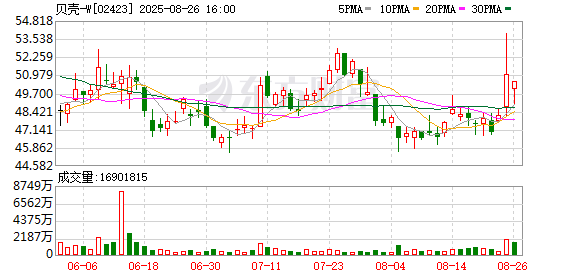
贝壳-W(02423):全链条生态成型,平台价值再重估
Guolian Minsheng Securities· 2025-08-13 12:12
Investment Rating - The report assigns a "Buy" rating for the company, Beike-W (02423), marking its first coverage [3][7]. Core Insights - Beike has evolved from a leading intermediary to a comprehensive residential service platform, with a projected GTV of 33,494 billion RMB and a revenue growth of 20.2% year-on-year for 2024 [3][11]. - The company's existing housing business remains robust, with a GTV of 22,000 billion RMB and a market share increase to 30.7%, continuing to be the core profit source [3][11]. - New housing business shows counter-cyclical growth, with a revenue increase of 10.1% year-on-year, while home decoration and rental services are rapidly expanding, with revenue growth of 36.1% and 135.0% respectively, forming a second growth curve [3][12]. - The adjusted net profit for 2025-2027 is expected to be 80.8 billion RMB, 90.6 billion RMB, and 99.7 billion RMB respectively, indicating significant platform ecosystem synergy [3][19]. Summary by Sections Company Overview - Beike, as a leading one-stop residential service platform in China, covers transactions, rentals, and home decoration, facilitating over 4.9 million transactions in 2024 with a GTV of 33,494 billion RMB [11][25]. Financial Performance - In 2024, Beike achieved total revenue of 93,457 million RMB, a year-on-year increase of 20.2%. The existing and new housing businesses contributed 30.2% and 36.0% to revenue respectively, while home decoration and rental services grew significantly [33][38]. - The GTV has shown a steady increase, with a market share rise in both new and existing housing from 2.2% and 12.6% in 2018 to 11.4% and 31.0% in 2024 respectively [33][37]. Business Segments - The existing housing business is expected to continue its recovery, with revenue projections for 2025-2027 at 298.3 billion RMB, 323.5 billion RMB, and 346.6 billion RMB, reflecting a stable growth trajectory [17]. - The new housing market is under pressure, but Beike's platform advantages are expected to enhance its market share during this phase [17]. - Home decoration and rental services are anticipated to grow significantly, with projected revenues of 182.9 billion RMB, 219.5 billion RMB, and 256.8 billion RMB for 2025-2027, indicating a strong upward trend [18]. Profitability and Valuation - The adjusted net profit for 2024 is projected at 72.11 billion RMB, reflecting a decrease of 26.4% year-on-year due to revenue structure disturbances and one-time employee incentives [12][19]. - The company is actively pursuing share buybacks and dividends, with a buyback plan of up to 30 billion USD and a dividend payout ratio exceeding 75% [56][57].