美元货币基金

Search documents
对冲失效、险遭强制平仓:一位亚太股票投资基金经理的惊魂一日
经济观察报· 2026-03-05 03:16
Core Viewpoint - Investors are expected to face a painful period over the next 18 to 24 months due to increased uncertainty from the impact of AI on U.S. software stocks and the escalation of conflicts in the Middle East [1][4]. Group 1: Market Reactions - The Korean Composite Index and the Nikkei 225 Index experienced significant volatility, with the former dropping 12.06% and the latter 3.61% on March 4, marking the largest single-day decline for the Korean index in over a decade [3][4]. - The escalation of conflict in the Middle East has led to fears of disrupted oil supplies, causing panic selling in the stock markets of Japan and South Korea, which are heavily reliant on Middle Eastern oil [3][4]. - Global capital flows have reversed sharply, with foreign investors withdrawing over $7 billion from the Korean stock market in just two trading days [4]. Group 2: Investment Strategies - Fund managers are increasingly adopting a "cash is king" strategy, shifting their investments into cash and dollar-denominated assets to mitigate risks amid market volatility [10][13]. - Risk hedging measures are being implemented, such as buying short contracts on Korean stock indices to protect against price declines [6][7]. - Despite a brief rebound in the stock market on March 5, many fund managers are still predicting a cumulative decline of over 15% in related stock indices due to ongoing geopolitical tensions [9]. Group 3: Traditional Safe Havens - Traditional safe-haven assets like gold and U.S. Treasuries have lost their appeal, with gold futures dropping below $5,000 per ounce and 10-year Treasury yields rising to 4.10% [11][12]. - The unusual behavior of these assets is attributed to rising oil prices, which have led to concerns about inflation and the Federal Reserve's potential interest rate policies [12][13]. - Many investment firms are liquidating profitable gold positions to cover losses from declining stock portfolios, further contributing to the volatility in these traditional safe-haven assets [13].

每日钉一下(投资美元债券类资产的两个思路)
银行螺丝钉· 2025-11-09 13:55
Group 1 - The article emphasizes that funds are suitable investment options for ordinary people [2] - It suggests that new investors should consider specific types of funds and provides a free course to help them understand fund investment [2] - The article discusses two investment strategies for dollar-denominated bond assets, focusing on risk tolerance [5][7] Group 2 - For investors who prefer lower volatility, options like dollar deposits, dollar money market funds, and R1-level dollar wealth management products are recommended [5][7] - It is noted that while these options have lower volatility, they are not risk-free, and currency exchange rate fluctuations between RMB and USD should be considered [7] - For those who can accept higher volatility, investing in dollar bond funds is suggested, although they are subject to market fluctuations [5][8] Group 3 - Short-term bond funds are mentioned as having relatively lower volatility compared to long-term bonds [9] - Long-term bonds are indicated to be more sensitive to interest rate changes, which can affect their performance [10]

博时基金亮相进博会:数智金融引领行业创新,科技赋能驱动高质量发展
Cai Jing Wang· 2025-11-05 08:48
Core Insights - The article highlights the significant advancements and strategic vision of Bosera Fund in the field of digital finance, particularly during the 8th China International Import Expo held in Shanghai from November 5 to 10 [1] Group 1: Intelligent Quantitative Investment - Bosera Fund has made substantial progress in intelligent quantitative investment, utilizing AI models to enhance investment strategies in areas such as factor mining, timing, sector rotation, and allocation [2] - The "Intelligent Quantitative Factor Allocation System," launched in 2022, has consistently generated significant and stable annualized excess returns, demonstrating its robustness in complex market conditions [2] - New strategies like "Stable Income Strategy" and "Sector Rotation Intelligent Strategy" have been successfully implemented in real investment portfolios, showcasing AI's potential in capturing market opportunities and smoothing portfolio volatility [2] Group 2: Intelligent Research and Decision-Making - Bosera Fund has developed the "Boshi" AI assistant and knowledge base to improve research personnel's information processing efficiency in market research, report reading, and data retrieval [3] - The firm is closely tracking advancements in large language models and multi-modal AI to enhance decision-making capabilities, focusing on market trend capture, stock profit forecasting, and investment strategy development [3] Group 3: Cross-Border Financial Services - Bosera International, a subsidiary of Bosera Fund, is expanding its financial services into cross-border areas, aligning with national financial opening strategies [4] - The introduction of T+0 rapid redemption mode in the Hong Kong market significantly enhances customer investment experience by improving fund efficiency and flexibility [4][5] - The collaboration with banks to create a coordinated system for redemption ensures immediate access to funds for investors, breaking traditional redemption time constraints [4] Group 4: Customer-Centric Ecosystem - Bosera Fund is building a customer-centric intelligent ecosystem that covers the entire investment process, integrating financial technology to enhance service quality [6] - The "Boluomi" and "ETF Zhihui Jia" WeChat mini-programs provide comprehensive solutions for clients, while the "Combination Cube" platform offers a simulated investment environment to improve users' asset allocation and risk management skills [6][7] Group 5: Risk Management Innovations - Bosera Fund emphasizes the importance of risk management, having upgraded its intelligent compliance platform to enhance operational efficiency and risk mitigation [8] - The platform supports comprehensive risk management processes, including pre-trade simulations, real-time monitoring, and automated compliance reporting, creating a closed-loop compliance system [8] Conclusion - The China International Import Expo serves as a vital platform for Bosera Fund to showcase its strategic foresight and capabilities in digital finance, with a commitment to deepening financial technology empowerment and exploring new service models for sustainable value creation [9]
美元理财收益优势减弱 外贸企业结汇升温
Sou Hu Cai Jing· 2025-10-18 01:28
Core Viewpoint - The article discusses the shift in foreign trade enterprises' currency exchange strategies in response to the Federal Reserve's interest rate cuts and the depreciation pressure on the US dollar, leading to an increased willingness to convert foreign currency into domestic currency [2][4][7]. Group 1: Currency Exchange Strategies - Following the Federal Reserve's interest rate cut in mid-September, many foreign trade enterprises, such as those in the consumer electronics sector, are opting to convert a portion of their dollar payments to lock in favorable exchange rates [2][4]. - Enterprises that previously adopted a "non-essential do not convert" strategy are now increasing their currency conversion efforts, recognizing that the Fed's rate cuts will lower the returns on dollar-denominated investments [4][6]. - The average currency conversion rate for foreign trade enterprises has slightly increased to 53.7% in the first eight months of the year, compared to the previous year's average [6]. Group 2: Impact of Interest Rates and Exchange Rates - The interest rate differential between US dollar investments and domestic RMB investments had previously attracted foreign trade enterprises to hold onto their dollar funds, with US dollar money market funds yielding around 4.6% [6][7]. - The recent shift in sentiment is attributed to the decline in US Treasury yields and the expectation of a rising RMB against the dollar, prompting enterprises to convert more of their dollar earnings [7][8]. - The RMB/USD exchange rate has recently strengthened, breaking the 7.1 mark, which has further encouraged enterprises to increase their currency conversion amounts [9][10]. Group 3: Risk Management and Financial Tools - Companies are adjusting their risk management strategies for currency fluctuations, with some opting to hedge against exchange rate risks by betting on RMB appreciation for future imports [4][12]. - Financial institutions are offering customized forward exchange solutions to help enterprises lock in favorable exchange rates and manage their cash flow needs [11][13]. - The use of foreign exchange hedging tools has increased, with the corporate foreign exchange hedging ratio rising to approximately 30% in September, up from 17% in 2020 [13].

美元存款利率还会再降吗?
Sou Hu Cai Jing· 2025-10-16 08:32
Core Insights - Recent divergence in dollar deposit interest rates among banks, with some offering higher rates for shorter terms and others for longer terms [1][2] - The expectation of further interest rate cuts by the Federal Reserve is influencing the current interest rate landscape for dollar deposits [3] Group 1: Divergence in Dollar Deposit Rates - The divergence in dollar deposit interest rates among banks is primarily due to expectations regarding Federal Reserve rate adjustments, market supply and demand, and individual bank strategies [2] - Foreign banks are more responsive to international market changes, predicting a continued decline in short-term rates, while some domestic banks maintain higher long-term rates to attract deposits [2] - Smaller banks often use high short-term rates as a marketing strategy, while larger state-owned banks focus on long-term stability through tiered interest rates [2] Group 2: Future of Dollar Deposit Rates - There is a high probability that dollar deposit rates at small and medium-sized banks will decline to the "2% range" within the year, driven by ongoing Federal Reserve rate cuts [3] - As the Federal Reserve lowers its benchmark rates, the cost of dollar funding for banks will decrease, further pushing down deposit rates [3] - Evidence of "2% range" rates is already emerging, with some banks having reduced rates below 3% and others expected to follow suit [3] Group 3: Investment Recommendations for Dollar Deposits - Current advice suggests caution against blindly investing in long-term dollar deposits; short-term products may be considered with awareness of interest and exchange rate risks [4] - A strategy of "short-term locking + purpose matching" is recommended for dollar deposits, especially for those with specific dollar usage needs [4] - Diversification is emphasized, with suggestions to consider dollar money market funds for liquidity and returns, as well as equity dollar assets through QDII funds targeting U.S. tech stocks [4]
美元存款利率,下调!
Sou Hu Cai Jing· 2025-09-26 09:51
Core Viewpoint - Following the Federal Reserve's interest rate cut in September, USD deposit rates have entered a downward trend, with expectations for further reductions in the future [1][2]. Group 1: USD Deposit Rate Changes - A foreign bank's USD deposit products now offer rates of 3.5% for 1-month, 3-month, and 6-month terms, and 3.05% for 12-month terms, with a 10 basis points (BP) reduction for 1-month and 20 BP for 6-month terms compared to previous rates [1]. - In South China, a foreign bank previously offered rates above 4% for short-term USD deposits, which have now been reduced to 3.75%, 3.85%, and 3.90% for the same terms [1]. - In North China, general account USD deposit rates have been adjusted to 3.1% for 1-month, 3.3% for 3-month, and 3.05% for 6-month terms, with VIP account rates being 45 BP higher [1]. Group 2: Future Expectations and Market Dynamics - The Federal Reserve's recent rate cut is characterized as a "risk management cut," aimed at preventing deterioration in the job market, with an implied 50 BP of additional cuts expected within the year [2]. - Different banks are adjusting their rates at varying paces, with state-owned banks maintaining more stable rates compared to foreign and city commercial banks, which are more flexible due to their dollar positions and market competition [2]. - Short-term rates are under greater downward pressure, with expectations that 3-month to 6-month rates may continue to decline, while long-term rates may adjust more moderately [2]. Group 3: Investment Considerations - Investors should be cautious of the risks associated with declining rates and shrinking investment returns, recommending a preference for short-term products to allow for timely strategy adjustments [3]. - Currency fluctuations and hedging costs should be considered, as a weaker dollar could lead to reduced actual returns on USD deposits, with options for hedging through forward contracts or structured deposits [3]. - Liquidity and minimum deposit requirements are important factors, as some high-yield products may have significant withdrawal penalties, necessitating careful fund allocation based on liquidity needs [3].
美联储又将放水?哪些资产值得关注?
Sou Hu Cai Jing· 2025-09-19 10:29
Group 1 - The core viewpoint of the article highlights the unprecedented global monetary easing led by major central banks, particularly the Federal Reserve and the European Central Bank, with a focus on their differing approaches to interest rate adjustments [1][5] Group 2 - The Federal Reserve has initiated a new round of interest rate cuts since September 2024, with a total reduction of 100 basis points over the past year, reflecting a clear and determined easing stance [2] - The European Central Bank has implemented eight interest rate cuts within a year, reducing the policy rate from 4.50% to 2.15%, but has recently opted to maintain rates as the economy shows signs of stabilization [3][6] - The People's Bank of China has adopted a more cautious and targeted approach to monetary policy, releasing liquidity gradually to avoid excessive flooding of the market, with over 1 trillion RMB net injection through various tools from May to June 2024 [4] Group 3 - Central banks are navigating different monetary policies based on domestic economic conditions, influenced by factors such as inflation pressures, economic growth, and government debt levels [5][7] - The U.S. labor market is showing signs of cooling, prompting the Federal Reserve to consider further rate cuts, while the European Central Bank has paused cuts due to improved economic indicators [6][7] Group 4 - In a low interest rate environment, certain assets are highlighted as attractive for investors, including U.S. dollar money market funds, short to medium-term U.S. Treasury bonds, and Hong Kong stocks, which are expected to draw more foreign capital due to their valuation advantages and growth potential [8]
美联储就要降息了?美债的投资机会来了吗?
Sou Hu Cai Jing· 2025-09-13 02:40
Core Viewpoint - The Federal Reserve is expected to restart interest rate cuts during its upcoming meeting, with market speculation on whether the cut will be 25 or 50 basis points, driven by signs of a cooling job market and a significant downward revision of non-farm employment data [1][2]. Group 1: Federal Reserve and Interest Rates - The Federal Reserve's anticipated rate cut is influenced by a downward revision of 911,000 non-farm jobs over the past year, indicating previous employment growth was overestimated [1]. - The current federal funds rate is approximately 4.33%, following a cumulative cut of 100 basis points, with the Fed having raised rates 11 times since 2022, totaling 525 basis points [4][7]. - As the Fed's rate cut expectations rise, the U.S. dollar weakens, leading to strong performances in both the stock and bond markets, with the 10-year Treasury yield falling to around 4% [1]. Group 2: Bond Market Performance - From January to August 2023, various bond indices showed positive performance, with the U.S. comprehensive bond index up 4.99%, U.S. Treasury index up 4.48%, investment-grade corporate bond index up 5.30%, and high-yield bond index up 6.35% [2]. - The 10-year Treasury yield fluctuated between 4.2% and 4.5% during July and August, with market concerns about a potential economic recession driving rate cut expectations [2]. Group 3: Investment Opportunities - The current high interest rates make U.S. dollar money market funds attractive, with the market size around $7.2 trillion, although yields are expected to decline as the Fed cuts rates [4][8]. - For U.S. Treasury bonds, short-term rates are likely to decrease with rising cut probabilities, while long-term rates may experience upward pressure due to fiscal policies and inflation expectations [9]. - U.S. credit bonds offer yield advantages and potential capital gains during rate cuts, but caution is advised regarding low-quality high-yield bonds and credit risk management [10].
国信证券(香港)宏观周报-20250804
Guoxin Securities Hongkong· 2025-08-04 09:14
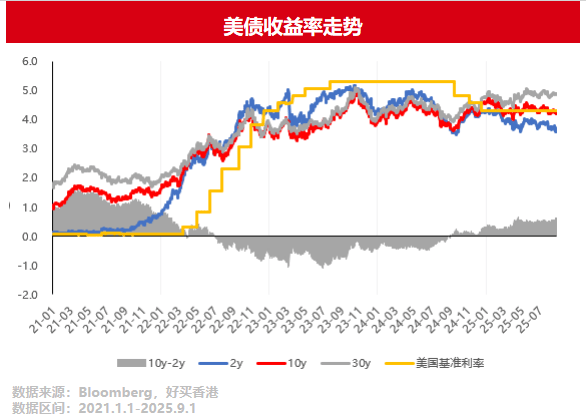
Economic Overview - The US and EU, South Korea, Cambodia, and Thailand reached trade agreements, with the lowest reciprocal tariff rate maintained at 10%[9] - The Federal Reserve maintained the benchmark interest rate at 4.25%-4.50%, showing caution towards rate cuts[10] - Japan's central bank kept its benchmark rate at 0.5%, aligning with market expectations, while raising inflation and GDP forecasts for FY2025[10] Market Performance - Major US stock indices experienced a decline, with the S&P 500 down 2.36% and the Nasdaq down 2.17% over the week[40] - The US 10-year Treasury yield fell to 4.22%, while the Chinese 10-year yield decreased to 1.71%[39] - The US dollar index rose by 1% to 98.69, indicating a strengthening of the dollar against other currencies[39] Economic Data Insights - The US added 73,000 non-farm jobs in July, below the expected 104,000, with the unemployment rate rising to 4.2%[24] - The US Q2 GDP grew at an annualized rate of 3%, surpassing the expected 2.5%[25] - The core PCE price index for Q2 increased by 2.5%, down from 3.5% but above the expected 2.3%[25] Commodity and Currency Trends - Gold prices surged above $3,400 per ounce, while Brent crude oil rose by 2.75% to $69.5 per barrel[39] - The MBA purchase index fell by approximately 10 basis points to 155.6, indicating a decline in mortgage applications[23] - The RedBook retail index showed a slight year-on-year increase, reflecting consumer spending resilience[12] Investment Recommendations - Short-term asset allocation should focus on defensive sectors due to market volatility and economic uncertainty[45] - Bonds are recommended for short-term positioning, with a focus on high-yielding, shorter-duration securities[46] - Gold remains a favorable long-term investment, supported by ongoing geopolitical tensions and central bank policies[46]
4月30日财经热点解读:节前暗流涌动!三大信号预示五月变盘玄机
Sou Hu Cai Jing· 2025-04-30 00:59
Group 1: US Market Signals - The Dow Jones has experienced six consecutive days of gains, but underlying issues such as Microchip's poor performance indicate a valuation crisis in tech stocks, with server inventory turnover days rising to 92 days and a significant 18% reduction in orders due to delayed customer pickups [2] - Consumer confidence index has fallen below pandemic lows, with median disposable income decreasing by 4.2%, raising concerns that this data is more alarming than the Federal Reserve's interest rate hikes [2] Group 2: A-Share Market Dynamics - Kweichow Moutai reported contrasting results, with the price of its flagship product falling below 2500 yuan, while its series of wines achieved over 10 billion yuan in quarterly revenue, indicating a trend of high-end consumption downgrade and the emergence of the light luxury market as a new opportunity [3] - Vanke's impressive repayment rate of over 100% is misleading, as it relies heavily on asset disposals, having sold over 20 billion yuan in commercial real estate in three months, a common survival strategy among real estate companies [3] Group 3: Energy Sector Developments - The Three Gorges Group's Yangjiang project has successfully connected to the grid, becoming the world's first offshore photovoltaic power station in a typhoon zone, exceeding expected output by 15% under 12-level wind conditions, creating a market space of 240 billion yuan [4] - Beneficiaries of this technological breakthrough are not the component manufacturers but rather the corrosion-resistant support structures and flexible cables, with orders for the latter extending to 2026 [4] Group 4: Investment Strategies - Position management suggests reducing total holdings to 50%, with 20% allocated to Changjiang Electric (4.3% dividend yield and dual drivers from flood control and power generation) and China Shenhua (lowest pithead coal cost in the industry) [5] - Identifying undervalued opportunities includes semiconductor equipment leader AMEC, which secured a major order of 12 etching machines from Yangtze Memory Technologies, and SMIC, which is trading at a 32% discount on Hong Kong stocks [5] - A hedging strategy includes a 3% allocation to a gold ETF (Shandong Gold trading at a 38% discount in Hong Kong compared to A-shares) and a 2% allocation to a dollar-denominated money market fund [5] Group 5: Key Observations for May - The MLF operation on May 15 could lead to a valuation recovery in the consumer sector if interest rates are cut by more than 10 basis points [6] - The LPR quote on May 20, particularly a reduction in the 5-year rate, is expected to stimulate the home appliance and building materials sectors [6] - The Federal Reserve's minutes on May 23 will be closely monitored for indications of a "slower balance sheet reduction," which may present buying opportunities in tech stocks [6]