行业指数ETF

Search documents
元素周期表里的投资密码:当“冷门”资源成为2026年“顶流”
Xin Lang Cai Jing· 2026-01-27 09:18
Core Viewpoint - The investment landscape for resources such as non-ferrous metals, rare earths, and gold is evolving, with these sectors transitioning from niche interests to mainstream investment opportunities, driven by underlying industrial logic and market dynamics [3][14]. Scientific Perspective - The periodic table serves as an industrial map, with 92 naturally occurring metal elements being crucial for current economic and industrial development. Metals are categorized into "ferrous" and "non-ferrous," with the latter being the focus of current investment interest. Rare earth elements, comprising 17 specific elements, and precious metals like gold and silver play significant roles in financial history [4][15]. Explosive Logic - The surge in resource sector interest is attributed to unexpected significant increases in commodity prices, driven by tightening supply and enhanced financial attributes under global liquidity conditions. Three main drivers are identified: the challenge to the dollar credit system, insufficient supply due to low capital expenditure, and the strategic value of rare earths in trade and security [5][16]. Investment Framework - The current supply side is characterized by vulnerabilities, including natural depletion of mining grades and increased resource nationalism. On the demand side, structural growth is supported by global energy transitions and infrastructure upgrades, particularly benefiting basic metals like copper and aluminum. Resources exhibit cyclical characteristics, but their strategic value is becoming more prominent, suggesting a potential for sustained high prices [7][18]. Opportunity Map - Investment opportunities in metals are categorized into four areas: basic metals (copper, aluminum) for electrification, precious metals (gold, silver) as hedges against currency risks, energy metals (lithium, cobalt, nickel) benefiting from energy transitions, and minor metals (tin, tungsten) with specific strategic applications. China's advantages in gold reserves and a complete rare earth supply chain position it favorably in the global market [8][19]. Participation Pathways - Investors are advised to align their investment strategies with their understanding of the resource cycle. Options include actively managed funds for broad exposure or sector-specific ETFs for targeted investments. Disciplined investment strategies, such as dollar-cost averaging, are recommended to mitigate volatility, while direct participation in high-risk products like futures is discouraged [9][20]. From Elements to Assets - The dialogue emphasizes that resource investment transcends simple cyclical trading, influenced by scientific, macroeconomic, and geopolitical factors. Understanding these dynamics is essential for investors to capitalize on emerging opportunities in the resource sector by 2026 [10][21].


黄金ETF大涨;股票ETF近8日资金大幅净流出丨ETF晚报
2 1 Shi Ji Jing Ji Bao Dao· 2026-01-26 11:05
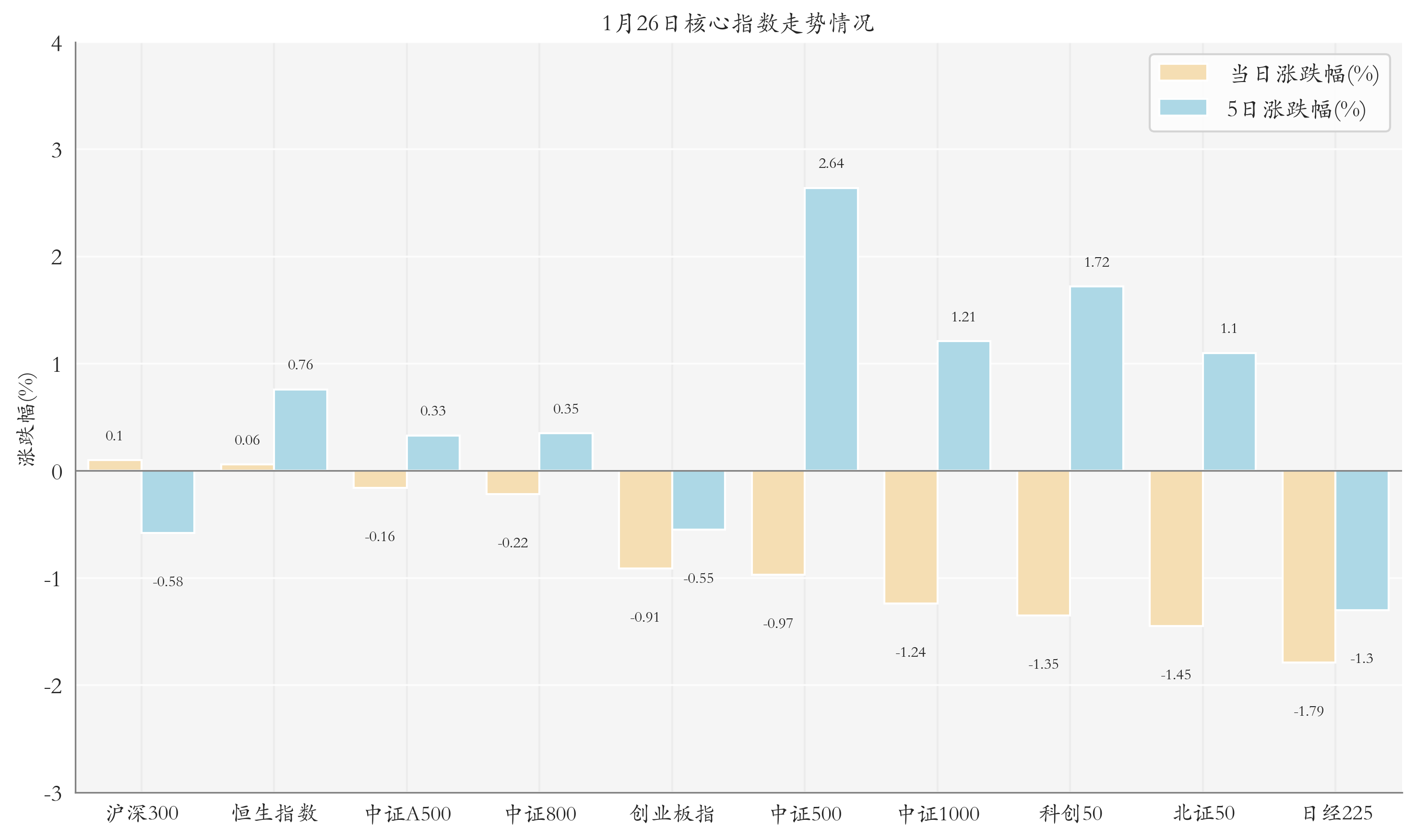
ETF Industry News - The three major indices experienced fluctuations and slight declines, with the Shanghai Composite Index down 0.09%, the Shenzhen Component Index down 0.85%, and the ChiNext Index down 0.91. Multiple gold-related ETFs saw significant gains, including the Gold Stock ETF (159321.SZ) up 8.67%, Gold Stock ETF Fund (159322.SZ) up 8.57%, and Gold Stock ETF ICBC (159315.SZ) up 8.45% [1][2] Stock ETF Market Trends - In the past eight trading days, stock ETFs have seen a net outflow of nearly 500 billion yuan, with significant redemptions in broad-based ETFs. The trading volume for stock ETFs has surged, with daily trading amounts exceeding 240 billion yuan since January 14, and two days recorded over 300 billion yuan in a single day [2][3] Market Overview - On January 26, the A-share market and major overseas indices collectively declined. The Shanghai Composite Index closed at 4132.61 points, the Shenzhen Component Index at 14316.64 points, and the ChiNext Index at 3319.15 points. The CSI 300 and Hang Seng Index showed slight increases, with daily changes of 0.1% and 0.06%, respectively [3][6] Sector Performance - In today's market, the non-ferrous metals, oil and petrochemicals, and coal sectors performed well, with daily increases of 4.57%, 3.18%, and 2.07%, respectively. Conversely, the defense and military, automotive, and social services sectors lagged, with declines of -4.47%, -2.31%, and -2.3% [6] ETF Performance Overview - Among various ETF categories, commodity ETFs performed the best with an average increase of 2.33%, while thematic stock ETFs had the worst performance with an average decrease of -0.82% [9] Top Performing ETFs - The top three performing stock ETFs today were the Gold Stock ETF (159321.SZ) with an increase of 8.67%, Gold Stock ETF Fund (159322.SZ) with an increase of 8.57%, and Gold Stock ETF ICBC (159315.SZ) with an increase of 8.45% [12] ETF Trading Volume - The top three stock ETFs by trading volume today were the CSI 300 ETF Huatai-PB (510300.SH) with a trading volume of 28.002 billion yuan, CSI 300 ETF E Fund (510310.SH) with 22.681 billion yuan, and the SSE 50 ETF (510050.SH) with 16.795 billion yuan [16]
金融产品周报20260125:持续看多,关注周期行业的长期机会
Soochow Securities· 2026-01-25 07:50
Investment Rating - The report maintains a bullish outlook, focusing on long-term opportunities in cyclical industries [2][24]. Core Viewpoints - The macro timing model for January 2026 scored 0, indicating a 76.92% probability of an increase in the Wande All A Index over the following month, with an average expected gain of 3.18% [24][31]. - The report emphasizes the strong upward momentum in cyclical industries, particularly in non-ferrous metals and chemicals, driven by global macro events [24][25]. - Short-term investments in thematic sectors such as commercial aerospace, AI applications, and space photovoltaics have shown significant rebounds, although caution is advised due to potential volatility from rapid price increases [25][27]. Fund Size Statistics - In the period from January 19 to January 23, 2026, the top three increasing equity ETF types were: thematic index ETFs (59.135 billion), industry index ETFs (7.975 billion), and cross-border industry index ETFs (5.346 billion) [9][10]. - The top three increasing equity ETF products were: power grid equipment ETF (7.326 billion), chemical ETF (5.717 billion), and sci-tech chip ETF (3.953 billion) [10][14]. - The top three increasing equity ETF tracking indices were: segmented chemical index (9.829 billion), power grid equipment thematic index (7.326 billion), and SSH gold stock index (5.251 billion) [18][20]. Market Outlook - The report suggests a positive outlook for the A-share market in January 2026, with a focus on the micro-cap index and the CSI 500 leading the market [24][25]. - Long-term recommendations include a focus on non-ferrous metals and chemicals, with silver prices surpassing the psychological level of 100, indicating potential for further increases [24][25]. - The report anticipates a market characterized by oscillating upward trends, recommending a growth-oriented ETF allocation [67][68].
6万亿ETF大盘点,谁是细分赛道隐形冠军?
Sou Hu Cai Jing· 2026-01-08 09:42
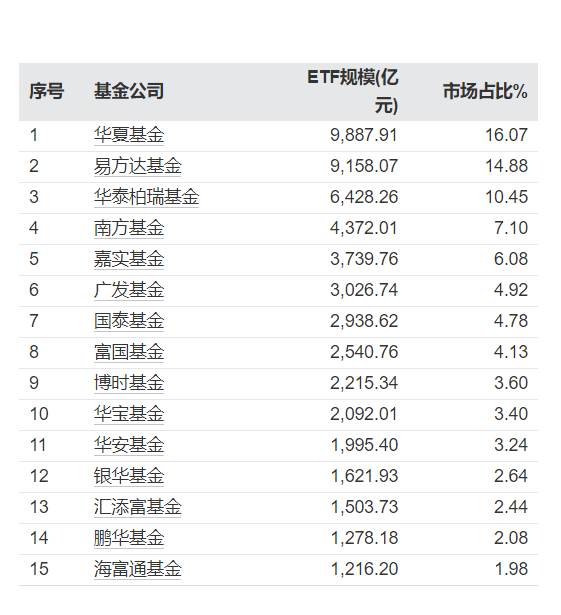
Core Insights - The total scale of ETFs has surpassed 6 trillion, specifically reaching 6.15 trillion [8] - Leading companies in the ETF market include Huaxia and E Fund, both exceeding 900 billion, followed by Haitai Baichuan, which has emerged as a significant player due to its performance in the CSI 300 ETF [9][10] - The ETF market is characterized by a mix of established leaders and emerging champions across various segments, indicating a competitive landscape [10] ETF Market Overview - The top three ETF companies by scale are Huaxia Fund (7,896.61 billion), E Fund (6,981.13 billion), and Haitai Baichuan Fund (5,671.73 billion) [2] - Other notable companies include Southern Fund, Huarun Fund, and GF Fund, which are also recognized as leading public funds in the industry [10] Segment Analysis - In the bond ETF segment, Haifutong Fund leads with a market share of 15.07%, being the only bond ETF to exceed 100 billion [12] - The money market ETF segment is led by Huabao Fund, followed closely by Yinhua Fund, both around 80 billion [13] - The commodity ETF segment is dominated by Huarun Fund with 980 billion, primarily benefiting from the rise in precious metals [13] Emerging Champions - In the cross-border ETF segment, major public funds dominate, with Morgan Fund emerging as a notable player due to its global investment capabilities [14] - The industry index ETF segment is led by Guotai Fund, which, despite being outside the top ten in total scale, excels in this specific category [14] - The thematic index ETF market is primarily held by established public funds, with Huaxia Fund leading at over 1,300 billion [14] Future Outlook - The ETF market is expected to continue growing, with projections suggesting it could reach 10 trillion in the next two years, indicating significant potential for expansion [15]
股票型ETF全解析
HUAXI Securities· 2025-11-27 14:01
Report Summary 1. Investment Rating The provided content does not mention the industry investment rating. 2. Core Viewpoint The report comprehensively analyzes the stock - type ETF market in China. It shows that the scale of stock - type ETFs has expanded rapidly in recent years, offering diverse investment options for both institutional and individual investors. Different types of stock - type ETFs, including broad - based index ETFs, industry index ETFs, theme index ETFs, strategy index ETFs, and style index ETFs, have their own characteristics and performance in various market environments, and there is still significant room for expansion in the future [2][5][6]. 3. Summary by Directory 3.1 Stock - type ETF Overview: Rapid Scale Expansion, Divided into Five Categories - **Market Overview**: Since 2024, the scale of China's stock - type ETFs has expanded by 2.22 trillion yuan. As of September 2025, the number reached 1040, with a share of 2.06 trillion and a scale of 3.70 trillion yuan, 2.53 times that of 2023. The scale has exceeded that of active funds, but the product quantity is still lower. Most single - product scales are below 10 billion yuan, and the overall scale is concentrated in products above 100 billion yuan [12][13][18]. - **Classification by Underlying Index**: Stock - type ETFs can be divided into five categories: broad - based index ETFs, industry index ETFs, theme index ETFs, strategy index ETFs, and style index ETFs. Broad - based index ETFs have the largest scale, accounting for 67.6% as of September 2025, and are the main source of scale growth in recent years. Theme index ETFs have the largest number of products. Different types of ETFs also vary in terms of institutional investor participation [23][24][25]. 3.2 In - depth Analysis of the Characteristics of Various Stock ETFs - **Broad - based Index ETFs: Scale Giants, Institutional Indicators**: As of September 2025, there were 358 broad - based index ETFs, with a highly concentrated scale. The products are actively traded and can meet large - scale capital allocation needs. In different market environments, different broad - based index ETFs perform differently. For example, in the decline stage, large - cap index ETFs are more stable; in the shock - rising and rising stages, small - cap and ChiNext - related products show high elasticity. Institutional investors generally prefer large - cap and more stable products [36][38][40]. - **Industry Index ETFs: Non - banking Finance Leads, Accounting for Nearly 40% of the Scale**: As of September 2025, there were 84 industry index ETFs, with the scale highly concentrated in eight industries such as non - banking finance, pharmaceutical biology, and banking. Some popular industries' ETFs may not receive corresponding attention due to the deviation of their positions from market hotspots. In different market stages, different industry ETFs perform differently. Institutions prefer industries with stable cash flows and defensive attributes, while individuals are more interested in non - banking finance and industries with high elasticity [58][60][65]. - **Theme Index ETFs: Elasticity Pioneers**: As of September 2025, there were 480 theme index ETFs, covering a wide range of market hot - topics with a relatively balanced scale distribution. In different market environments, they show high elasticity. For example, in the decline stage, securities insurance and central - state - owned enterprise themes are more stable; in the shock - rising stage, technology - related themes are leading; in the rising stage, communication - related themes perform outstandingly. Institutions prefer low - elasticity and stable products, while individuals like high - elasticity products [85][89][93]. - **Strategy and Style Index ETFs: Dividend Strategy Dominates, Accounting for Over 70% of the Scale**: As of September 2025, there were 115 strategy and style index ETFs, with dividend - related ETFs accounting for 75.54% of the scale. They are efficient tools for implementing rotation strategies. In different market stages, different products perform differently. Institutions prefer defensive products such as dividend and value - style products, while growth - and quality - related products are more popular among individuals [111][114][121].
主题ETF高光之年:规模已近翻倍,超百只产品年内收益过50%
Sou Hu Cai Jing· 2025-10-27 05:15
Group 1 - The core viewpoint of the articles highlights the explosive growth of thematic ETFs in 2025, with a significant increase in both scale and number of products, driven by investor demand, industry opportunities, and product supply [2][5][6] - Thematic ETFs have seen a scale increase from 410.39 billion to 795.54 billion, marking a year-on-year growth rate of 93.85%, the highest among five categories of stock ETFs [2][3] - The number of thematic ETF products has risen from 422 to 487, reflecting a 15.40% increase in product offerings [2] Group 2 - The market share of stock ETFs has decreased from 77.38% to 65.32%, while thematic ETFs' market share has increased from 11.00% to 13.97%, indicating a growing interest in thematic products [3] - The issuance of thematic ETFs has been particularly strong in technology and AI sectors, with 67 new thematic ETFs established this year, surpassing last year's total of 47 [6][7] - The total issuance scale of thematic ETFs reached 29.94 billion, a 167.49% increase compared to the same period last year [6] Group 3 - Notably, 19 thematic ETFs have surpassed 10 billion in scale this year, with the largest being the Jiashi Shanghai Stock Exchange Science and Technology Innovation Board Chip ETF at 41.74 billion [11] - Thematic ETFs have generally performed well, with 95.28% of the 487 products yielding positive returns this year, and 116 products achieving returns over 50% [10] - Thematic ETFs related to technology, batteries, gold, and rare earths have shown particularly strong performance [10] Group 4 - Despite the overall growth, 40 out of 67 newly established thematic ETFs have seen a decrease in scale, highlighting a competitive market environment [8] - Thematic ETFs related to chips have experienced significant net outflows, with the largest being 7.25 billion for the Huaxia National Chip ETF [16] - The trading volume for technology and high-end manufacturing ETFs has been robust, averaging 29.83 billion per day, supported by government policies favoring technological innovation [17][18]

多只建材ETF上涨;行业主题ETF合计规模破万亿丨ETF晚报
2 1 Shi Ji Jing Ji Bao Dao· 2025-10-10 10:40
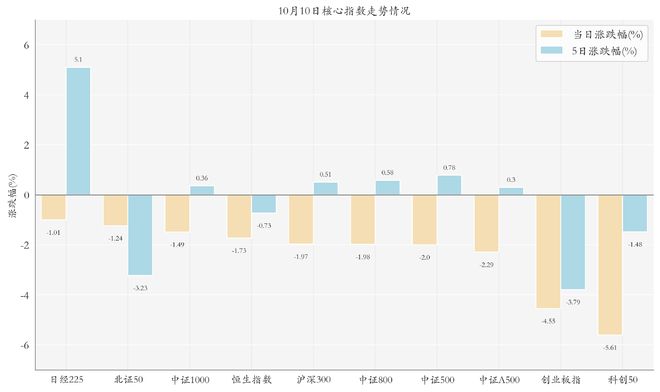
Market Overview - The three major indices experienced fluctuations and declines, with the Shanghai Composite Index down by 0.94%, the Shenzhen Component Index down by 2.7%, and the ChiNext Index down by 4.55% [1] - Multiple ETFs in the oil and petrochemical sector saw increases, including the Oil and Gas Resources ETF (563150.SH) up by 1.72% and the Energy ETF (159945.SZ) up by 1.45% [1] ETF Market Growth - As of September 30, the total scale of ETFs in the market reached a historical high of 5.63 trillion yuan, an increase of 1.9 trillion yuan since the beginning of the year, representing a growth rate of over 50% [2] - The total number of ETF shares reached 3.01 trillion, with an increase of 353 billion shares, marking a growth of over 13% [2] - Stock ETFs accounted for approximately 66% of the total ETF scale, with a total scale of 3.71 trillion yuan, while bond ETFs surpassed 690 billion yuan, making up about 12% of the total [2] Industry and Thematic ETFs Performance - The combined scale of industry and thematic ETFs exceeded 1 trillion yuan, with a year-to-date growth of over 77% [3] - As of September 30, there were 483 thematic ETFs with a total scale of 774.79 billion yuan and 84 industry ETFs with a scale of 287.63 billion yuan [3] - The number of shares for industry ETFs increased by 84.71 billion to 306.54 billion, while thematic ETFs saw an increase of 205.03 billion to 728.06 billion [3] ETF Market Dynamics - Analysts suggest that the ETF market is evolving from "blurry allocation" to "precise allocation," with industry and thematic ETFs attracting significant investment due to market conditions, product offerings, and demand [4] - Looking ahead to Q4, high-quality sectors are expected to continue performing well, although overall growth rates may slow [4] Sector Performance - In today's market, sectors such as construction materials, coal, and textiles showed positive performance, with daily increases of 1.92%, 1.37%, and 1.3% respectively [7] - Conversely, the electronics, power equipment, and computer sectors experienced declines, with daily decreases of 4.71%, 4.46%, and 3.7% respectively [7] ETF Performance by Category - Among different categories of ETFs, the stock strategy index ETFs performed the best with an average increase of 0.24%, while the thematic index ETFs had the worst performance with an average decrease of 3.14% [10] - The top-performing ETFs included the Construction Materials ETFs, with the highest daily returns of 3.12%, 2.97%, and 2.94% [12][13] Trading Volume Insights - The top three ETFs by trading volume were the Sci-Tech 50 ETF (588000.SH) with 8.808 billion yuan, the Sci-Tech Chip ETF (588200.SH) with 7.096 billion yuan, and the ChiNext ETF (159915.SZ) with 6.982 billion yuan [15][16][17]