铜杆

Search documents
星凯控股(01166)发布中期业绩 股东应占亏损1512.1万港元 同比收窄42.34%
智通财经网· 2026-02-26 13:51
Core Viewpoint - Xingkai Holdings (01166) reported a decline in revenue and a narrowed loss for the six months ending December 31, 2025, indicating challenges in its core business segments [1] Financial Performance - The company's revenue was approximately HKD 238 million, representing a year-on-year decrease of 20.6% [1] - The loss attributable to shareholders was HKD 15.121 million, which is a 42.34% reduction compared to the previous year [1] - Basic loss per share was HKD 0.13 [1] Business Segment Analysis - Revenue from the wire and cable segment was approximately HKD 66.925 million, down 27.9% year-on-year, accounting for 28.1% of total revenue [1] - Revenue from the copper rod segment was about HKD 168 million, a decrease of 14.6% year-on-year, making up 70.5% of total revenue [1] - Rental income was approximately HKD 3.421 million, reflecting a significant decline of 67.7% year-on-year, contributing 1.4% to total revenue [1]
星凯控股发布中期业绩 股东应占亏损1512.1万港元 同比收窄42.34%
Zhi Tong Cai Jing· 2026-02-26 13:48
Core Viewpoint - Xingkai Holdings (01166) reported a mid-term performance for the six months ending December 31, 2025, showing a significant decline in revenue and a reduced loss compared to the previous year [1] Financial Performance - Revenue for the period was approximately HKD 238 million, representing a year-on-year decrease of 20.6% [1] - The loss attributable to shareholders was HKD 15.121 million, which is a reduction of 42.34% year-on-year [1] - Basic loss per share was HKD 0.13 [1] Business Segment Performance - The revenue from the wire and cable segment was approximately HKD 66.925 million, down 27.9% year-on-year, accounting for 28.1% of total revenue [1] - The copper rod business generated revenue of approximately HKD 168 million, a decrease of 14.6% year-on-year, making up 70.5% of total revenue [1] - Rental income was approximately HKD 3.421 million, reflecting a significant decline of 67.7% year-on-year, contributing 1.4% to total revenue [1]
江西铜业(600362):首次覆盖报告:铜矿盈利能力提升,冶炼业务短期承压
Guoyuan Securities· 2026-02-13 14:55
Investment Rating - The report assigns an "Accumulate" rating to Jiangxi Copper Co., Ltd. with a target price of 56.59 yuan [7]. Core Insights - Jiangxi Copper's comprehensive copper industry chain advantages are driving rapid performance growth, with a significant increase in revenue and net profit due to rising copper prices [1][4]. - The company is the largest cathode copper supplier in China, with a production capacity exceeding 2 million tons per year, and is expected to maintain steady growth in performance due to high copper prices and scale effects [3][4]. - The company is actively expanding its overseas resource layout, which is crucial for long-term strategic positioning [4][13]. Summary by Sections Financial Performance - For Q1-Q3 2025, Jiangxi Copper achieved operating revenue of 396.05 billion yuan, a year-on-year increase of 0.98%. In Q3 2025, revenue reached 139.09 billion yuan, up 14.09% year-on-year. The net profit attributable to shareholders was 6.02 billion yuan, a 20.85% increase year-on-year, with Q3 net profit at 1.85 billion yuan, up 35.20% year-on-year [1][2][26]. Resource and Capacity - The company has a well-established resource reserve layout, with a cathode copper production capacity of over 2 million tons per year. In 2024, cathode copper production is expected to reach 2.29 million tons, a year-on-year increase of 9.28% [3][15]. - Jiangxi Copper's resource reserves include 8.90 million tons of copper, 239.08 tons of gold, and 8,252.60 tons of silver, with significant investments in overseas resources [12][13]. Industry Outlook - The copper market is expected to experience sustained high price fluctuations due to supply-demand dynamics, with global copper reserves growing at a slower pace and potential shortages in refined copper [4][49]. - The demand for refined copper is anticipated to continue growing, driven by both emerging and traditional applications, which will support copper prices [4][49]. Profitability and Valuation - The report forecasts Jiangxi Copper's net profit attributable to shareholders for 2025-2027 to be 8.45 billion, 11.37 billion, and 12.87 billion yuan, respectively, with corresponding P/E ratios of 23.19, 17.24, and 15.22 [4][6]. - The company maintains a stable gross margin, with a slight increase in net margin, indicating effective cost management and operational efficiency [41]. Product Contribution - Cathode copper remains the primary revenue source, contributing 50.21% of total revenue in H1 2025, despite a year-on-year decline in revenue from cathode copper and copper rod lines [30][31]. - The gold business is also showing strong growth, with revenue from gold reaching 37.25 billion yuan in H1 2025, a year-on-year increase of 5.62% [32]. Strategic Initiatives - Jiangxi Copper is advancing key projects, including the expansion of its copper processing capacity and the development of new mining projects, which are expected to enhance its competitive position in the market [25][36].
从“不敢扩产”到“万吨大单”
Qi Huo Ri Bao Wang· 2026-02-11 16:31
Core Viewpoint - The integration of futures trading into the operations of a copper processing company has significantly improved its ability to manage raw material price volatility, leading to increased confidence and production capacity expansion [1][7]. Group 1: Company Operations and Futures Integration - The copper processing company recycles scrap copper to produce copper plates and rods, which are used in various industries such as cables and home appliances [2]. - The company initially faced significant price volatility in copper, leading to anxiety over potential losses, prompting them to seek risk management tools [2][3]. - After implementing a futures hedging strategy, the company reported a 30% year-on-year increase in refined copper production in 2025, with monthly production exceeding 10,000 tons [3]. Group 2: Risk Management and Strategy Development - The company developed a tailored hedging plan with the assistance of a futures company, which included dynamic inventory management and accounting integration [4]. - The company learned that different industries require different hedging strategies, emphasizing the importance of practical experience in refining these strategies [4][5]. - The use of options, such as selling call options, has been introduced to enhance revenue while managing risk [5]. Group 3: Communication and Support - Continuous communication between the futures company and the copper processing company has been crucial for refining hedging strategies and addressing potential risks [6]. - The futures company has provided not only trading support but also facilitated connections with potential customers, broadening the company's sales channels [6]. Group 4: Industry Trends and Future Outlook - The copper processing company plans to expand its production capacity further in 2026, reflecting increased confidence from effective risk management through futures [7]. - The broader trend shows that more companies across various sectors are recognizing the value of futures markets for risk management and operational stability [8][9].
铜产业链周度报告-20260206
Zhong Hang Qi Huo· 2026-02-06 11:00
1. Report Industry Investment Rating - Not mentioned in the report 2. Core Viewpoint of the Report - Copper prices will continue to adjust in the short - term, and attention should be paid to precious metal price fluctuations. In the medium - term, the upward trend of copper prices will remain unchanged [5][52] 3. Summary According to the Directory 3.1 Report Summary - US manufacturing index reached a new high since August 2022, while the service index declined slightly. US ADP employment was lower than expected, and the release of the non - farm employment report was postponed. The large - scale selling of the world's largest silver leveraged ETF added selling pressure to the precious metal market, and market risk appetite was poor [5][12] - The China Nonferrous Metals Industry Association plans to improve the copper reserve system, expand the national strategic copper reserve scale, and explore a commercial reserve mechanism. It also considers including copper concentrates in the reserve scope [5] - Globally, copper mine supply is facing structural challenges, and the supply of copper concentrates is expected to have a significant gap in 2026. In China, refined copper production remained high in December 2025, and there were plans for smelter overhauls in January 2026 [5][20][25] - The import volume of scrap copper in China reached a new monthly high in December 2025. The production enthusiasm of refined copper rod enterprises declined significantly in December 2025, and the increase in production in January 2026 was limited [25][29][33] - The refined - scrap copper price difference was at a high level, which was not conducive to refined copper consumption. The inventory of global electrolytic copper increased significantly, and the discount range of domestic and foreign copper spot prices decreased [36][44][49] - The Chinese real estate market is still in the adjustment period, but there may be policies to improve and stabilize expectations. China's automobile production and sales reached a new high in 2025, and the new - energy vehicle market continued to grow. The new photovoltaic installation scale is expected to decline in 2026 and then return to an upward trend [39][41] 3.2 Multi - and Short - Focus - **Bullish factors**: The tight situation of copper mines remains unchanged [8] - **Bearish factors**: Refined copper production remains at a high level, refined copper inventory continues to accumulate, precious metals continue to decline, and market risk appetite is poor [8] 3.3 Data Analysis - **Copper mine supply**: In 2025, global copper mine supply was severely disrupted, and the supply of copper concentrates had a large gap. The supply is expected to decline in 2026 and turn to a more relaxed state in 2027 [20] - **Copper concentrate TC**: The spot TC/RC of copper concentrates is in a deep negative range, and the profit of the smelting end is under pressure. Chile has postponed the goal of annual copper production exceeding 6 million tons and lowered production expectations [23] - **Refined copper production**: In December 2025, China's refined copper production was 1.326 million tons, a year - on - year increase of 9.1%. In January 2026, there were plans for smelter overhauls and new plant startups [25] - **Scrap copper import**: In December 2025, China's scrap copper import volume was 239,000 tons, a month - on - month increase of 14.81% and a year - on - year increase of 9.90%, reaching a new monthly high in 2025 [29] - **Refined copper rod production**: In December 2025, the production of refined copper rods in China decreased significantly, and the production increase in January 2026 was limited [33] - **Refined - scrap copper price difference**: As of February 5, the refined - scrap copper price difference was around 3,380 yuan/ton, remaining at a high level, which was not conducive to refined copper consumption [36] - **Electrolytic copper inventory**: The inventory of LME, COMEX, and SHFE copper increased, and the domestic spot inventory of electrolytic copper also increased [45] - **Copper spot premium**: On February 5, the premium of Shanghai Wumaotrade 1 copper spot was around - 105 yuan/ton, and the LME 0 - 3 spot discount was around 77.58 US dollars/ton, with the discount range narrowing [49] 3.4 Market Outlook - Copper prices will continue to adjust in the short - term, and attention should be paid to precious metal price fluctuations. In the medium - term, the upward trend of copper prices will remain unchanged [52]
铜 | 行业动态:供需抽紧格局持续强化,短期调整迎来布局良机
中金有色研究· 2026-02-06 04:19
Industry Overview - The China Nonferrous Metals Industry Association announced the need to improve the copper resource reserve system, coinciding with the U.S. launching a $12 billion critical mineral reserve plan, including copper, to mitigate supply chain risks [1][2] - On February 2, domestic copper prices briefly fell, but downstream replenishment demand surged, with electrolytic copper and copper rod transaction volumes reaching 38,000 and 43,000 tons, respectively, marking increases of 108% and 198% compared to the previous period, hitting new highs in three months [1] Commentary - Both China and the U.S. have initiated copper resource reserve plans, indicating a sustained growth in strategic stockpiling demand. China is focusing on a combination of state and commercial storage models, considering both refined copper and copper concentrate [2] - The U.S. has seen a rapid increase in copper inventories at its two major exchanges, with LME copper inventory rising to 15,000 tons in just 11 trading days, and COMEX copper inventory reaching 530,000 tons, up 2% week-on-week [2] - The industry's replenishment is expected to support copper prices, with strong demand for low-priced copper amid low inventory levels and the upcoming spring peak season. Supply disruptions in overseas copper mines and low TC/RC levels may further tighten supply and push copper prices higher [2] - The long-term outlook for the copper industry remains bullish, with a significant increase in demand driven by insufficient capital expenditure over the past decade. The copper supply-demand balance is expected to remain tight, potentially raising the price center. As of February 3, the Shenyin Wanguo copper industry PE (TTM) was 25.6 times, a 13% adjustment from the January 29 peak, positioned at the 31st percentile of the past decade's valuation levels [2]


省政协委员柴兴臣:锚定战新产业,加快河南铜加工转型升级
Sou Hu Cai Jing· 2026-01-27 12:08
Core Viewpoint - The copper industry in Henan is poised for significant development opportunities as the provincial government emphasizes upgrading traditional industries, including steel, coal, and non-ferrous metals [1] Group 1: Industry Performance - In 2025, China's non-ferrous metal industry is expected to stabilize and recover, with profits from large-scale enterprises reaching 448.62 billion yuan, a year-on-year increase of 15.9% [2] - The copper industry, as the second-largest sector in Henan's non-ferrous metals, has surpassed a production value of 100 billion yuan, closely linked to the province's industrial technology development [2] Group 2: Supply and Demand Dynamics - The global copper market is experiencing unprecedented production challenges on the supply side, while demand is surging, particularly from emerging industries such as renewable energy, artificial intelligence, and 5G communications [3] - Copper is referred to as the "blood vessel of industry," essential for developing new productive forces, with Henan's manufacturing scale providing ample application scenarios for copper processing [3] Group 3: Future Development Strategies - Henan can focus on selecting 3-5 key industrial chains with strong foundations and potential within trillion-yuan industrial clusters, implementing "collaborative innovation" actions [4] - The province aims to establish a provincial-level collaborative innovation fund to support leading enterprises in forming innovation alliances with universities and research institutions [4] Group 4: Logistics and Supply Chain Optimization - Henan is transitioning from a "geographical center" to an "economic circular core," with improvements in multi-modal transport systems expected to reduce logistics costs and enhance the attractiveness of high-end manufacturing and bulk commodity trade [5] - There is potential for further reduction in logistics costs for manufacturing enterprises, particularly in the "last mile" connectivity, which can be improved through integrated transport networks [6] Group 5: Market Positioning and Global Integration - As a major copper processing country, China accounts for over 50% of global refined copper production, but has historically relied heavily on imported raw materials and lacks sufficient pricing power in the industry [6] - With the growth of Henan's port hub economy, copper processing enterprises are expected to access overseas copper resources more economically and facilitate the distribution of finished products to national and global markets [6]

盘前公告淘金:复牌!上海国资拟入主江化微,华是科技实控人变更、盈方微重大资产重组;湖南裕能2025年净利同比预增94%-136%
Jin Rong Jie· 2026-01-20 01:43
Important Events - Yidian Tianxia has resumed trading after the suspension for verification [1] - Jianghuai Microelectronics will have its actual controller changed to Shanghai State-owned Assets Supervision and Administration Commission, and its stock has resumed trading [1] - Huas Technology's actual controller has changed to Zheng Jianbo, and its stock has resumed trading [1] - Yingfang Microelectronics plans to acquire 100% shares of Shanghai Xiaokeli and Fujide China, which is expected to constitute a major asset restructuring, and its stock has resumed trading [1] - Hualing Cable has terminated the acquisition of Xingxin Aerospace's controlling stake, which provides supporting products for Shenzhou series spacecraft, Chang'e series detectors, and various launch vehicles [1] - Rongsheng Development's subsidiary plans to acquire 100% equity of Yingde Jihong and Yingde Jiyue for 40 million yuan [1] - Donghua Software plans to establish a wholly-owned subsidiary, Donghua Zhizhi, with an investment of 300 million yuan [1] - Zhongwei Semiconductor is about to launch its first non-volatile memory chip [1] - Xingqi Eye Medicine's SQ-24071 eye drops have received clinical trial approval [1] Contracts & Project Bids - Pingzhi Information has pre-qualified for an intelligent computing service project worth approximately 489 million yuan [1] - Nanshan Aluminum plans to invest 437 million USD to build a 250,000-ton annual electrolytic aluminum project in Indonesia [1] - Yian Technology's controlling company has signed a project entry contract to create a benchmark project for high-quality amorphous alloy (liquid metal) [1] - Jiangxi Copper has signed a three-year cooperation framework agreement with the Ordnance Material Department, expecting to sell 9.7 billion yuan worth of copper rods and other products annually [1] - Wutong Holdings' wholly-owned subsidiary did not win the bid for the Agricultural Bank of China mobile SMS long number agency service project, which is expected to have a significant adverse impact on the company's future operating performance [1] Operations & Performance - Hunan Yuneng expects a net profit increase of 94%-136% year-on-year in 2025, driven by a rebound in lithium carbonate prices enhancing overall profitability [1] - Jilin Carbon Valley anticipates a net profit increase of 92.81%-135.66% year-on-year in 2025 [1] - Fulai Anticipates a net profit increase of 81.67%-127.08% year-on-year in 2025 [1] - Dingtong Technology expects a net profit increase of 120% year-on-year in 2025, with significant growth in high-speed communication product business [1] - Chengdu Huamei anticipates a net profit increase of 74%-109% year-on-year in 2025, with Q4 net profit expected to grow by 458%-614% quarter-on-quarter [1] - Anfu Technology expects a net profit increase of 28.55%-50.91% year-on-year in 2025 [1] - Dinglong Co. anticipates a net profit increase of 34.44%-40.20% year-on-year in 2025 [1] - Mingtai Aluminum expects a net profit increase of 12%-14% year-on-year in 2025 [1] - Huace Testing anticipates a net profit increase of 10%-11% year-on-year in 2025 [1] - Xianglu Tungsten Industry expects a net profit of 125 million to 180 million yuan in 2025, with tungsten metal raw material prices continuing to rise throughout the year [1] Financing & Capital Increase - Jiangxi Copper plans to register and issue debt financing instruments not exceeding 25 billion yuan [2] - Goldwind Technology has terminated the public REITs application and issuance work [2] - Huichuan Technology is planning to issue H-shares and list on the Hong Kong Stock Exchange [2]

上证早知道|卫星互联网 加速组网!易点天下 停牌核查完成!华菱线缆 终止收购商业航天资产!
Shang Hai Zheng Quan Bao· 2026-01-19 23:01
Company News - Hunan YN announced an expected net profit of 1.15 billion to 1.4 billion yuan for 2025, representing a year-on-year growth of 93.75% to 135.87%, driven by the rapid development of the new energy vehicle and energy storage markets [10] - Jiangxi Copper has signed a cooperation framework agreement with a military materials supplier to supply various copper and nickel products, effective until December 31, 2028, which will enhance the company's market competitiveness [10] - Ding Tong Technology expects a net profit of 242 million yuan for 2025, an increase of 119.59% compared to the previous year [10] - ST Yuan Zhi anticipates a net profit of 90 million to 110 million yuan for 2025, a year-on-year increase of 396.77% to 507.16%, supported by strong export growth and domestic market opportunities [11] - Hao Shang Hao expects a net profit of 65 million to 83 million yuan for 2025, reflecting a year-on-year growth of 115.64% to 175.35%, driven by increased sales and improved gross margins [12] Industry Insights - The satellite internet industry is entering a rapid development phase, with successful launches of low-orbit satellites and a growing number of satellites in orbit, indicating a significant market opportunity for satellite manufacturing and related industries [7] - The demand for AI is driving up the prices of copper-clad laminates (CCL) due to supply constraints and rising raw material costs, with price increases of over 30% announced by major suppliers [9] - The electric grid sector is experiencing a surge, with ETFs related to the sector rising over 7%, and the State Grid Company planning to invest 4 trillion yuan during the 14th Five-Year Plan, a 40% increase from the previous plan [6]
江西铜业与兵工物资三年合作官宣:将就阴极铜、粗铜、电解镍等产品建立购销关系
Mei Ri Jing Ji Xin Wen· 2026-01-19 12:33
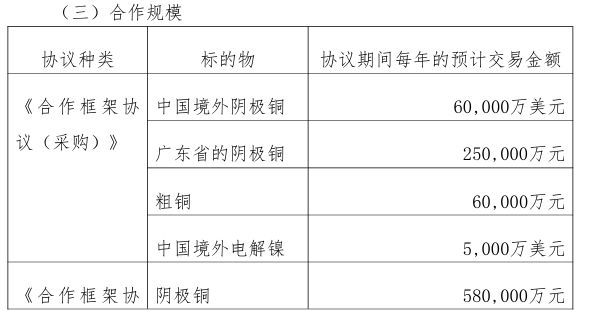
Core Viewpoint - Jiangxi Copper has signed a three-year cooperation framework agreement with China Ordnance Material Group, focusing on the purchase and sale of cathode copper, crude copper, and electrolytic nickel, while also pursuing a cash acquisition of SolGold to enhance its global copper resource layout [1][3]. Group 1: Cooperation Agreement - The cooperation agreement will be effective from January 1, 2026, to December 31, 2028, covering transactions in cathode copper, crude copper, and electrolytic nickel [1]. - Expected annual transaction amounts include $600 million for overseas cathode copper, 2.5 billion RMB for Guangdong cathode copper, 600 million RMB for crude copper, and $50 million for overseas electrolytic nickel [1]. - Sales projections include 5.8 billion RMB for cathode copper, 500 million RMB for copper rods, 700 million RMB for aluminum ingots, 1.5 billion RMB for electrolytic nickel, 700 million RMB for zinc ingots, 30 million RMB for tin ingots, and 500 million RMB for precious and rare metals [1]. Group 2: Acquisition of SolGold - Jiangxi Copper announced a formal offer to acquire all issued shares of SolGold at 28 pence per share, valuing the target company at approximately £867 million [3]. - The board of SolGold has deemed the acquisition terms fair and is recommending shareholders support the deal [3]. - Jiangxi Copper has received irrevocable commitments from major shareholders, including BHP, Newmont, and Maxit Capital LP, representing about 25.7% of SolGold's shares [3]. Group 3: Industry Context - The copper industry is experiencing a shift towards consolidation among leading enterprises, with a significant reduction in processing fees for copper concentrate, impacting smelter profit margins [4]. - Jiangxi Copper's revenue figures for 2022 to 2024 are projected at 479.94 billion RMB, 521.89 billion RMB, and 520.93 billion RMB, with net profit expected to reach 6.962 billion RMB in 2024 [5]. - The company is enhancing its resource control and industry influence through strategic acquisitions and partnerships, particularly during a period of overall capacity adjustment in the industry [5].