
AI主播

Search documents
监管“利剑”出鞘 中国亮剑整治市场竞争乱象
Zhong Guo Xin Wen Wang· 2026-02-01 10:35
Group 1 - The Chinese market regulatory authorities have intensified efforts to address market competition issues, particularly in the food delivery and travel service sectors, by launching investigations into practices such as price wars and market dominance abuse [1][2] - The National Market Supervision Administration has emphasized the need to deepen fair competition governance, focusing on anti-monopoly and anti-unfair competition enforcement to combat "involution" in various industries [2][3] - Recent regulatory measures include the implementation of the "Live E-commerce Supervision Management Measures" and the prohibition of certain mergers in the public utility sector, aimed at curbing monopolistic behaviors and ensuring fair practices [3][4] Group 2 - The regulatory authorities are creating a favorable institutional environment for companies to engage in lawful mergers and acquisitions, particularly in sectors experiencing "involution," such as automotive and renewable energy [4] - A notable example of regulatory support is the approval of a joint venture between China National Petroleum Corporation and Contemporary Amperex Technology Co., which aims to enhance innovation and efficiency through strategic collaboration [4]
蔬果禽蛋等须持“放心证”上市、整治拒收人民币现金……2月新规一起来看!
Xin Hua She· 2026-01-30 11:59
Group 1: Agricultural Product Management - The "Commitment to Quality Certificate" management for agricultural products, including fruits and vegetables, will be implemented starting February 1, ensuring that these products do not contain banned pesticides or veterinary drugs and that residue levels of permitted substances are within limits [1] Group 2: Live E-commerce Regulation - The "Live E-commerce Supervision Management Measures" will also take effect on February 1, incorporating AI-generated content, such as digital anchors, into regulatory frameworks to prevent the spread of false information and promote the responsible use of AI in live e-commerce [2] Group 3: Cash Payment Regulations - The "Regulations on Cash Payment and Services" will be enforced from February 1, prohibiting the refusal of cash payments except in legally mandated situations, and requiring businesses to maintain adequate cash change to facilitate smooth cash transactions [3] Group 4: Promotion of Reading - The "National Reading Promotion Regulations" will be enacted on February 1, focusing on enhancing reading accessibility in underdeveloped areas and providing support for vulnerable groups, including children, the elderly, and individuals with disabilities [4] Group 5: Unified Social Credit Code - The "Unified Social Credit Code Management Measures" will be effective from February 1, establishing a unique, lifelong identification code for organizations to improve the accuracy of identification and tracking within the social credit system [5] Group 6: Administrative Law Enforcement Supervision - The "Administrative Law Enforcement Supervision Regulations" will come into force on February 1, emphasizing the need for balanced supervision and guidance in administrative law enforcement to enhance the quality and effectiveness of enforcement actions [6]
“AI主播”纳入直播电商监管、整治拒收人民币现金……2月新规一起来看!
Xin Hua She· 2026-01-30 01:37
Group 1 - The new regulations require that fruits, vegetables, poultry, and eggs must have a "reassurance certificate" to be sold in the market [1] - AI-generated avatars and videos used in live e-commerce must be clearly identified and continuously reminded to consumers [3] - The new regulation on cash payments prohibits refusal to accept cash, except in legally mandated situations, and requires businesses to maintain reasonable change availability [3] Group 2 - The "National Reading Promotion Regulations" aim to enhance reading across all demographics, with a focus on supporting rural, revolutionary, ethnic, border, and underdeveloped areas [3] - The regulations emphasize providing suitable reading materials and courses for minors, disabled individuals, and the elderly [3] - The "Unified Social Credit Code Management Measures" establish a unique, lifelong identification code for organizations to improve social credit systems and market regulation [4] Group 3 - The "Administrative Law Enforcement Supervision Regulations" focus on improving the quality and effectiveness of administrative law enforcement through enhanced supervision and management [4] - The regulations aim to prevent and correct issues in administrative enforcement, including illegal practices and arbitrary charges [4]


宁夏银川数字经济总量突破1200亿元 全力打造“算力之都”
Xin Lang Cai Jing· 2026-01-22 09:56
Core Insights - Yinchuan's digital economy has reached a total of 120 billion yuan, doubling since the end of the 13th Five-Year Plan, and is transitioning from a "digital pilot" to a "computing power capital" [1][2] Group 1: Digital Economy Development - Yinchuan has implemented policies such as "17 measures for digital transformation" and "12 measures for computing talent" to optimize the digital industry environment, attracting 85% of Ningxia's digital service enterprises [2] - The city has established 9 computing power centers, achieving 100% coverage of gigabit networks, and has launched three national 10-gigabit optical network pilot projects [2] - Yinchuan's AI industry model "Helan Mountain No. 1" has been launched, and the AI application in trade and tourism has been successfully implemented [2] Group 2: Green Development Integration - Yinchuan's renewable energy installed capacity accounts for 54%, making it the largest power source, with energy consumption per unit of industrial added value decreasing by 22% [5] - The number of new energy buses has achieved full coverage, and the ownership of new energy vehicles has increased by 28.5 times [5] Group 3: Future Goals and Innovations - Yinchuan aims to increase its digital economy to 130 billion yuan in the next five years, with the core industry value added accounting for 10% of the regional GDP [5] - The city plans to deepen initiatives in "Artificial Intelligence +" and "Data Elements ×", and to construct new projects such as the Ningxia Computing Power Monitoring and Dispatch Center [5] - Yinchuan will focus on developing specialized models in healthcare and wine, and will implement 20 projects including Turing Town, while fostering 50 typical application scenarios [5]
对抗AI的人
3 6 Ke· 2026-01-09 11:20
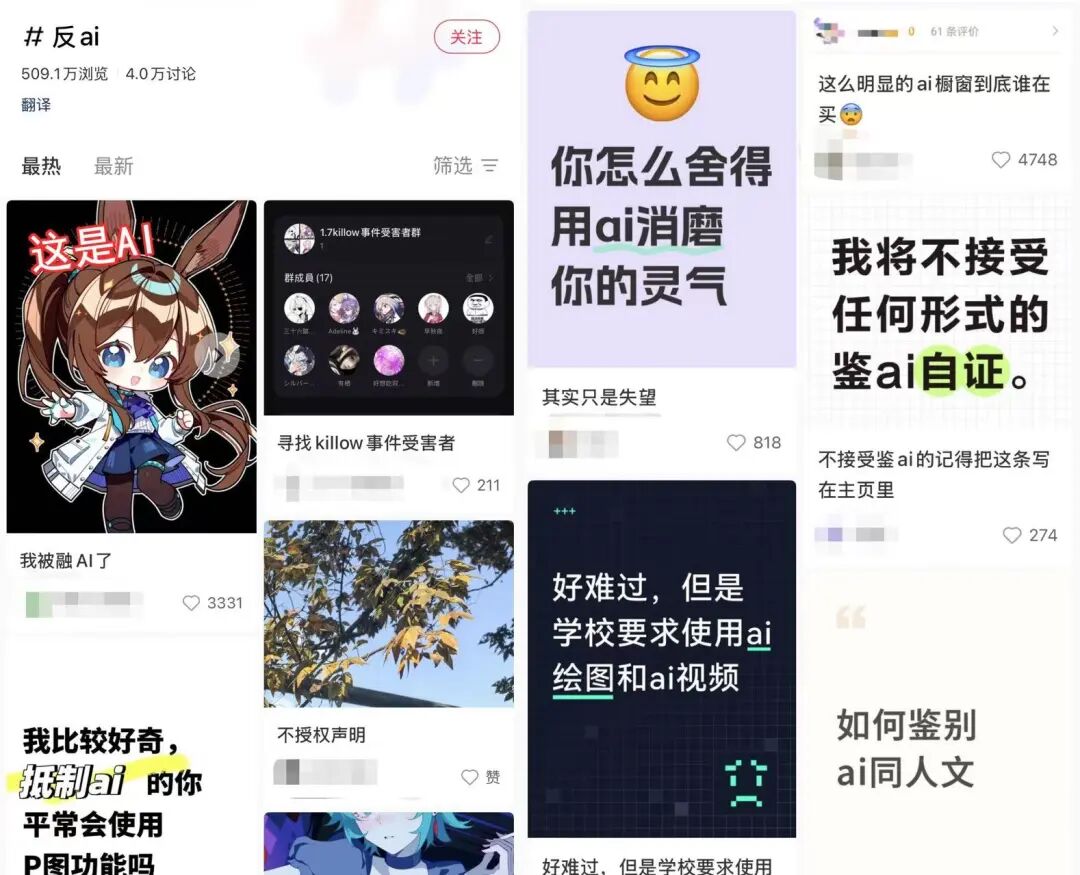
Core Viewpoint - The rapid advancement of AI has transformed it from a novel concept to an omnipresent element in daily life, leading to both increased efficiency and significant negative impacts on various creative industries [1][2]. Group 1: Impact on Creative Industries - Reddit reported the deletion of over 40 million pieces of spam and false content, with estimates suggesting that up to 50% of content in large communities may be AI-influenced [1]. - The influx of AI-generated content has led to a crisis in creative expression, with writers, musicians, and artists feeling pressured to adapt or compete with AI [1][6]. - The number of new web novels surged dramatically, with 5,606 new titles launched in March 2024 compared to just 400 in the same month of 2023, indicating a significant rise in AI-generated literature [3][4]. Group 2: Personal Experiences and Reactions - Creators like Han Yiqiu express deep disappointment over the use of AI in writing, feeling that it undermines genuine human expression and creativity [3][12]. - Many artists, such as Xiao Han, have faced job losses or reduced opportunities due to AI's encroachment into their fields, leading to feelings of despair and thoughts of changing careers [6][7]. - The rise of AI-generated content has led to a decline in the perceived value of human-created works, with creators feeling the need to prove their authenticity [12][14]. Group 3: Adaptation and Resistance - Some individuals are attempting to find ways to coexist with AI, recognizing that complete resistance may not be feasible [16][17]. - Xiao Han's success in creating a popular comic series demonstrates that human creativity can still thrive in the face of AI competition by focusing on emotional depth and complex storytelling [18][20]. - The ongoing debate about the role of AI in creative industries highlights the need for a balance between leveraging AI's capabilities and preserving the authenticity of human expression [8][11].
平台经济出新规:涉AI主播、电商打假、平台不合理行为等乱象
2 1 Shi Ji Jing Ji Bao Dao· 2026-01-07 23:37
Core Viewpoint - The rapid development of live e-commerce has led to significant issues such as counterfeit products, false marketing, and privacy violations, prompting the introduction of new regulatory measures to enhance oversight and accountability in the industry [1][2][3]. Group 1: Regulatory Measures - The State Administration for Market Regulation and the National Internet Information Office jointly issued the "Network Transaction Platform Rules Supervision Management Measures" and the "Live E-commerce Supervision Management Measures" to clarify platform responsibilities and reduce illegal activities [1][8]. - The "Live E-commerce Supervision Management Measures" specifically regulate the use of AI in live streaming, prohibiting the creation and dissemination of misleading commercial information and requiring clear identification of AI-generated content [2][3]. Group 2: Flow Control and Private Domain Live Streaming - The new regulations include flow control measures for live streaming, allowing regulatory bodies to impose penalties such as traffic restrictions and account closures on violators [3][4]. - Over 80% of reported violations in private domain live streaming involved false advertising of health products and misleading elderly consumers, leading to the inclusion of private domain live streaming under regulatory oversight [3][4]. Group 3: Platform Accountability - The "Network Transaction Platform Rules Supervision Management Measures" mandate platforms to provide clear reasons for negative management actions and to inform consumers of any changes to membership rules [5][6]. - Platforms are required to publicly disclose rule changes and provide channels for consumer appeals, enhancing transparency and accountability in platform operations [6][8]. Group 4: Combating Malicious Marketing and Data Privacy - Regulatory efforts are focused on addressing malicious marketing practices, including the use of fake reviews and data manipulation by "internet water armies," with a long-term governance mechanism established to combat these issues [7][8]. - The authorities are also working to protect personal information by addressing illegal data collection practices across various services and platforms [7][8].
直播电商监管进入精细化阶段,剑指AI虚假宣传与刷单顽疾
2 1 Shi Ji Jing Ji Bao Dao· 2026-01-07 13:35
Core Viewpoint - The introduction of the "Live E-commerce Supervision Management Measures" aims to clarify the legal responsibilities of various stakeholders in the live e-commerce industry, including platforms, operators, and MCN institutions, while enhancing the regulation of AI-generated content to prevent misinformation [1][5]. Group 1: Regulatory Framework - The new regulations require live e-commerce platforms to fulfill responsibilities related to qualification verification, information reporting, illegal activity handling, consumer rights protection, and complaint mechanisms [1]. - Live room operators must improve information disclosure, identity verification, pre-compliance audits, and error correction systems for hosts [1]. - MCN institutions are mandated to standardize the recruitment, training, and management of hosts, ensuring compliance with legal obligations [2]. Group 2: AI Content Regulation - AI-generated content, including AI hosts and videos, is now subject to regulatory oversight to prevent the misuse of AI as a shield for spreading false information [1][5]. - The regulations prohibit the use of AI to fabricate or disseminate misleading commercial information and require clear identification of AI-generated content [5]. Group 3: Industry Trends and Challenges - The live e-commerce sector is transitioning towards higher quality and premium offerings, with AI technology playing a significant role in this evolution [1]. - The industry faces challenges such as low content quality, unclear legal relationships, and frequent negative public sentiment, necessitating a shift towards standardized governance [6]. - The market for live e-commerce is projected to exceed 4.5 trillion yuan in transaction volume by 2024, accounting for nearly one-third of online retail sales [6]. Group 4: MCN Institutions' Responsibilities - MCN institutions must establish internal management systems and sign agreements with live marketing personnel to clarify responsibilities and ensure compliance [2]. - They are also required to verify the information of live room operators and maintain records of product quality and consumer rights protection for at least three years [2]. Group 5: Industry Response and Future Outlook - Industry insiders believe that the new regulations will help clarify responsibilities and promote healthier industry development, although implementation may take time [2]. - Companies like Meiwang have already initiated specialized training programs for hosts to enhance compliance and industry knowledge [3]. - The application of AI across the e-commerce value chain is expected to drive significant positive effects, while regulatory measures are crucial for curbing poor practices and fostering fair competition [7].
华西证券可选消费投资策略
HUAXI Securities· 2026-01-06 12:26
Group 1: Macro View on Consumer Discretionary - China's service consumption has significant growth potential compared to developed countries, with the consumer spending to GDP ratio projected at 39.93% in 2024, significantly lower than the US (67.93%) and Japan (55.50%) [5][6] - Since 2000, China's savings as a percentage of GDP have remained higher than those of developed nations, indicating a conservative consumer spending habit [5] Group 2: Industry Insights - The US consumer structure has shifted from goods to services, with entertainment and dining services experiencing substantial growth. By 2024, the market sizes for entertainment services and dining services are expected to reach $777 billion and $14.29 billion, respectively, reflecting growth rates of 149.47% and 186.81% since 2004 [12] - The trend of emotional consumption is rising, with 56.3% of youth willing to spend for emotional value, indicating a shift towards experiences and personal satisfaction in consumer behavior [42] Group 3: Recent Policy Interpretations - The implementation plan by the Ministry of Industry and Information Technology aims to enhance the adaptability of consumer goods supply and demand, focusing on new technologies and flexible manufacturing to meet diverse consumer needs [60][62] - Policies are being introduced to promote tourism and the silver economy, with the silver economy projected to reach approximately 2 trillion yuan in 2024, highlighting the growth potential in high-quality and premium services for the elderly [47][49] Group 4: Industry Outlook - The emotional consumption trend is expected to continue, with sectors like trendy toys, fashion jewelry, and health foods benefiting from this shift [42] - The AI application in commercial settings is accelerating, with various companies integrating AI into their operations to enhance customer experience and operational efficiency [51] - Quality supermarkets are projected to perform well, with significant sales growth expected for major players like Walmart and local brands, indicating a strong demand for quality retail experiences [53][56]
中文在线上市后亏损超28亿,腾讯、阅文等股东也在疯狂减持
Sou Hu Cai Jing· 2025-11-19 06:36
Core Viewpoint - Chinese Online, once known as the "first stock of digital publishing" in China, is now facing significant losses, with a total loss exceeding 28 billion yuan since its listing in 2015 [3][8]. Financial Performance - In Q3 2025, Chinese Online reported a loss of 294 million yuan, bringing the total loss for the first three quarters to 520 million yuan. Cumulatively, the company has incurred losses of over 28 billion yuan since its IPO [3][8]. - The company's revenue for the first three quarters was 1.011 billion yuan, a year-on-year increase of 25.12%. However, the net profit attributable to shareholders was -520 million yuan, reflecting a year-on-year decline of 176.64% [4][5]. - In Q3 alone, revenue was 455 million yuan, up 31.43% year-on-year, but the net profit was -294 million yuan, a drastic decrease of 673.14% [4][5]. Business Strategy and Operations - The revenue growth is attributed to the overseas income from the short drama platform FlareFlow, which has seen significant downloads and user engagement [6][7]. - FlareFlow, launched in April 2025, has reached over 19 million downloads and has over 3,000 works available, but the high costs associated with its promotion have led to substantial losses [6][7]. - Sales expenses surged to 660 million yuan in the first three quarters of 2025, nearly doubling from the previous year, primarily due to increased marketing costs for overseas operations [6]. Historical Context and Challenges - Since its listing, Chinese Online has frequently pursued trending concepts such as "AIGC," "metaverse," and "anime," but these efforts have not translated into sustainable financial performance [10][12]. - The company has faced multiple setbacks, including failed acquisitions and investments in the past, which have negatively impacted its financial stability [10][12]. - Despite the CEO's long-term vision, there is a trend of shareholders and executives reducing their stakes in the company, indicating a lack of confidence in its future prospects [13][14].


国际传播如何走向情感共振?记者分享主流媒体系统性变革经验
Nan Fang Du Shi Bao· 2025-05-27 07:40
Core Insights - The forum focused on the transformative trends in media, emphasizing the need for adaptation in narrative, channels, and technology [1] Group 1: Narrative Transformation - The first transformation discussed is the shift from "grand narratives" to "emotional resonance," exemplified by a report titled "I Cried in the Great Hall of the People," which tells a relatable story of a representative dedicated to elderly care for 16 years, reflecting the theme of Chinese democracy [1] Group 2: Channel Reconstruction - The second transformation involves the reconstruction of communication channels, where traditional metrics like circulation and channel coverage are replaced by engagement metrics such as likes, completion rates, and algorithm recommendations. The rise of social media and short videos has created new opportunities for international communication, breaking language barriers [1][2] Group 3: Technological Disruption - The third transformation is the disruptive impact of technology, with the introduction of AI anchors in 2023 significantly enhancing the efficiency of multilingual news production. Large language models like DeepSeek have become standard tools in daily operations, and a media big data platform has been established to provide precise content recommendations and risk alerts [2] Group 4: Challenges and Vigilance - Despite the opportunities presented by social media, challenges such as algorithm suppression and threats to personal safety have been encountered. The company remains vigilant about the risks associated with AI technology while emphasizing the importance of truth, professionalism, and mission [2][3]