AI软件应用

Search documents
加速与应用——2025年全球人工智能技术、政策、产业与投融资趋势全景洞察报告-国泰海通
Sou Hu Cai Jing· 2026-02-01 11:00
Group 1: Global AI Industry Overview - The global AI industry in 2025 shows a differentiated pattern of "China's recovery and overseas cautious restructuring," with multi-dimensional collaboration in capital, policy, technology, and industry driving AI from "technological illusion" to a new stage of "commercial evidence" [1] - In China, AI financing reached 3,180 events in 2025, with a significant increase in H2 compared to H1, focusing on AI software applications and embodied intelligence with clear ROI [1][14] - Overseas financing declined quarterly, with a shift back to foundational large models and computing infrastructure, and a slowdown in IPO activity [1] Group 2: Capital Market Dynamics - In China, the application service layer accounted for 69% of AI financing events, with hardware and software sectors showing significant growth in H2 [16][22] - Early-stage financing represented over 56% of total financing events in China, indicating a trend towards lighter, vertical-focused startups [25][29] - In contrast, overseas AI financing events totaled 1,637 in 2025, reflecting a shift from "frenzied pursuit" to a more selective and cautious investment approach [37][38] Group 3: Policy Evolution - Countries are moving towards a dual-track approach of "sovereign construction + scenario-driven" policies, with China promoting full-scene value realization through "AI +" initiatives [1] - The U.S. is deepening its strategy of "internal innovation and external binding," focusing on exporting comprehensive technology standards [1] - European countries, the UK, Japan, and South Korea are emphasizing computing sovereignty, while Southeast Asia and the Middle East are accelerating the establishment of autonomous ecosystems and data hubs [1] Group 4: Industry Chain Innovation - The AI industry chain is characterized by "system-level energy efficiency competition," with large models focusing on deep reasoning and native multi-modal capabilities [2] - The AI chip competition has shifted to a three-dimensional game of "efficiency - ecology - customization," with edge computing enhancing "end-edge-cloud" collaboration [2] - Significant breakthroughs in engineering delivery have been achieved in robotics, autonomous driving, and healthcare applications, marking a transition to industrial-level evolution for humanoid robots [2] Group 5: Strategic Differentiation Among Major Players - Overseas giants like NVIDIA are focusing on reconstructing intelligent agent paradigms and computing infrastructure, while Google and Microsoft are enhancing their differentiated advantages [2] - Chinese companies such as Huawei, Baidu, and ByteDance are deepening their focus on vertical scenarios and open-source ecosystems, building core competitiveness through breakthroughs in computing power and ecosystem empowerment [2][10]



AI硬件设备龙头“易中天”全天成交额居前!港股AI应用为何迟迟不动?
Mei Ri Jing Ji Xin Wen· 2025-12-22 08:25
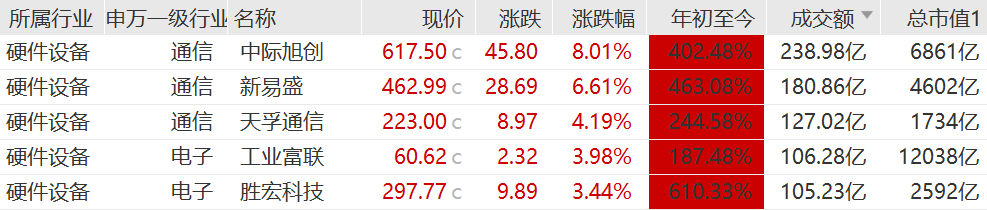
Core Viewpoint - The A-share hardware sector has seen a significant resurgence, with major companies like Zhongji Xuchuang, Xinyi Sheng, and Tianfu Communication experiencing substantial stock price increases year-to-date, indicating strong market sentiment and investment interest in AI hardware [1][2]. Group 1: A-share Hardware Sector Performance - Zhongji Xuchuang's stock price has increased by 402.48% year-to-date, with a recent trading volume of 23.898 billion RMB and a total market capitalization of 686.1 billion RMB [2]. - Xinyi Sheng has seen a year-to-date increase of 463.08%, with a trading volume of 18.086 billion RMB and a market cap of 460.2 billion RMB [2]. - Tianfu Communication's stock has risen by 244.58% year-to-date, with a trading volume of 12.702 billion RMB and a market cap of 173.4 billion RMB [2]. - Industrial Fulian has experienced a 187.48% increase year-to-date, with a trading volume of 10.628 billion RMB and a market cap of 1,203.8 billion RMB [2]. - Shenghong Technology has shown a remarkable increase of 610.33% year-to-date, with a trading volume of 10.523 billion RMB and a market cap of 259.2 billion RMB [2]. Group 2: Comparison with Hong Kong Internet Sector - Major Hong Kong internet companies like Alibaba, Tencent, and Baidu have lagged behind in stock price increases, with Alibaba up 80.41% and Tencent up 48.65% year-to-date, indicating a slower recovery compared to A-share hardware firms [2]. - The analysis from CICC suggests that the hardware sector benefits from clearer policy support in areas such as computing infrastructure and domestic substitution, while the internet sector faces uncertainties in profitability models [2]. Group 3: Investment Opportunities in Hong Kong Market - Some institutions view the Hong Kong internet application sector as having "high odds" opportunities, suggesting that certain segments may be undervalued and could benefit from unexpected industry events or technological breakthroughs [3]. - The East Wu Strategy team recommends a proactive investment approach in AI applications, considering them as a "call option" for potential future gains [3]. Group 4: Hong Kong Market AI Application Related Funds - The Hang Seng Internet ETF and its related funds focus on AI software applications and media, including major players like Tencent and Alibaba [4]. - The Hang Seng Technology Index ETF also covers hard technology and smart vehicle leaders, providing a diversified investment approach [4]. - The Hong Kong Stock Connect Technology ETF targets core leading companies in high-end manufacturing, biotechnology, and the internet sector, allowing for concentrated investments in key players [4].
机构展望 | 哑铃策略应对风格再平衡 机构建议布局“周期+科技”
Shang Hai Zheng Quan Bao· 2025-11-10 01:57
Core Viewpoint - The A-share market is experiencing a narrow fluctuation with a notable rotation of hot sectors, indicating a clear trend of style rebalancing, particularly between cyclical and technology growth sectors [1][2] Group 1: Market Trends - The cyclical sectors such as chemicals, lithium batteries, and photovoltaics have shown strength, while the previously leading artificial intelligence sector is undergoing high-level consolidation [1] - The current market environment suggests a need for investors to focus on the phase rebalancing between technology and cyclical styles due to significant performance improvements in cyclical products reported in Q3 [2] - The overall market is expected to maintain a volatile pattern as the main market narrative remains centered around the AI industry, which is crucial for breaking through index resistance [1][3] Group 2: Investment Strategies - Analysts recommend a "cyclical + technology" allocation strategy to balance risk and return in the current market [2] - Investment opportunities are identified in cyclical sectors such as steel, chemicals, construction materials, agriculture, and new consumption, alongside a focus on AI software applications and innovative pharmaceuticals in the technology sector [3] - The emphasis is placed on sectors benefiting from policy support and market recovery, particularly in the brokerage sector, which is seen as having a phase-specific allocation opportunity [3]
十大券商:风格切换可能会越来越强
Zheng Quan Shi Bao Wang· 2025-11-09 23:27
Group 1 - The core viewpoint is that the AI narrative has influenced the slope of market trends rather than the overall trend itself, with a focus on the stability of the corporate overseas environment and AI infrastructure investment [2] - The A-share market is expected to maintain resilience supported by stable economic and policy expectations, with a focus on cyclical sectors such as steel, chemicals, and new consumption [3] - The market is preparing for a new upward trend, with structural highlights in the third-quarter reports indicating fundamental resilience [3] Group 2 - The A-share market is likely to remain in a volatile state, with long-term upward trends in technology growth facing short-term fundamental concerns [4] - There are three parts of mid-term returns yet to be realized, including cyclical improvement, asset allocation towards equities, and China's increasing global influence [5] - November is favorable for small-cap and thematic investments, with a focus on themes related to the "14th Five-Year Plan" such as AI applications and new materials [7] Group 3 - The recent market rally is seen as a preemptive move for a cyclical recovery year, with price increases concentrated in sectors like coal, non-ferrous metals, and renewable energy [11] - Short-term attention is drawn to the power equipment sector and chemicals, as the market shifts towards high-certainty products [12] - The A-share investment focus is shifting towards strategic upstream industries and technology applications under the "anti-involution" theme [13]




十大券商一周策略:市场正为新一轮向上趋势蓄势!风格切换可能越来越强
Zheng Quan Shi Bao· 2025-11-09 22:47
Group 1 - The market is experiencing increased volatility, but the success rate of timing strategies is low due to changes in the underlying structure of incremental capital, with steady absolute return funds entering the market [1] - The AI narrative is influencing various sectors, including TMT, non-ferrous metals, chemicals, and new energy, which together account for over 60% of institutional holdings [1] - The focus for portfolio adjustment should be on selecting stocks with upward trends in ROE rather than avoiding the AI narrative [1] Group 2 - A-shares are expected to maintain resilience supported by stable economic and policy expectations, with a focus on cyclical sectors such as steel, chemicals, and new consumption [2] - The market is likely to experience rapid rotation of hotspots, with sectors like electric grid equipment, lithium batteries, and chemicals showing upward movement [3] - The long-term trend for A-shares remains upward, driven by structural improvements in the economy and increased global influence [4] Group 3 - November is historically favorable for small-cap and thematic investments, with a focus on AI applications, robotics, and new materials [5] - The market is expected to enter a major upward phase from November to December, driven by policy and liquidity improvements [6] - The upcoming spring market may start earlier than usual, with a focus on growth-oriented sectors [7] Group 4 - Recent price increases in the market are seen as a preemptive move for a cyclical recovery next year, particularly in sectors like coal, non-ferrous metals, and renewable energy [8] - Short-term attention is on power equipment and chemicals, with a shift towards high-certainty stocks as the market rebalances [9] - The overall performance of A-shares is improving, with a focus on strategic industries and technology applications [10][11]
哑铃策略应对风格再平衡 机构建议布局“周期+科技”
Shang Hai Zheng Quan Bao· 2025-11-09 17:28
Group 1 - The core viewpoint is that the A-share market is experiencing a phase of style rebalancing, with a focus on "cyclical + technology" strategies due to significant performance improvements in cyclical sectors and the need for technology stocks to digest previous gains [1][2] - Institutions suggest that while cyclical sectors show strong performance, the long-term trend remains in favor of technology growth, particularly driven by AI narratives [1][2] - The current market environment indicates that the stability of the corporate overseas environment and AI industry trends are crucial variables influencing various sectors, including TMT, non-ferrous metals, chemicals, and electric new energy [1] Group 2 - Analysts emphasize the importance of recognizing the cyclical sectors' performance improvements as seen in Q3 reports, while also noting that technology growth remains the market's main focus [2][3] - The recommendation for investors is to adopt a "barbell strategy" that balances risks and returns by investing in both cyclical and technology sectors [2] - There is a suggestion to explore investment opportunities in cyclical sectors like steel, chemicals, and new consumption, alongside technology applications in AI and innovative pharmaceuticals [3]
【十大券商一周策略】市场正在为新一轮向上趋势蓄势!风格切换可能会越来越强
券商中国· 2025-11-09 14:55
Group 1 - The core viewpoint is that the AI narrative has influenced the slope of market trends rather than the overall trend itself, with a focus on the stability of the corporate overseas environment and AI infrastructure investment in the context of US-China relations [2] - The current market volatility is attributed to changes in the underlying structure of incremental capital, with steady absolute return funds entering the market, reducing the effectiveness of traditional aggressive timing strategies [2] - The TMT sector, along with materials like non-ferrous metals and chemicals, has seen price increases influenced by the AI narrative, with these sectors comprising over 60% of institutional holdings [2] Group 2 - A-shares are expected to maintain resilience supported by stable economic and policy expectations, with a focus on cyclical sectors such as steel, chemicals, and new consumption [3] - The market is anticipated to be in a phase of rapid rotation among themes, with attention on sectors like electric grid equipment, lithium batteries, and chemicals, reflecting a gradual confirmation of the anti-involution theme [4] - The market is preparing for a new upward trend, with structural highlights emerging from the third-quarter reports of listed companies, emphasizing high-quality development and technological self-reliance [4][5] Group 3 - The overall A-share market may remain in a fluctuating state, with long-term upward trends in technology growth facing short-term fundamental concerns [6] - November is seen as favorable for small-cap and thematic investments, with historical data indicating a higher probability of small-cap style gains during this month [7] - The recent price increase in the market is viewed as a preemptive move for a cyclical recovery year, with key sectors including coal, non-ferrous metals, and parts of the chemical industry being highlighted for potential investment [10] Group 4 - The A-share market's investment focus is shifting towards three main lines: AI applications, anti-involution strategies, and brokerage opportunities, with an emphasis on sectors like robotics and innovative pharmaceuticals [12] - The market is expected to experience a structural rebalancing, with a focus on high-certainty products as the industry transitions from reliance on US-based infrastructure to China's advantages in power and manufacturing [11] - The upcoming spring market is likely to start earlier than usual, with a focus on growth-oriented sectors driven by AI and domestic policy initiatives [9]

科创、海外市场策略深度报告:科技龙头震荡蓄力,中小盘接力开启
ZHESHANG SECURITIES· 2025-10-15 08:54
Core Insights - The report indicates that since September, the small-cap sectors represented by the CSI 1000 and CSI 2000 have entered a period of consolidation, while technology-weighted stocks have seen strong gains. Recently, technology stocks have begun to adjust, which is viewed as a correction of strong stocks, characteristic of the later stage of market consolidation. As this period of fluctuation approaches its end, small-cap stocks are expected to stabilize first [1][3][4]. Trend Dimension - The current market is in a small-cap outperformance cycle, which began in 2022 with the rise of the AI industry. This cycle is expected to last 5-7 years, indicating a shift in market style driven by the transition between traditional and emerging industries [2][11]. Wave Dimension - From a wave perspective, small-cap stocks have significantly underperformed technology-weighted stocks since September. The CSI 2000 and CSI 1000 have lagged behind the STAR 50 and ChiNext 50 indices. As technology stocks enter a correction phase, small-cap stocks are anticipated to stabilize as the market moves towards the end of the consolidation period. Additionally, historical data suggests that small-cap stocks have a higher probability of outperforming the broader market in November, following the release of Q3 reports [3][15][23]. Industry Dimension - Potential directions for small-cap technology stocks during the October consolidation period include AI applications (both software and hardware), the expansion of domestic computing power, and the proliferation of innovative drugs. For AI applications, there are notable advancements in large models and vertical applications, while hardware applications are led by robotics and innovations such as autonomous driving and AI glasses. The report emphasizes the importance of monitoring technological advancements and new product developments in these areas [4][25][26]. - The report also highlights that leading companies in AI chips, wafer manufacturing, storage, and semiconductor equipment have already seen gains, suggesting that there are opportunities for small-cap stocks to benefit from ongoing technological and market developments. In the innovative drug sector, if the upward trend in market conditions continues, small-cap stocks are expected to follow suit [25][26].
“重估牛”系列之AI主线:科技内部若高切低,关注什么方向?
Changjiang Securities· 2025-09-28 13:14
Group 1 - The AI software application sector has not yet experienced an explosion, with industry progress lagging behind the upstream foundational and technical layers, awaiting the emergence of blockbuster applications [2][3][11] - Financial data indicates that while revenue in the AI application sector has seen growth, profitability remains unstable, with a noticeable slowdown in revenue growth in Q2 2025 [16][27][23] - The software-related indices have significantly underperformed compared to hardware-related indices since the beginning of the year, with most AI software indices still at low levels [27][28][30] Group 2 - The TMT (Technology, Media, and Telecommunications) sector is expected to continue internal industry rotation, with low-positioned TMT segments likely to benefit [4][33] - The recent policy document titled "Opinions on Deepening the Implementation of 'Artificial Intelligence+' Action" supports the rapid development of the AI application industry, aiming for over 70% penetration of new intelligent terminals and agents by 2027 [35][36] - Internet giants are accelerating capital expenditure on self-developed chips, which is expected to enhance the trend of AI applications and lead to the emergence of blockbuster products [38]
圆桌论坛:「疯狂只是表象」丨WAVES新浪潮2025
3 6 Ke· 2025-06-18 03:38
Core Insights - The Chinese venture capital market is at a turning point, characterized by a structural transformation and a focus on capturing opportunities amidst uncertainty [1] - The "WAVES New Era 2025" conference gathered top investors and innovators to discuss AI technology, globalization, and value reassessment [1] Investment Trends - Investors are increasingly focusing on early-stage investments in AI, with many firms actively participating in seed and angel rounds [4][5][6] - The emergence of younger founders and the rapid pace of technological change in AI are reshaping the investment landscape [9][10] Market Dynamics - The current AI startup environment is perceived as less crowded compared to previous tech waves, indicating potential for growth and innovation [33][35] - High valuations for AI startups are driven by competitive dynamics and the need for firms to position themselves within hot sectors [26][28] Investment Strategies - Investors emphasize the importance of understanding the unique backgrounds and capabilities of founders, particularly in the context of rapidly evolving technologies [14][16] - The traditional metrics for assessing product-market fit (PMF) are being reevaluated, with a shift towards more dynamic indicators that reflect the fast-paced nature of AI development [22][23] Future Outlook - The consensus among investors is that AI will continue to be a major driver of economic growth, suggesting that opportunities for startups will persist in the coming years [35] - Founders are encouraged to focus on practical execution and iterative development rather than getting caught up in long-term uncertainties [32][34]