DDR5 RDIMM

Search documents
江波龙(301308):深度报告:国内存储器龙头多维布局,伴随AI大势迎来广阔成长空间
CMS· 2026-03-04 14:51
Investment Rating - The report initiates coverage with an "Accumulate" investment rating for the company [1][8]. Core Insights - The company, Jiangbolong, is positioned as a leading domestic NAND module manufacturer with a multi-dimensional layout, benefiting from the AI trend and anticipating significant growth opportunities [1]. - Jiangbolong has developed its own main control chip capabilities and established three brands: FORESEE, Lexar, and Zilia, enhancing its market presence both domestically and internationally [1][12]. - The company is expected to increase its investment in AI storage and advanced packaging, aiming to boost the proportion of enterprise-grade and automotive-grade products [1][8]. Summary by Sections Company Overview - Jiangbolong has built a comprehensive "design + firmware + packaging" capability, transitioning from a trading company to a technology brand enterprise, with significant growth in its three brand matrix [12]. - The company has achieved a compound annual growth rate (CAGR) of 26.7% in revenue from 2018 to 2024, with a projected revenue of 225-230 billion yuan in 2025, reflecting a year-on-year increase of 30.27% [20][7]. Financial Performance - The company expects to achieve a net profit of 12.5-15.5 billion yuan in 2025, representing a year-on-year increase of 181% [34]. - Revenue from enterprise-grade products has begun to ramp up, with significant growth in the first half of 2025, reaching 6.93 billion yuan, a year-on-year increase of 138.66% [34][41]. Market Position and Strategy - Jiangbolong is transitioning to a TCM model, integrating upstream and downstream resources, and collaborating with leading wafer manufacturers to enhance its competitive strength [1][41]. - The company is focusing on AI-driven storage demand, with AI servers requiring significantly higher DRAM and NAND Flash capacities compared to traditional servers [45][55]. Product Development - The company has launched its UFS 4.1 main control chip and is actively developing high-end storage products tailored for AI applications, which are expected to drive future growth [20][43]. - Jiangbolong's product lines include embedded storage, solid-state drives, mobile storage, and memory modules, with a notable increase in the share of enterprise-grade products [23][41]. Future Outlook - The report anticipates that Jiangbolong will benefit from the ongoing expansion of capital expenditures by domestic cloud service providers, which is expected to exceed 600 billion yuan annually, driving demand for enterprise-grade storage solutions [55][56]. - The company is well-positioned to capitalize on the rising demand for high-performance storage driven by AI applications and the ongoing transition to advanced storage technologies [45][55].
longsys江波龙聚焦AI存储,端云协同有新招
Quan Jing Wang· 2026-02-04 03:01
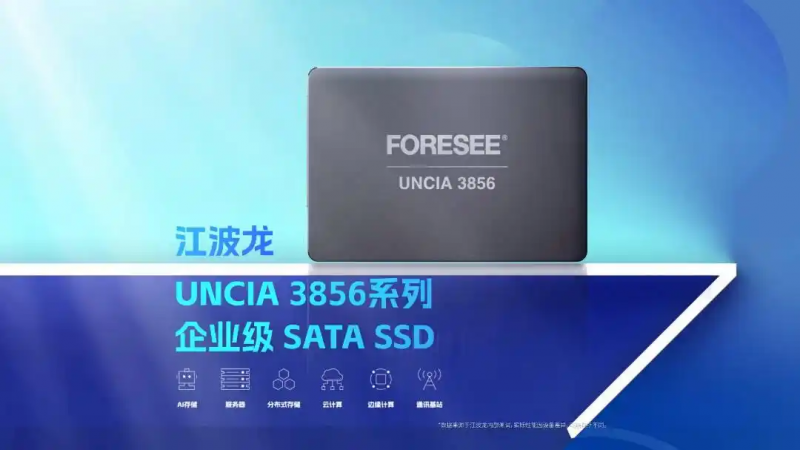
Core Insights - AI technology is reshaping various industries, with storage technology becoming increasingly critical as a backbone for AI applications. Jiangbolong has emerged as a key player in the AI storage transformation with innovative solutions and precise market positioning [1]. Group 1: Full-Stack Solutions - Jiangbolong provides a full-stack solution for AI servers and computing integrated machines, covering all scenarios of AI training and inference. Key products include eSSD, RDIMM, SOCAMM2, and innovative memory solutions, which offer efficient and reliable storage performance tailored to complex AI needs [1]. - The new UNCIA 3856 SATA eSSD features high-quality 3D eTLC NAND and self-developed firmware algorithms, achieving a balance of large capacity, low power consumption, and high endurance, thus providing a solid data storage foundation for AI servers [1]. Group 2: Memory Solutions - Jiangbolong's DDR5 RDIMM and MRDIMM memory modules are core choices for general servers and AI infrastructure due to their high bandwidth, low latency, and excellent compatibility. The DDR5 MRDIMM significantly enhances data transfer rates through a multi-channel architecture, delivering unprecedented performance for AI computing integrated machines [3]. - The SOCAMM2 memory product, based on LPDDR5/5x particles and CAMM modular design, meets the stringent performance and energy efficiency requirements of data centers. It offers ultra-high transmission rates (up to 8533 Mbps) and low power consumption (one-third of standard DDR5 RDIMM), providing dual enhancements in capacity and bandwidth for intelligent computing centers [3]. Group 3: Edge AI Solutions - Jiangbolong has introduced the integrated packaging mSSD for edge AI applications, utilizing wafer-level system-in-package (SiP) technology to integrate the controller, NAND, PMIC, and other components into a single package. This makes mSSD an ideal storage solution for edge AI devices such as AI PCs and robots, offering flexibility and efficiency [5]. Group 4: Strategic Vision - In the AI era, mere improvements in storage performance are insufficient to meet the complex and changing application demands. Jiangbolong aims to achieve efficient utilization of storage resources and flexible release of computing power through an edge-cloud collaborative strategy. The company strengthens partnerships within the industry chain to inject critical storage capabilities into AI intelligent computing center construction and promote the continuous advancement and widespread application of edge AI storage technology [7]. - Jiangbolong's outstanding performance in the AI storage sector is reflected not only in the continuous launch of innovative products but also in its deep insights into industry trends and precise understanding of customer needs. The company will continue to adhere to an innovation-driven development strategy, focusing on core media like mSSD to iterate more forms and scenarios of innovative packaged storage, contributing further to the popularization and application of AI technology [7].

华尔街集体看多半导体设备!
是说芯语· 2026-01-24 08:19
Core Viewpoint - The global semiconductor industry is expected to experience stronger demand, particularly driven by the AI computing infrastructure and a "super cycle" in semiconductor equipment manufacturing, benefiting companies involved in AI chips and DRAM/NAND storage expansion [1][3]. Semiconductor Equipment Sector - KeyBanc Capital Markets highlights that semiconductor equipment manufacturers will be the largest beneficiaries of the AI chip and storage capacity expansion trends [1]. - Citigroup predicts a "Phase 2 bull market" for the semiconductor equipment sector, suggesting a shift from valuation recovery to sustained profit growth, with leading companies like ASML, Lam Research, and Applied Materials being key players [3]. - The semiconductor equipment sector is expected to see significant growth due to the ongoing demand for AI computing and storage solutions, with a focus on advanced manufacturing processes [4][5]. AI Infrastructure Investment - The construction of large-scale AI data centers by tech giants like Microsoft, Google, and Meta is accelerating the expansion of advanced AI chip production and storage capacity [4]. - The global AI infrastructure investment wave is projected to reach $3 trillion to $4 trillion by 2030, indicating that the current phase is just the beginning [5]. - The semiconductor market is expected to grow significantly, with a forecasted value of $772.2 billion in 2025 and $975.5 billion in 2026, driven by strong demand for AI GPUs and storage systems [6][9]. Market Dynamics - The demand for DRAM/NAND storage chips is surging, with prices increasing due to the heightened importance of these products in AI training and inference systems [10]. - TSMC reported a record gross margin exceeding 60% and raised its 2026 revenue growth forecast to nearly 30%, indicating strong demand for AI-related chip manufacturing [10][11]. - The semiconductor investment chain driven by AI demand is expected to lead to increased capital expenditures (capex) from major manufacturers like SK Hynix, Samsung, and Intel [12][13]. Company-Specific Insights - KeyBanc maintains an "overweight" rating on AEI Industries, citing its strong position in the data center sector and potential for revenue growth in semiconductor manufacturing equipment [14]. - Applied Materials is recognized for its diverse product offerings across various semiconductor manufacturing processes, with expectations for significant revenue growth in the coming years [15][16]. - MKS Instruments is positioned to benefit from the ongoing demand for advanced packaging and semiconductor manufacturing technologies, with a focus on maintaining a strong market share in NAND and advanced packaging sectors [18].


存储股集体爆发,有龙头净利暴增超10倍
2 1 Shi Ji Jing Ji Bao Dao· 2026-01-22 12:56
Core Viewpoint - The storage chip industry is experiencing significant growth driven by AI demand, with major companies like Demingli and Bawei Storage reporting substantial revenue and profit increases for 2025, indicating a strong market trend and potential investment opportunities [2][4][9]. Company Performance - Demingli expects 2025 revenue between 10.3 billion to 11.3 billion yuan, a year-on-year increase of 115.82% to 136.77%, and net profit of 650 million to 800 million yuan, up 85.42% to 128.21% [2][7]. - In Q4 2025, Demingli's net profit is projected to be between 677 million to 827 million yuan, reflecting a staggering growth of 1051.59% to 1262.41% [7]. - Bawei Storage anticipates 2025 revenue of 10 billion to 12 billion yuan, a growth of 49.36% to 79.23%, and net profit of 850 million to 1 billion yuan, an increase of 427.19% to 520.22% [7]. - Lankai Technology forecasts a net profit of 2.15 billion to 2.35 billion yuan for 2025, representing a growth of 52.29% to 66.46% [8]. Market Trends - The storage market is entering a "super cycle" driven by AI, with a persistent supply-demand gap leading to rising prices for storage products, benefiting module manufacturers [4][10]. - Major storage companies have raised product prices significantly since September 2025, driven by increased demand for high-performance storage chips for AI applications [9][13]. - The storage market is expected to exceed historical highs, with predictions of a 40% to 50% price increase in Q1 2026 and an additional 20% in Q2 2026 [10][14]. Industry Dynamics - Domestic storage manufacturers are accelerating expansion plans, with many companies increasing capital expenditures to capture market share amid a changing supply-demand landscape [13][15]. - Companies like Jiangbolong and Demingli have announced substantial fundraising plans to enhance production capabilities and focus on high-performance storage products [14][15]. - The ongoing AI trend is reshaping the storage market, with increasing requirements for high-capacity, low-latency storage solutions across various applications [13][14].


存储股集体爆发,有龙头净利暴增超10倍
21世纪经济报道· 2026-01-22 12:25
Core Viewpoint - The storage chip industry is experiencing a significant growth phase driven by AI demand, with leading companies like Demingli (001309.SZ) forecasting substantial revenue and profit increases for 2025, indicating a robust market outlook for storage products [1][6][12]. Group 1: Company Performance Forecasts - Demingli expects 2025 revenue between 10.3 billion to 11.3 billion yuan, a year-on-year increase of 115.82% to 136.77%, with net profit projected at 650 million to 800 million yuan, reflecting an increase of 85.42% to 128.21% [1][6]. - The fourth quarter of 2025 is anticipated to see net profit between 677 million to 827 million yuan, marking a staggering growth of 1051.59% to 1262.41% year-on-year [1][6]. - Other companies like Baiwei Storage (688525.SH) and Lanke Technology (688008.SH) have also reported optimistic forecasts, with Baiwei expecting revenue of 10 billion to 12 billion yuan, a growth of 49.36% to 79.23% [6][7]. Group 2: Market Trends and Drivers - The global storage market is entering a "super cycle" driven by AI, with supply-demand imbalances leading to rising prices for storage products, benefiting manufacturers [4][12]. - Major storage manufacturers are adjusting production strategies, with companies like Samsung and SK Hynix reducing output of traditional memory chips while increasing capacity for high-performance products [12][13]. - The demand for high-performance storage solutions is surging due to the proliferation of AI applications, which require advanced storage capabilities for data centers and AI servers [12][13]. Group 3: Stock Market Performance - The storage sector has seen significant stock price increases, with companies like Xiangnong Chip (300475.SZ) rising over 407% and Demingli increasing by over 273% since the beginning of the year [8][9]. - The storage index has risen nearly 119% over the past year, with continued upward momentum in 2023 [1][9]. Group 4: Expansion Plans of Domestic Manufacturers - Domestic storage manufacturers are ramping up production capacity through new investments and expansions, with Demingli and Baiwei Storage announcing significant fundraising plans to enhance their production capabilities [11][14]. - The industry is expected to see continued price increases for storage products into 2026, driven by ongoing supply constraints and rising demand [12][14].

存储超级周期里 国产厂商“涨”声一片
2 1 Shi Ji Jing Ji Bao Dao· 2026-01-22 09:37
Core Viewpoint - The storage chip industry is experiencing a significant growth cycle driven by AI demand, with major companies like Demingli (德明利) forecasting substantial revenue and profit increases for 2025, indicating a robust market outlook for storage products [1][2][3]. Company Performance - Demingli expects 2025 revenue between 10.3 billion to 11.3 billion yuan, a year-on-year increase of 115.82% to 136.77%, with net profit projected at 650 million to 800 million yuan, reflecting an increase of 85.42% to 128.21% [1][2]. - In Q4 2025, Demingli anticipates revenue of 3.641 billion to 4.641 billion yuan, representing a growth of 209.72% to 294.79% [1]. - Other companies in the storage sector, such as Baiwei Storage (佰维存储) and Lanqi Technology (澜起科技), have also reported optimistic forecasts, with Baiwei expecting revenue of 10 billion to 12 billion yuan and net profit of 850 million to 1 billion yuan, and Lanqi projecting net profit of 2.15 billion to 2.35 billion yuan [2][3]. Market Trends - The storage market is undergoing a transformation, with major players like SanDisk, Micron, and Samsung raising product prices due to increased demand for high-performance storage chips driven by AI applications [3][6]. - The demand for high-performance storage solutions is growing as AI applications proliferate, leading to a significant increase in the market size [6][7]. - The supply side is tightening as major manufacturers reduce production of traditional storage chips while focusing on advanced processes for AI server applications, contributing to rising prices [6][7]. Industry Dynamics - The AI-driven storage supercycle is creating a favorable environment for domestic storage manufacturers, who are increasing capital expenditures to expand production capacity [5][8]. - Companies like Jiangbolong (江波龙) and Demingli are actively pursuing fundraising initiatives to enhance their production capabilities and market presence [7][8]. - Baiwei Storage is also investing in expansion projects, with plans for advanced packaging manufacturing to enhance competitiveness in the storage market [9].

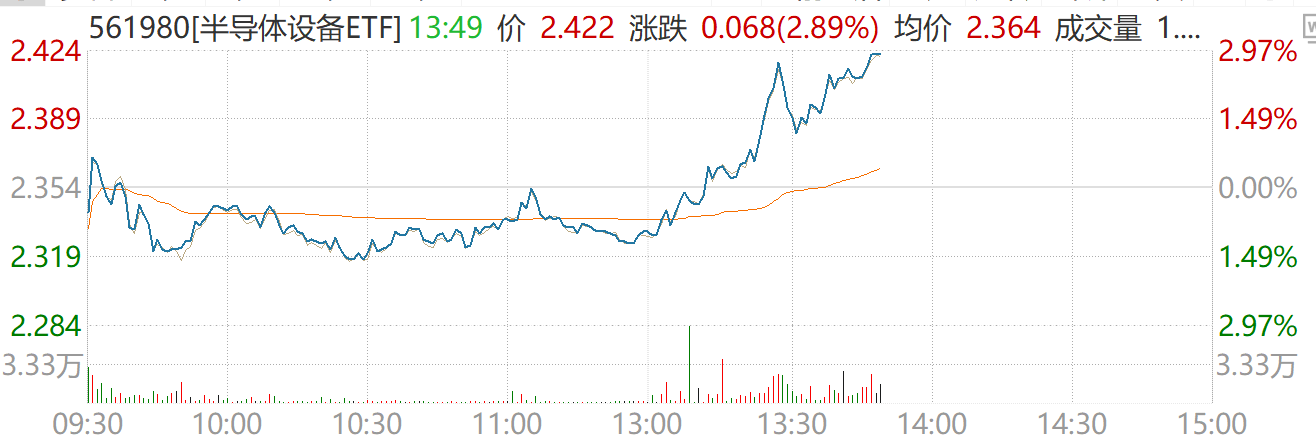
存储周期上行叠加关税窗口,半导体设备ETF(561980)午后拉涨2.89%,上海新阳、三佳科技强势涨停!
Sou Hu Cai Jing· 2026-01-15 06:45
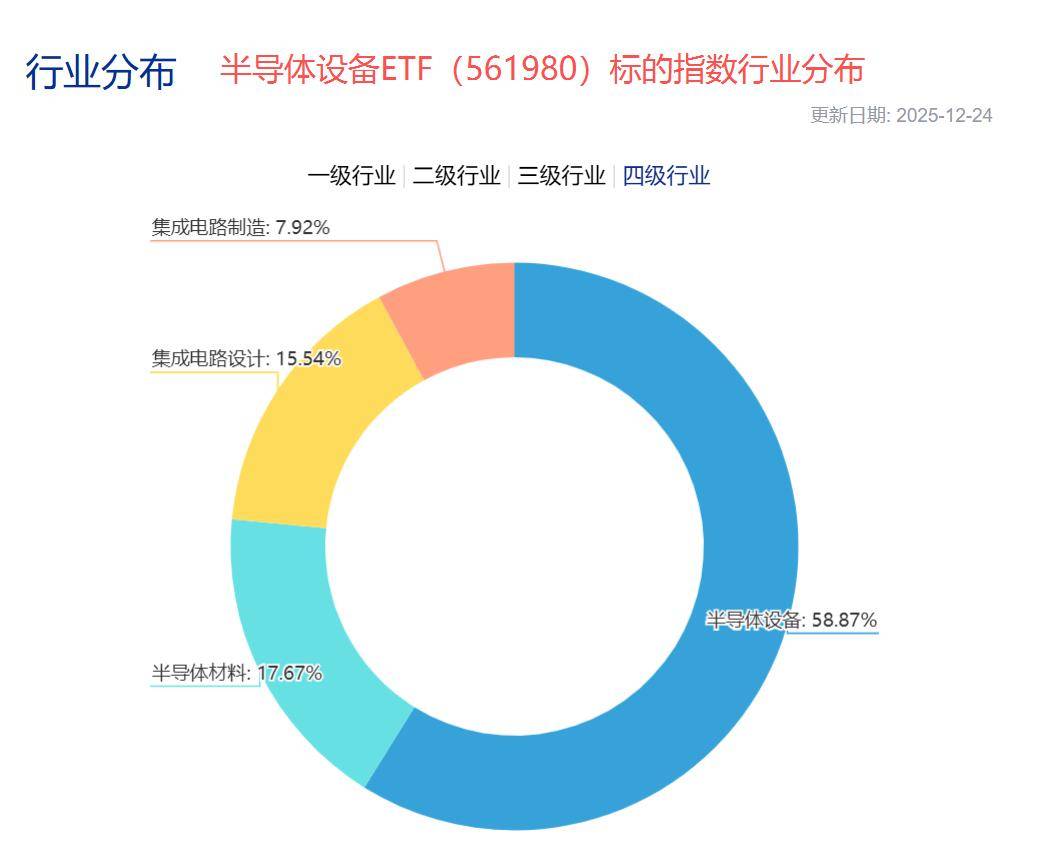
Core Viewpoint - The semiconductor equipment sector is experiencing significant growth, driven by domestic substitution and self-sufficiency trends, particularly in light of recent U.S. tariffs on semiconductor imports [1][2]. Group 1: Market Performance - The semiconductor equipment ETF (561980) saw a 2.89% increase, with a trading volume exceeding 200 million yuan, and a net inflow of over 137 million yuan in the last five trading days [1]. - Key stocks such as Shanghai Xinyang and Sanjia Technology hit the daily limit, with Shanghai Xinyang rising over 13%, and other significant gains from companies like Zhongwei and Nanda Optoelectronics [1]. Group 2: Impact of Tariffs - The U.S. announced a 25% import tariff on certain semiconductor products starting January 15, 2026, which is expected to create a stronger "acceleration substitution" window for domestic semiconductor equipment [1]. - The direct impact of these tariffs on domestic semiconductor equipment is considered limited, but they may increase supply chain uncertainties [1]. Group 3: Industry Trends - The rise of domestic storage chip manufacturers is reshaping the global pricing cycle, reducing import dependency, and enhancing supply chain security [2]. - The storage chip segment accounts for approximately 30% of the integrated circuit market, indicating significant growth potential for upstream semiconductor equipment [2]. Group 4: Future Outlook - The global storage industry is entering a new upcycle driven by AI demand for high-performance storage products, with significant growth expected in etching and thin-film deposition equipment due to the shift towards 3D architectures [3]. - Domestic semiconductor equipment companies like North Huachuang and Zhongwei are anticipated to strengthen their market positions as demand increases [3]. Group 5: ETF Composition - The semiconductor equipment ETF focuses on the "selling shovels" segment of the chip industry, with over 90% of its composition in semiconductor equipment, materials, and design [4]. - The index has shown a maximum increase of over 640% since the last semiconductor upcycle, outperforming similar indices [4].





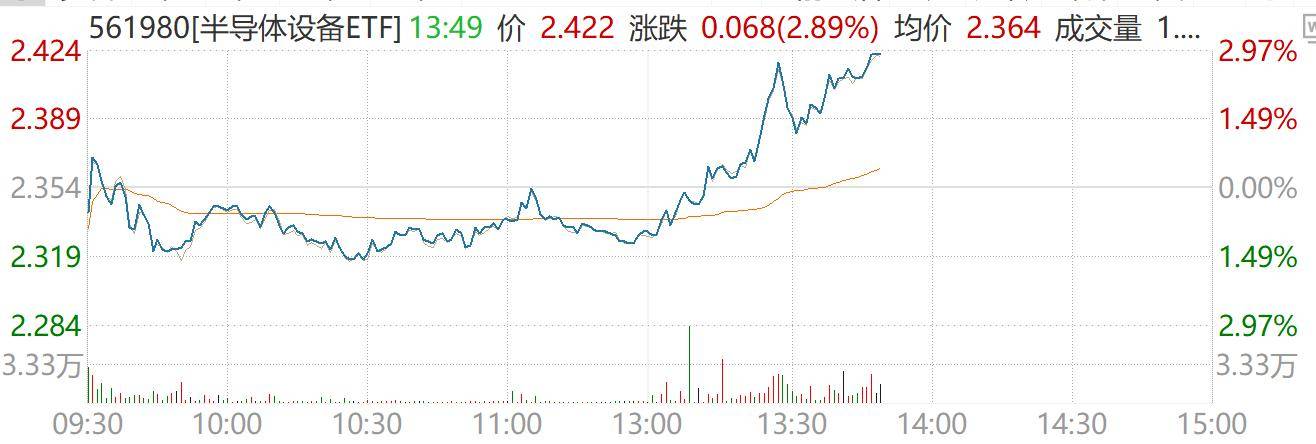
加征关税强化国产替代逻辑,半导体设备ETF(561980)午后大涨近3%!机构:“卖铲人”确定性受益
Sou Hu Cai Jing· 2026-01-15 06:33
Core Viewpoint - The semiconductor equipment sector is experiencing significant growth, driven by domestic substitution and self-sufficiency trends, particularly in light of recent U.S. tariffs on semiconductor imports [1][2]. Group 1: Market Performance - The semiconductor equipment ETF (561980) saw a 2.89% increase, with a trading volume exceeding 200 million yuan, and a net inflow of over 137 million yuan in the last five trading days [1]. - Key stocks such as Shanghai Xinyang and Sanjia Technology hit the daily limit, with Shanghai Xinyang rising over 13%, and other significant players like Zhongwei Company and Nanda Optoelectronics also showing strong gains [1]. Group 2: Impact of Tariffs - The U.S. announced a 25% import tariff on certain semiconductor products starting January 15, 2026, which is expected to create a stronger "acceleration replacement" window for domestic semiconductor equipment despite limited direct impact [1]. Group 3: Industry Trends - The rise of domestic storage chip manufacturers is reshaping the global pricing cycle, reducing import dependency, and enhancing supply chain security, supported by policy initiatives and capital investments [2]. - The global storage industry is entering a new upcycle driven by AI demand for high-performance storage products, with significant growth expected in etching and thin-film deposition equipment due to the shift towards 3D architectures [3]. Group 4: ETF Composition and Performance - The semiconductor equipment ETF focuses on the "selling shovels" segment of the chip industry, with over 90% of its composition in semiconductor equipment, materials, and design [4]. - The index has shown a maximum increase of over 640% since the last semiconductor upcycle, outperforming similar indices, with a year-to-date increase of 87.38% as of January 9, 2026 [4].
国产算力水平有望不断提升,AI人工智能ETF(512930)交投活跃
Xin Lang Cai Jing· 2025-12-31 05:23
Group 1 - The core viewpoint of the news highlights the rapid growth and innovation in the demand for AI-related computing power chips in China, supported by the government's "Artificial Intelligence +" initiative [1] - The domestic chip products are accelerating their adaptation in various application scenarios, with significant improvements in performance, particularly through technologies like "super nodes" [1] - The collaboration across the industrial chain is expected to enhance domestic computing power levels, providing robust support for the development of the AI industry [1] Group 2 - The AI-driven demand for high-performance storage products such as DDR5 RDIMM and eSSD is rapidly increasing, indicating a new upward cycle in the global storage industry, with price increases expected to continue into 2026 [1] - The transition of DRAM and NAND to 3D structures is significantly boosting the demand for etching and thin-film deposition equipment, with the investment per wafer reaching 1.7 to 1.8 times previous levels, indicating clear growth momentum for the semiconductor equipment sector [1] - The CSI Artificial Intelligence Theme Index (930713) includes 50 listed companies involved in providing resources, technology, and application support for AI, reflecting the overall performance of AI-related securities [2]
AI需求井喷引爆半导体涨价周期,半导体设备ETF(561980)午后走强
Sou Hu Cai Jing· 2025-12-25 06:46
Core Viewpoint - The semiconductor industry is experiencing a new wave of price increases driven by rising demand, particularly from AI applications, and supply-side capacity shortages [2][3]. Group 1: Price Increases - Semiconductor companies such as SMIC and GlobalFoundries have issued price increase notices to downstream customers, primarily focusing on the 8-inch BCD process platform with an increase of around 10% [3]. - The NAND price index has surged by 173% and the DRAM price index by 169% since the end of July, with expectations of further increases in DDR5 RDIMM prices by over 40% and eSSD prices by 20-30% in Q1 2026 [3]. Group 2: Market Growth - According to SEMI, global semiconductor manufacturing equipment sales are projected to reach $133 billion in 2025, marking a 13.7% year-on-year increase, with continued growth expected in the following years, reaching $145 billion in 2026 and $156 billion in 2027 [4]. - The semiconductor equipment ETF (561980) tracks an index where nearly 60% is composed of equipment, and over 90% is focused on the upstream sectors of the semiconductor industry, indicating significant potential for domestic substitution [4]. Group 3: Investment Opportunities - The semiconductor equipment ETF has a strong focus on leading companies such as Zhongwei Company, North Huachuang, and Cambrian, with the top ten holdings accounting for nearly 80% of the index, showcasing high elasticity characteristics [7]. - As of December 24, the index has seen a year-to-date increase of over 65%, outperforming other mainstream semiconductor indices, suggesting it may have greater resilience in the upcoming semiconductor upcycle [7].