
Jing Ji Ri Bao

Search documents
高铁发展更上一层楼
Jing Ji Ri Bao· 2026-01-01 22:16
Core Viewpoint - The opening of the Xi'an to Yan'an high-speed railway marks a significant milestone as it brings the revolutionary old area of Yan'an into the "high-speed rail era," contributing to China's high-speed rail network exceeding 50,000 kilometers, thus elevating the development of high-speed rail to a new level [1] Group 1: Macro Planning - There is a need for forward-looking optimization of the national comprehensive transportation network layout based on the high-speed rail expansion, enhancing the support of high-speed rail lines for regional development strategies [1] - The goal is to guide the efficient aggregation of production factors through this optimized layout [1] Group 2: Regional and Industrial Development - Local governments are encouraged to deeply integrate regional industrial planning and urban function upgrades into the national high-speed rail economic map [1] - This integration aims to promote a new pattern of complementary advantages and coordinated development [1] Group 3: Technological Innovation - It is essential to consolidate existing leading advantages while advancing towards more intelligent, greener, and safer technological frontiers through the improvement of an independent innovation system [1] - This technological advancement is intended to inject stronger and more sustainable momentum into high-quality economic and social development [1]
银行为何对互联网助贷做减法
Jing Ji Ri Bao· 2026-01-01 22:14
Group 1 - The core viewpoint of the articles highlights the shift in the internet lending cooperation model between banks and external platforms, emphasizing the need for clearer responsibilities and risk management as banks reduce reliance on these partnerships [1][2][3] - Recent data indicates that several small and medium-sized banks in regions like Xinjiang and Heilongjiang are scaling back their internet lending collaborations, with some banks halting new partnerships altogether [1][2] - The regulatory environment is tightening, with new rules set to take effect on October 1, 2025, mandating banks to implement a "white list" management system for partner institutions and to enhance their risk management practices [2][3] Group 2 - The increase in regulatory scrutiny is evident, as recent penalties have been imposed on banks for inadequate management of internet loan and agency businesses, signaling a shift towards more standardized practices in the industry [2] - The evolving landscape of internet lending is pushing banks to transition from a focus on scale and flow dependency to enhancing core risk management capabilities, leveraging technology for better marketing efficiency [3] - The role of lending platforms is expected to change, moving from providing guarantees to becoming technology enablers and service intermediaries, with a more transparent profit model emerging [3]
长春点“白”成金笑迎天下客
Jing Ji Ri Bao· 2026-01-01 22:14
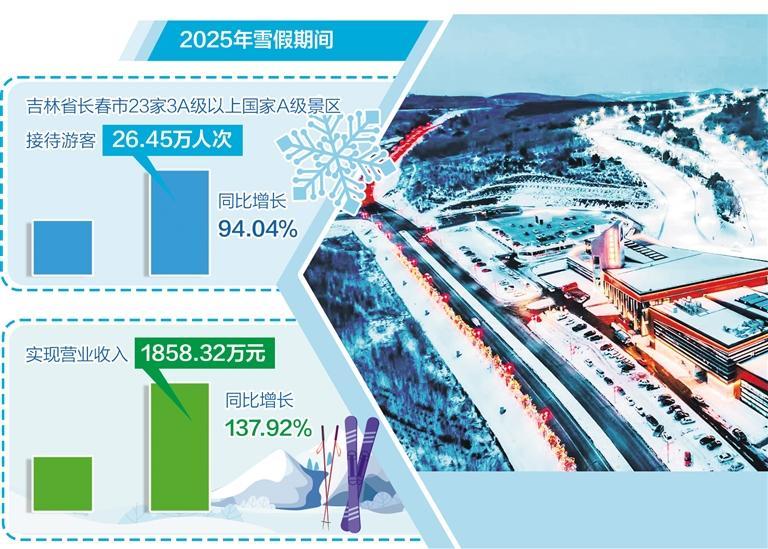
Core Viewpoint - The 29th Changchun Ice and Snow Festival has officially opened, marking the start of the 2025-2026 winter season, with a focus on enhancing the ice and snow economy as a core industry for high-quality urban development [3][4]. Group 1: Product Quality Upgrade - Changchun is enhancing its ice and snow offerings by creating a unique experience with "one heart, two parks, and six venues" to meet diverse and high-quality consumer demands [3][4]. - The Jingyuetan Ski Resort is positioned as a key support for Changchun's ice and snow economy, combining public and cross-country skiing, and is the only ski training base located within the city [3][4]. - The Tianding Mountain Ski Resort has planned 18 high-quality snow trails and is equipped with two 1,600-meter-long chairlifts and a professional coaching team of 120 to cater to skiers of all levels [4][5]. Group 2: Event Highlights - Changchun is hosting over 100 ice and snow sports events during the 12th National Mass Ice and Snow Season, with a focus on engaging the public and promoting ice sports [6][7]. - The city has introduced the first urban lighted cross-country ski trail, enhancing the night economy related to ice sports [6]. - The 33rd Winter Universiade will be held in Changchun and Jilin City in 2027, which is expected to boost the city's international profile and promote mass participation in ice sports [7]. Group 3: Service Optimization - A "snow holiday" for 163,000 students in Jilin Province was introduced, leading to a significant increase in tourist numbers and revenue during the holiday period [8]. - The "Changchun Rest Assured Travel" platform offers services such as direct delivery of ski equipment to resorts and optimized transportation options for tourists, enhancing the overall visitor experience [9][10]. - The city has developed a digital platform to improve visitor services, including a consumption card and integrated tickets for various activities, ensuring a seamless experience for tourists [10].

上海普陀打造大宗商品贸易高地
Jing Ji Ri Bao· 2026-01-01 22:13
近年来,作为上海大宗商品贸易的"老牌核心区",普陀区加快推动大宗商品贸易高质量发展。数据显 示,2025年1月至11月,普陀区有色金属销售额已达1.2万亿元,占全区规上商销额的78.8%。 20世纪90年代,在上海中山北路沿线的物贸大厦内,国内首家期货试点交易所——上海金属交易所的铜 锣在这里敲响,开启了中国大宗商品市场化交易的大门。此后,普陀区继续紧抓上海贸易中心建设机 遇,以"一栋楼"为核心,持续推动商贸向现代化、专业化转型。如今,400余家有色金属商贸企业陆续 在物贸大厦扎根,年交易额已超7600亿元。历经在大宗商品贸易领域数十年的沉淀与积累,普陀区的视 野也正在向更广阔的领域拓展。 "2025年,全社会物流总额预计达380万亿元左右,大宗商品生产资料销售额预计将首次突破百万亿元大 关,这一超大规模市场优势,既是我们抵御外部风险的坚实底气,更是驱动全球大宗商品贸易增长的核 心引擎。"中国物流与采购联合会副会长何辉说。 为了让"上海价格"更好走向世界,交易中心目前一方面通过"货融通"数字化平台构建可信交易体系,为 价格形成提供了坚实的技术支撑;另一方面更积极对接上海期货交易所,通过期现联动手段提升定价影 ...
统一披露规则让投资者买得更明白
Jing Ji Ri Bao· 2026-01-01 22:13
Core Viewpoint - The article emphasizes the importance of information disclosure in protecting the rights of financial consumers, particularly regarding asset management products, through the newly released regulatory framework by the National Financial Regulatory Administration [1][2]. Group 1: Information Disclosure Standards - The regulatory approach advocates for a unified standard for information disclosure across similar financial products, ensuring fair competition and protection of investor rights [2]. - Prior to the new regulations, there was no dedicated information disclosure system for asset management trust products, wealth management products, and insurance asset management products, leading to inconsistent standards [2]. Group 2: Product Lifecycle Disclosure - During the product fundraising phase, financial institutions must clearly communicate the investment areas, operational methods, and risk levels associated with the product to investors [2][3]. - In the product operation phase, investors need to be informed about net value changes, profit and loss performance, and investment asset status, allowing them to adjust their investment strategies accordingly [3]. - At the product termination phase, financial institutions are required to disclose key information such as fee structures, profit distribution, and remaining asset allocation to ensure investors understand their returns [3].
合力打击金融领域“黑灰产”
Jing Ji Ri Bao· 2026-01-01 22:13
国家金融监督管理总局和公安部在日前举行的新闻发布会上表示,2025年6月至11月,公安部会同金融 监管总局部署17个重点省市开展为期6个月的金融领域"黑灰产"违法犯罪集群打击。工作开展以来,共 立案查处金融领域"黑灰产"犯罪案件1500余起,涉案金额累计近300亿元,有效净化了金融市场生态。 近年来,金融领域的消费纠纷较为突出,滋生了非法贷款中介等乱象,并借助互联网快速蔓延,已形成 完整的黑灰产业链,严重侵害金融消费者合法权益,扰乱金融市场正常秩序。 素喜智研高级研究员苏筱芮表示,目前贷款领域金融"黑灰产"的操作手段和套路通常有以下3类:一是 在社交平台上以"代理维权""征信修复"等为名对债务人实施欺骗;二是不法贷款中介包装"职业背债 人",伪造身份和流水材料实施骗贷;三是不法分子利用AI换脸、仿冒APP、虚假交易平台等技术手段 实施欺诈。 在互联网经济浪潮下,金融"黑灰产"依托平台进行市场营销和规模扩张,呈现出链条化、批量化等特 点。"经过公安系统和监管系统半年多的努力,金融领域'黑灰产'蔓延的势头虽有所收敛,但作案手段 不断翻新且愈加隐蔽。"国家金融监督管理总局稽查局局长邢桂君表示。 面对这一严峻形势,消 ...
扩大支持范围,细化补贴标准,完善实施机制—— “两新”政策优化升级促内需
Jing Ji Ri Bao· 2026-01-01 22:13
Core Viewpoint - The National Development and Reform Commission and the Ministry of Finance have issued a notice to implement large-scale equipment updates and a consumer goods replacement policy in 2026, aiming to optimize support scope, subsidy standards, and implementation mechanisms for the "Two New" policies [1][2]. Group 1: Equipment Updates - The 2026 policy will continue to support the areas established in 2025, with new additions including the installation of elevators in old residential communities, equipment updates in elderly care institutions, and enhancements in firefighting and rescue facilities [1][2]. - The subsidy for updating residential elevators will shift from a fixed amount to a tiered subsidy based on the number of elevator floors [2]. - The policy prioritizes the replacement of old operational trucks with electric vehicles and adjusts subsidies for household appliances to focus on energy-efficient products [2]. Group 2: Consumer Goods Replacement - The policy continues to support the replacement of old cars and household appliances, specifically targeting six categories: refrigerators, washing machines, televisions, air conditioners, computers, and water heaters [1]. - The subsidy for household appliances will be set at 15% of the product price, with a maximum subsidy of 1,500 yuan per item [2]. - The scope of digital product subsidies has been expanded to include smartphones, tablets, smartwatches, smart glasses, and smart home products [1]. Group 3: Implementation and Oversight - The notice emphasizes the need for clear funding channels, standardized fund usage, and enhanced supervision to ensure effective implementation of the policies [2]. - It includes measures to optimize project application mechanisms and reduce investment thresholds, particularly to support small and medium-sized enterprises [2]. - The policy aims to establish a unified subsidy standard nationwide for vehicle scrapping, replacement, and the six categories of household appliances and four categories of digital products [2][3].
一体化培育新型文化业态
Jing Ji Ri Bao· 2026-01-01 22:13
Group 1 - The core viewpoint emphasizes the importance of developing new cultural formats, which leverage advanced technologies like big data and artificial intelligence to reconstruct the entire chain of cultural resource creation, production, dissemination, and consumption [1] - New cultural formats are characterized by cross-industry integration, such as "culture + technology" and "culture + tourism," which open up new growth spaces [1] - The article highlights the need to eliminate barriers through improved intellectual property protection policies, promoting the flow and restructuring of cultural elements across various sectors [1] Group 2 - The digital cultural sector is a strategic competitive area globally, with the U.S. maintaining a monopoly in streaming and online gaming, while South Korea effectively operates its IP through K-POP and film [2] - China possesses the largest and most active digital cultural consumption market, providing a vast stage for industry rooting, technological iteration, and large-scale development [2] - To transition from a large to a strong cultural industry, China must address challenges such as an overemphasis on technology at the expense of content and the need for a collaborative development system that integrates content, technology, ecology, and institutional frameworks [2] Group 3 - The focus on technology-driven innovation includes core technologies like blockchain, cloud computing, and generative AI, with an emphasis on creating collaborative innovation entities [3] - There is a need to deepen demand-driven approaches and expand application scenarios by integrating technology research and scene applications, particularly in cultural tourism and exhibition venues [3] - The article advocates for building a collaborative development ecosystem among enterprises of all sizes, establishing a national cultural gene and material database, and enhancing the protection of intellectual property in the digital cultural sector [3]
多重突破见证中国经济“逆袭”
Jing Ji Ri Bao· 2026-01-01 22:13
Group 1 - The core viewpoint emphasizes that China's long-term economic fundamentals remain strong, with high-quality development being continuously consolidated and expanded despite challenges [1][4] - China's GDP is expected to reach approximately 140 trillion yuan, marking a new milestone in economic scale, with total electricity consumption exceeding 10 trillion kilowatt-hours for the first time [1][2] - Key indicators of economic stability include stable grain production above 1.4 trillion jin for two consecutive years and effective energy security measures [2][4] Group 2 - The progress in China's economy is characterized by a dual focus on quantity and quality, with significant advancements in technological innovation, placing China in the top 10 of the global innovation index for the first time [3][4] - The optimization and upgrading of the economic structure are evident, with high-tech manufacturing growth outpacing overall industrial growth, and a rapid rise in green industries such as new energy vehicles [3][4] - The ongoing reforms and opening-up policies are enhancing economic stability and growth, with international institutions raising their forecasts for China's economic growth in 2025 [4]
巩固提升海洋装备制造业优势
Jing Ji Ri Bao· 2026-01-01 22:13
Core Viewpoint - The development of China's marine equipment manufacturing industry is crucial for enhancing the country's maritime capabilities, with a focus on upgrading towards green and low-carbon technologies [1][2]. Group 1: Industry Development - The marine equipment manufacturing industry is a significant part of China's marine economy and a key growth point for foreign trade, with shipbuilding completion and order volumes increasing by 6.7% and 25.7% year-on-year, respectively, in the first three quarters of 2025 [1]. - China's global market shares for new orders, shipbuilding completions, and hand-held orders are 63.5%, 47.3%, and 58.6%, respectively, maintaining a leading position worldwide [1]. Group 2: International Context - The 21st century is recognized as the century of the ocean, with marine equipment being a focal point for national strategic development among marine nations [2]. - Countries like South Korea and France are advancing their marine equipment sectors, focusing on nuclear-powered ships and seawater desalination, respectively [2]. Group 3: Strategic Advantages - China possesses unique advantages for developing its marine equipment manufacturing industry, including a complete industrial system and vast maritime territory, which provides a stable market demand [2]. - The new type of national system allows for resource integration and concentrated efforts in tackling key core technologies, supporting the industry's upgrade [2]. Group 4: Future Directions - To enhance the marine equipment manufacturing industry's advantages, there is a need for systematic and forward-looking development, focusing on innovation and collaboration between academia and industry [3]. - Emphasis should be placed on addressing areas with significant gaps compared to global standards and high import dependency, particularly in chips, industrial software, and advanced materials [3]. Group 5: Integration and Globalization - Promoting land-sea integration and connecting marine equipment manufacturing with other manufacturing sectors is essential for industry upgrade [4]. - Utilizing artificial intelligence to improve collaboration efficiency across the supply chain and enabling real-time data sharing among upstream and downstream enterprises will enhance industry resilience [4]. - Encouraging advanced manufacturing enterprises to engage in global layouts and integrate into the global division of labor will create greater growth opportunities for the marine equipment manufacturing industry [4].