
Jing Ji Ri Bao

Search documents
有基础有条件保持经济稳定向好
Jing Ji Ri Bao· 2026-01-22 21:58
Core Viewpoint - China's economy is expected to maintain stable and positive growth despite facing multiple pressures, with a focus on high-quality development and innovation as key drivers for the future [1][2][3] Economic Performance - In the "14th Five-Year Plan" period, China's economy crossed significant milestones, reaching over 140 trillion yuan, with an economic increment exceeding 36 trillion yuan [1] - Domestic demand contributed over 67% to economic growth in 2025, with consumption accounting for 52% [2] - The trade volume reached new highs, and foreign exchange reserves exceeded 3.3 trillion USD [2] Innovation and Development - By 2025, R&D expenditure intensity surpassed the OECD average, with significant advancements in AI, biomedicine, and robotics [1] - The transition to a green and low-carbon economy is progressing, and the digital economy is thriving [1][3] Structural Advantages - China's economic foundation is strong, with advantages in the socialist system, large market size, complete industrial system, and rich talent resources [3] - The shift in consumer behavior towards a balance of goods and services consumption is evident, indicating potential for further domestic demand expansion [3] Policy and Future Outlook - The central economic work conference has outlined comprehensive measures to address existing challenges and enhance macroeconomic policies for 2026 [2] - International organizations have raised their growth forecasts for China, reflecting confidence in the country's economic prospects [3]
16年规模第一,中国制造当更强
Jing Ji Ri Bao· 2026-01-22 21:58
最后看产业体系完整性,这是保持规模优势的重要因素。中国是全球唯一拥有联合国产业分类中全部工 业门类的国家,覆盖41个工业大类、207个中类、666个小类,从上游原材料、中游零部件到下游整机制 造,形成了自主可控、协同高效的完整产业链。这一独特优势既保障了生产的稳定性与抗风险能力,又 能快速响应全球市场多元化需求。 高端化,是中国制造补齐短板的关键。制造业高端化,既包括突破核心技术、关键零部件、核心装备 等"卡脖子"短板,增强产业链自主可控性;也包括提升中国制造的品质与技术水平,满足高端市场需 求;还包括向研发、设计、品牌等价值链高端延伸,提高利润空间与整体效益。2025年,规模以上装备 制造业、高技术制造业增加值比上年分别增长9.2%和9.4%,占规模以上工业比重分别提升到36.8%和 17.1%。这两个关键领域多年来保持高速增长,表明中国制造高端化特征更加鲜明。 智能化,是中国制造换道超车的关键。传统制造依赖百年积累与工艺沉淀,发达国家已形成先发优势, 中国追赶起来难度较大。而智能化以AI、大数据、工业互联网等新技术为核心,重塑生产模式、竞争 格局,让中国制造得以在新赛道上与全球站在同一起跑线上。并且,中国 ...
提升金融服务实体经济高质量发展质效 ——访中国人民银行党委书记、行长潘功胜
Jing Ji Ri Bao· 2026-01-22 21:58
Core Viewpoint - The Central Economic Work Conference emphasizes the continuation of a moderately loose monetary policy to support key areas such as domestic demand, technological innovation, and small and medium-sized enterprises as part of the "14th Five-Year Plan" [1][2]. Monetary Policy Implementation - The People's Bank of China (PBOC) will implement a moderately loose monetary policy, focusing on stabilizing economic growth and ensuring reasonable price recovery as key considerations [2]. - The PBOC plans to maintain ample liquidity and match the growth of social financing and money supply with economic growth and price level expectations, indicating room for further cuts in reserve requirements and interest rates [2]. - Structural monetary policy tools will be optimized to enhance support for major strategies and key areas, with recent policy adjustments already made to improve these tools [2]. Financial Market Stability - The PBOC aims to maintain stable financial markets and manage expectations, ensuring the RMB exchange rate remains stable at a reasonable level [3]. - There will be a focus on strengthening supervision across various markets, including bonds, foreign exchange, and gold, while establishing mechanisms to provide liquidity to non-bank institutions under specific scenarios [3]. Monetary Policy Framework - The PBOC will optimize the monetary policy target system, emphasizing intermediate variables and reducing focus on quantitative targets to enhance the effectiveness of interest rate adjustments [4][5]. - A market-oriented interest rate formation and transmission mechanism will be improved to facilitate the flow of central bank policy rates to market rates [4]. Macro-Prudential Management - The PBOC will enhance monitoring and assessment of systemic financial risks, expanding the scope of macro-prudential management to include new areas such as financial markets and internet finance [7]. - A comprehensive macro-prudential management toolbox will be developed, with a focus on standardization and practical application [7]. Support for Key Areas - The PBOC will increase policy support for expanding domestic demand, enhancing consumption, and supporting technological innovation and small enterprises [8]. - Specific measures include a dedicated 500 billion RMB for consumer and elderly care loans, and an increase in the quota for technology innovation loans from 800 billion RMB to 1.2 trillion RMB [8]. - Additional support for small and medium-sized enterprises includes increasing re-loan quotas and enhancing financing accessibility [8]. International Financial Cooperation - The PBOC will actively engage in global financial governance reforms and international cooperation, promoting a fair and inclusive global financial governance system [10]. - Efforts will include enhancing the internationalization of the RMB and developing a secure and efficient cross-border payment system [10].
住行消费迈向高品质
Jing Ji Ri Bao· 2026-01-22 21:57
Group 1: Housing Consumption Trends - The shift in housing consumption reflects a move from basic needs to a focus on quality, experience, and emotional value, with consumers increasingly willing to invest in comfort and aesthetics [1] - Growth in specific living spaces such as living rooms, bedrooms, and balconies highlights the demand for products that enhance relaxation and emotional well-being, including functional sofas, smart beds, and aroma diffusers [1] - The rise of segmented home appliance consumption is driven by the aging population, leading to a rapid increase in smart home products tailored for older adults, as well as a surge in multi-tub washing machines to meet the demand for separate laundry care [1] Group 2: Service Consumption Evolution - Home service consumption has transitioned from occasional use to regular budgeting, with consumers prioritizing on-demand services that offer cleanliness and efficiency, reflecting a dual pursuit of quality and convenience [2] - The travel consumption landscape is evolving, with consumers increasingly valuing enhanced travel experiences, leading to significant growth in services like chartered travel and customized outings [2] - The automotive consumption model is shifting from one-time purchases to long-term service engagements, emphasizing safety and thorough maintenance, which indicates a growing preference for integrated product-service experiences [2] Group 3: Outdoor Activity and Lifestyle Changes - Outdoor activities are becoming a regular part of life, with increased consumer interest in parks, camping sites, and winter sports, driven by a desire for health and a break from urban monotony [3] - The rise in outdoor consumption is enriching the travel experience and fostering innovation across related industries, creating a comprehensive consumption ecosystem that spans equipment supply and venue services [3] - The overall upgrade in housing and travel consumption is a reflection of matured consumer attitudes and improved living standards, with a clear trend towards high-quality living experiences becoming a daily reality for more individuals [3]
打造有温度的“享老”生态圈
Jing Ji Ri Bao· 2026-01-22 21:57
Group 1 - The Ministry of Civil Affairs and seven other departments have jointly issued measures to cultivate elderly care service operators and promote the silver economy, focusing on brand building, supply-demand platform construction, and optimizing the development environment with 14 specific initiatives [1] - The silver economy in China has significant potential, shifting from basic survival needs to quality-oriented consumption, with health and cultural tourism becoming key drivers for market growth in elderly nutrition, health products, and travel services [1] - The supply side is evolving from passive modifications of general products to proactive development of elderly-specific products, with industries like fitness equipment and rehabilitation aids experiencing rapid revenue growth [1] Group 2 - To align with international standards, a legal framework for the silver economy is needed to enhance industry regulation and protect the rights of the elderly, clarifying the legal status and responsibilities of participants [2] - There is a need for systematic integration of policies supporting the silver industry, including tax incentives, financial support, and technological innovation, to establish a solid foundation for standardized elderly care services [2] - Promoting positive consumption attitudes among the elderly and developing diverse consumption scenarios such as "silver markets" and "silver fashion" can enhance their purchasing power and stimulate new consumption models [2] Group 3 - Advancements in technologies like smart sensing, emotional computing, and human-computer interaction should be integrated into elderly care products, focusing on health management and home care to create a safe and convenient "smart elderly care" ecosystem [3] - Establishing a unified digital platform for smart elderly care can efficiently integrate offline services such as health care, emergency assistance, and meal delivery, improving service accessibility for the elderly in the digital age [3]
权威访谈丨住建部部长倪虹:以安居为基点,推动房地产高质量发展
Jing Ji Ri Bao· 2026-01-22 15:40
第一,民生工程。一是持续推进城镇老旧小区改造,抓好"楼道革命""环境革命""管理革命",消除安全隐 患、改善居住条件和生活环境。二是全面推进完整社区建设,着眼于便民、利民、安民,更加呵护"一 老一小",着力补上公共服务设施短板。三是开展城市小微公共空间改造,增加群众身边的社区公园、 口袋公园,推动更多公园绿地开放共享。 "十五五"时期是基本实现社会主义现代化夯实基础、全面发力的关键时期。住房城乡建设领域如何实现 高质量发展?城市更新如何推进?房地产市场如何稳定?带着这些问题,《经济日报》采访了住房城乡 建设部党组书记、部长倪虹。 记者:您对于"十五五"时期实现住房城乡建设高质量发展有哪些考虑? 倪虹:"十五五"时期,住房城乡建设总体上处在转型发展的关键期,既伴随不少挑战,更面临难得机 遇。习近平总书记高度重视住房城乡建设工作,作出一系列重要指示批示。党的二十届四中全会擘画 了"十五五"我国发展的宏伟蓝图,在去年召开的中央城市工作会议上,党中央作出了城镇化和城市发 展"两个转向"的重大判断,提出了建设现代化人民城市的奋斗目标,这为住房城乡建设工作指明了方 向。 2026年是"十五五"开局之年。我们将高质量推进城 ...
【图解】数说2025中国人工智能发展“成绩单”
Jing Ji Ri Bao· 2026-01-22 12:57
Group 1 - The core viewpoint of the article highlights the significant advancements in China's artificial intelligence (AI) industry in 2025, showcasing a robust growth trajectory and diverse applications [2][3][4] Group 2 - The foundation of the AI industry is being solidified with the release of multiple AI chip products, achieving a smart computing power scale of 1590 EFLOPS, and the emergence of high-quality industry data sets [2] - The number of AI companies in China is projected to exceed 6,000, with the core industry scale expected to surpass 1.2 trillion yuan [2] Group 3 - The variety of AI products is expanding, with AI smartphones, computers, and glasses becoming increasingly accessible to consumers [2] - In the first three quarters of 2025, the smart glasses market shipped over 1.78 million units, with nearly 80% being AI glasses [3] Group 4 - AI applications are expanding across key industries such as steel, non-ferrous metals, electricity, and telecommunications, enhancing product development, quality inspection, and customer service [3] - For instance, a home appliance company implemented a self-developed "5G+AI" industrial vision inspection system, achieving a detection accuracy rate of 99.98% and increasing per capita production efficiency by 275% [3] Group 5 - The ecosystem for AI is rapidly flourishing, with the launch of a national AI industry investment fund totaling 60 billion yuan and the implementation of a standardized action plan for AI [4] - By 2025, over 40 key national and industry standards are expected to be developed and released, along with the incubation of several critical open-source projects [4]


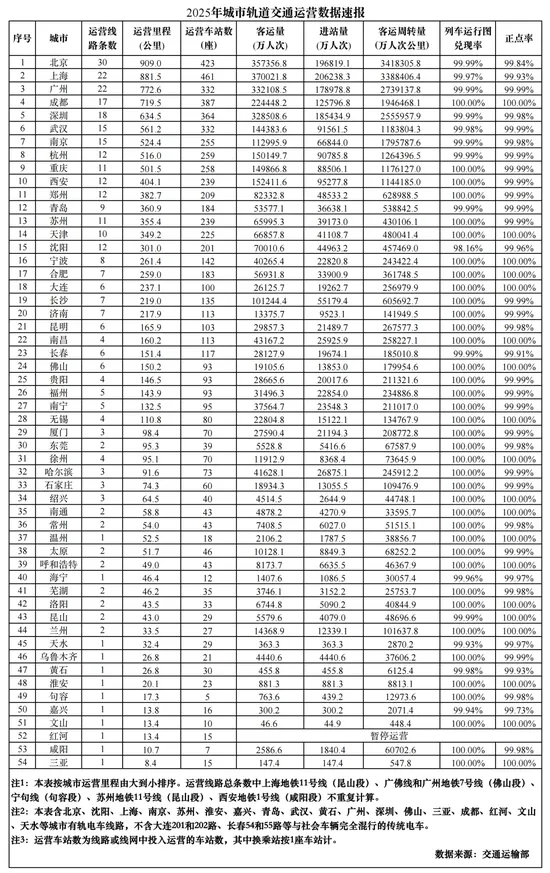
轨道交通排行:北京领跑,南京有变化
Jing Ji Ri Bao· 2026-01-22 10:20
Group 1 - The core viewpoint of the article highlights the growth and changes in urban rail transit systems across major Chinese cities, with a specific focus on Nanjing's rising ranking in operational mileage [3][4]. - As of December 31, 2025, a total of 54 cities in China will have 343 urban rail transit lines in operation, covering 11,710.3 kilometers and 6,680 stations, with an addition of 18 new lines and 764.7 kilometers of new operational mileage in 2025 [2]. - Beijing continues to lead the nation in urban rail transit operational mileage, with 30 lines and 909 kilometers, while Nanjing has moved up to the seventh position, surpassing Hangzhou and Chongqing, due to the opening of new lines [4]. Group 2 - Several major cities are set to open new rail transit lines this year, including Beijing's first interprovincial line, which will span approximately 81.2 kilometers, and Shanghai's line expected to be operational by the end of the year [5]. - Nanjing is preparing for the opening of two lines, the 6th line and the Ningma line, which will connect Jiangsu and Anhui provinces, with the 6th line measuring about 32.35 kilometers and the Ningma line about 54.23 kilometers [5]. - The urban rail transit landscape is expected to continue evolving as cities announce progress on ongoing projects, potentially leading to further changes in rankings by the end of the year [6].
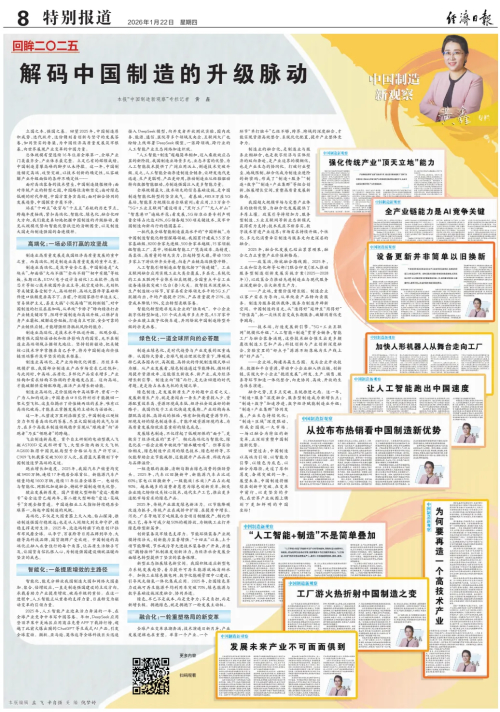
《经济日报》整版报道 解码2025年中国制造的升级脉动
Jing Ji Ri Bao· 2026-01-22 06:41
Core Viewpoint - The article emphasizes the significant advancements in China's manufacturing sector by 2025, highlighting its transition towards high-end, intelligent, green, and integrated manufacturing, which is crucial for the country's economic high-quality development [3][4]. High-end Manufacturing - High-end manufacturing is identified as a critical focus for achieving high-quality development in the manufacturing sector, addressing issues such as reliance on foreign technology and the need for a self-sufficient supply chain [5][6]. - The article notes that by 2025, China's automotive production and sales are expected to exceed 34 million units, maintaining its position as the world's largest automotive market for 17 consecutive years [6][7]. - The successful development of advanced technologies, such as the AS700D electric airship and AG600 amphibious firefighting aircraft, showcases China's progress in high-end manufacturing [6][7]. Intelligent Manufacturing - Intelligent manufacturing is positioned as a primary pathway for enhancing quality and efficiency, with artificial intelligence becoming a driving force for transformation [8][9]. - By 2025, China is expected to have over 1 million industrial devices connected through industrial internet platforms, significantly improving production efficiency and reducing operational costs [10]. - The integration of AI into manufacturing processes is leading to faster R&D cycles and smarter production methods, marking a shift from experience-driven to data-driven manufacturing [9][10]. Green Manufacturing - The article highlights the necessity of green manufacturing as a response to global climate challenges, emphasizing the importance of reducing carbon emissions and enhancing resource efficiency [11][12]. - By 2025, nearly 60% of new energy vehicles are projected to be part of vehicle replacement programs, indicating a strong consumer shift towards green products [12][13]. - The development of green technologies and equipment is expected to support traditional industries in reducing emissions and enhancing sustainability [12][13]. Integrated Manufacturing - Integrated manufacturing is described as a transformative approach that combines manufacturing with services and digital economies, enhancing overall competitiveness [14][15]. - Policies are being implemented to promote the deep integration of advanced manufacturing and modern services, fostering new growth drivers [15][16]. - The article notes that the integration of manufacturing with digital technologies and services is reshaping the value chain, moving from product sales to service-oriented models [15][16].
大幅跃升!100万!重奖→
Jing Ji Ri Bao· 2026-01-22 06:14
Core Viewpoint - The China Securities Regulatory Commission (CSRC) and the Ministry of Finance have revised the "Whistleblower Reward Work Regulations" to enhance the whistleblower system, aiming to promote a culture of accountability and better adapt to the requirements of high-quality capital market development and regulatory enforcement [1] Group 1: Whistleblower System Overview - A "whistleblower" is defined as an individual or entity that provides information about violations in the securities and futures markets to protect investors' rights [1] - The whistleblower system is a crucial mechanism for combating illegal activities in mature capital markets, with the initial regulations established in June 2014 [1] Group 2: Changes in Reward Standards - The new regulations significantly increase the reward standards, raising the reward from 1% to 3% of the penalties collected from violations [1] - The maximum reward for providing major violation leads has been increased from 100,000 yuan to 500,000 yuan, with cases of national significance or involving substantial amounts eligible for rewards up to 1 million yuan [2] Group 3: Conditions for Rewards - The criteria for rewarding whistleblowers have been expanded to include cases that severely disrupt market order or harm financial security, with the minimum penalty amount for rewards raised from 100,000 yuan to 1 million yuan [2] - Anonymous whistleblowers who provide necessary supplementary materials and those with minor or assisting roles in violations are also eligible for rewards [2] Group 4: Protection Mechanisms for Whistleblowers - The regulations enhance protection mechanisms for whistleblowers, ensuring anonymity and prohibiting retaliation through various means [3] - The dual mechanism of "incentives and protection" is expected to improve the efficiency of regulatory enforcement and encourage compliance among companies and intermediaries [3] Group 5: Future Recommendations - Suggestions for further improvement include establishing a unified, efficient, and confidential reporting platform, enhancing the protection of whistleblower rights, and clarifying legal standards for malicious reporting [4]