Xin Hua Cai Jing

Search documents
【环球财经】2025年约2100万外国公民入境吉尔吉斯斯坦 增长18.6%
Xin Hua Cai Jing· 2026-01-23 15:31
2025年,超3700万人次经吉尔吉斯斯坦国界出入境,其中入境1850余万人次,出境1840余万人次;320 余万辆汽车经吉国界出入境,其中入境160余万辆。 (文章来源:新华财经) 新华财经比什凯克1月23日电(记者江宥林)吉尔吉斯斯坦国家安全委员会边防局23日发布消息说, 2025年,约2100万外国公民入境吉尔吉斯斯坦,与2024年和2023年相比有明显增长。 消息说,过去一年,共有20978965名外国公民入境吉尔吉斯斯坦,较2024年和2023年分别增长18.6%和 20%。入境人数增长得益于旅游基础设施发展、国际交通线路扩充、对吉自然和文化资源推广力度加 大,以及商务和投资往来增多。 ...
【环球财经】印尼总统称已关闭约1000处非法矿场
Xin Hua Cai Jing· 2026-01-23 15:29
Group 1 - The Indonesian government has closed approximately 1,000 illegal mining sites and will continue to crack down on violations in the natural resources and environmental sectors to uphold the rule of law [1] - President Prabowo Subianto emphasized that the rule of law is fundamental for creating a favorable investment environment, stating that without fair and just legal frameworks, there will be no investment [1] - Since taking office, the government has seized around 4 million hectares of illegal plantations and mining areas, and has decided to revoke or confiscate the operating licenses of 28 companies, affecting over 1.01 million hectares of land [1] Group 2 - Illegal mining activities often disregard safety and environmental standards, leading to natural disasters such as floods and landslides [1] - The Indonesian National Disaster Management Agency reported that floods and landslides on Sumatra Island at the end of last year resulted in approximately 1,200 deaths, with many residents forced to evacuate and seek temporary shelter [1]
截至1月15日当周 美国2025/2026年度大豆出口净销售为244.6万吨
Xin Hua Cai Jing· 2026-01-23 14:50
美国农业部数据显示,截至1月15日当周,美国2025/2026年度大豆出口净销售为244.6万吨,前一周为 206.2万吨。 (文章来源:新华财经) ...
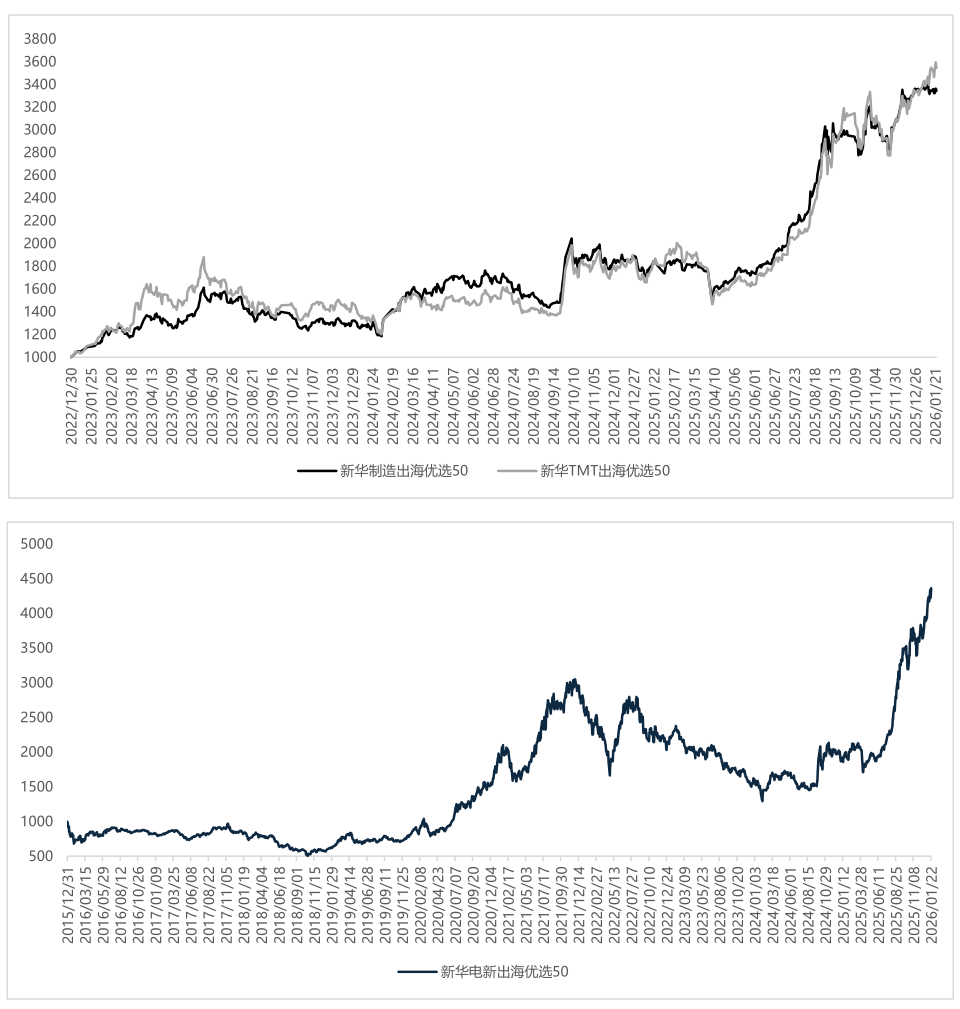
新华指数丨AI催生电力需求激增 新华出海电新指数再创新高
Xin Hua Cai Jing· 2026-01-23 13:32
新华财经上海1月23日电(谈瑞、周子涵)人工智能(AI)芯片生产正呈指数级增长,但电力供应增长缓慢,阻碍了人工智能数据中心训练和部署人工智能 模型的效率。美国企业家埃隆·马斯克日前在2026年达沃斯世界经济论坛上关于AI与电力之间的论断在本周资本市场上也得到了体现。在AI驱动的电力需求 爆发下,市场普遍看好电力板块表现。新华财经数据显示,截至1月23日收盘,新华出海电新指数周度上涨3.5%,再创历史新高,其中,其他电源设备、电 网设备、风电设备等板块领涨。 马斯克的上述论断不仅揭示了全球能源供给与AI发展的核心矛盾,也凸显了中国在电力能源领域的布局优势。事实上,伴随这一趋势,中国电力设备企业 正以技术和产能为依托,加速向海外市场渗透,在全球能源转型浪潮中抢占先机。 风电设备企业同样在全球市场占据重要地位,成为中国装备出海的一张"金名片"。明阳智能2025年12月与阿联酋公用事业开发公司正式签署沙特SPPC R6 1.5GW风电项目协议,成为该项目独家风机制造商,这也是明阳智能迄今在海外斩获的规模最大单体订单。另一行业龙头金风科技,在埃及的苏伊士湾建设 有500兆瓦风电项目,是非洲目前单机容量最大、总装机容量最 ...

商业不动产REITs入局 公募 REITs市场迎规模化发展新征程
Xin Hua Cai Jing· 2026-01-23 12:38
Core Viewpoint - The announcement by Maoye Commercial Co., Ltd. to initiate the public offering of commercial real estate REITs based on its Chengdu office assets has sparked significant industry discussion, indicating a shift in China's real estate securitization market towards a dual-driven model of infrastructure and commercial property [1][2]. Group 1: Market Development - China's real estate securitization market is transitioning from a "infrastructure-first" approach to a "infrastructure + commercial property" dual-driven model, driven by market-oriented reforms [1]. - The commercial real estate stock market in China is substantial, with non-residential properties accounting for 15% to 20% of total residential properties, providing a solid foundation for the expansion of REITs [1]. Group 2: Industry Insights - Real estate companies are shifting from high-leverage, fast-turnover developers to investment and operation-focused entities, with REITs seen as a significant benefit for revitalizing existing assets and alleviating heavy asset investment pressures [2]. - The introduction of commercial real estate REITs is viewed as a complementary evolution to infrastructure REITs, which will enrich the REITs market system in China [2]. - Experts predict that within 1 to 2 years, the first batch of commercial real estate REITs projects will be launched, with the market size expected to exceed 500 billion yuan; over 3 to 5 years, the overall REITs market could grow to between 1 trillion and 2 trillion yuan, driven by increased participation from private real estate companies and the inclusion of logistics and industrial properties [2].
建行首发自贸区人民币结构性存款开辟离岸企业资金管理新路径
Xin Hua Cai Jing· 2026-01-23 12:19
Core Viewpoint - The launch of the China Construction Bank's (CCB) free trade zone (FTZ) RMB structured deposit product marks a significant step in meeting the offshore enterprises' RMB fund management needs, filling a market gap for structured deposit products under the FTZ [1][2] Group 1: Product Launch and Features - The CCB's FTZ RMB structured deposit product was officially launched on January 23, with two offshore enterprises successfully utilizing the product on its first day [1] - This product is a funds management tool that innovatively links to financial indicators such as exchange rates and interest rates, providing clients with the potential for enhanced returns while ensuring principal protection and a minimum guaranteed return [2] - The product supports customized linkage to various financial benchmarks, maintaining a conservative nature while offering flexible options for enterprises with strict capital preservation requirements [2] Group 2: Market Context and Demand - The demand for structured deposit products in the FTZ has been growing due to the increasing number of enterprises engaging in cross-border business as Shanghai develops into an international financial center [1] - The existing scarcity of deposit products in the FTZ has led to low fund retention rates and insufficient yields for cross-border enterprises, highlighting a significant market pain point [1] - CCB has conducted in-depth research on enterprise needs and adapted its domestic structured deposit experience to create a tailored version for offshore enterprises [1] Group 3: Future Plans and Strategic Goals - CCB's Shanghai branch is committed to enhancing financial services in the FTZ, aligning with national policies aimed at improving cross-border financial service convenience [2] - The bank plans to continue expanding its FTZ product offerings, focusing on customized, professional, and comprehensive service upgrades to support efficient cross-border fund management [2] - CCB aims to contribute to the high-quality development of the FTZ and the construction of Shanghai as an international financial center through innovative financial solutions [2]

中钢协:2025年12月份国内市场钢材价格震荡盘整运行
Xin Hua Cai Jing· 2026-01-23 11:34
Core Viewpoint - The domestic steel market in China is expected to experience a weak overall performance in 2025, characterized by a "倒N" shaped price trend, with prices showing a slight increase in December but a significant year-on-year decline [1][2]. Group 1: Market Performance - In December 2025, the China Steel Price Index (CSPI) averaged 92.03 points, with a month-on-month increase of 0.56 points (0.61% rise) but a year-on-year decrease of 5.70 points (5.83% drop) [1]. - The CSPI for long products averaged 94.21 points in December, reflecting a month-on-month increase of 1.69 points (1.82% rise) and a year-on-year decrease of 6.04 points (6.03% drop) [1]. - The CSPI for flat products averaged 90.22 points in December, showing a slight month-on-month decrease of 0.07 points (0.07% drop) and a year-on-year decrease of 5.74 points (5.98% drop) [1]. Group 2: Annual Overview - The average CSPI for 2025 was 93.19 points, which represents a year-on-year decline of 9.28 points (9.05% drop) [2]. - In the first half of 2025, steel prices exhibited a continuous downward trend, with the index dropping below 90 points to 89.51 points by the end of June, marking the lowest level since November 2016 [2]. - The market saw a brief recovery in July due to expectations surrounding "反内卷" policies, but prices faced renewed pressure in August to October as demand recovery fell short of expectations, leading to further price declines [2].
锦江酒店将与飞书共同打造AI 办公平台“锦鲲” 数字化转型全面提速
Xin Hua Cai Jing· 2026-01-23 11:25
Core Viewpoint - The partnership between Jin Jiang Hotels and Feishu to create the AI collaborative office platform "Jin Kun" signifies a significant acceleration in the digital transformation of Jin Jiang Hotels, emphasizing the necessity of embracing AI in the industry [1][2]. Group 1: Digital Transformation and AI Integration - The launch of "Jin Kun" marks the beginning of a deep collaboration between Jin Jiang Hotels (China) and Feishu, aimed at enhancing the company's digital transformation and fully embracing AI [1]. - The CEO of Jin Jiang Hotels (China) highlighted that the value of technology must address real-world problems, advocating for a collaborative evolution that improves service quality and customer trust [1]. - The platform is designed to facilitate efficient collaboration across over 10,000 stores and thousands of employees, moving beyond simple tool upgrades to a comprehensive approach to operational management [1][2]. Group 2: Platform Features and Implementation - "Jin Kun" covers all levels of Jin Jiang Hotels (China), including headquarters, regional offices, and stores, ensuring closed-loop communication and collaboration [2]. - The platform offers customized work interfaces and functions tailored to individual employee needs, enhancing decision-making and execution efficiency [2]. - The platform was launched on November 10, 2025, achieving a 100% activation rate within a week and consolidating 20 critical systems and program entries within a month [2]. Group 3: Company Overview - Jin Jiang Hotels (China) operates in the limited-service hotel sector in the Chinese market, with a diverse brand portfolio that includes high-end to economy options [3]. - As of June 30, 2025, Jin Jiang Hotels (China) had over 16,300 signed hotels and more than 1.54 million rooms, maintaining the largest scale in the domestic hotel industry [3].

日本财务大臣:正以高度的紧迫感留意外汇市场
Xin Hua Cai Jing· 2026-01-23 10:34
Core Viewpoint - Japanese financial authorities are closely monitoring currency trends with a sense of urgency, particularly in light of recent fluctuations in the yen's value [1] Group 1: Currency Monitoring - Japanese Finance Minister Shunichi Suzuki emphasized the importance of maintaining a high level of urgency regarding currency movements [1] - The authorities have not disclosed any information regarding potential market interventions following recent yen volatility [1] Group 2: Yen Fluctuations - The yen experienced significant fluctuations after the Bank of Japan's decision to maintain the benchmark interest rate [1] - The yen fell below the 160 mark against the US dollar, prompting Japanese authorities to intervene in the foreign exchange market four times, spending nearly $100 billion to purchase yen [1] Group 3: Intervention Strategy - Officials indicated that interventions are not aimed at specific exchange rate targets but are responses to sharp fluctuations, disorderly movements, or speculative behavior in the market [1]
控制使用67个账户操纵“博士眼镜” ,违法所得5.11亿元;证监会开出罚单:余韩被罚没10.23亿元!
Xin Hua Cai Jing· 2026-01-23 10:31
中国证监会发布行政处罚决定书,认定余韩操纵证券市场行为成立。 2019年6月3日至2024年8月15日期间,余韩控制使用67个证券账户,利用资金优势、持股优势,通过连 续买卖、对倒交易等方式,操纵"博士眼镜"股票价格和交易量,扰乱证券市场秩序。经查,余韩违法所 得为5.11亿元。依据《证券法》相关规定,证监会决定:没收余韩违法所得5.11亿元,并处以5.11亿元 罚款,合计罚没金额10.23亿元。同时,对余韩采取3年证券市场禁入措施。 ...