
Xin Hua Cai Jing

Search documents
【2026年汇市展望】2025卢布领跑全球 2026俄罗斯能否驾驭“强币陷阱”?
Xin Hua Cai Jing· 2026-01-08 08:42
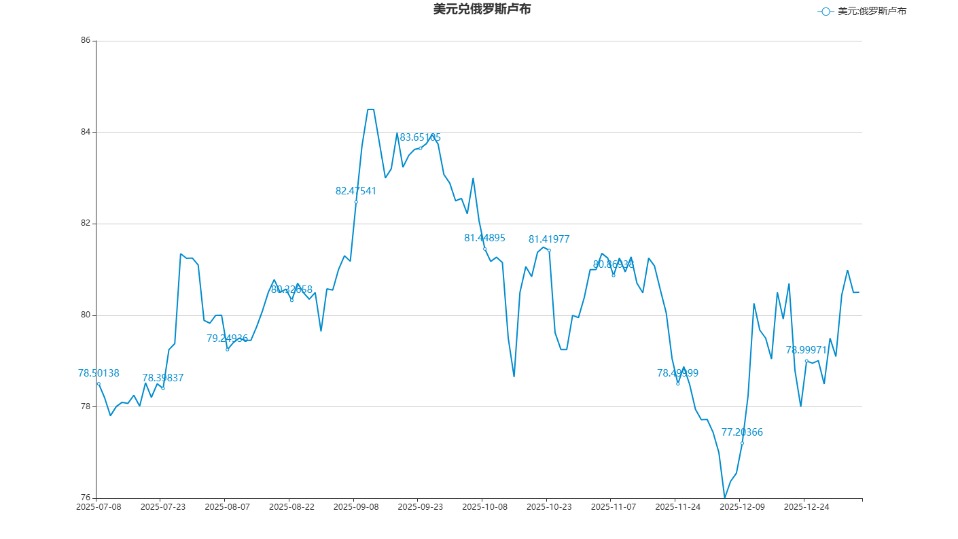
Core Viewpoint - The Russian ruble appreciated by 45% in 2025, leading among major global currencies, marking the largest increase since 1994. This appreciation, while positioning the ruble among the top five assets globally in terms of returns, poses potential risks to the Russian economy, particularly in balancing export competitiveness and foreign exchange income in 2026 [1][10]. Group 1: Ruble Performance and Economic Impact - The ruble's rise contradicts expectations of depreciation due to falling oil prices and geopolitical tensions, with the USD/RUB exchange rate stabilizing below 80 rubles per dollar by year-end, down from over 100 rubles at the beginning of the year [2][4]. - International financial sanctions have reduced Russia's demand for foreign exchange, leading to a decreased need for rubles among businesses and consumers. The restructuring of payment flows to favor domestic currencies in trade has further diminished reliance on the USD and EUR [4][5]. - The ruble's strength is attributed to reduced foreign exchange dependency, tight monetary policy, and structural changes in productivity, with experts noting that the ruble's appreciation has significantly impacted the economy, contributing to a slowdown [5][6]. Group 2: Monetary Policy and Inflation - The Central Bank of Russia's high benchmark interest rates have been a key factor in the ruble's strength, with a series of rate cuts in the latter half of 2025 reducing the rate from 21% to 16% [6][7]. - Inflation rates have decreased, with December figures showing inflation below 6%, but risks remain due to fiscal stimulus and potential price increases from VAT hikes [7][8]. - The Russian economy is projected to grow at approximately 1% in 2025, with factors such as reduced fiscal stimulus and the impact of tight monetary policy on businesses and consumers contributing to this slowdown [8][11]. Group 3: Structural Changes and Future Outlook - The Russian economy is undergoing a structural transformation, with experts indicating that the transition's success will depend on resolving geopolitical issues and effectively reallocating investments to civilian sectors [9][10]. - Economists predict that the ruble may stabilize in 2026, but its strength could undermine Russia's export competitiveness in energy and raw materials, which are crucial for foreign exchange income [10][11]. - The key challenge for 2026 will be maintaining a balance between a strong ruble and export competitiveness, especially as oil revenues decline and the Central Bank reduces foreign exchange sales [11][12].

以破“7”收官2025,2026年人民币汇率将何去何从?
Xin Hua Cai Jing· 2026-01-08 08:36
Core Viewpoint - In 2025, the RMB exchange rate experienced significant appreciation against the USD, influenced by tariff expectations, fluctuations in the USD, and improvements in the domestic environment, with onshore and offshore RMB appreciating approximately 4.27% and 4.93% respectively [1][2][3] Group 1: RMB Exchange Rate Trends in 2025 - The RMB exchange rate reached its highest levels since May 2023, closing at 6.9879 for onshore and 6.9697 for offshore [2] - The year can be divided into two phases: the first phase saw a depreciation of about 0.65% until early April due to rising global tariff risks, while the second phase from mid-April to year-end saw a cumulative appreciation of approximately 4.9% as external economic conditions improved [2][3] - The depreciation of the USD, driven by various factors including the Federal Reserve's shift to a loose monetary policy, contributed to the RMB's strength [3] Group 2: Internal and External Factors Supporting RMB Appreciation - Strong export performance supported the RMB's appreciation, with a trade surplus exceeding $1 trillion for the first 11 months of 2025 [3] - The Chinese capital market showed resilience, with the Shanghai Composite Index rising 18.41%, the Shenzhen Component Index increasing by 29.87%, and the ChiNext Index up by 49.57%, providing solid support for the RMB [3] - The implementation of stable exchange rate policies helped to smooth fluctuations and maintain market expectations [3][4] Group 3: Outlook for 2026 - The RMB is expected to continue a gradual appreciation against the USD in 2026, influenced by the USD's potential depreciation and narrowing interest rate differentials between China and the US [6][7] - The external economic environment's impact on the RMB may lessen, with improved resilience in China's economy and financial markets [6][7] - Despite potential short-term fluctuations, the RMB is projected to maintain a range of 6.9 to 7.3 against the USD, with a focus on balanced exchange rate management [7][8]
报告:我国新型储能平稳较快发展 技术路线多元协同
Xin Hua Cai Jing· 2026-01-08 08:03
Core Insights - The report by State Grid Energy Research Institute indicates that by September 2025, China's new energy storage capacity will reach 103 million kilowatts, representing a growth of over 30 times compared to the end of the 13th Five-Year Plan [1] - The utilization level of energy storage stations is continuously improving, with the equivalent utilization hours for new energy storage nationwide increasing by approximately 120 hours year-on-year to about 770 hours from January to September 2025 [1] - The report forecasts that by 2030, the cumulative demand for new energy storage in China will exceed 300 million kilowatts, with lithium battery storage remaining the primary technology during the 14th Five-Year Plan [3] Group 1: Current Status - As of September 2025, the total installed capacity of new energy storage in the State Grid operating area is 83.146 million kilowatts, with an average charge and discharge duration of 2.43 hours [1] - The maximum adjustable power of new energy storage in the State Grid operating area is 64.23 million kilowatts, with an average discharge duration of 2.4 hours during peak summer evenings [1] - In regions like Jiangsu, Shandong, and Zhejiang, the maximum simultaneous utilization rate of new energy storage has reached over 95%, playing a crucial role in peak supply [1] Group 2: Technological Development - The report highlights a "diverse collaboration and multiple breakthroughs" in new energy storage technology, with rapid iterations and declining costs across various technology routes [2] - The construction cost for lithium-ion battery storage is projected to be between 900-1100 RMB/kWh by 2025, while sodium-ion battery storage costs are expected to range from 2500-3500 RMB/kWh [2] - New compressed air storage has achieved key indicators, entering an accelerated industrialization phase with construction costs dropping to 5000-6000 RMB/kWh [2] Group 3: Future Outlook - The report anticipates steady growth in new energy storage, with a projected cumulative demand exceeding 300 million kilowatts by 2030 [3] - The diversification of technology routes will include both short-term and long-term energy storage solutions, with new energy storage playing an increasingly significant role in peak shaving, load following, and long-cycle regulation [3]
交易所接连出手、彭博商品指数年度再平衡迫近 贵金属短期回调压力加大
Xin Hua Cai Jing· 2026-01-08 08:00
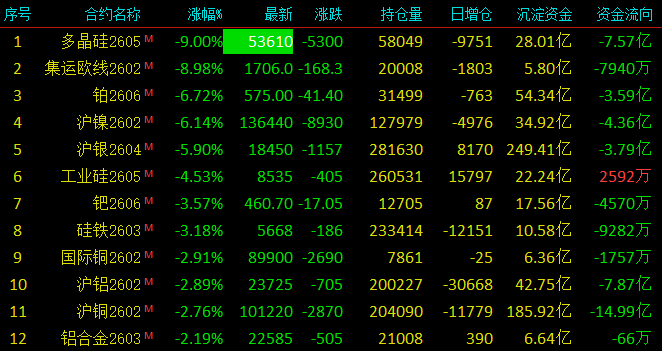
Group 1 - The domestic metal sector experienced a significant pullback, particularly in precious metals, with declines of around 6% for platinum, nickel, and silver, and over 4% for industrial silicon and palladium [1][2] - Gold prices fell by more than 1% during the day but narrowed the decline to 0.72% by the end of trading [1] - The Bloomberg Commodity Index's annual rebalancing attracted selling pressure and profit-taking, negatively impacting the short-term metal market [5] Group 2 - The Shanghai Futures Exchange implemented a series of risk control measures for silver futures, including increased margin requirements and trading limits, which dampened market speculation [5][6] - Analysts noted that geopolitical risks and macroeconomic signals from the U.S. are influencing precious metal traders, with a cautious sentiment prevailing in the market [8] - Despite short-term volatility, the long-term outlook for precious metals remains optimistic, supported by factors such as the continuous increase in gold reserves by the People's Bank of China [9]
特朗普:禁止囤房
Xin Hua Cai Jing· 2026-01-08 07:47
Core Viewpoint - The U.S. President Trump announced measures to prohibit large institutional investors from purchasing single-family homes to address the affordability crisis faced by many Americans, particularly the youth [1] Group 1: Policy Announcement - Trump plans to request Congress to legislate a ban on institutional investors buying more single-family homes [1] - The issue of housing affordability has become a focal point for voters and policymakers due to rising costs and unemployment affecting low- to middle-income families [1] Group 2: Market Reaction - Following Trump's announcement, shares of residential investment firms, including Blackstone Inc., experienced a decline of approximately 10% [1] Group 3: Economic Context - Trump attributed the housing affordability crisis to "record high inflation" caused by former President Biden and the Democrats [1] - The ongoing high prices and rising unemployment rates are significantly impacting middle- and low-income households [1]
科创板收盘播报:科创50指数涨0.82% 半导体股表现分化
Xin Hua Cai Jing· 2026-01-08 07:42
Group 1 - The core index, the Sci-Tech 50 Index, opened slightly lower on January 8 but quickly rose, eventually closing at 1455.17 points with a gain of 0.82% and a total trading volume of approximately 99.25 billion yuan [1] - The Sci-Tech Comprehensive Index increased by 1.14% to close at 1766.57 points, with a total trading volume of about 318.1 billion yuan [2] - On the Sci-Tech board, 600 stocks showed more gains than losses, with an average increase of 1.27% and an average turnover rate of 4.23% [2] Group 2 - Notable individual stock performances included Beibetter, Aerospace Nanhu, and Aerospace Hongtu, which hit the daily limit up, while Jiabiyou experienced a significant drop of 11.91% [3] - In terms of trading volume, Cambrian Technology led with a volume of 21.58 billion yuan, while Zhongke Weizhi had the lowest at 909.1 million yuan [4] - The highest turnover rate was recorded by Hengkang New Materials at 52.85%, while Zhongke Weizhi had the lowest turnover rate at 0.22% [5]
收评:沪指微跌0.07% 军贸概念、商业航天、脑机接口板块大幅上涨
Xin Hua Cai Jing· 2026-01-08 07:42
Market Overview - The Shanghai Composite Index opened down 0.2%, the Shenzhen Component down 0.42%, and the ChiNext Index down 0.63% on January 8. The Shanghai index experienced slight fluctuations, ultimately closing with a minor decline, while the Shenzhen index saw a more significant drop before rebounding slightly at the end. The ChiNext index also faced a downward trend but showed some recovery towards the close [1][2]. Sector Performance - Despite adjustments in major indices, the market remained active, with nearly 90 stocks reaching historical intraday highs. Notable sectors that saw significant gains included military trade, commercial aerospace, and brain-computer interfaces. Conversely, sectors such as insurance, securities, and non-ferrous metals experienced considerable declines [1]. Institutional Insights - According to institutional perspectives, the A-share market is expected to align with economic recovery, driven by ongoing domestic economic transformation and policy support. Investment opportunities are suggested in high-growth areas such as semiconductors, consumer electronics, artificial intelligence, robotics, and commercial aerospace [3]. - The space data center industry is transitioning from technology validation to commercial satellite deployment, with projections indicating that the first phase of the computing constellation could generate over tens of billions in industry chain output by 2027. Key areas of focus include radiation cooling systems, space photovoltaic energy systems, radiation-resistant chips/servers, and inter-satellite laser communication [4]. Policy Developments - The Chinese government released the 2025 report on the progress of scientific research and applications related to the Chinese space station, highlighting the successful implementation of 265 scientific and application projects in areas such as space life and human research, microgravity physics, and new space technologies [5]. - The State Administration for Market Regulation introduced new national standards aimed at enhancing the efficiency of government services, focusing on standardized processes to improve service quality and reduce burdens on grassroots levels [6].
【环球财经】东京股市继续回落 日经225指数下跌1.63%
Xin Hua Cai Jing· 2026-01-08 07:41
Market Overview - The Tokyo stock market indices continued to decline on January 8, with the Nikkei 225 index falling by 1.63% and the Tokyo Stock Exchange Price Index decreasing by 0.77% [1][2] - The Nikkei index closed down by 844.72 points at 51,117.26 points, while the Tokyo Stock Exchange index fell by 27.00 points to 3,484.34 points [2] Sector Performance - Most of the 33 industry sectors on the Tokyo Stock Exchange experienced declines, particularly in non-ferrous metals, electrical products, and information and communication sectors [2] - Conversely, sectors such as pharmaceuticals, electric and gas utilities, and air transportation saw gains [2] Influencing Factors - The decline in the Tokyo stock market was influenced by the overnight drop in the Dow Jones Industrial Average and the Philadelphia Semiconductor Index, which negatively impacted semiconductor-related stocks like SoftBank Group and Tokyo Electron [1] - The announcement by China to strengthen export controls on dual-use items to Japan was a significant factor contributing to market pressure [1] - Additionally, China's decision to initiate anti-dumping investigations on imported dichlorodihydrosilane from Japan led to a nearly 4% drop in the stock price of chemical giant Shin-Etsu Chemical [1]
债市日报:1月8日
Xin Hua Cai Jing· 2026-01-08 07:38
Market Overview - The bond market showed significant recovery on January 8, with futures and cash bonds strengthening in the afternoon, leading to a rise in government bond futures across the board [1] - The interbank cash bond yield decreased by approximately 2 basis points, while the central bank conducted a net injection of 9.9 billion yuan in the open market [1] Bond Futures Performance - Government bond futures closed higher, with the 30-year main contract rising by 0.37% to 111.00, the 10-year main contract up by 0.15% to 107.79, and the 5-year main contract increasing by 0.09% to 105.60 [2] - The China Convertible Bond Index rose by 0.39% to 509.26 points, with notable gains in several convertible bonds [2] International Bond Market - In North America, U.S. Treasury yields showed mixed results, with the 2-year yield increasing by 1.45 basis points to 3.470% and the 10-year yield decreasing by 2.16 basis points to 4.147% [3] - In Asia, Japanese bond yields fell significantly, with the 10-year yield down by 5.1 basis points to 2.07% [3] - In the Eurozone, yields on various government bonds also decreased, with the 10-year French bond yield down by 3.1 basis points to 3.520% [3] Primary Market Activity - The Export-Import Bank issued financial bonds with yields below market estimates, with the 1.2521-year and 5.5041-year bonds yielding 1.4444% and 1.7827%, respectively [4] - The China Development Bank's 3-year and 7-year financial bonds had yields of 1.6783% and 1.94%, respectively, indicating strong demand [4] Liquidity Conditions - The central bank announced a 99 billion yuan reverse repo operation at a fixed rate of 1.40%, with no reverse repos maturing on that day [5] - Short-term funding rates in the Shibor market mostly increased, with the overnight rate rising by 0.4 basis points to 1.27% [5] Institutional Insights - Guotai Junan Fund emphasized the importance of pure bond funds focusing on stable long-term returns and the transformation of "fixed income +" funds to attract more aggressive capital [6] - CITIC Securities projected that China would remain in a low-interest-rate environment through 2026, with potential downward pressure on long-term bond yields as economic recovery progresses [6] - Shenwan Hongyuan suggested that monetary policy would likely remain generous in 2026, with expectations of 1-2 reserve requirement ratio cuts and one interest rate cut during the year [6]
汽车行业2026十大趋势:国央企整车企业迎来发展机遇、具身智能进入量产前夜
Xin Hua Cai Jing· 2026-01-08 07:18
Core Viewpoint - The Chinese automotive industry is at a critical juncture in the transition towards electric and intelligent vehicles, with three distinct industry curves coexisting: traditional fuel vehicles, electric intelligent vehicles, and future industries represented by autonomous driving. The year 2026 is anticipated to be a pivotal turning point for the industry, characterized by structural transformation driven by policy, market growth, technological breakthroughs, and global competition [1]. Group 1: Trends in the Automotive Industry - Trend 1: The "old-for-new" policy is expected to become a normalized tool, addressing the growing gap in vehicle replacement as the annual scrappage rate remains significantly lower than new car sales. This policy is projected to enhance market demand and support steady domestic consumption and industrial production [2]. - Trend 2: New automotive players are driving an upgrade in export structure, with Chinese automotive exports experiencing significant growth, becoming a "second growth curve." These companies are shifting from single vehicle exports to localized production, enhancing China's brand value and technological image in the global market [3]. - Trend 3: A clear differentiation is emerging between "mass-market pure electric" and "high-end range-extended" vehicles, with structural changes in market demand as the penetration rate of new energy vehicles exceeds 50%. The mainstream configuration for high-end SUVs/MPVs remains "large battery long-range range-extended" [4]. Group 2: Market Dynamics and Competitive Landscape - Trend 4: The industry is transitioning to a "late-stage mass market," where consumers prioritize brand reputation, after-sales support, and residual value certainty. Resources are increasingly consolidating around leading technology firms, enhancing conversion efficiency in mainstream price segments [5]. - Trend 5: State-owned enterprises are poised for growth opportunities as regulatory bodies strengthen the assessment of their new energy businesses, driving resources towards electric intelligence. These enterprises hold advantages in manufacturing systems and compliance, particularly in the realm of conditional autonomous driving [6]. - Trend 6: The penetration of new energy commercial vehicles is accelerating, with heavy-duty and light-duty trucks entering a rapid growth phase. The total cost of ownership for heavy trucks is now within a 1.5-2 year recovery period, while urban electric vehicle infrastructure is fully mature [7]. Group 3: Technological Advancements and Future Prospects - Trend 7: High-perception intelligent cockpit configurations are reshaping purchasing decisions, with smart features becoming a core competitive differentiator. The integration of advanced displays and intelligent seating systems is driving a new wave of competition in the market [8]. - Trend 8: Intelligent driving architecture is transitioning to an "end-to-end" model, enhancing the integration of perception and decision-making processes. The "equalization of intelligent driving" is facilitating advanced driving assistance features in lower-priced models [9][10]. - Trend 9: Three major commercial scenarios for autonomous driving are on the verge of mass production, including Robotaxi, mining autonomous vehicles, and unmanned logistics vehicles, with significant cost reductions and operational efficiencies being realized [11]. - Trend 10: Embodied intelligence is approaching mass production, with humanoid robots transitioning to dual-core intelligence. The automotive industry is well-suited for this technology due to the high degree of technical reuse, with several manufacturers planning to launch production in 2025 [12]. Overall, the Chinese automotive industry is expected to exhibit characteristics of multiple technological pathways, market structure differentiation, and accelerated intelligence implementation, supported by policy guidance and technological innovation, leading to high-quality development [13].