
Hua Er Jie Jian Wen

Search documents
绕开美国监管,币安加密交易所重启“美股代币”,创造一个平行世界的股市
Hua Er Jie Jian Wen· 2026-01-26 02:31
Core Insights - Major cryptocurrency exchanges are competing to launch crypto token products that track U.S. stocks, creating a parallel stock market outside the U.S. regulatory framework, allowing overseas investors to bypass traditional brokerage restrictions on trading U.S. stocks, raising concerns about market manipulation and regulatory arbitrage [1][4] Group 1: Market Trends - Binance is exploring the reintroduction of stock tokens after previously halting them due to regulatory warnings from Germany in 2021 [1][3] - Other exchanges like OKX, Kraken, and Bitget are also considering or have made progress in offering tokenized stocks, with Kraken reporting strong demand from clients in Europe, Latin America, and Asia [2][3] - The total value of circulating tokenized stocks is currently $915 million, reflecting a 19% increase over the past month, although this remains small compared to the $60 trillion market capitalization of the S&P 500 [1][3] Group 2: Regulatory Landscape - U.S. lawmakers and regulators have yet to determine how to handle tokenized stocks, which has stalled a cryptocurrency market structure bill in Congress [4][5] - Coinbase is advocating for modifications to the bill to allow certain exemptions for tokenized stock products from existing securities rules, believing blockchain technology makes some rules unnecessary [5] Group 3: Risks and Challenges - Tokenized stocks are not actual equity but are issued by third parties like xStocks and Ondo Finance, which purchase U.S. stocks and place them in offshore special purpose entities [3][6] - The trading volume of tokenized stocks is still low and concentrated on popular stocks, making them susceptible to market manipulation due to their small scale [3][6] - The structure of tokenized stocks poses risks, as companies may either buy stocks and place them in special entities or use financial derivatives, which can lead to potential issues for investors [6]
日本外汇主管:正与美国密切联系,应对日元汇率波动
Hua Er Jie Jian Wen· 2026-01-26 02:31
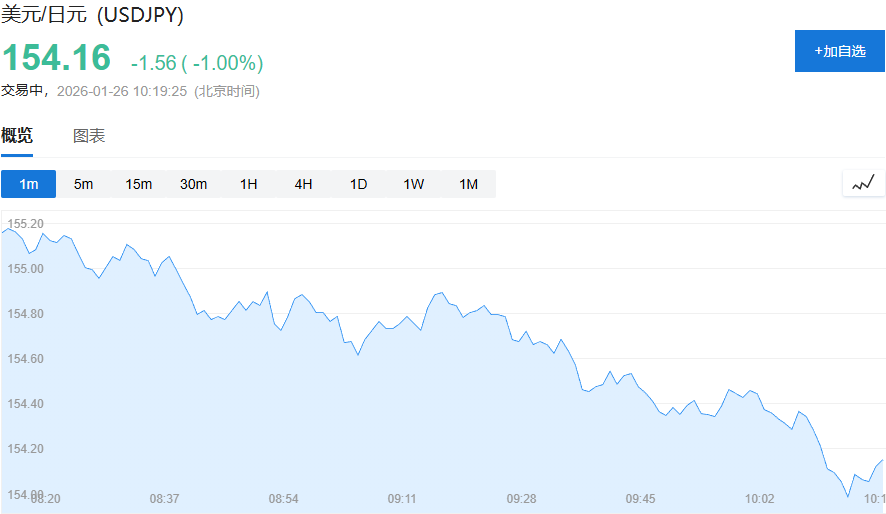
正值日元上周五突然走强、市场猜测日美当局可能联手干预汇市之际,日本财务省外汇主管Atsushi Mimura表态,日本当局将 根据需要与美国当局密切协调,对外汇市场波动做出适当应对。 据彭博社报道,Mimura在周一上午抵达财务省时对记者表示,日本将按照去年9月日美财长联合声明的精神,在必要时与美方 密切合作,继续对汇率波动做出适当应对。他拒绝回应市场关于当局上周五进行汇率检查的猜测。 日本首相高市早苗周日表态称,日本将"采取一切必要措施"应对投机性和高度异常的汇率波动。财务大臣片山皋月上周五也 表示,当局正以紧迫感监控汇率走势。这些表态强化了市场对日本可能干预汇市的预期。 周一日元延续涨势,交易员对日本可能入场干预保持高度警惕。日元一度上涨近1%至1美元兑154.16日元。 据彭博报道,知情人士透露,纽约联储在美国财政部指示下于上周五致电各大金融机构询问美元兑日元汇率报价。 这种所谓的"汇率检查"是央行向交易员询问货币兑美元报价的做法,虽然不是实际的日元交易,但有时是干预行动的前兆。市 场将此解读为美日当局已准备联手遏制日元跌势的信号,引发大规模日元空头回补。 日本去年四次干预耗资近千亿美元 日本当局在20 ...

香港:推动机管局及金融机构在港拓展黄金仓储容量,以三年超越2000吨为目标
Hua Er Jie Jian Wen· 2026-01-26 02:26
Core Viewpoint - The Hong Kong Financial Secretary, Paul Chan, aims to enhance the gold storage capacity in Hong Kong by collaborating with the Airport Authority and financial institutions, targeting over 2,000 tons within three years to establish Hong Kong as a trusted global gold storage hub [1] Group 1 - The initiative focuses on expanding the gold storage capacity in Hong Kong [1] - The target is to exceed 2,000 tons of gold storage within a three-year timeframe [1] - The goal is to position Hong Kong as a reliable global destination for gold storage [1]
阶跃星辰完成超50亿元B+轮融资,为国产大模型一年内单笔融资最高
Hua Er Jie Jian Wen· 2026-01-26 01:32
市场有风险,投资需谨慎。本文不构成个人投资建议,也未考虑到个别用户特殊的投资目标、财务状况或需要。用户应考虑本文中的任何 意见、观点或结论是否符合其特定状况。据此投资,责任自负。 阶跃星辰(StepFun)完成超50亿元B+轮融资,创下过去12个月中国大模型赛道单笔最高融资纪录。参 投机构包括上国投先导基金、国寿股权、浦东创投、徐汇资本、无锡梁溪基金、厦门国贸、华勤技术等 产业投资人,腾讯、启明、五源等老股东进一步跟投。 风险提示及免责条款 ...
脱钩美国、"重建军工",欧洲需要砸万亿
Hua Er Jie Jian Wen· 2026-01-26 01:32
Core Insights - Europe is accelerating the reconstruction of its defense industry to achieve military independence in response to threats from Russia and disagreements with the U.S. Analysts estimate that Europe needs to invest around $1 trillion to fully replace U.S. military capabilities [1] Group 1: Defense Spending and Investment - European defense spending surged to approximately $560 billion last year, doubling from a decade ago, and is projected to reach 80% of Pentagon's equipment spending by 2035, up from less than 30% in 2019 [1] - The cost of replacing U.S. military equipment and personnel in Europe is estimated to be around $1 trillion [1] Group 2: Production Capacity Expansion - European defense companies are expanding production at the fastest rate in decades, with Rheinmetall opening or constructing 16 new factories since February 2022 [2] - Leonardo has increased its workforce by nearly 50% to 64,000 employees over the past two years [2] - MBDA's production of short-range "North Wind" air defense missiles has increased from 10 to 40 units per month, and anti-tank missile production has doubled to 40 units per month [2] - Rheinmetall produces 1.5 million 155mm shells annually, surpassing the total output of the entire U.S. defense industry [2] Group 3: Existing Gaps in Capabilities - Europe still faces significant gaps in key equipment, particularly in producing stealth fighter jets and satellite intelligence, relying heavily on U.S. procurement for F-35 jets [3] - The continent lacks production capabilities for critical weapons like ballistic missiles and long-range missiles, with U.S. systems remaining the preferred choice [3] - Fragmentation in investment, research, and procurement across European nations hinders military rearmament efforts [3] Group 4: Strategic Shifts - Some European countries are beginning to favor domestic over U.S. weapons, with Denmark's arms imports from Europe exceeding half due to pressures related to Greenland [4] - The UK has established its own military satellite system, previously reliant on the U.S., and other European nations are increasing their space deployments [5] Group 5: Future Outlook - Analysts suggest that while Europe can arm itself, it will require time to achieve full independence from U.S. defense capabilities [5] - The significant increase in military spending and renewed focus on research and development are bringing Europe closer to independent operational capabilities [5] - The shift towards local supply could impact U.S. defense manufacturers, as Europe accounts for up to 10% of their revenue [5]
又一个火出圈的AI应用!个人AI助理的雏形:Clawdbot来了
Hua Er Jie Jian Wen· 2026-01-26 00:47
Core Insights - Clawdbot represents a new paradigm in personal AI assistants, capable of self-improvement and operating locally on user devices, distinguishing itself from mainstream applications like ChatGPT and Claude [1][2][3] Group 1: Clawdbot Features - Clawdbot can remember user preferences, control smart home devices, manage schedules, and learn new skills autonomously by accessing the computer's file system and terminal commands [1][3] - The assistant stores settings, preferences, and memories in Markdown documents locally, allowing users to view and modify them directly [1][3] - Clawdbot's architecture consists of a locally running LLM-driven agent and a gateway system connecting various communication applications [3][5] Group 2: Self-Improvement Capabilities - Clawdbot can autonomously add new features upon user request, completing the entire development process [7][9] - In tests, it successfully integrated Google’s Nano Banana Pro model for image generation and created a virtual remote for an LG TV based on simple text commands [7][13] - The assistant can adapt its response style based on the interaction mode, providing voice replies for voice requests and text replies for written requests [9][13] Group 3: Automation and Cost Efficiency - Clawdbot can replace traditional cloud-based automation services, such as Zapier, by executing tasks locally without subscription fees [10][12] - It can automate processes like creating weekly newsletters and sending daily reports based on calendar data, all through local cron tasks [10][12] Group 4: Implications for Software Development - The emergence of Clawdbot raises questions about the future of app development, as AI assistants can create tailored functionalities on demand, challenging the value of traditional app stores [2][13] - The project exemplifies a shift towards highly personalized, adaptive AI software, potentially leading to significant changes in the software industry [2][14] - Clawdbot's design allows users to have complete control over the assistant's capabilities, moving away from pre-defined developer constraints [13][14]
苹果AI手机还有多远?报道称“Gemini驱动”的新版Siri将在2月亮相
Hua Er Jie Jian Wen· 2026-01-26 00:47
Core Insights - Apple plans to announce a new version of Siri powered by Google's Gemini in late February, marking a significant collaboration between Apple and Google in AI [1][2] - The new Siri will utilize user personal data and screen content to perform tasks, representing a fundamental shift in Apple's AI strategy [1][2] - A larger upgrade, codenamed Campos, is expected to be unveiled at the Worldwide Developers Conference in June, featuring conversational capabilities and context awareness [3] Group 1: Upcoming Releases - The first Gemini-driven version of Siri is set to be announced in late February, potentially during a large event or a small briefing in New York [2] - This version will be released alongside iOS 26.4 and is expected to enter testing next month, with a formal launch in March or early April [2] - The technology used in this version is internally labeled as "Apple Foundation Models version 10," with approximately 1.2 trillion parameters, hosted on Apple's Private Cloud Compute servers [2] Group 2: Major Upgrades - The significant upgrade in June will introduce a new architecture and interface for Siri, designed for the chatbot era, with capabilities comparable to ChatGPT and Google Gemini [3] - This version will utilize a more advanced Gemini model, referred to as "Apple Foundation Models version 11," expected to compete with Gemini 3 [3] - Discussions are ongoing to run this version directly on Google's cloud infrastructure to enhance accuracy and response speed [3] Group 3: Strategic Shift - Apple's collaboration with Google comes after internal AI model development faced challenges, leading to a decision to partner with a third-party supplier [4][5] - The partnership was solidified after Apple reassessed Gemini's technology and found it significantly improved, with Google agreeing to a financially acceptable structure [5] - The collaboration is seen as a necessary step for Apple to demonstrate competitive AI capabilities to investors [1][4] Group 4: Organizational Changes - The departure of AI head John Giannandrea and the rise of software chief Craig Federighi have led to a broad restructuring of Apple's AI initiatives [6] - Several ambitious AI projects have been scaled back or put on hold, including a revamped AI version of the Safari browser and the World Knowledge Answers project [6] - The company is now focusing on deeply integrating the new Siri into core applications rather than offering standalone chatbot experiences [6] Group 5: Team Dynamics - While the AI model team remains intact for now, there is a trend of engineers leaving for better-paying and more stable opportunities [7] - Apple had previously attempted to acquire an external model developer to strengthen its team, but the deal fell through [7] - The future direction of Apple's AI strategy remains uncertain, particularly whether it will prioritize developing its own large-scale AI models or continue relying on partnerships [7]


极为罕见!美日联合干预,这对市场意味着什么?
Hua Er Jie Jian Wen· 2026-01-26 00:21
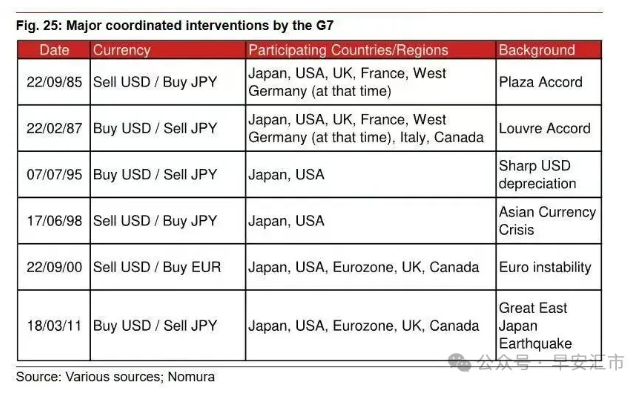
Core Viewpoint - Japan is facing a severe financial dilemma between a potential yen collapse and a bond market crisis, with policymakers seemingly having no way out. The market is closely watching for signals that the U.S. may intervene to assist Japan in stabilizing the yen [1][6]. Group 1: Market Reactions and Speculations - Prime Minister Fumio Kishida issued a stern warning, promising to take "all necessary measures" to address speculative and extreme market volatility, following a significant drop in the dollar-yen exchange rate [1][2]. - The New York Federal Reserve's rare "rate check" action is interpreted as a precursor to potential intervention, suggesting that U.S. and Japanese authorities are prepared to work together to curb the yen's decline [1][3]. - The expectation of a "coordinated intervention" is reshaping investor risk preferences, with analysts drawing parallels to the "Plaza Accord 2.0" scenario, indicating a potential joint effort to stabilize the yen [2][7]. Group 2: Historical Context and Implications - The New York Fed's "rate check" is a rare occurrence, with only three instances of U.S. intervention in the currency market since 1996, the last being in 2011 after the Japanese earthquake [3][4]. - The urgency from Japanese authorities stems from the yen's sharp decline over the past two weeks and the looming threat of a "Japanese bond crisis," which has raised concerns about Japan's fiscal financing capabilities [4][6]. - The current situation presents a dilemma for the Bank of Japan, which is caught between the need to stabilize the currency and the risk of exacerbating the bond market crisis through interest rate hikes [6]. Group 3: Future Scenarios and Market Strategies - Analysts suggest three potential paths for the dollar-yen exchange rate: a likely stabilization action by the Japanese Ministry of Finance, a zero-cost attempt to stabilize the exchange rate without follow-up intervention, or a macro agreement among the U.S., Japan, and South Korea to jointly address currency depreciation [12][13]. - The market is advised to remain vigilant, as the potential for significant yen short-covering exists if the anticipated intervention does not materialize [10][12]. - The involvement of the U.S. Treasury in the currency market indicates that the situation has escalated beyond typical foreign exchange concerns, marking a significant moment in international financial relations [7][8].
白银首破100美元重要关口,后市还会再涨吗?
Hua Er Jie Jian Wen· 2026-01-25 23:38
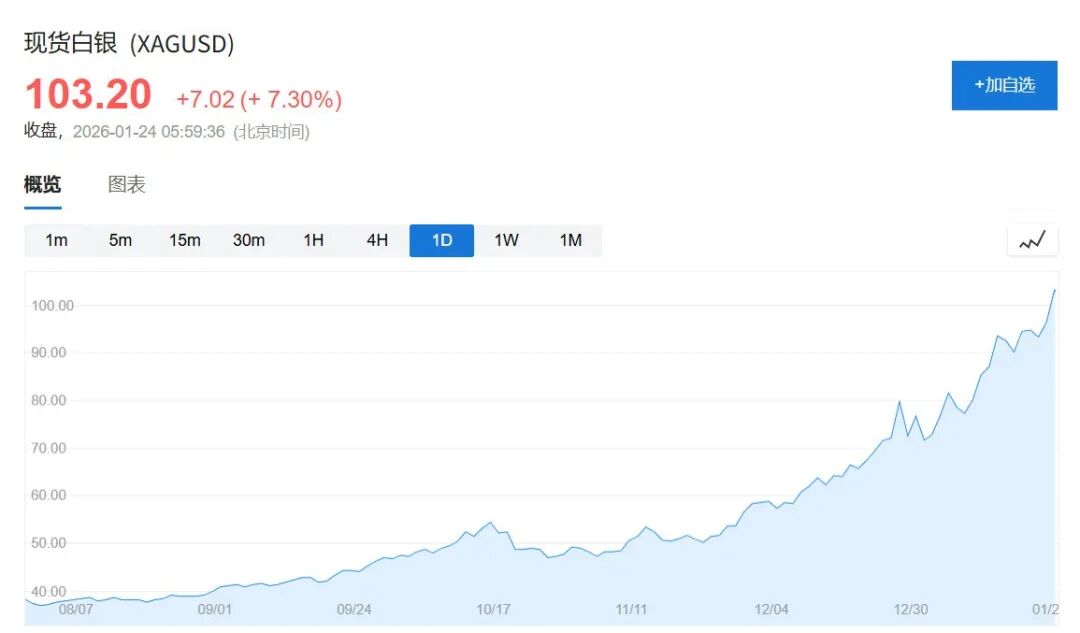
Group 1: Market Overview - The global metal market has entered a new phase of price increases, with gold and silver achieving their largest weekly gains since 2020, maintaining a cumulative rise since the beginning of 2026 [1] - Silver futures and spot prices have historically surpassed the $100 mark for the first time [1] - Gold has reached a new intraday high for the fifth consecutive trading day, approaching the $5000 mark, while copper has rebounded to over $13,000 [6][19] Group 2: Factors Driving Price Increases - The surge in metal prices is driven by multiple factors, including a weakening dollar, significant capital outflows from currencies and sovereign bonds, and geopolitical tensions, particularly comments from former President Trump regarding military movements towards Iran [6][10] - The ongoing geopolitical instability and criticism of the Federal Reserve have heightened risk aversion among investors, leading to increased demand for safe-haven assets like gold and silver [10][17] Group 3: Institutional Outlook - Major financial institutions are bullish on precious metals, with JPMorgan forecasting gold prices to reach $5000 by Q4 2026 and Citigroup raising its short-term silver price target to $100 [7][18] - UBS anticipates that silver still has about 25% upside potential, although it warns of potential volatility throughout the year [7][11] Group 4: Silver Market Dynamics - Silver has outperformed gold in 2025, with prices rising nearly 150% compared to gold's over 60% increase, reflecting a shift in investor interest [8][10] - Analysts suggest that the $100 mark for silver is a psychological barrier, with strong industrial demand, particularly from the solar sector, contributing to price increases [10][12] Group 5: Copper and Other Industrial Metals - Copper prices have rebounded due to supply disruptions and a weaker dollar, with LME copper trading above $13,000 per ton [19][22] - The recent price increases in copper are attributed to labor strikes affecting production and easing trade tensions between the U.S. and Europe [22][23]
美元走低日元急升,现货黄金突破5000美元,美国天然气期货价格上涨16%
Hua Er Jie Jian Wen· 2026-01-25 23:26
Group 1 - The Nasdaq futures fell over 1% and the S&P 500 index futures dropped by 0.75% [1] - U.S. natural gas futures prices increased by 16% due to the impact of a winter storm [1] - Spot gold surpassed the $5000 per ounce mark, while spot silver briefly exceeded $106 per ounce, gaining nearly 3% during the day [1] Group 2 - The U.S. dollar index declined by 0.52%, with the euro rising by 0.52% against the dollar to 1.1888 [1] - The dollar to yen exchange rate fell by 0.89% to 154.32, currently reported at 154.77, as the market remains alert to potential intervention by the Japanese government in the currency market [1]