
Zhong Guo Neng Yuan Wang

Search documents
IEA、OPEC下调2026年全球原油累库预期
Zhong Guo Neng Yuan Wang· 2026-02-09 01:07
Oil Price Sector - As of February 2, 2026, the prices for Brent crude, WTI crude, Russian ESPO crude, and Russian Urals crude are $66.30, $62.14, $52.90, and $65.49 per barrel respectively [1][2] - The price changes over the past month for major oil products are as follows: Brent crude (+9.14%), WTI crude (+8.41%), Russian ESPO (+8.34%), and Russian Urals (0.00%) [1][2] Oil Inventory Sector - According to the January 2026 report, IEA, EIA, and OPEC predict global oil inventory changes of +372.24, +282.58, and -56.86 thousand barrels per day respectively, compared to December 2025 predictions which were -14.27, +56.86, and -59.34 thousand barrels per day [2] - The average forecast for global oil inventory changes in 2026 is +199.32 thousand barrels per day, which is a decrease of 5.58 thousand barrels per day from the December 2025 average [2] Oil Supply Sector - The January 2026 report from IEA, EIA, and OPEC forecasts global oil supply for 2026 to be 10,870.29, 10,765.19, and 10,593.14 million barrels per day respectively, showing increases of 251.53, 138.75, and 122.43 million barrels per day compared to 2025 [3] - For Q1 2026, the predicted global oil supply changes are +421.90, +353.62, and -166.79 thousand barrels per day from IEA, EIA, and OPEC respectively [3] Oil Demand Sector - The January 2026 report indicates that IEA, EIA, and OPEC predict global oil demand for 2026 to be 10,498.05, 10,482.61, and 10,650.00 million barrels per day respectively, with increases of 93.22, 113.81, and 136.34 million barrels per day compared to 2025 [4] - For Q1 2026, the forecasted changes in global oil demand are +84.07, +140.81, and +133.59 thousand barrels per day from IEA, EIA, and OPEC respectively [4] Related Companies - Relevant listed companies include China National Offshore Oil Corporation (CNOOC), China Petroleum & Chemical Corporation (Sinopec), and China National Petroleum Corporation (CNPC) among others [5]
太空光伏前景广阔,全球科技巨头持续扩大AI资本开支
Zhong Guo Neng Yuan Wang· 2026-02-09 01:07
Group 1 - The outlook for space photovoltaic technology is promising, with Elon Musk announcing plans for SpaceX and Tesla to achieve 100GW/year solar capacity each over the next three years, specifically for space AI data centers and Starlink satellites [2][1] - Several domestic photovoltaic companies in China are actively engaging in the space photovoltaic sector and collaborating with commercial aerospace enterprises [2][1] - Recommended companies in the photovoltaic equipment sector and those involved in space business development include Maiwei Co., Ltd. (300751), JinkoSolar, Junda Co., Ltd. (002865), and Dongfang Risheng (300118) [2] Group 2 - Major global tech companies are significantly increasing their capital expenditures, which is expected to benefit the AIDC power equipment sector; Amazon plans to spend approximately $200 billion by 2026, a year-on-year increase of over 50%, while Google’s capital expenditure is projected to reach $175 billion to $185 billion, reflecting a growth of 91%-102% [3] - Meta is expected to allocate $115 billion to $135 billion for capital expenditures in 2026, marking a year-on-year increase of 59%-87% [3] - The overall acceleration in global data center construction indicates a surge in power demand for equipment in the AI era, with key companies to watch including Jinpan Technology, Xinte Electric (301120), Hewei Electric (603063), Shenghong Co., Ltd. (300693), and Zhongheng Electric (002364) [3] Group 3 - The solid-state battery industry is advancing, with companies like Enjie Co., Ltd. (002812) forming strategic partnerships in solid-state battery materials, and leading firms like Xianlead Intelligent Equipment (300450) providing new solid-state battery equipment [4] - The first prototype of a solid-state battery vehicle developed by China FAW has successfully rolled off the production line, and Geely plans to complete its first solid-state battery pack by 2026 [4] - Companies to focus on in the solid-state battery supply chain include Xiamen Tungsten (300750), Rongbai Technology, and Dingsheng Technology (300073) [4] Group 4 - The demand for global energy storage is steadily increasing, with domestic energy storage capacity policies driving a surge in orders, and the U.S. experiencing heightened demand for large-scale storage due to data center load issues [4] - European grid instability and widening price differentials in the spot market are also contributing to increased storage demand, with emerging markets seeing supportive government policies [4] - It is projected that global energy storage installation demand will reach 455GWh by 2026, representing a year-on-year growth of 40%, with recommended companies including CATL (300750), Yiwei Lithium Energy (300014), and DeYuan Co., Ltd. (605117) [4] Group 5 - The profitability of wind turbine manufacturers is recovering, with domestic wind power installations expected to grow by 10%-20% in 2026, supported by saturated orders and stable pricing [5] - Export growth is contributing to improved performance, with a positive correlation between domestic and international market conditions [5] - Key companies to monitor in the wind power sector include Goldwind Technology (002202), Taisheng Wind Power (300129), and SANY Renewable Energy [5]
磁体材料迭代推动产业升级
Zhong Guo Neng Yuan Wang· 2026-02-09 00:51
Core Insights - The fusion industry is entering an accelerated phase driven by policy support and capital expenditure, with major countries expected to introduce fusion policies by 2025, marking a shift from laboratory research to industrial layout and regulatory framework construction [2] - Low-temperature superconductors are relatively mature, while high-temperature superconductors are expected to become the mainstream in the future, with magnetic materials being the core foundation for stable magnetic field confinement in fusion devices [2] Industry Overview - The magnet system is a core cost component of fusion projects, with the ITER project using low-temperature superconductors having 86% of its component costs attributed to parts, of which magnets account for 28% [3] - In high-temperature superconductor projects, the cost of the magnet system increases further, with the ARC project showing that magnets account for 46% of the total cost [3] Market Potential - The market size for second-generation high-temperature superconducting tapes for global controllable fusion devices is projected to reach 300 million yuan in 2024, with an expected growth to 4.9 billion yuan by 2030, representing a compound annual growth rate of 59.3% from 2024 to 2030 [3] Investment Recommendations - The magnet segment, being the highest value component in the fusion system, is currently transitioning from low-temperature to high-temperature technology validation and evolution, indicating a positive outlook for demand driven by the capital expenditure cycle in fusion [3] - Key suppliers in the magnet segment include: 1) Low-temperature superconductors: Western Superconductor 2) High-temperature superconductors: Shanghai Superconductor (not listed, controlled by Jingda Co., Ltd. (600577)), Lianchuang Optoelectronics (600363), Eastern Superconductor (not listed, a subsidiary of Yongding Co., Ltd. (600105)) 3) Core suppliers of tantalum and niobium: Dongfang Tantalum Industry (000962) [3]
1月重卡批发销量约10万辆,蔚来2026Q4经营利润转正
Zhong Guo Neng Yuan Wang· 2026-02-09 00:42
Group 1: Market Overview - In January 2026, China's heavy truck market is expected to sell approximately 100,000 units (wholesale), with terminal sales projected to decline by 5% to 10% year-on-year [1][2] - The new energy heavy truck segment is experiencing a severe decline, with terminal sales expected to drop over 85% month-on-month, while year-on-year figures are expected to remain stable, leading to a decrease in domestic penetration rate from 54% in December last year to around 20% [1][2] - The natural gas heavy truck segment is showing some year-on-year growth [1][2] Group 2: Industry News - He Xiaopeng announced that the Xiaopeng GX is expected to launch in April or May [2] - Xiaoma Zhixing and Moore Threads have formed a strategic partnership, bringing domestic full-function GPUs into the core area of autonomous driving [2] - The new generation of Li Auto L9 has launched the Livis ultimate version, positioning it as a flagship SUV for the embodied intelligence era [2] - NIO expects to achieve an adjusted operating profit of 700 million to 1.2 billion yuan in Q4 2025 [2] - BYD plans to achieve local manufacturing and procurement of half of its components at its Brazil factory by the end of the year [2] - Tesla is fully shifting towards humanoid robot business, with Elon Musk estimating the long-term value of the robot business to reach $25 trillion, planning to release the third-generation Optimus in 2026 and aiming for an annual production capacity of 1 million units by 2027 [2] - New forces in the industry are restructuring to focus on robot research and development, indicating a shift towards "embodied intelligence" [2] - The humanoid robot industry competition is shifting towards large models, with manufacturers accelerating efforts to enhance AI capabilities [2] Group 3: Market Performance - This week, the CSI 300 index fell by 1.33%, while the automotive sector rose by 0.47%, ranking 10th among A-share primary industries [3] - The passenger vehicle II index increased by 0.01%, with Li Auto-W and Seres leading the gains [3] - The commercial vehicle index rose by 1.34%, with Jinlong Automobile and Foton Motor leading the gains [3] - The automotive parts II index increased by 0.58%, with Xingmin Zhitong and Yinlun Co. leading the gains [3] - The electric control system sector saw a decline of 2.49%, while the bearing sector rose by 0.40% [3] - The reduction gear/gear sector increased by 2.32%, while the lightweight & structural components sector fell by 1.06% [3] - The motor sector rose by 0.49%, while the Tier 1 sector increased by 1.93% [3] - The sensor sector saw a slight decline of 0.15%, and the linear transmission components sector fell by 3.19% [3] Group 4: Investment Recommendations - For passenger vehicles, the demand for domestic high-end luxury vehicles is exceeding expectations, with a favorable competitive landscape; companies recommended include Jianghuai Automobile and Seres, with Geely Automobile as a beneficiary [4] - In the parts sector, the industry is expected to see an upward turning point in profitability against the backdrop of reduced internal competition, with recommended companies including Desay SV Automotive, Zhejiang Xiantong, Meili Technology, and others [4]

锂电淡季尾声旺季可期,太空光伏星辰大海
Zhong Guo Neng Yuan Wang· 2026-02-09 00:37
东吴证券近日发布电力设备行业跟踪周报:电气设备10727上涨2.2%,表现强于大盘。(本周,2月2日-2 月6日,下同),光伏涨3.43%,电气设备涨2.2%,锂电池涨0.77%,发电设备涨0.37%,核电跌0.35%, 新能源汽车跌0.12%,风电跌0.01%。 以下为研究报告摘要: 投资要点 电气设备10727上涨2.2%,表现强于大盘。(本周,2月2日-2月6日,下同),光伏涨3.43%,电气设备涨 2.2%,锂电池涨0.77%,发电设备涨0.37%,核电跌0.35%,新能源汽车跌0.12%,风电跌0.01%,涨 幅前五为杭电股份(603618)、三变科技(002112)、新动力、通光线缆(300265)、晶盛机电 (300316);跌幅前五为中电电机(603988)、中际旭创(300308)、中材科技(002080)、华光股 份、晓程科技(300139)。 行业层面:储能:1月储能采招:36.3GWh,4小时系统均价半年上涨42%,宁夏需求强劲;甘肃零碳园 区建设:储能容量占比/绿电直供比例/需求响应能力纳入指标体系;国网山东省电力公司:进一步优化 储能等项目接入管理;宁夏累计废止超15GWh储能项目 ...


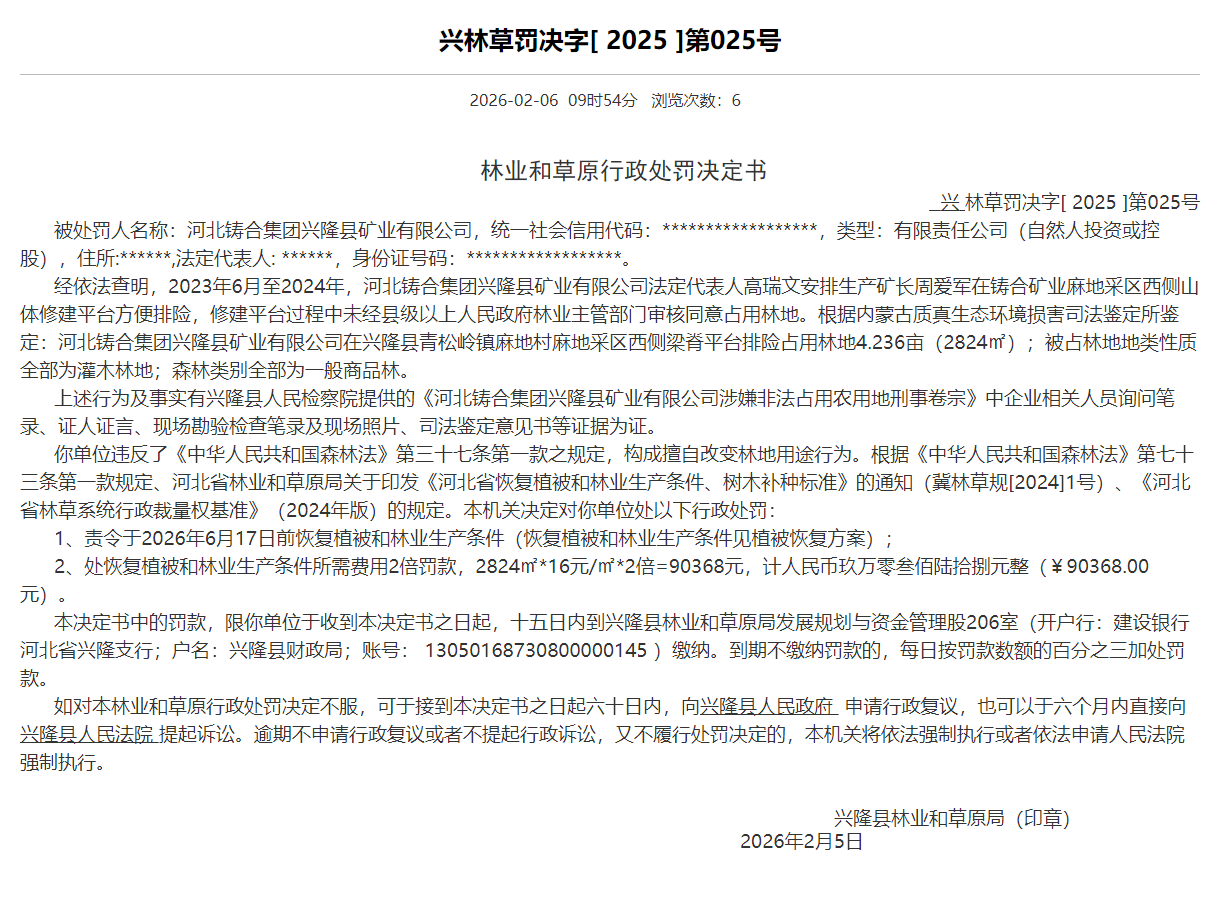
河北承德:兴隆县依法查处河北铸合集团兴隆县矿业 非法占用林地被罚9万余元并限期恢复植被
Zhong Guo Neng Yuan Wang· 2026-02-08 03:12
近日,河北省承德市兴隆县林业和草原局依法对河北铸合集团兴隆县矿业有限公司非法占用林地行为作出行政处罚,责令其限期恢复植被和林业生产条件, 并处罚款9万余元。 经查实,2023年6月至2024年期间,河北铸合集团兴隆县矿业有限公司法定代表人高瑞文安排生产矿长周爱军,在该公司铸合矿业麻地采区西侧山体修建排 险平台时,未经县级以上人民政府林业主管部门审核同意,擅自占用林地施工,违反了林地保护相关法律法规。 根据内蒙古质真生态环境损害司法鉴定所鉴定,该企业在兴隆县青松岭镇麻地村麻地采区西侧梁脊平台排险过程中,共计占用林地4.236亩(折合2824平方 米),被占用林地地类性质全部为灌木林地,森林类别均为一般商品林。 案件查办过程中,兴隆县人民检察院提供了《河北铸合集团兴隆县矿业有限公司涉嫌非法占用农用地刑事卷宗》,其中包含企业相关人员询问笔录、证人证 言、现场勘验检查笔录、现场照片及司法鉴定意见书等一系列证据。 兴隆县林业和草原局指出,河北铸合集团兴隆县矿业有限公司的上述行为,违反了《中华人民共和国森林法》第三十七条第一款规定,构成擅自改变林地用 途行为。 依据《中华人民共和国森林法》第七十三条第一款规定、河北省林业 ...

亏损也能拿高分! 美锦能源ESG获评BBB级,氢能转型藏潜力
Zhong Guo Neng Yuan Wang· 2026-02-07 04:14
Core Insights - In 2025, nearly 80% of listed coal companies in China will independently publish annual ESG reports, achieving a record high disclosure rate, which is a 21% increase compared to 2024 [1] - Despite a global cooling trend in ESG development, Chinese coal enterprises are enhancing their ESG information disclosure as part of their ongoing transformation efforts, aligning with the ESG principles [1] - The significant increase in disclosure rates indicates that ESG concepts have taken root in the coal industry and are becoming an internal driving force for corporate transformation and upgrading [1] ESG Ratings Improvement - The importance of ESG principles is growing for coal companies, with key areas of focus including green mining and clean coal utilization for sustainable development [2] - According to Wind ESG rating data, the proportion of AA-rated companies in the coal sector increased from 2.9% in 2024 to 4.55% in 2025, while A-rated companies rose from 2.9% to 11.36%, and BBB-rated companies increased from 11.8% to 38.64% [2] - The Wind ESG rating system categorizes companies from AAA to CCC, reflecting their long-term sustainability and short-term risk profiles [2] Company-Specific ESG Ratings - China Shenhua (601088) maintains an AA rating, indicating high management standards and low ESG risks, while several other companies like China Coal Energy (601898) and Jinneng Holding (000723) received A ratings [3] - A total of 17 coal companies received BBB ratings, indicating average ESG risk levels, while 20 companies were rated BB or B, suggesting a need for improvement in sustainability capabilities [3] Industry Diversification Trends - A key characteristic of A-rated coal companies is their diversified operations, transitioning from traditional coal dominance to comprehensive energy suppliers [4] - China Coal's social responsibility report highlights its expansion into coal, electricity, coal chemical, and mining equipment manufacturing, alongside initiatives in renewable energy [4] - In 2025, coal consumption in China is projected to decline for the first time in recent years, with only the coal chemical sector showing moderate growth [4] Joint Ventures and Unique Entities - Notable joint ventures like Jinneng Holding and South Gobi are recognized for their unique positioning in the market, combining resources and logistics capabilities [5] Guidance for Transformation - ESG serves as a strategic indicator for coal companies, providing insights into their transformation during challenging times [7] - Companies like Anyuan Coal Industry, despite facing losses, are actively enhancing their ESG disclosures and transitioning to technology-focused enterprises [7] - Meijin Energy, despite losses, maintains a leading ESG score, emphasizing the long-term potential of hydrogen energy transition over short-term financial setbacks [7] Future Directions - As coal production capacity shifts to central and western regions, coal companies will face increasing pressure for transformation, necessitating exploration of resource continuity and new development strategies [8] - Companies are accelerating their investments in advanced computing, high-end materials, and modern finance, marking a shift towards new growth areas while adhering to ESG principles [8]

从“能不能捕”到“更好捕”!12项CCUS新国标落地,2026年7月1日正式实施
Zhong Guo Neng Yuan Wang· 2026-02-07 04:08
Core Viewpoint - The recent approval of 12 national standards for Carbon Capture, Utilization, and Storage (CCUS) by the National Market Supervision Administration marks a significant advancement in the standardization of CCUS technology, which is crucial for achieving China's dual carbon goals [1][2]. Group 1: National Standards and Implementation - The new national standards will be fully implemented starting July 1, 2026, and cover critical technical routes such as carbon capture from thermal power, long-distance pipeline transportation, saline aquifer storage, and enhanced oil recovery [1]. - The standards aim to provide a systematic framework for CCUS project planning, design, construction, operation, and management, thereby supporting the orderly and healthy development of the CCUS industry [1][2]. Group 2: Industry Development and Technological Progress - China's CCUS technologies have made significant progress, with over 120 planned and operational demonstration projects across various sectors, including power, oil and gas, chemicals, cement, and steel, with operational projects accounting for more than half [2]. - The total carbon capture capacity is approximately 9.4 million tons per year, while injection capacity stands at about 5.9 million tons per year, indicating a maturing capability for large-scale engineering and operation [2]. Group 3: Standardization and Risk Management - The newly released standards cover all key processes in the CCUS value chain, establishing clear boundaries, processes, and methods for greenhouse gas emission reduction calculations [4]. - The standards address previous ambiguities and enhance the credibility of emission reductions by transitioning from self-reported data to third-party verifiable evidence chains [4][6]. Group 4: Approval Process Optimization - The standardization of the approval process is expected to reduce inconsistencies and expedite the review timeline, potentially decreasing approval time by 30% if the number of review rounds is reduced by 1 to 2 [5]. - The shift towards standardized approvals will facilitate better resource allocation and improve industry collaboration [5]. Group 5: Market and Technological Synergy - The establishment of foundational technical principles and practical frameworks for emission reduction calculations is crucial for the normative development of the industry, although challenges remain [6]. - The Ministry of Ecology and Environment is actively promoting methodological research to integrate CCUS projects into voluntary emission reduction trading mechanisms, which will support cost optimization in the CCUS industry [6][7]. Group 6: Competitive Landscape and Future Directions - With the standardization of key performance indicators, competition among companies is expected to shift from merely capturing carbon to achieving lower energy consumption and more stable operations [7]. - The focus on developing large-scale, clustered projects leveraging carbon networks is anticipated to reduce unit costs, while long-term cost reductions will depend on technological innovations [7].
目标2800万!我国充电桩“三年倍增”,2027年剑指8000万辆车需求
Zhong Guo Neng Yuan Wang· 2026-02-07 04:08
Core Insights - The rapid expansion of electric vehicle (EV) charging infrastructure in China is highlighted, with projections indicating that by the end of 2025, there will be 20.09 million charging facilities, supporting over 40 million new energy vehicles [1][2] - The charging infrastructure is evolving from quantity to quality, with technological advancements and innovative models expected to drive further upgrades in the industry [1][4] Infrastructure Development - The construction of charging facilities has accelerated significantly, with the number of charging stations increasing from 1 million in 2019 to over 10 million by mid-2024, and reaching 20 million in just 18 months [2] - In 2025, the incremental growth of charging infrastructure is projected to be 7.274 million, a year-on-year increase of 72.3%, with a charging pile to vehicle ratio of 1:1.9, indicating that infrastructure development is keeping pace with the rapid growth of new energy vehicles [2] - Currently, 19 provinces have achieved full coverage of charging facilities, and over 98% of highway service areas have charging stations [2] Future Projections - By the end of 2027, the goal is to establish 28 million charging facilities nationwide, providing over 300 million kilowatts of public charging capacity to meet the needs of more than 80 million electric vehicles [3] Technological and Ecological Innovation - The expansion of charging facilities is accompanied by continuous innovation in technology and service models, with a focus on high-power charging and standardized solutions to enhance user experience [4] - The average charging power at public stations has reached 46.5 kW, with a 33% year-on-year improvement in charging efficiency [4] - The development of vehicle-to-grid (V2G) technology is being prioritized, allowing electric vehicles to act as mobile energy storage units, which supports the efficient operation of new energy systems [4][5] Service Optimization and Coverage Expansion - Despite rapid development, there are still areas for improvement in layout optimization and user experience, particularly in rural regions where charging convenience varies significantly [7] - The Action Plan aims to address the shortfall in rural charging infrastructure, with plans to add at least 14,000 direct current charging guns in towns lacking public charging stations by 2027 [7] - The industry is entering a new phase of simultaneous large-scale construction and model innovation, with strong policy guidance and collaborative innovation expected to lead to a more balanced public charging network and improved operational efficiency [8]
重磅落地!华中四省(鄂湘豫赣)电力互济细则出台,保供再添底气
Zhong Guo Neng Yuan Wang· 2026-02-07 04:05
Core Viewpoint - The release of the "Implementation Rules for Inter-provincial Power Trading in the Central China Region" marks a significant step in the construction of the electricity market covering Hubei, Hunan, Henan, and Jiangxi provinces, aiming to establish a market-oriented mechanism for inter-provincial power exchange and enhance resource optimization and supply security in the Central China power grid [1][2]. Group 1: Mechanism Establishment - The new rules aim to address the mismatch between the existing inter-provincial auxiliary service market and national policies, necessitating a market-oriented mechanism for power exchange [2]. - The core logic of the rules is to leverage the moderate scale of the regional power grid to explore the remaining transmission capacity for inter-provincial power trading [2][3]. Group 2: Features of the Rules - The most distinctive feature of the rules is the "mutual assistance" mechanism, allowing provinces to flexibly switch between buying and selling electricity based on their supply and demand situations [3]. - The rules promote a "dual openness" approach, allowing various energy sources, including coal, hydropower, new energy, and storage, to participate in trading, breaking traditional boundaries between generation and consumption [4]. Group 3: Market Participation and Flexibility - The rules provide multiple market participation modes, including flexible switching of roles for coal, pumped storage, and new energy storage, enhancing the potential for resource adjustment [4][5]. - The design allows for various reporting modes tailored to the characteristics of the Central China region's energy sources, facilitating efficient trading [4]. Group 4: Execution and Risk Management - The rules establish a comprehensive management system for transaction execution, deviation handling, measurement, settlement, and risk prevention, ensuring the seriousness and operability of market operations [6][7]. - Specific execution logic is outlined for different scenarios in the provincial market, ensuring that power purchase agreements are strictly enforced to prevent malicious arbitrage [7]. Group 5: Future Implications - The innovative design of the rules, along with the introduction of diverse participants and stringent operational controls, is expected to significantly support power supply security and the absorption of clean energy in the Central China region [6][7].